Ver esta publicación en Instagram
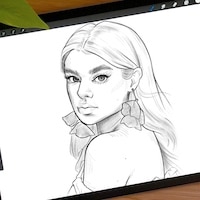
Japanese artist Kei Meguro loves a challenge. Her detailed works toe the line between photorealism and surrealism, mixing portraits that easily look like black and white photographs, with dreamlike elements that are just as elaborate. Most impressively, she creates her pieces exclusively with pencil. But rather than seeing this tool as a restriction, Meguro revels in the endless possibilities this medium offers.
Born in Japan, Meguro splits her time between Tokyo and Brooklyn. In her delicate compositions, fantasy elements and sharp portraiture come together to explore themes of identity and psychology. Although explored through a soft lens, the message is no less striking. As she guides her pencil on paper, it’s as though a portal to a whimsical yet sophisticated world opens right before our eyes.
In Meguro’s drawings, fashion also becomes a boundless entity and a narrative resource. Having come up with her own universe where there are no rules, the artist indulges in creating pieces that intersect with nature in ways that defy physics and reality as we know it—from a lotus umbrella to an oversized floral headpiece.
Above all else, Meguro’s work shines the most when capturing movement—whether it be bubbling water, flowing hair, or rustling fabrics. Together, her drawings signal that our inner world is more expansive than we think, and how our fanciful impulses can be charged with creativity and meaning.
We had the opportunity to chat with Meguro about her creative process, her preferred tools, and her favorite thing about working with pencils. Read on for My Modern Met’s exclusive interview with Kei Meguro.
Ver esta publicación en Instagram
How did your artistic journey begin? When did you start working with pencils?
My artistic journey began during my childhood when I would spend hours sketching, often losing myself in the process. Growing up, drawing was my escape and a way to express emotions I couldn’t always put into words.
I began working more seriously with pencils during a time when I was struggling as a full-time graphic designer, right out of art school in New York. There’s something about the simplicity of pencil work that immediately drew me in. It felt raw, honest, and versatile. I missed working with my hands and being offline, away from screens. Over time, I realized that pencils allowed me to capture fine details and evoke emotions in a way that felt most natural to me.
Ver esta publicación en Instagram
How do you choose your compositions or what to draw?
Choosing what to draw often comes from a blend of intuition and intention. I draw inspiration from a wide range of sources—personal experiences, nature, the human figure, emotions, and sometimes even dreams. Many of my compositions are deeply personal, reflecting themes I’m working through emotionally or stories I want to tell visually.
Sometimes, I start with a clear idea and sketch out thumbnails to explore composition, balance, and flow. Other times, I let myself experiment and see where the pencil takes me. For me, the most important aspect of a composition is its ability to convey a feeling or mood. If I feel connected to the subject, I trust that viewers will feel that connection too.
Ver esta publicación en Instagram
What does your creative process look like?
My creative process is both structured and organic. It usually begins with brainstorming or collecting inspiration—I might jot down ideas, take reference photos, look through stock photos (thanks Adobe Stock!), or sketch out rough concepts in a notebook.
Once I settle on an idea, I work on building a foundation. I used to use the grid technique but after years of studying anatomy, I’ve been able to step away from that process. I start with light pencil marks, focusing on proportions, structure, and composition. From there, I slowly build layers, adding details and refining textures. I like to step back frequently to observe the work from a distance and adjust as needed.
A crucial part of my process is allowing myself space and time. Some days, I’ll dive deep into the work, losing track of time. Other days, I’ll step away entirely to let the piece breathe. This rhythm helps me stay connected to the art without feeling burnt out.
Ver esta publicación en Instagram
As an artist, what do you like about working with pencils?
Pencils are incredibly versatile—they allow for a range of techniques, from the lightest, almost imperceptible lines to deep, bold shading. I love how intimate and tactile the medium feels; there’s a sense of immediacy when you hold a pencil in your hand and see marks appear on the paper.
Pencils also teach patience and precision. Unlike digital tools or paints, you’re working with a medium that requires attention to subtle details. It feels meditative to work in this way, and the process itself becomes as fulfilling as the final result.
Ver esta publicación en Instagram
How long does it usually take you to complete a drawing?
The time it takes varies depending on the complexity and scale of the piece. A smaller or simpler drawing might take a few hours, but more detailed works can take several days or even weeks.
I’ve learned to embrace the time it takes to complete a piece, allowing myself to revisit it with fresh eyes. Sometimes stepping away and returning later helps me refine areas I might have overlooked. For me, the journey of creating is just as important as the finished work.
Ver esta publicación en Instagram
Is there a particular challenge to working only with pencils?
One of the main challenges is creating depth and variety without relying on color. When working exclusively with pencils, you have to think carefully about shading, texture, and contrast to bring a piece to life. Achieving a sense of light and shadow, or conveying certain emotions, requires a lot of attention to detail.
Additionally, working in monochrome can sometimes feel limiting, but I’ve learned to see this as an opportunity rather than a constraint. It pushes me to experiment with different techniques and fully explore what pencils can do.
Ver esta publicación en Instagram
Do you have a favorite tool that you like to use?
Yes, I have a few favorites! I often use Pentel Graph Gear mechanical pencils for precision, graphite powder for shading, or blending tools like tortillons or eye-makeup brushes. Each tool serves a unique purpose in my process.
I’m also very particular about the paper I use. A good-quality surface can make all the difference when it comes to achieving the textures and effects I want. Finding the right combination of tools and materials has been a process of trial and error, but it’s incredibly rewarding when everything clicks. For the past couple of years I’ve stuck to either Bristol (for a smoother, crisp outcome) or watercolor (for a warm, textured feel).
Ver esta publicación en Instagram
What do you hope people will take away from your work?
At its core, I hope my art resonates emotionally with viewers. Whether it’s a sense of calm, nostalgia, or introspection, I want people to feel something when they see my work.
Many of my recent pieces explore themes of vulnerability, connection, and inner healing. I hope my art can serve as a reminder that there’s beauty in imperfection and strength in vulnerability. If my work inspires someone to pause, reflect, or feel less alone in their own experiences, then I consider it a “success.”
Ver esta publicación en Instagram
Kei Meguro: Website | Instagram
Related Articles:
Poetic Colored Pencil Drawings Reveal the Elegance of the Human Body
Intricate Beauty of Hands and Feet Captured in Colorful Pencil Drawings
Stunning Ink and Colored Pencil Architecture Drawings Inspired by Old-World Europe
Artist Spends Months Creating Detailed Pen Drawings Using Thousands of Tiny Dots [Interview]