Photo: Nicolas Gerardin
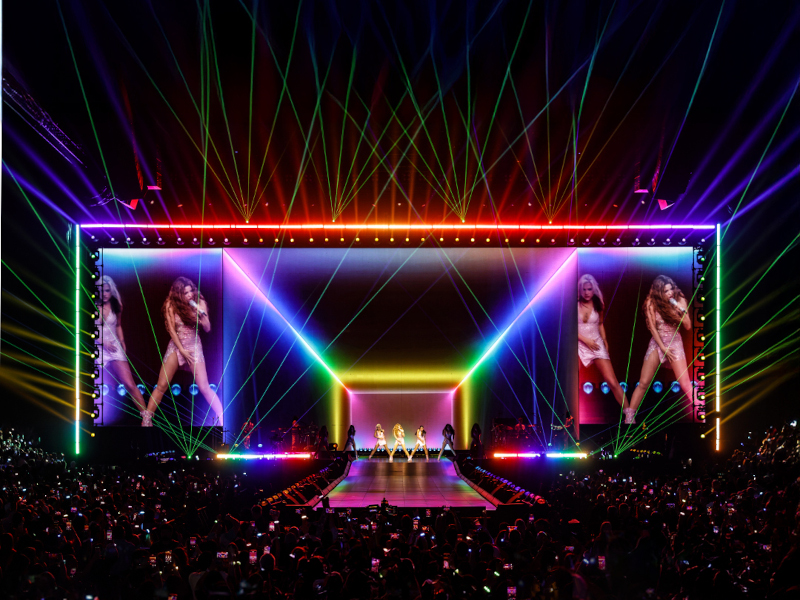
When a pop star goes on tour, there are many elements that need to be pieced together by a creative team. This usually includes booking venues, hiring dancers and musicians, choreographing performances, creating shiny costumes, coming up with a hit-filled setlist, and designing a memorable stage. For Shakira’s latest tour, Las Mujeres Ya No Lloran World Tour (“Women No Longer Cry”), the stage design was in the hands of Yellow Studio, a NYC-based international design firm.
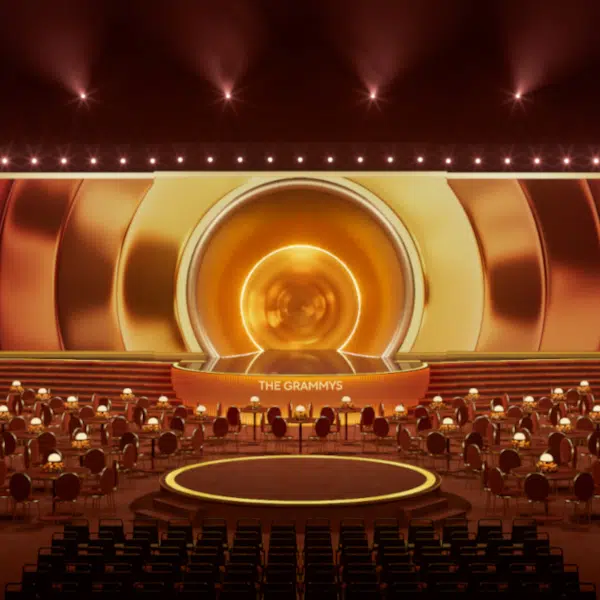
Yellow Studio has long specialized in broadcast and live events. Their vision has led them to design the stage for the Grammy Awards for its last four editions. They’ve also collaborated with the British Academy Film and Television Awards, the MTV Video Music Awards, and Eurovision, in addition to designing sets for Disney and TikTok events.
Their notable résumé matches Shakira’s tour, which has broken ticket-selling records and packed stadiums in the Americas. In North America, several shows originally booked in arenas were upgraded to stadiums due to demand. In Argentina, Peru, and Chile, tickets to her shows were sold out in 40 minutes. She also became the first artist to play and sell out the 65,000-person capacity at Estadio GNP Seguros in Mexico City seven times in a single tour, prompting her to add five more shows for a total of 12 performances in the Mexican capital.
The show has been a hit both with lifelong fans and casual listeners, in great part because of Yellow Studio’s work. One of the most talked about details is the massive “She Wolf” that takes center stage during the climax of the show, instantly becoming an iconic moment of the entire show. The craft of Yellow Studio can also be seen in more subtle details, such as the diamond motif that has defined the Las Mujeres Ya No Lloran album visuals.
We had the chance to talk to Damun Jawanrudi, senior designer & creative strategist at Yellow Studio and lead designer for the show, about the stage design for Las Mujeres Ya No Lloran World Tour, his team’s creative process, and fan-favorite pieces. Read on for My Modern Met’s exclusive interview with Damun Jawanrudi.
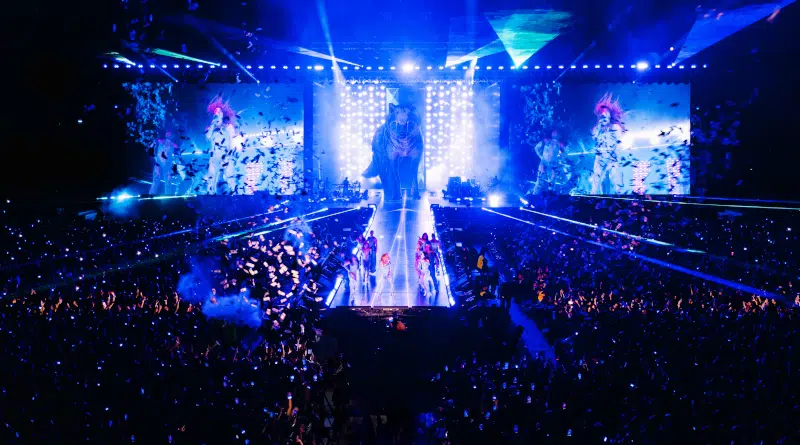
Photo: Cu4tro
How did this collaboration with Shakira come to be?
At Yellow Studio we’re fortunate to collaborate across many areas of live performance, and one of the spaces we’re consistently involved in is music. Over the years, we’ve designed for numerous award shows—including the GRAMMYs for the past four years —and through that ecosystem, we’ve built some truly meaningful relationships.
Our connection to Shakira began through The Squared Division, her wonderful creative directors. We had worked with them before, and when they started shaping the concept for her iconic pop-up Times Square performance, they brought us on to design that stage—as well as a performance on The Tonight Show with Jimmy Fallon around the same time.
There was a strong creative alignment and a lot of trust from the team, which led to a natural evolution: we were invited to design the stage for the world tour. It was a very organic progression—built on collaboration, shared creative thinking, and mutual respect.
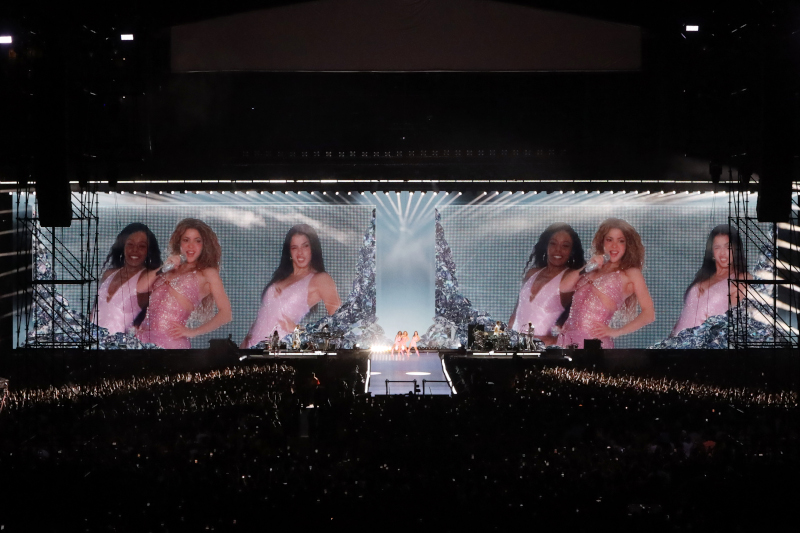
Photo: Leonardo Ferraz
What was the creative process like?
The process was deeply collaborative from the very beginning. Julio, the founder of Yellow Studio, and I started by immersing ourselves in Shakira’s new album—playing it on repeat, absorbing its emotional tone, energy shifts, and lyrical depth. That became our entry point into the world she was building with this body of work.
We then sat down with Shakira and her creative directors from The Squared Division for a series of creative discussions. These weren’t transactional meetings; they were real conversations, sitting around a table, exchanging thoughts and ideas, getting to the heart of what this show needed to express. That kind of open and intimate dialogue helped form a solid creative foundation that we could build on together.
From there, we began crafting conceptual frameworks and spatial ideas, focusing less on aesthetics at first and more on how the stage could carry and amplify the emotional journey. Every design choice grew out of that intention: to create a world that felt honest, dynamic, and deeply connected to the music. The process was fluid, collaborative, and grounded in a lot of mutual trust.

Photo: Leonardo Ferraz
What was it like to translate the album imagery into a stage design?
We spent days immersed in the album—listening, feeling, reflecting—trying to understand not just what it sounded like, but what it felt like. From there, we began translating those emotions into visual language: we created mood boards, collages, symbolic references, and word associations. These became our shared vocabulary with Shakira and her team, allowing us to communicate conceptually in early meetings and stay aligned throughout the design process.
Once we had a clear foundation, we began designing a stage that could embody all those layers—strength, vulnerability, transformation, intimacy. Many of the album’s themes are about personal rebirth and emotional evolution, so we made sure the design could constantly shift—between bold and delicate, open and contained, grand and intimate. The structure, lighting, and video elements were designed to work fluidly together to mirror the emotional transitions in the music and her performance.

Photo: Leonardo Ferraz
As designers, how do you offer a great experience for both fans in the front row and those in the nosebleed section?
We were very intentional about creating a design that connects with every audience member, whether you’re in the front row or the farthest seat in the venue. One of the key tools for this was the extended video thrust that reaches out into the space. It’s physically connected to the main video wall upstage, creating a seamless visual corridor that pulls Shakira into the room and allows her to be among her audience—not just in front of them.
We also integrated a series of hydraulic lifts and giant operable video doors, giving us the ability to shift scale instantly. One moment you’re watching an intimate performance under minimal, curated lighting; the next, the floor lifts, the video doors open, and a dramatic centerpiece or new lighting environment is revealed. These elements were designed not just for visual impact, but to carry emotion all the way to the back of the room. It’s about reach—not just physical, but emotional.
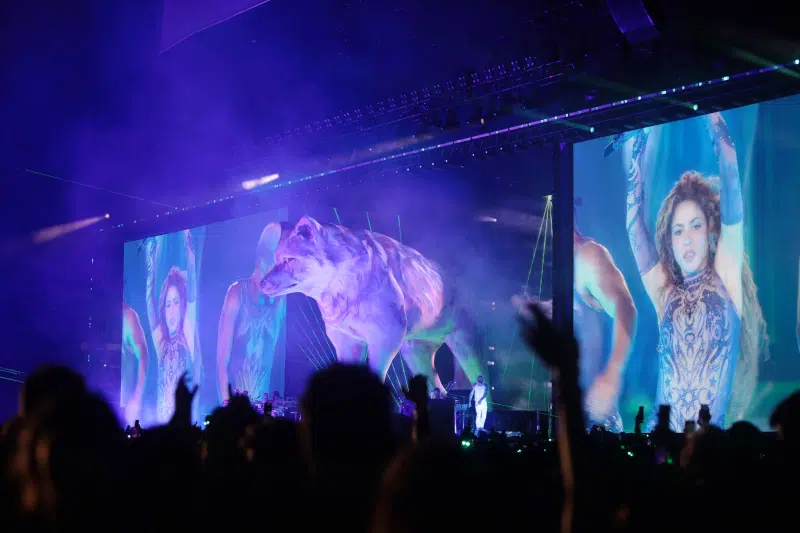
Photo: Leonardo Ferraz
The massive inflatable wolf seems to be a fan favorite. How did this element come to be?
The wolf was introduced as part of the broader creative concept, and once we received the brief, we began exploring how to bring it to life in a way that felt powerful and symbolic. We went through multiple studies to find the right pose—something that captured the essence of the “She Wolf” with strength, pride, femininity, and presence.
Throughout the show, the character of the wolf appears in various forms—woven into interludes and video packages that link sections of the performance. This recurring presence builds a sense of narrative and evolution, culminating in a powerful final reveal: the physical, inflatable wolf standing tall behind Shakira, dramatically lit and forming a bold silhouette in the closing segment of the show. That emergence isn’t just a visual effect; it carries emotional weight, echoing the show’s core themes of transformation, resilience, and turning vulnerability into strength. Every detail, from form language to scale, was crafted to anchor that emotional energy in a single iconic image.
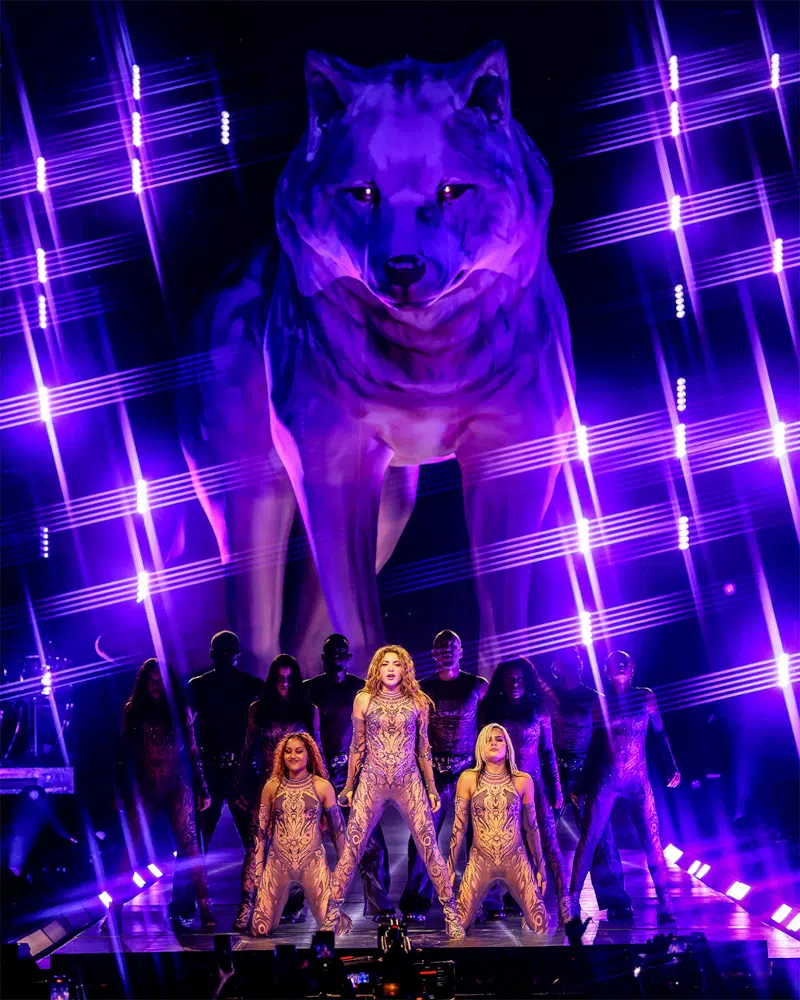
Photo: Nicolas Gerardin
What was the most challenging part or element of this project?
The challenge was creating a design that could transform repeatedly while staying minimalist, functional, and emotionally resonant. The set needed to hold both intimacy and spectacle and do so with fluid transitions that never distracted from Shakira’s storytelling. We didn’t want it to feel like one static environment. Instead, it had to breathe with her.
Balancing that kind of complexity with a clean aesthetic was a constant puzzle. We covered all the mechanics from the audience’s eye—hydraulic lifts, transformable video elements, kinetic structures—so that when things revealed themselves, they felt like emotional shifts rather than technical ones. It was a delicate dance between engineering and design.
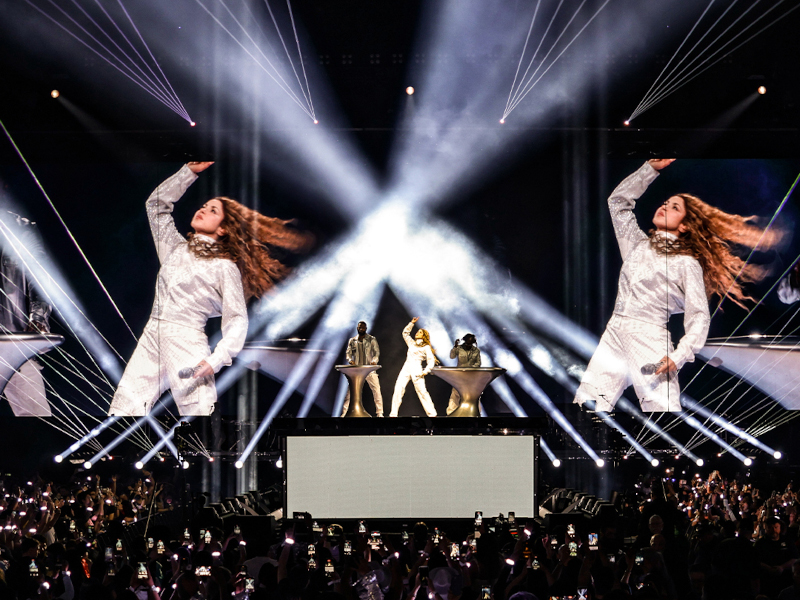
Photo: Nicolas Gerardin
What do you hope fans will take away from your designs?
Our focus from the beginning was to design a stage that gave Shakira the freedom to tell her story—truthfully, powerfully, and on her own terms. She has an incredibly deep love for her fans and says they’re the best in the world, so creating space for that reconnection was essential. After so many years since her last tour, this was a moment of return, and the design needed to hold the emotional weight of that homecoming.
When Shakira shared her journey with us, it was raw and deeply personal. Our role was to translate those conversations into physical form—turning shared ideas into space, movement, and light. The design became a kind of visual amplifier, helping her voice reach every seat in the arena.
If fans walk away feeling more connected to her—if they see their own stories in hers or feel the impact of her transformation—then that’s the most meaningful outcome we could hope for.
Photo: Leonardo Ferraz
Yellow Studio: Website | Instagram
Shakira: Website | Instagram | YouTube
Sources: Shakira shares new North American tour dates after upgrading venues to stadiums; Shakira reacts to the ticket sale numbers for her ‘Las Mujeres Ya No Lloran' Tour; El impresionante récord que rompió Shakira en México y el impacto económico de sus conciertos en ese país
My Modern Met granted permission to feature photos by Yellow Studio / MOTIF PR.
Related Articles:
Olivia Rodrigo’s Guitarist Reveals the Singer Paid for Everyone on Her Tour To Go Therapy
Taylor Swift Gives $55M in Total as a Bonus to Everyone Working on Her ‘Eras Tour’
New Poster Celebrates Oasis During Their Much-Anticipated Reunion Tour
Olivia Rodrigo Falls Through a Hole on Stage Mid-Show and Recovers Gracefully