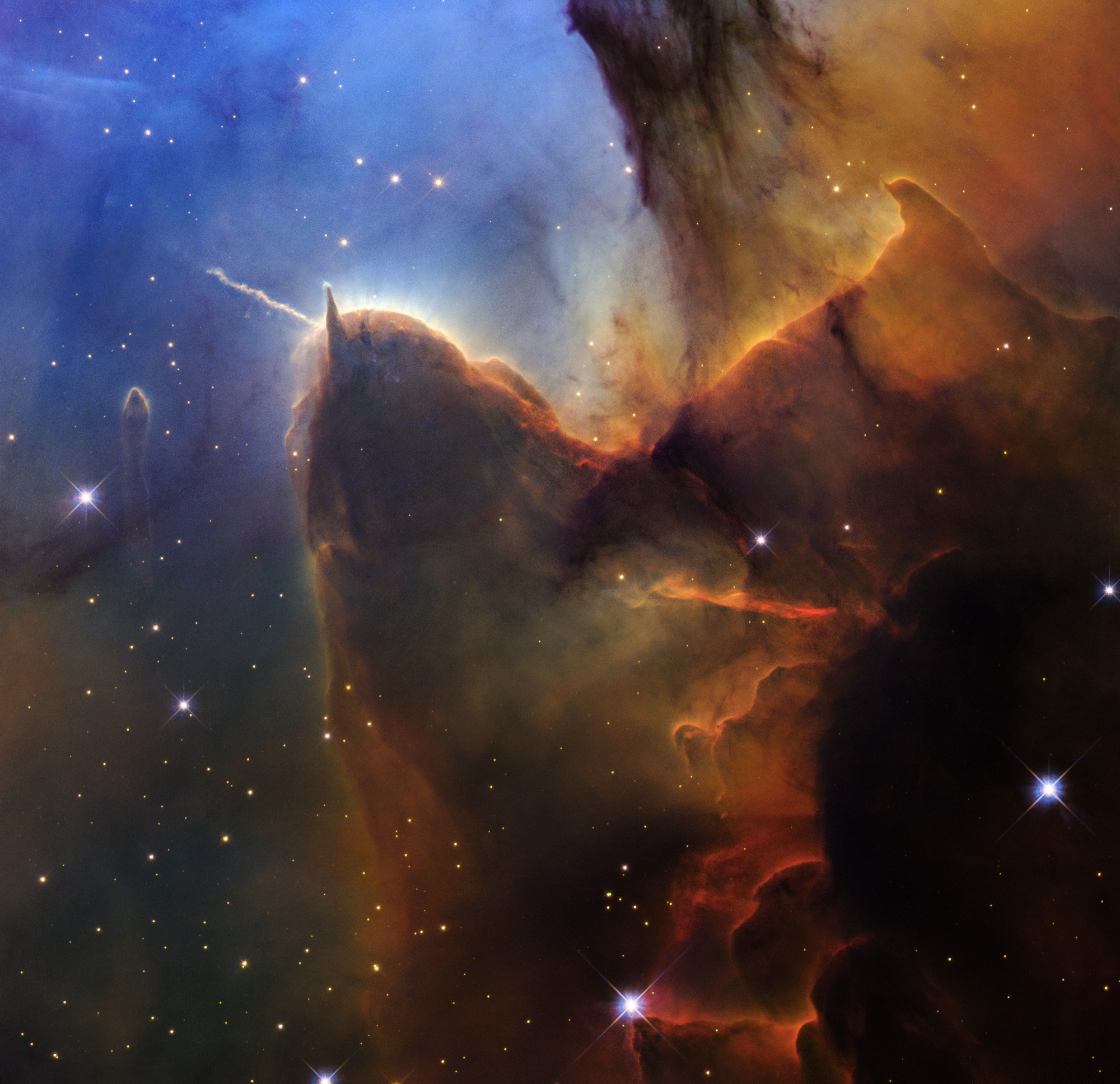
NASA celebrated Hubble’s 36th anniversary with a new image of the Trifid Nebula, a star-forming region it first captured in 1997. The telescope leveraged almost its full operational lifetime to show us changes in the nebula on human time scales with an improved camera. (Photo: NASA, ESA, STScI; Image Processing: Joseph DePasquale)
Last month, on April 24, NASA’s Hubble Space Telescope marked an exciting milestone: its 36th anniversary. To celebrate, the telescope once again set its sights on the Trifid Nebula, a star-forming region located about 5,000 light-years away in the constellation Sagittarius. Hubble had captured the area 29 years earlier, in 1997, but its newest photograph of Trifid offers an even more mesmerizing glimpse into the iconic nebula.
The anniversary image depicts a small portion of Trifid, peppered with rust-colored dust trails, shimmering stars, and an enormous bubble formed by powerful winds. At the center of the scene is what NASA describes as the “head” and “undulating body” of a cloud of gas and dust. The bulbous form resembles a “marine sea lemon or sea slug” gliding through the cosmos, and is complete with two “horns” that reveal critical information not just about the nebula, but stars as a whole. The cloud’s left horn is part of a plasma jet known as Herbig-Haro 399, which is periodically launched by a young protostar ejecting excess matter. By comparing the 1997 and 2026 pictures, scientists can deepen their understanding of the protostar, the speed of its jet, and how it interacts with the greater environment, especially in terms of the amount of energy it dispenses into its surrounding regions.
By contrast, the head’s right horn bears a darker, more triangular appearance. Embedded at its tip is another young star, which, upon closer inspection, appears in the image as a faint red dot with a tiny jet. A green arc enshrines the star, possibly suggesting the presence of a circumstellar disk. A rotating cloud of gas, dust, rocky or icy fragments, and larger objects orbiting a star, circumstellar disks orbit stars and, when circling the youngest of stars, these disks serve as cocoons in which planets may eventually form.
Aside from these astronomical observations, the Trifid photograph also holds clues within its “prismatic sea of color,” as NASA claims. Based on its color palette alone, the composition is naturally divided into two halves, with its top-left corner vibrating with a deep blue hue, while its bottom-right corner is shrouded in total darkness. This pitch black is the result of dense patches of dust, where stars may very well be forming (though perhaps not in Trifid’s star-forming region). The blue tint, on the other hand, is caused by ionized gas, cleared away by ultraviolet light emitted by massive stars. The image illustrates this effect beautifully—at the top of the “sea slug’s” head, a bright yellow glow seems to be streaming upward.
“This is an example of ultraviolet light plowing into the dark brown dust, stripping and dismantling the gas and dust,” NASA explains. “Many ridges and slopes of dark brown material will remain for a few million years, as the stars’ ultraviolet light slowly eats away at the gas.”
To date, Hubble has taken more than 1.7 million observations and almost 29,000 astronomers have published peer-reviewed science papers featuring Hubble data. In that way, this anniversary image isn’t simply a testament to Hubble’s evolving capabilities. It’s also a celebration of its enduring importance.
To learn more about the Hubble Space Telescope, visit NASA’s website.
NASA’s Hubble Space Telescope celebrated its 36th anniversary by capturing a stunning new photograph of the Trifid Nebula, located 5,000 light years away in the constellation Sagittarius.
All images via NASA’s press office.
Sources: NASA’s Hubble Dazzles With Young Stars in Trifid Nebula; The Day of the Trifid Nebula; Hubble turns 36 with a dazzling Trifid Nebula portrait; Hubble Telescope celebrates 36th anniversary with gorgeous new image of famous Trifid Nebula
Related Articles:
NASA Releases Over 12,000 Unseen Images From the Artemis II Mission
Marvel at NASA’s Artemis II Mission Launch by Watching It in Extreme Slow Motion
Timelapse by NASA Reveals How a Supernova Remnant Has Grown Over 25 Years