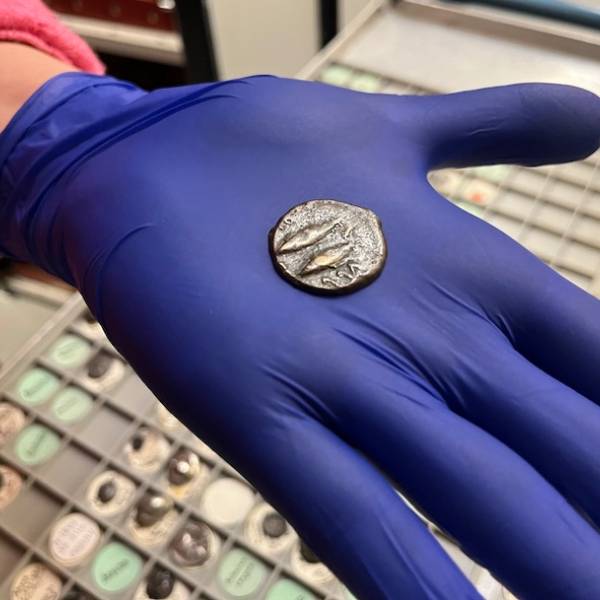
This coin, depicting Queen Berenice II, joins a small group of others like it and is the only one found outside of Egypt, making it exceptionally rare.

Photo: Eliyahu Yanai, City of David

Photo: Eliyahu Yanai, City of David
This coin is smaller than a fingernail. But don't let its diminutive size fool you; the bit is made of 99.3% solid gold. It’s thought by the Israel Antiquities Authority (IAA) to have been minted in Alexandria 2,200 years ago, or around 246 to 241 BCE. The coin is also rare—just one of about 20 of its kind that we know of—and the only one to be found outside of Egypt.
The piece features Queen Berenice II on the front and a cornucopia on the back. So, what do the symbols on the coin mean? The cornucopia, for one, is an ancient symbol of fertility and abundance, and next to it is a Greek inscription “ΒΑΣΙΛΙΣΣΗΣ” meaning “of Queen Berenice.” Unusually, she’s depicted as a ruler rather than a consort. This makes the discovery extra notable as it’s one of the oldest coins depicting a woman, suggesting that the queen had significant political power or influence.
Berenice II was the wife and cousin of Ptolemy III, who ruled in a region known as Cyrenaica, now modern-day Libya. Their union made the region a very significant Hellenistic power. Berenice II took over the reins when her husband went on a campaign to capture Syria. The coin may have been part of a larger collection gifted to soldiers returning from that campaign, the Third Syrian War.
The bit reveals a lot about Jerusalem and helps fill in the gaps on what we know about the city from this time period. It is not certain how the coin wound up in Jerusalem, but there are some theories that tell us a lot about both regions. Perhaps, for instance, important individuals were conducting business or passing through. It also suggests that the city was quickly bouncing back after a siege. It was previously thought that it was small, desolate, and poor after the capture. But that is being reevaluated, and experts believe Jerusalem was already recuperating, having been strengthened by ties to other centers of power.
Photo: Eliyahu Yanai, City of David
Child Playing in a Sandbox Discovers Ancient Roman Coin Buried Within
2,000-Year-Old Hologram Ring Features Face of Woman’s Deceased Son
Volunteer Archeologist Unearths Rare Pictish Ring in Scotland