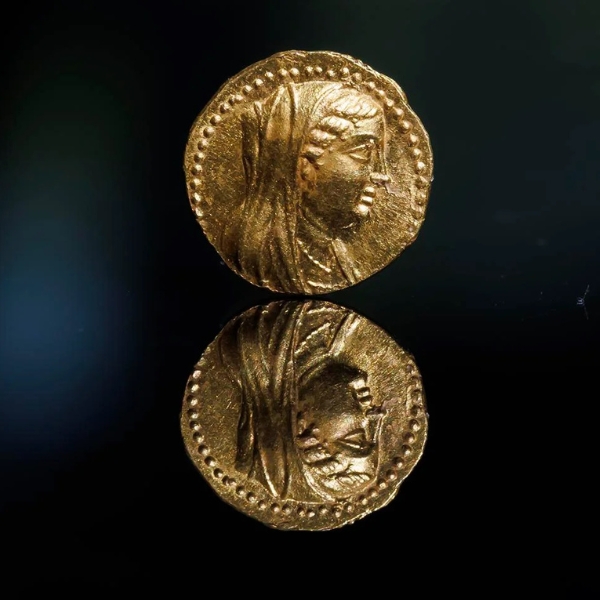
Sunken treasure comes in many forms, and it's not all jewels. Piecing together history is just as valuable. Recently, a trove of relics was recovered by Egyptian officials off the coast of Alexandria, Egypt. The remains were from an ancient sunken city called Canopus, and the pieces range from individual statues to building ruins to the city's infrastructure.
On August 21, 2025, archaeologists hoisted the relics from an underwater site in Abu Qir Bay. Divers helped locate the artifacts and then watched as a crane lifted the objects out of the water. This submerged site is believed to be part of Canopus, an important seaport city that functioned as a hub for trade, luxury, and religion during the Egyptian Ptolemaic dynasty and the Roman Empire.
Some of the recently recovered objects date back at least 2,000 years. Notable relics include: a mostly intact large sphinx statue made of quartz that features cartouches of King Ramses II; a black granite statue of a Ptolemaic queen; and even ponds carved from rock that could have been used for water storage or fisheries. Eighty-six of these relics are now on view at Alexandria National Museum in an exhibition titled Secrets of the Sunken City.
This impressive recovery of Canopus’ submerged artifacts is the result of 30 years of combined efforts by the European Institute for Underwater Archaeology (IEASM) and Egypt’s Ministry of Tourism and Antiquities, led by Franck Goddio, a French underwater archaeologist. “There’s a lot underwater, but what we’re able to bring up is limited,” explained Sherif Fathi, the Egyptian Minister of Tourism and Antiquities, “it’s only specific material according to strict criteria. The rest will remain part of our sunken heritage.”
Researchers believe that a series of environmental disasters was the reason for Canopus’ oceanic submersion. Rising sea levels, tsunamis, and earthquakes were, and continue to be, an issue for the region. The United Nations posits that by 2050, at least a third of Alexandria will be uninhabitable due to rising sea levels. The archaeological developments of Canopus underscore the fragility of Egyptian coastal cities in the face of natural disasters. As these relics resurface after thousands of years, they serve as both a window into ancient civilizations and a reminder of the urgent environmental challenges we still face today.
On August 21st, archaeologists recovered numerous relics from the long-lost underwater city of Canopus, off the coast of Alexandria.
Divers and cranes recovered granite statues, portions of buildings, and pieces of the city's ancient infrastructure.
Canopus was a bustling seaport city that was central to trade, religion, and luxury in the Ptolemaic dynasty and Roman Empire.
View this post on Instagram
A temporary exhibition at the Alexandria National Museum is showcasing 86 of these relics.
View this post on Instagram
Sources: Ancient Sculptures Recovered From Sunken City Off Alexandria; Ancient artefacts from sunken city lifted out of Mediterranean near Alexandria
Related Articles:
Ancient Egyptian Drawing Now Theorized To Represent the Milky Way’s Great Rift\
Researchers Discover the First Royal Tomb of an Ancient Egyptian Pharaoh in Over a Century
4,000-Year-Old Handprint Discovered on Ancient Egyptian Clay Artifact