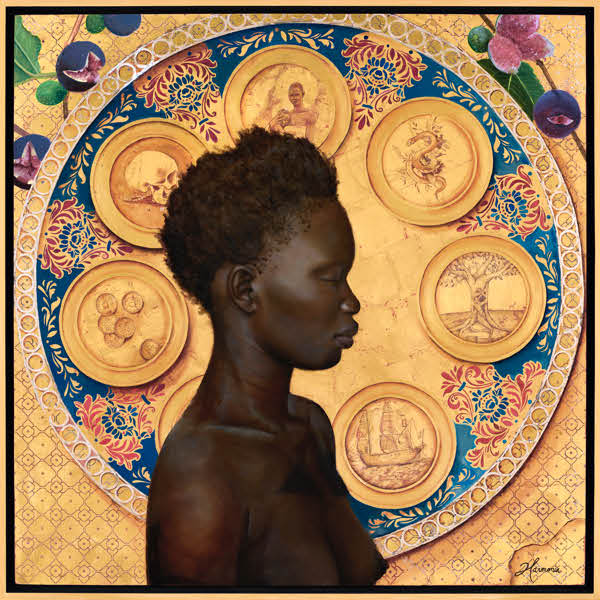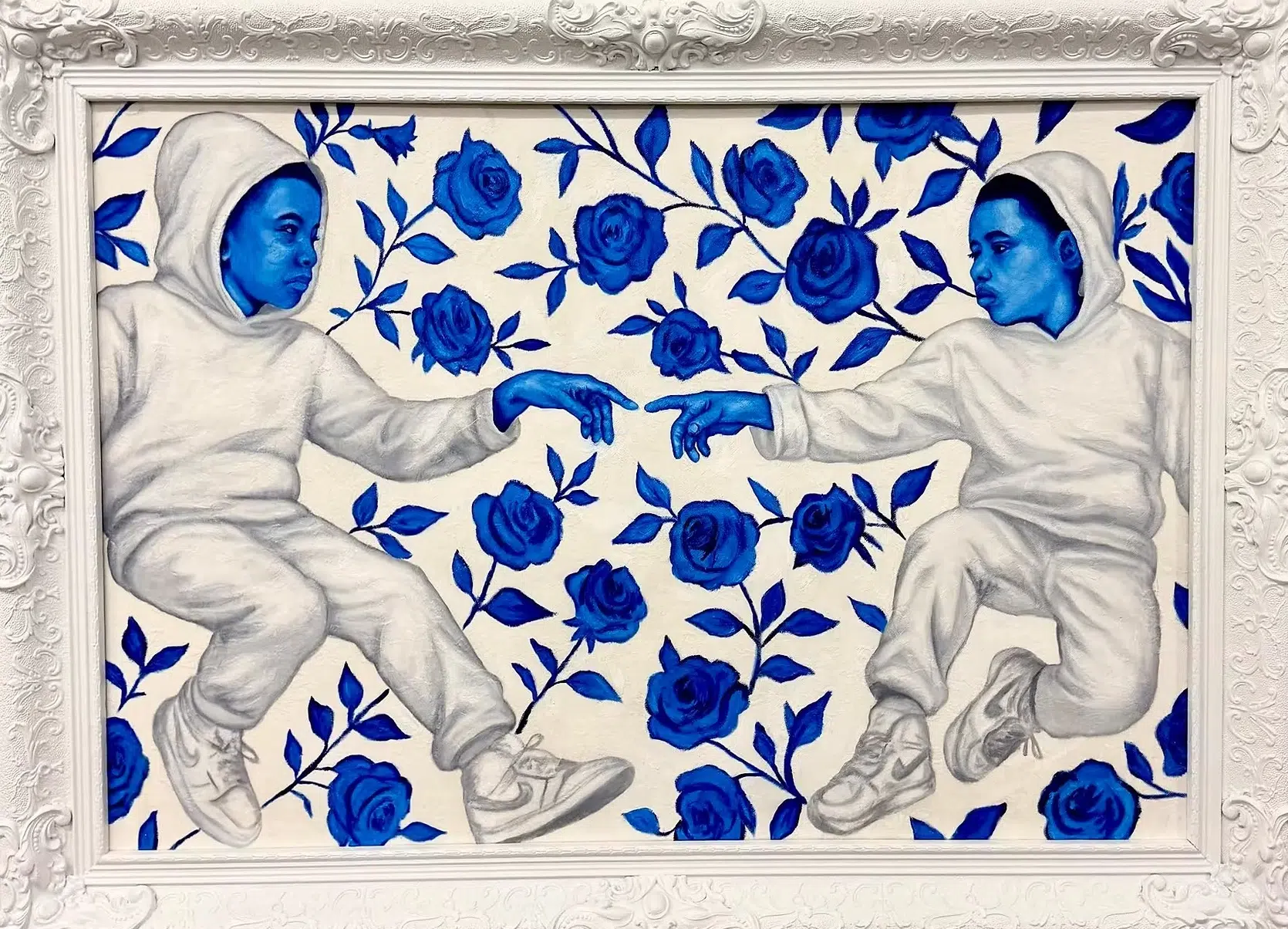
“Hand to God,” part of the “Tell Me Heaven Ain’t Black” series
It all began with a spiritual encounter in 2022. On the final night of her trip to Eswatini, Ashley Nora danced and sang alongside a group of girls at the orphanage that hosted her throughout her stay. Suddenly, amid the festivities, she noticed that their bodies began radiating with a blue aura, a brilliant glow that exceeded the confines of their flesh.
“It was the first time I had ever experienced anything like it,” the Indianapolis-based artist tells My Modern Met. “In that moment, I felt a clear instruction: to no longer paint the flesh of a person, but to paint the spirit.”
In the past few years, Nora has heeded that directive. Now, her work largely revolves around portraits of Black subjects, each rendered with striking blue skin. The effect, she explains, is not that of negating Black identity, but of heightening it, unearthing the divine, ethereal, and more intimate qualities that have so often been overlooked across art history. In grounding Blackness within this blue essence, Nora’s paintings don’t simply resist expectation; they invite us to peer beyond the surface and to accept that the self is fundamentally layered.
“In a world that so often reduces Black identity to stereotype or circumstance, I felt called to move beyond the physical body and into something deeper, something unmarked by bias, yet undeniably present,” Nora adds. “The blue becomes a visual language for that space. It asks the viewer to pause, to reconsider, and to look again.”
Nora’s blue color palettes also inform another critical aspect of her practice: the frame. The artist’s canvases are often encased in intricate structures, which function as a stand-in for what she calls the “boxes that society places around Black identity.” Though present across most of her work, frames play a particularly significant role in Nora’s Tell Me Heaven Ain’t Black series, in which every frame is painted white.
“They reference the pervasive ‘white boxes’ my community is often placed within, spaces that may appear elevated, prestigious, or adorned, yet still impose limitations,” she says. “Ultimately, the frame allows me to hold tension between containment and transcendence, between what is imposed and what cannot be held.”
My Modern Met had the chance to speak with Ashley Nora about her creative practice, her signature blue motifs, and the ways in which she contends with Blackness across her work. Read on for our exclusive interview with the artist.
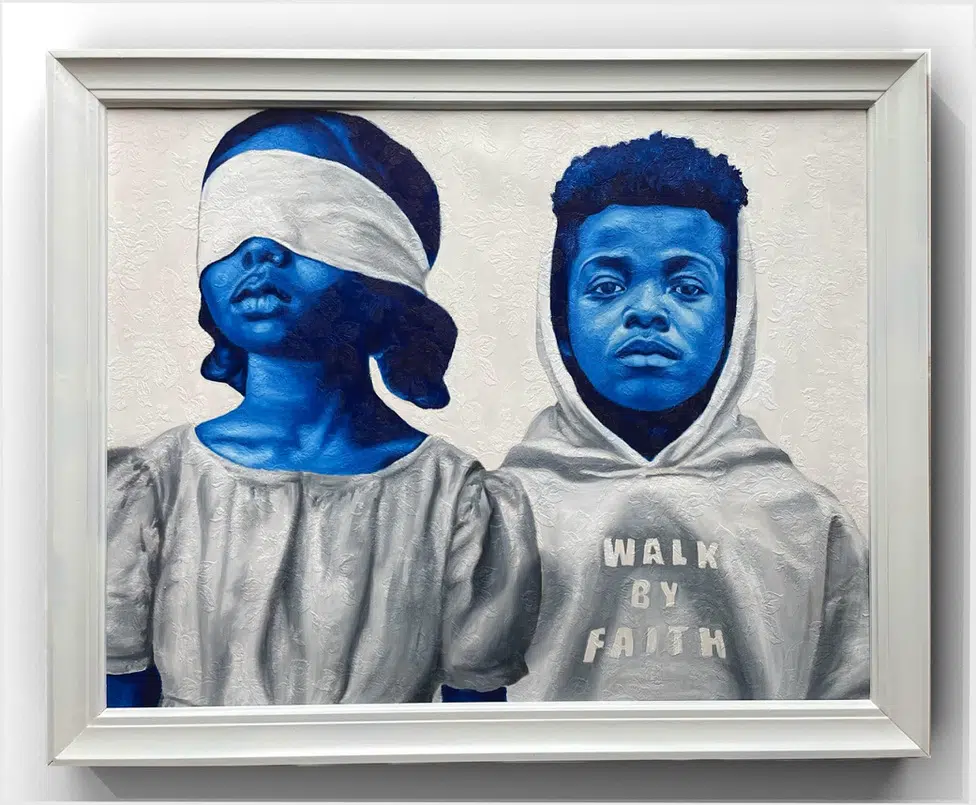
“Not by Sight,” part of the “Tell Me Heaven Ain’t Black” series
What first drew you to painting as your primary artistic medium?
I often say I grew up in an art desert—there wasn’t direct access to galleries, formal training, or a visible path into the art world. Because of that, I learned to see through what was available to me: photography. Images became my first teachers. They held joy, memory, and proof that a moment could live beyond itself. Very early on, I became obsessed with that idea, with preserving something beautiful long enough for it to outlive me. Painting became the way I could do that on my own terms. It allowed me to take a moment that already existed and reimagine it, stretch it, deepen it, and sanctify it.
What began as a desire to recreate joy evolved into a practice of building worlds where memory, divinity, and presence could live permanently. It also felt innate. Painting was something I could do without a classroom. It came naturally, almost like a language I already knew how to speak. Over time, I explored other mediums to challenge myself, but painting remained the clearest and most honest extension of that original gift.
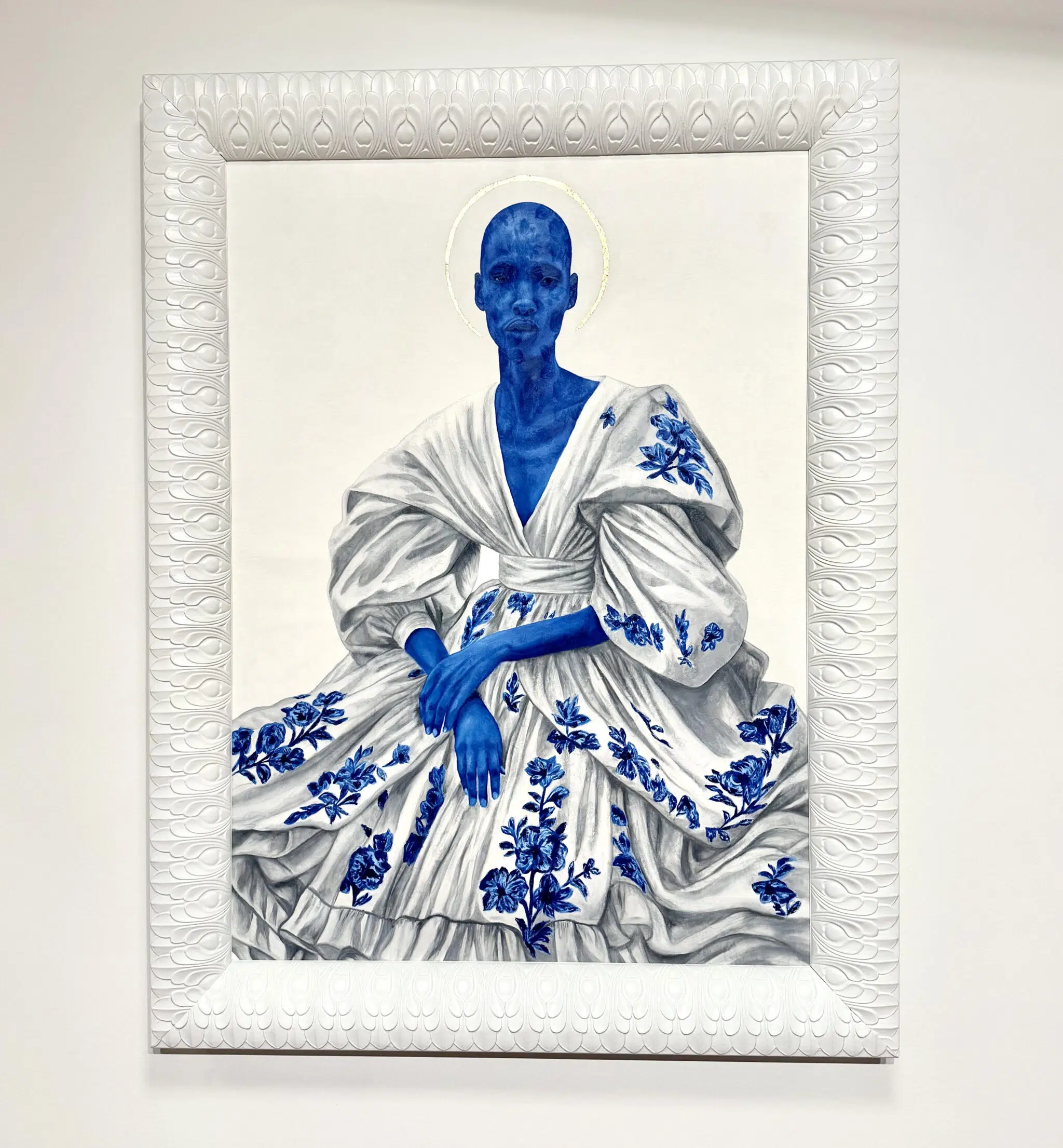
“Haddassah Crowned,” part of the “Tell Me Heaven Ain’t Black” series
What is the process of creating one of your paintings?
My process begins before the painting ever exists, often in dreams. I keep a journal beside my bed, and over time I’ve filled it with hundreds of visions, fragments, and fully formed concepts. But the work doesn’t truly begin until I encounter the frame.
The frame is what calls the piece forward. It determines the scale, the energy, and ultimately which story is ready to be brought into the world. Each frame carries its own history. Some I build and carve by hand, some I restore, and others I source and reimagine.
Once the frame is established, I begin constructing the environment within it, selecting fabrics that act as both material and metaphor, grounding the narrative I’m about to tell. Only then does the painting begin. The fabric is stretched, sealed, and prepared before I move into drawing and paint. From there, the work unfolds slowly and intentionally. Every layer, every texture, every detail is considered. The process is labor intensive, but it has to be because I’m not just creating images, I’m building worlds that hold memory, divinity, and permanence.
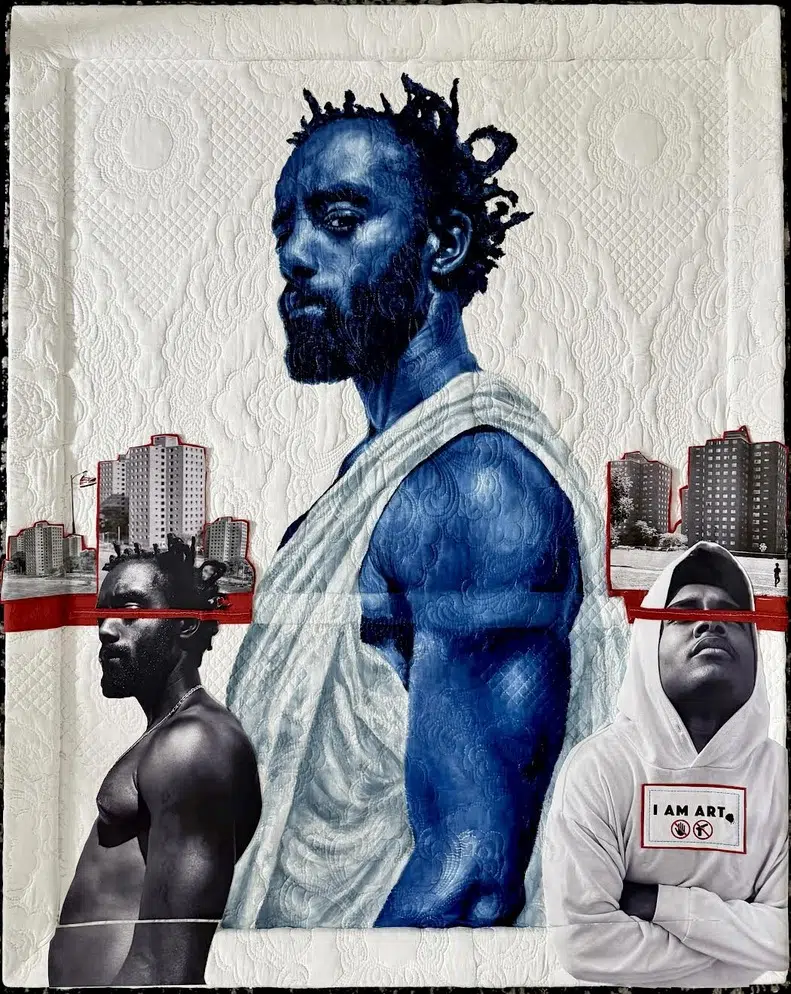
“God in Me,” made in collaboration with Blu Murphy
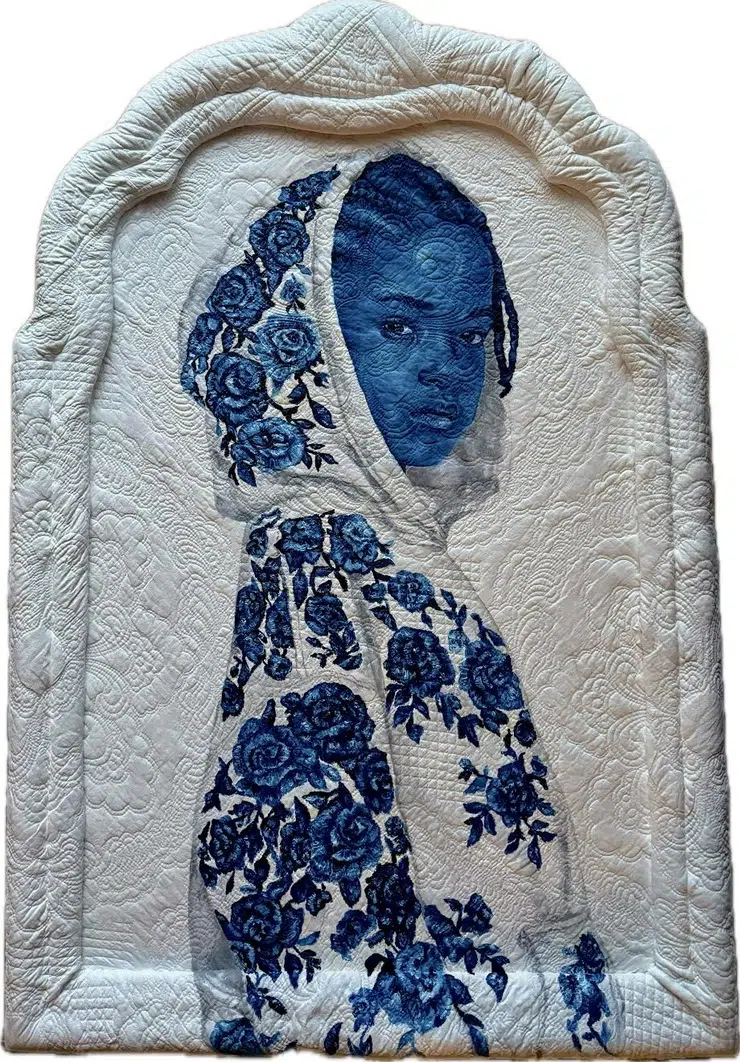
“Of Heaven, Still”
You often combine painted and sculptural forms, including quilts and lace. What compels you about this multimedia approach?
I’m interested in telling stories that cannot be contained. Working across painting, sculpture, textile, and lace allows me to expand the language of the work, to move beyond a single surface and into something more dimensional, more embodied. Each material carries its own history, its own weight, its own cultural memory. When they come together, the work begins to speak in layers rather than a single voice.
Quilts, lace, and fabric in particular hold a deep sense of lineage and care. They reference what has been passed down, what has been held, what has been protected. When I integrate those materials into my paintings, I’m not just adding texture, I’m embedding memory, identity, and presence directly into the work.
At its core, my practice is about expanding the way we are seen. And to do that honestly, the work itself cannot be confined to a two-dimensional plane. Our identities are layered, complex, and multidimensional. My approach reflects that, each medium becoming a way to push against limitation and create space for a fuller, more expansive representation of who we are.
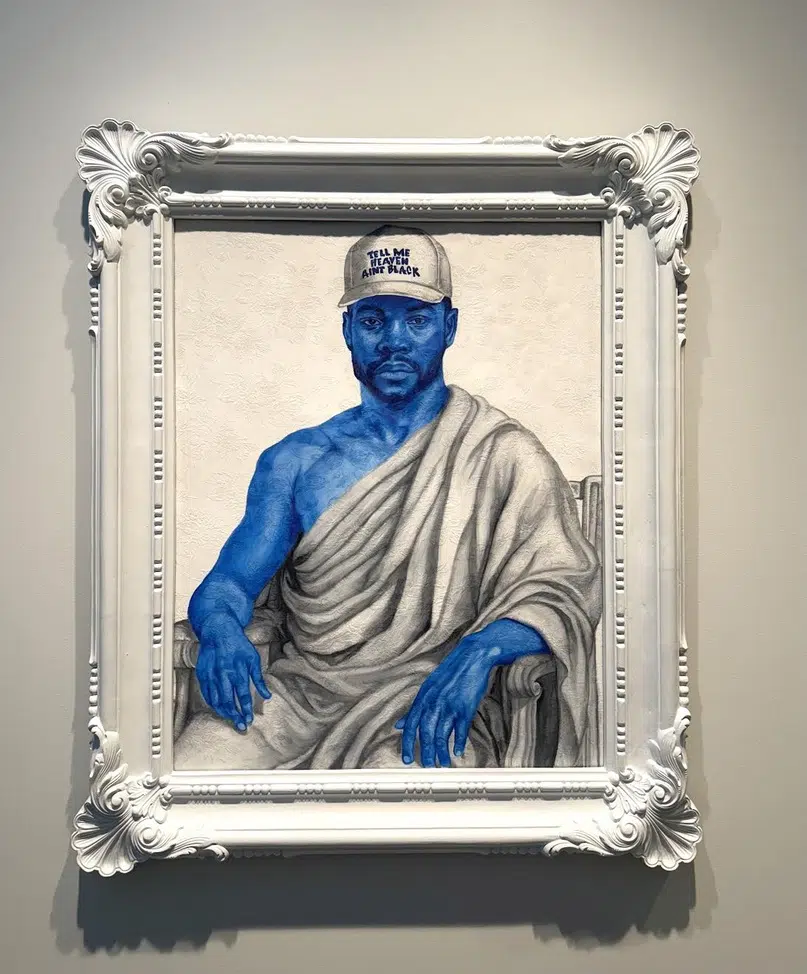
“Inheritance,” part of the “Tell Me Heaven Ain’t Black” series
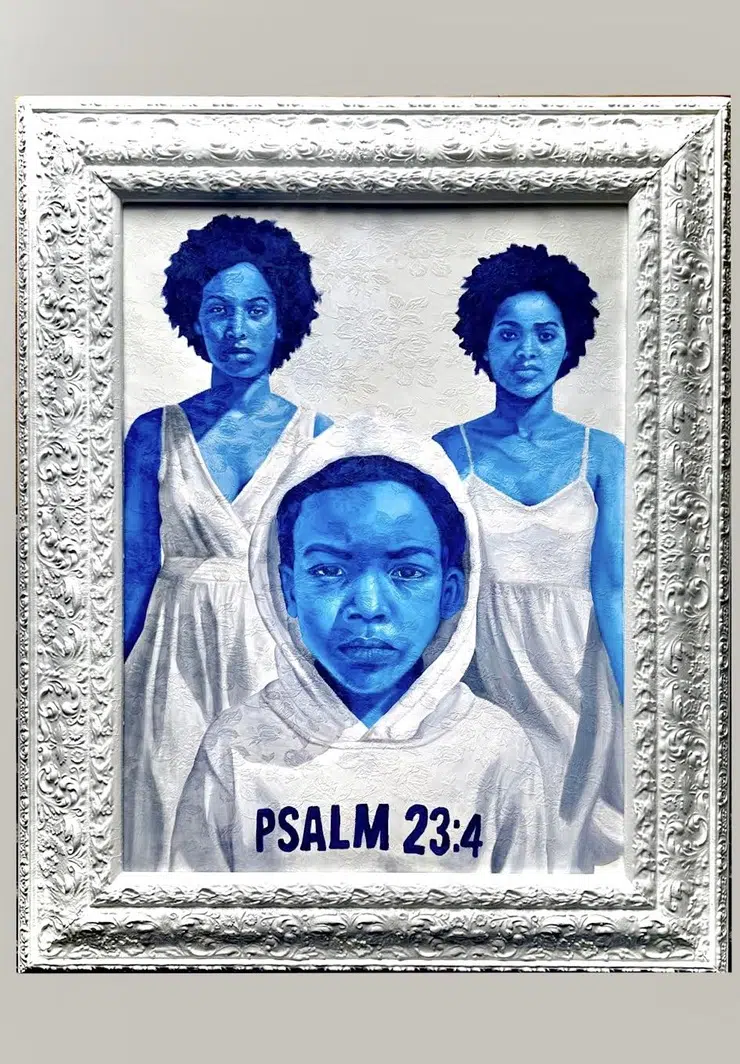
“For Thou Art With Me,” part of the “Tell Me Heaven Ain’t Black” series
Your paintings are typically accompanied by intricate frames. What role does framing play throughout your practice?
The frame is not secondary to the work—it is the work. I use framing as both a physical structure and a conceptual device to speak about the systems that attempt to contain us. The frame becomes a stand-in for the “boxes” society places around Black identity, constructed, imposed, and often inescapable.
Across my practice, I challenge that containment in different ways. In Glory, I built the frame so that it can never touch the ground. It must be carried, held with care, reverence, and intention, which transforms the act of handling the work into something sacred. In Wisdom, the figure exists with a frame that isn’t a box, embodying a presence that refuses containment. And in more recent works, I’ve begun painting beyond the edges, allowing the figure’s aura and divinity to extend outwards which suggests that the spirit cannot be confined, even when a structure is present.
Within my Tell Me Heaven Ain’t Black series, the frames are intentionally white. They reference the pervasive “white boxes” my community is often placed within, spaces that may appear elevated, prestigious, or adorned, yet still impose limitations. My work exists within those structures, but it also resists them, expanding, pressing outward, and taking up space unapologetically. Ultimately, the frame allows me to hold tension between containment and transcendence, between what is imposed and what cannot be held.
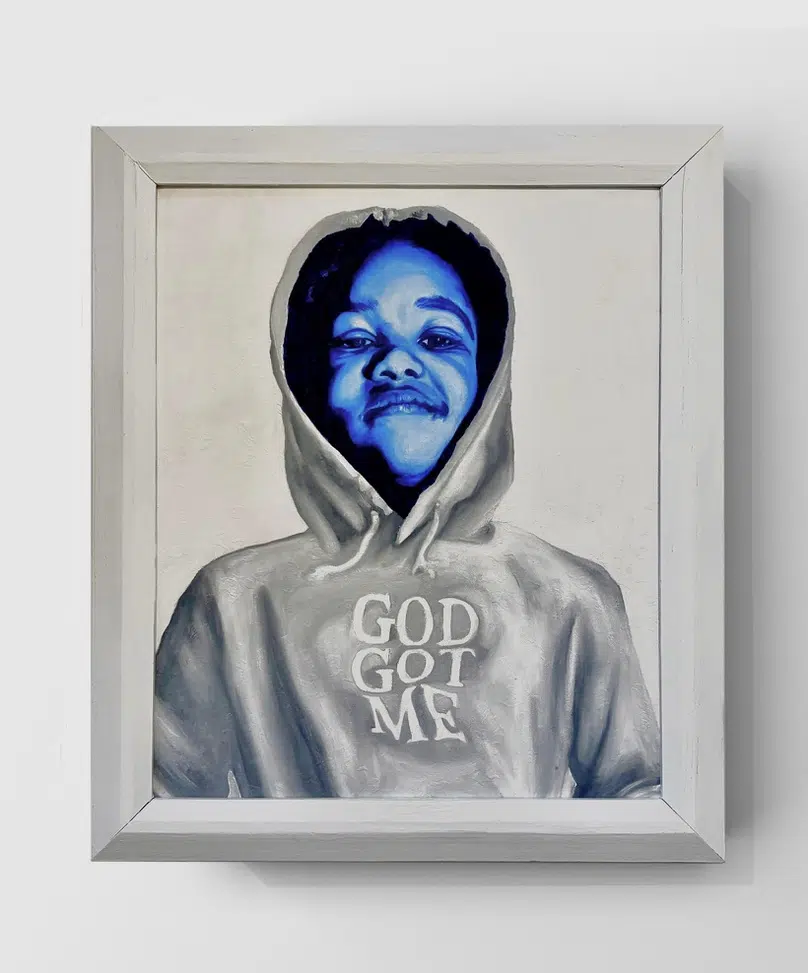
“Weapons May Form, But,” part of the “Tell Me Heaven Ain’t Black” series
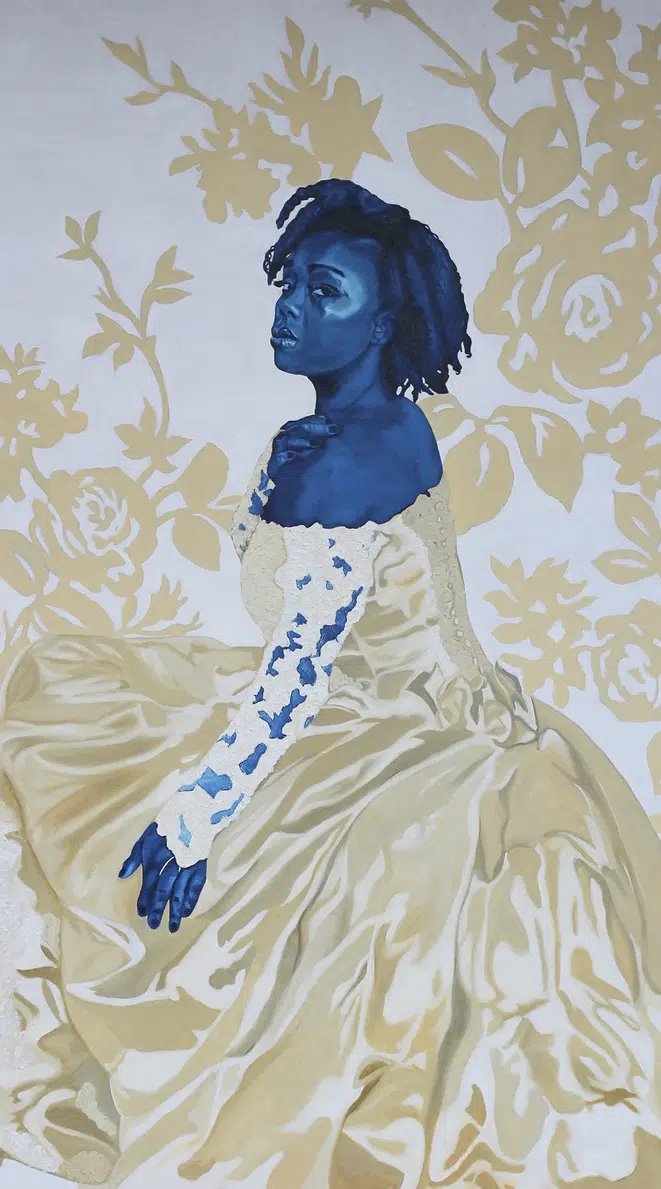
“Glory” (unframed)
When did you originally begin painting your figures with blue skin and what inspired that decision?
I began painting my figures with blue skin in 2022, following a deeply transformative trip to Eswatini. I traveled there to speak with young girls and women about pursuing their dreams, and to create a mural for children at a local orphanage. I arrived with the intention of pouring into them, but what I experienced instead reshaped me entirely. There was a joy I encountered there that I had never witnessed before. These children, many of whom had faced circumstances far more difficult than my own, carried a lightness, a fullness, and a sense of presence that felt almost otherworldly.
On my final night, I stayed with the girls at the orphanage. We sang, we danced, and in that moment, something shifted. I began to see a blue aura radiating from their bodies. It was as if their spirits couldn’t be contained in their fleshly bodies. It was the first time I had ever experienced anything like it.
I understood it as a spiritual encounter. In that moment, I felt a clear instruction: to no longer paint the flesh of a person, but to paint the spirit. Since then, blue has become a visual language within my work, a way of rendering the soul rather than the surface. It allows me to move beyond physical identity and into something eternal, something divine.
Within the Tell Me Heaven Ain’t Black series, this shift is essential. The work asks the viewer to look beyond circumstance, beyond perception, and beyond what is immediately visible and to recognize the divinity that exists within each person.
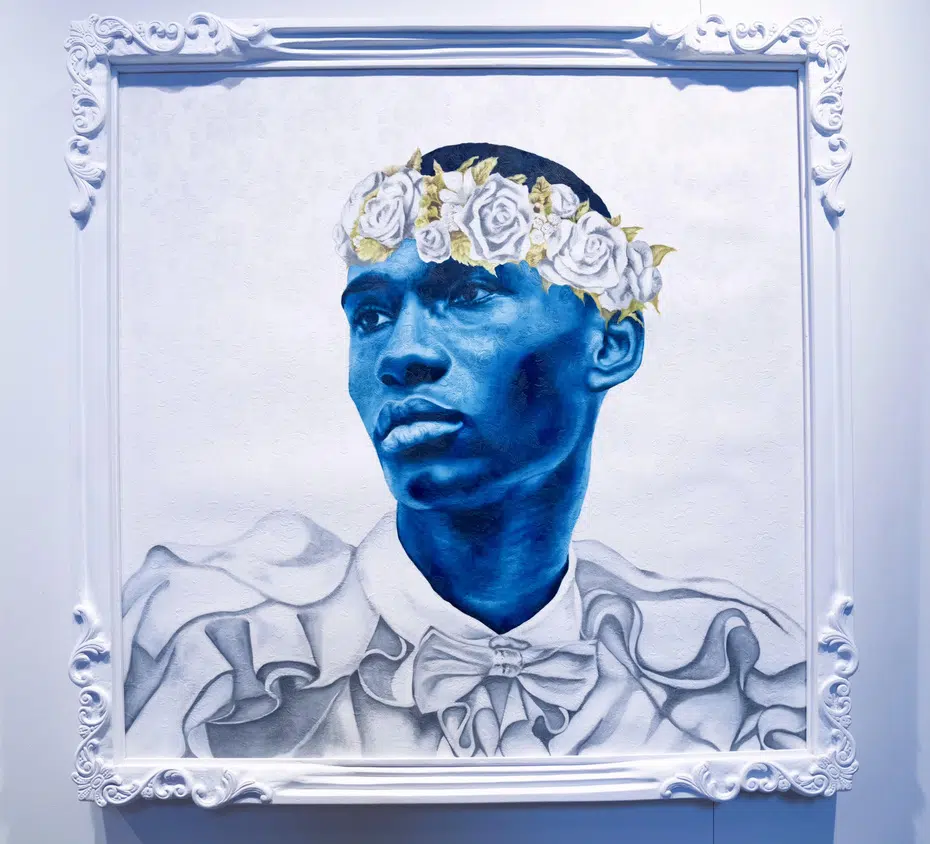
“King David,” part of the “Tell Me Heaven Ain’t Black” series
What do these blue motifs reveal about Blackness, and what does it mean to you to investigate Black identity through your art?
The blue in my work is not an erasure of Blackness, but rather a return to its essence. I paint the soul.
In a world that so often reduces Black identity to surface, stereotype, or circumstance, I felt called to move beyond the physical body and into something deeper, something unmarked by bias, yet undeniably present. The blue becomes a visual language for that space. It asks the viewer to pause, to reconsider, and to look again.
What does it mean to see someone when you are no longer relying on skin as the first point of understanding? For me, investigating Black identity is not about removing it, it’s about expanding it. It’s about revealing the fullness, the divinity, and the humanity that has always been there, even when it has been overlooked or misrepresented. The figures I paint are not absent of Blackness—they are saturated in it. In their posture, their presence, their adornment, their stillness. The blue simply shifts the entry point. It disrupts expectation and invites a deeper encounter.
Ultimately, my work asks a quiet but urgent question: If you can recognize the soul first, how does that change the way you see us?
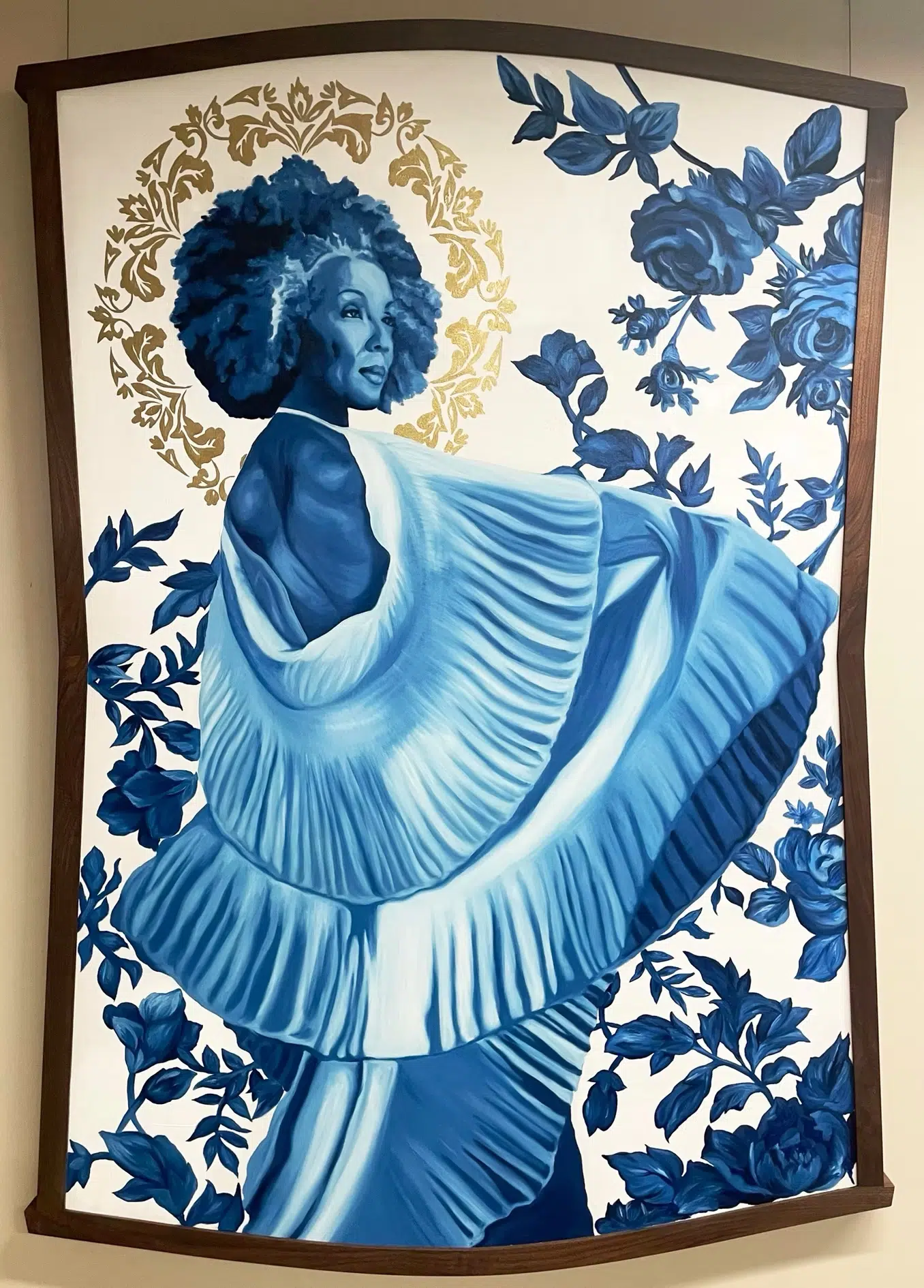
“Wisdom”
What do you hope people will take away from your work?
I often think about artists like Michelangelo and the way their work has shaped how we collectively imagine heaven, divinity, and sacredness. When you stand inside spaces like the Sistine Chapel or walk through institutions like the Louvre Museum, you are surrounded by beauty, but you are also confronted with absence. You don’t see us there. My work exists to challenge that absence. To reimagine heaven as something that belongs to all of us.
I want viewers to slow down and to truly sit with the work. To notice the details, the layers, the quiet “Easter eggs” embedded within each piece. The frame, the fabric, the flowers, none of it is accidental. Each element is asking a question: What does this frame mean to you? What boxes have you been placed in or participated in creating? What do you recognize when you look beyond the surface?
The flowers in my work represent the fruits of the spirit, the quiet, often unseen expressions of character: love, joy, patience, kindness. Within the Black community, these qualities exist in abundance, yet they are so often overlooked. My work is a visual reminder that these virtues are always blooming, whether they are acknowledged or not.
More than anything, I want my people to see themselves reflected in divinity and to feel pride, wholeness, and belonging in that reflection. And for others, I hope the work creates a shift. A moment where they move beyond skin, beyond assumption, and begin to see the soul.
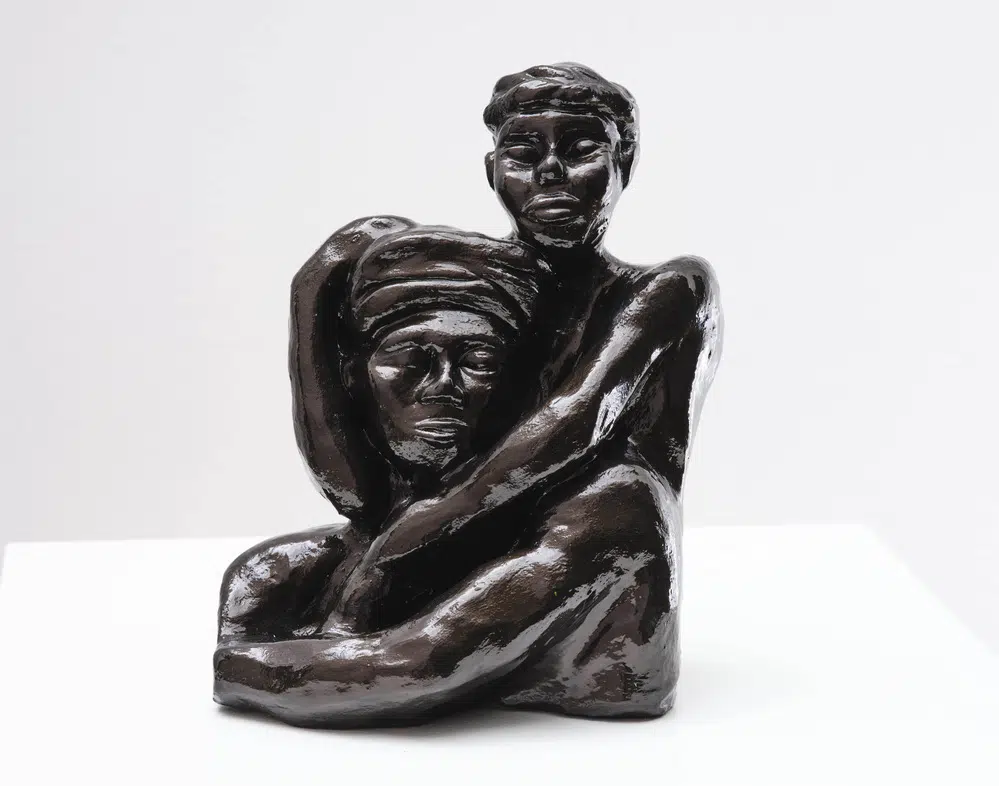
“Promises in the Moonlight”
Ashley Nora: Website | Instagram
My Modern Met granted permission to feature photos by Ashley Nora.
Related Articles:
New Exhibition Contends With Black Heritage Through Layered, Evocative Textile Art
Ceramic Artist Pays Tribute to Black Culture Through Hair–Inspired Vases
Hyperrealistic Pencil Drawings Meditate Upon Black Identity and Heritage [Interview]