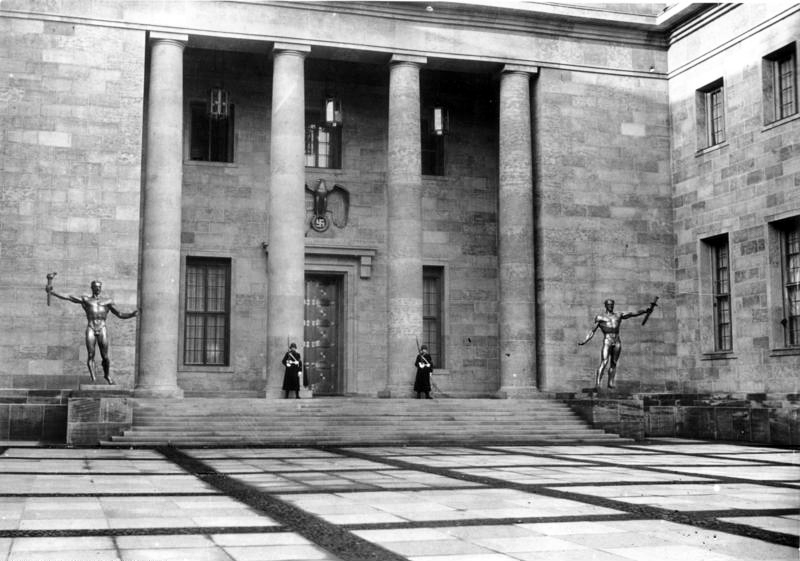
The New Reich Chancellery's Courtyard of Honor in 1939. The main entrance was flanked by Arno Breker’s two bronze statues Die Wehrmacht and Die Partei. (Photo: German Federal Archives via Wikimedia Commons, CC 3.0 Germany)
During the 20th century, several countries around the world grappled with fascism and its eventual ramifications. But fascism was far from simply an ideological or political system—it was also grounded within cultural artifacts. A recent video essay by IMPERIAL explores exactly that, revealing how art and architecture were both manipulated by dictators, such as Hitler and Mussolini, to exert control over their respective countries.
Fascism’s visual language traces its roots back to two art movements, namely Romanticism and Futurism. The former contended with a longing for the past through sublime, naturalistic compositions, while the latter focused on agility, movement, and a boundless future defined by machines, strength, and violence. When taken together, both movements complement one another and the fascist project perfectly: one looks backward to glorious empires, and the other looks forward to a radical new order. In fact, Italian futurists like Filippo Tommaso Marinetti were some of Mussolini’s first supporters, maintaining that the dictator could propel Italy forward through technology and warfare.
Aside from futurism’s bold, provocative aesthetic, Rome also figured strongly into Mussolini’s agenda. “Rome is our reference, it is our symbol or, if you wish, our myth. We dream of a Roman Italy, that is wise and strong, disciplined and imperial,” he remarked in 1922. Hitler was equally enamored by ancient Rome and Greece, believing that both had reached the highest stage of culture and civilization. This idolization resulted in an explosion of Neoclassicist architecture in Italy and Germany alike, a physical reminder of antiquity and its alleged purity, monumentality, and grandeur.
In Berlin, for instance, the New Reich’s Chancellery was flanked by two sculptures produced by the dictator’s official state sculptor, Arno Breker. The statues were known as “the Army” and “the Party,” both of which observed everyone that approached the building.
“Like in Rome, these statues weren’t just decoration,” IMPERIAL says. “They were ideological tools, broadcasting a clear message about the kind of body, the kind of citizen, that fascism sought to produce.”
Beyond this, Hitler and Mussolini both spearheaded urban projects designed to recall imperial Rome: Germania and the EUR district, respectively. In the EUR district, the Square Colosseum combined modernist design with ancient influence, assuming a harsh, geometric silhouette that, unlike the Colosseum or other examples of classical Roman architecture, signified dominance while towering over passersby. Here, ornament has been stripped away in favor of something sharper—and more intimidating.
“Fascism wasn’t just about the domination of the present,” IMPERIAL continues. “It was about creating a legacy, a grand historical narrative where the state never fails, even when the leaders themselves are long gone.”
Neoclassicism, of course, exists in several other contexts, including democracies. But, unlike their fascist counterparts, these architectural forms are less rigid and are scaled differently, creating a more welcome rather than menacing environment. After all, aesthetics are a form of control.
“Fascist aesthetics created a reality in which the state was ever-present, always powerful, always sacred,” IMPERIAL concludes. “Art and architecture flattered your image of the state and gave rise to pride, if you were of a patriotic persuasion. If you were not, fascist design threatened and constantly reminded you of just how very small and powerless you really were.”
To learn more, watch the full video below.
Art, design, and architecture have always played pivotal roles in reflecting culture and defining eras in history.
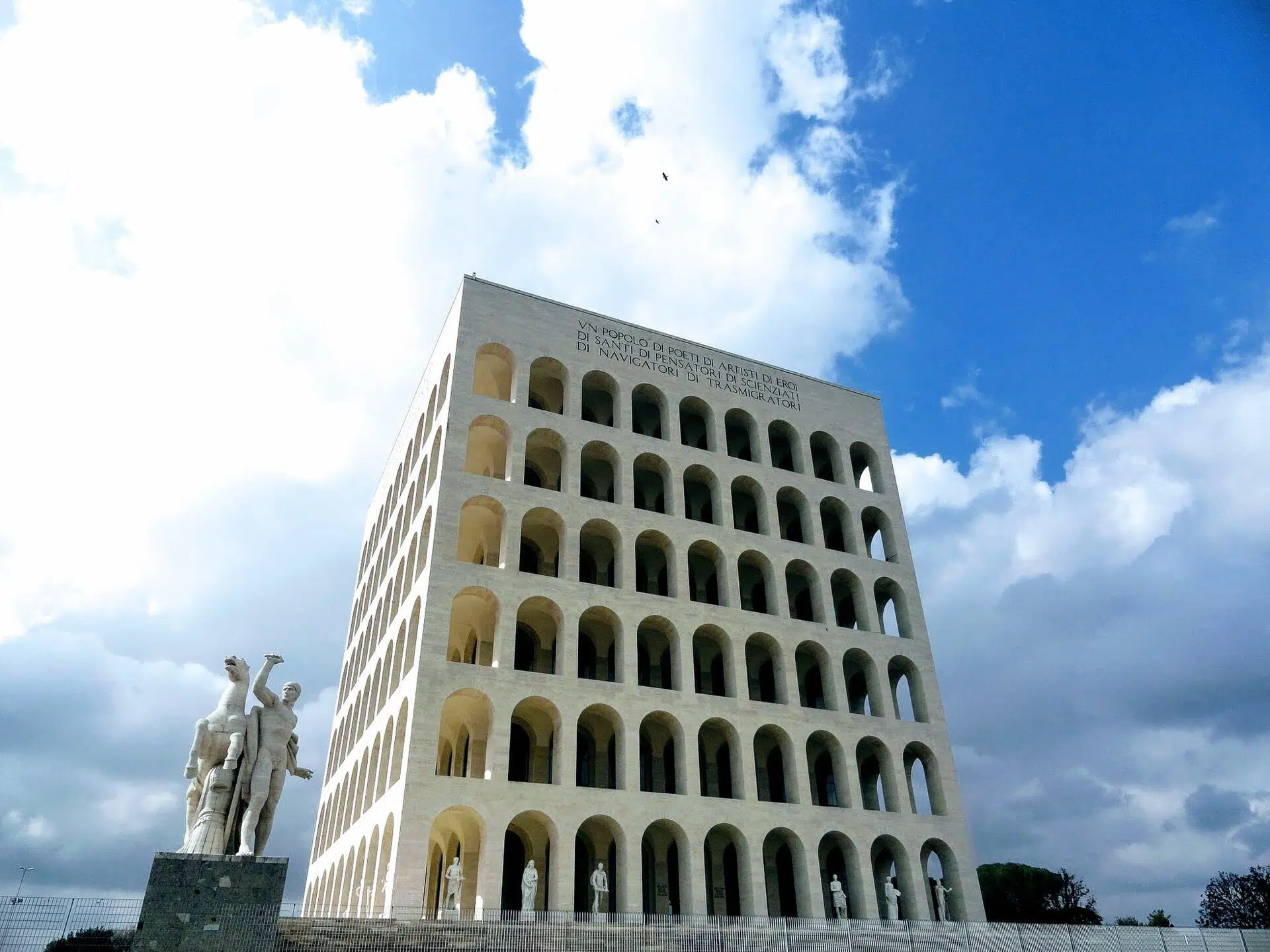
The Square Colosseum, also known as the Palazzo della Civiltà Italiana, in Rome. (Photo: Katalin Bán via Wikimedia Commons, CC 4.0)
A recent video by IMPERIAL explores how art and architecture were manipulated by Hitler and Mussolini in order to exert control over their respective countries.
Related Articles:
During World War II, Parachuting Pigeons Carried Messages to French Resistance
Listen to 14-Year-Old Elizabeth Deliver Her First Speech to the British People During World War II