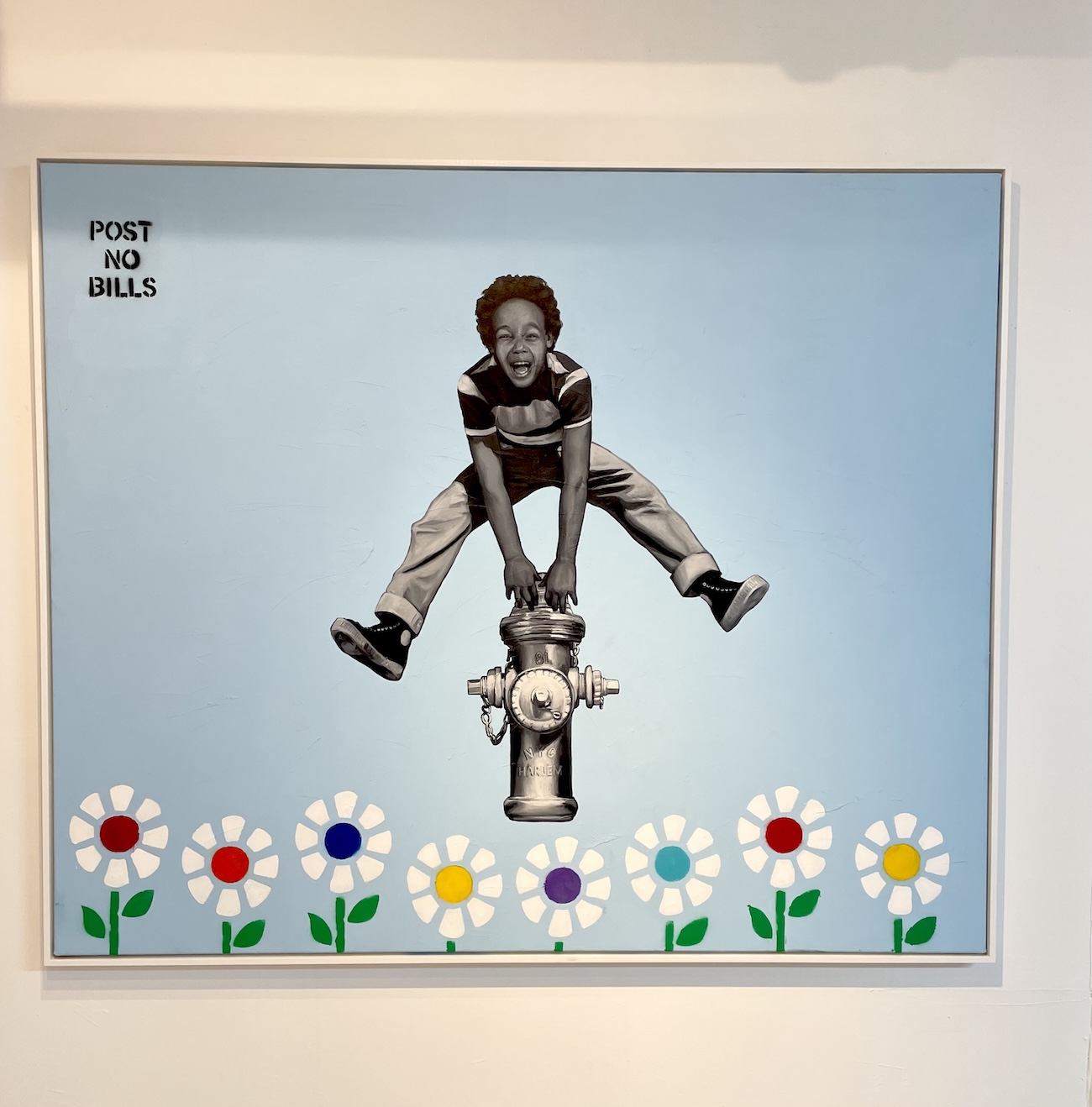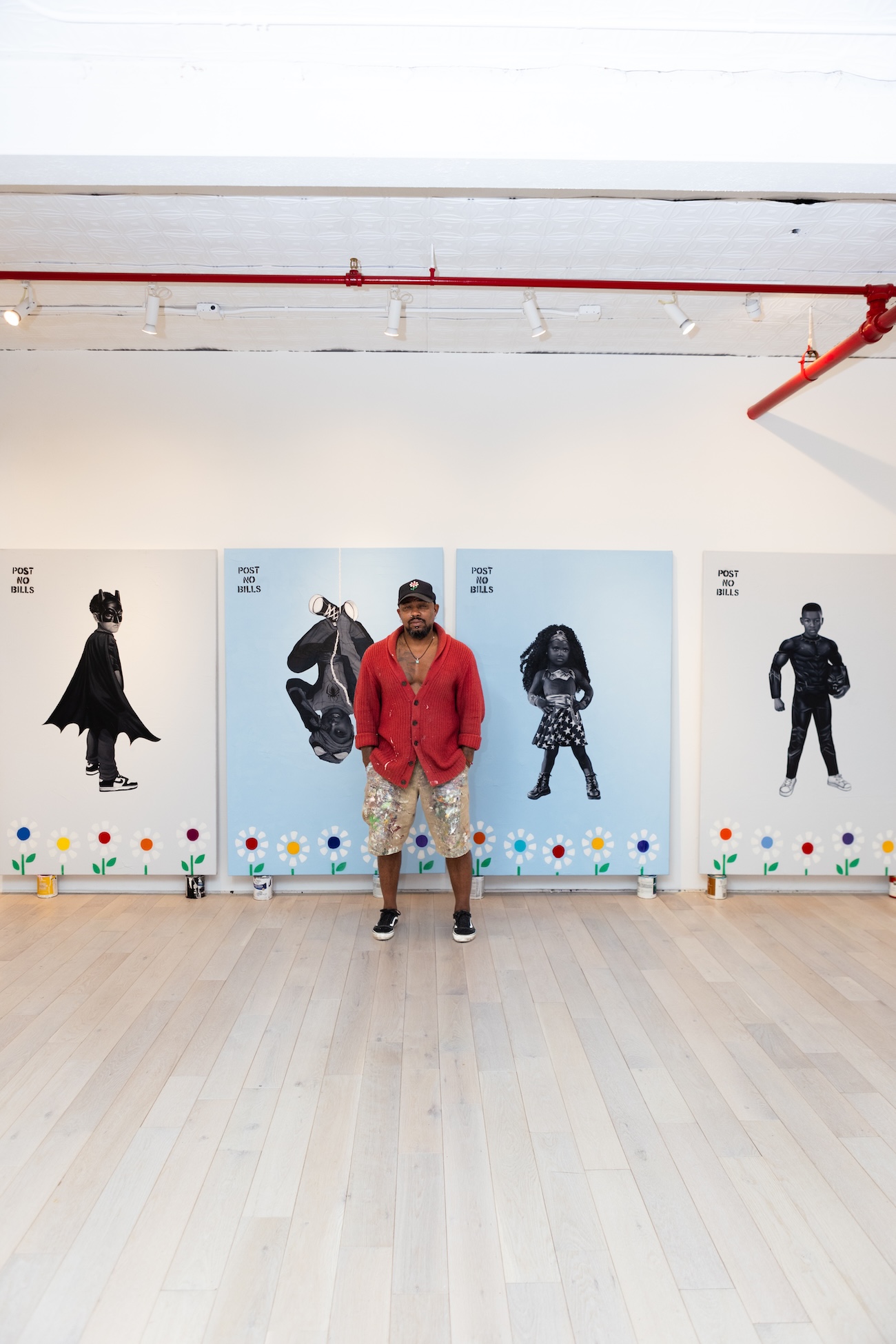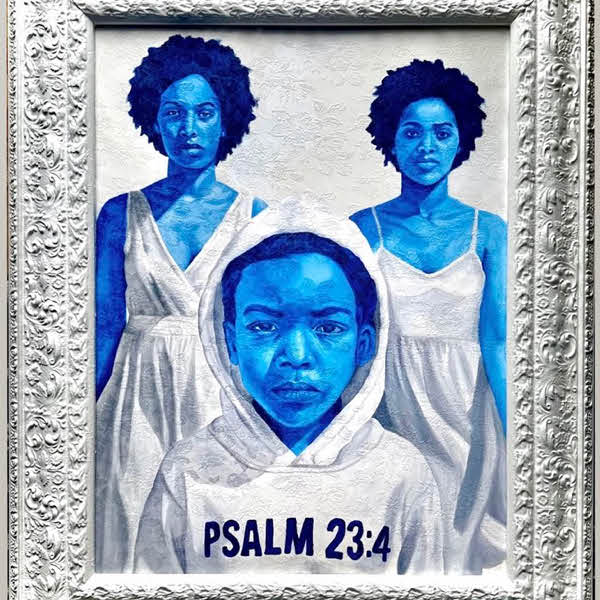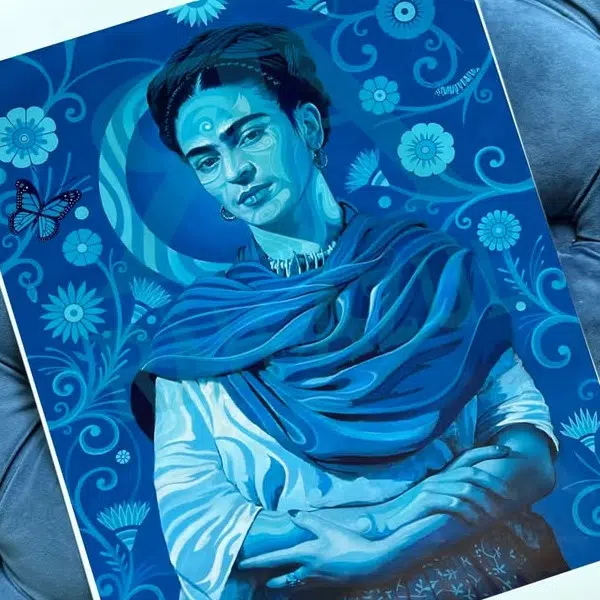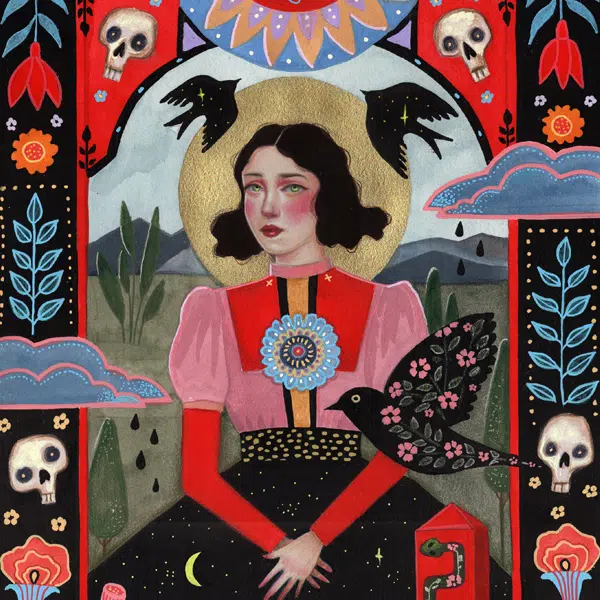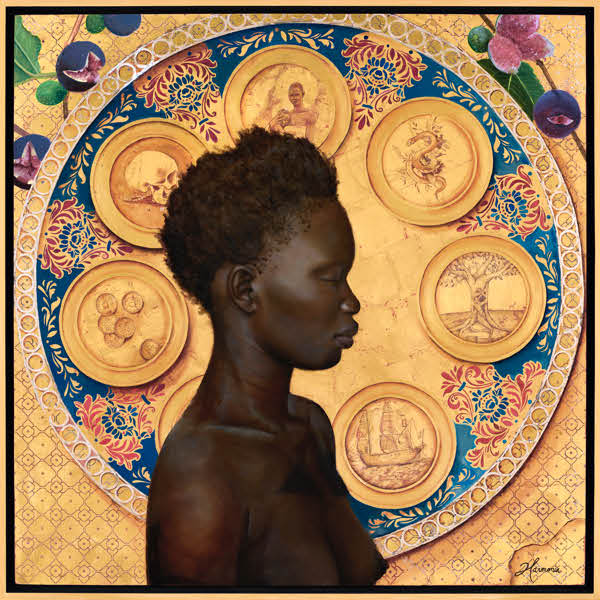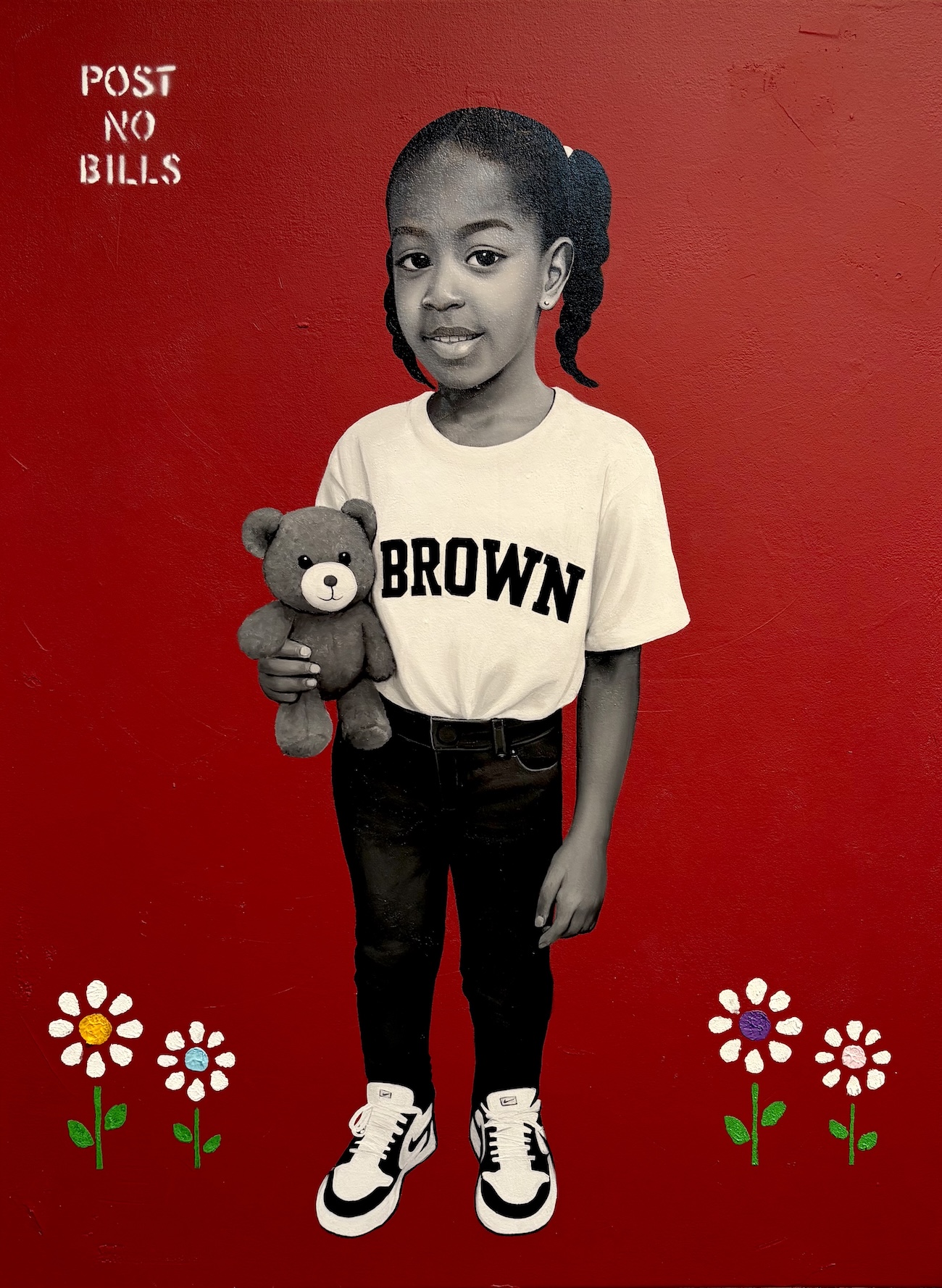
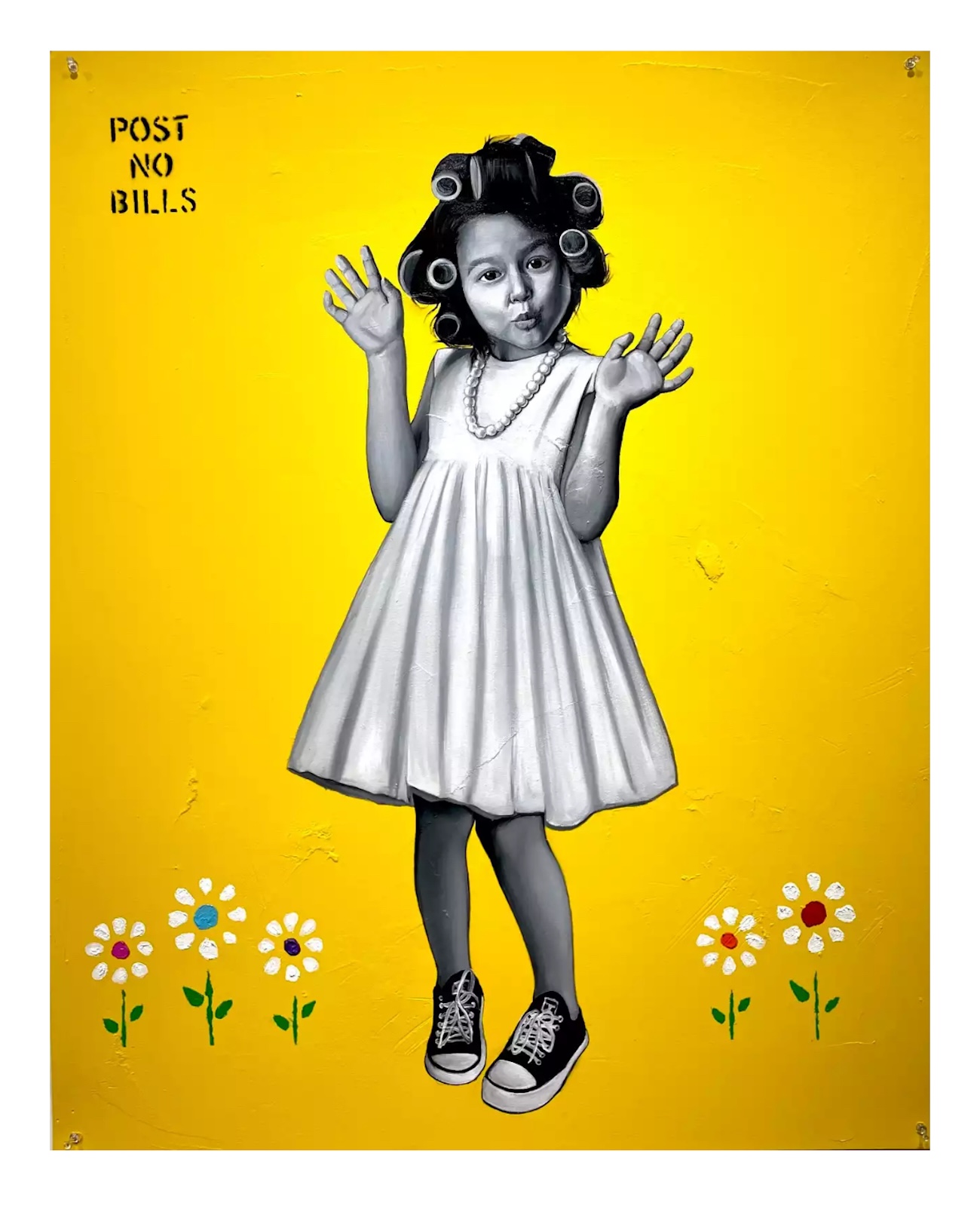
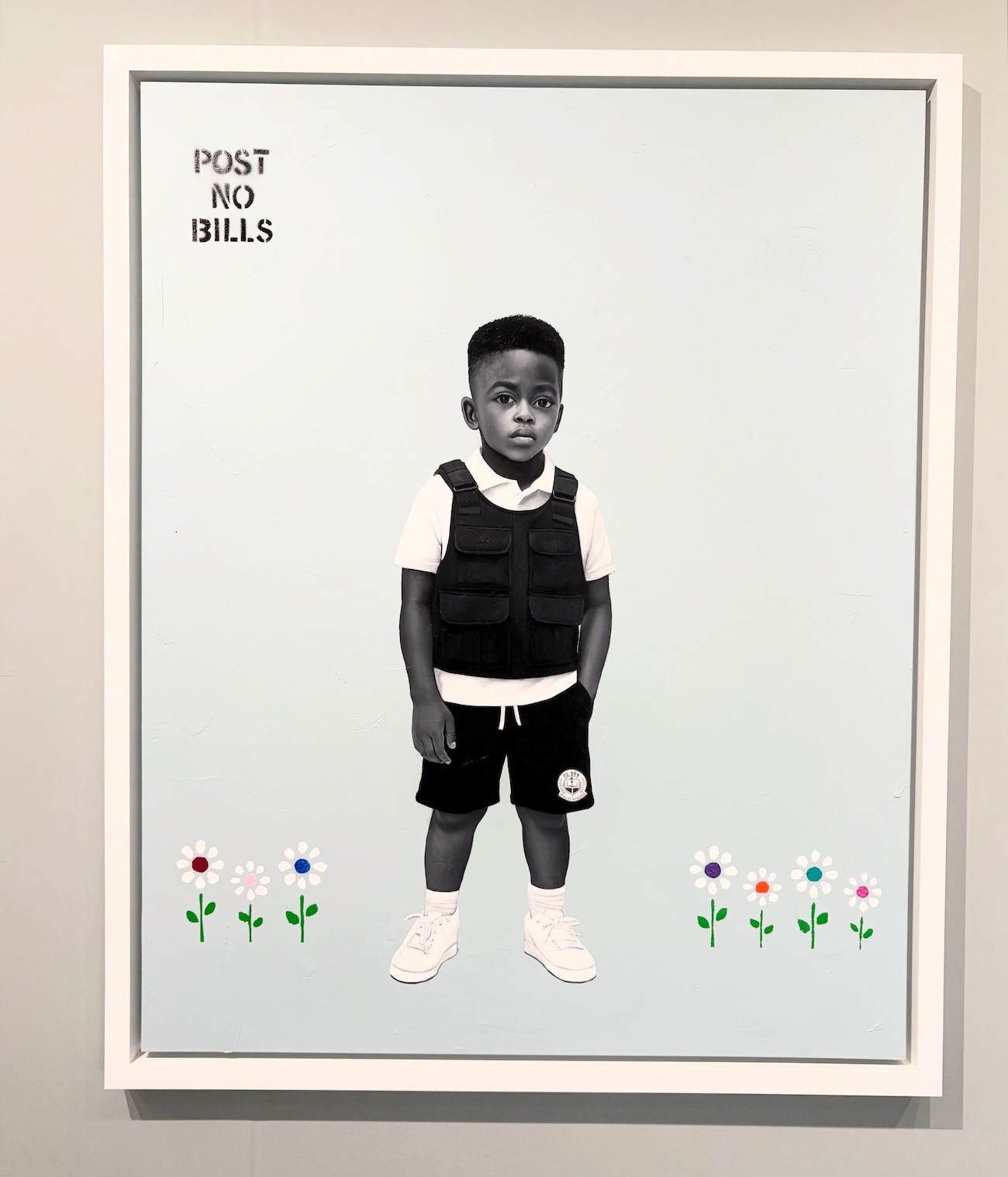
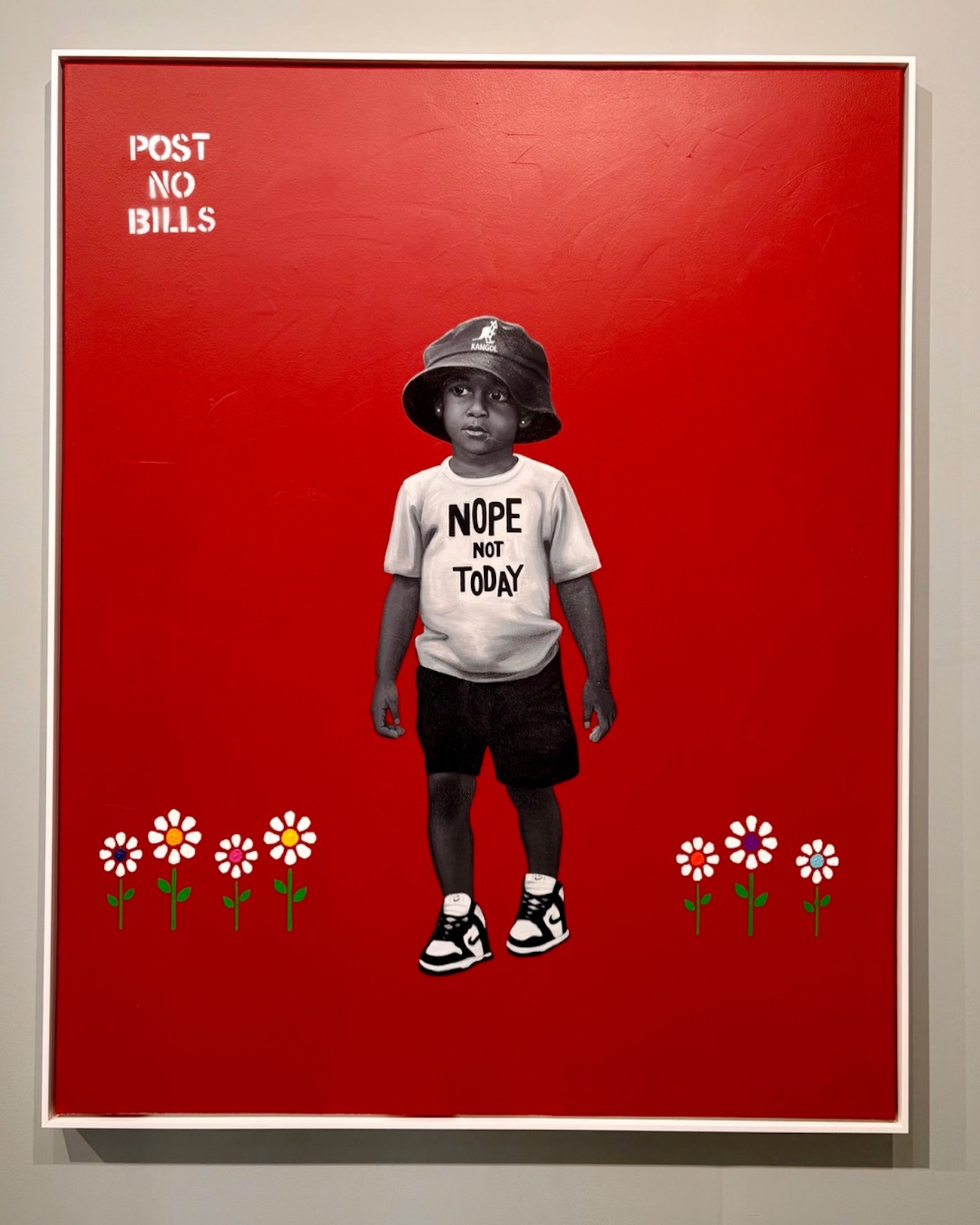
Artist Guy Stanley Philoche creates work blending realistic portraiture with abstraction. The juxtaposition is visually striking, showcasing his rendering abilities alongside an emotional core. This is best exemplified in his series titled Higher Learning, which features Black children rendered in a monochromatic palette, standing against bright, solid-color backgrounds with some stenciled elements.
“My work is figurative,” Philoche explains to My Modern Met. “It can be considered realism, but it is not about realism for its own sake. I paint Black bodies, sometimes vulnerable and sometimes defiant, set against flat, uninterrupted fields of color. The figures are quiet, but they are not passive. There is a psychological tension in the stillness.”
Because of the minimalist slant to his work, everything that Philoche paints has significance. From the clothes his subjects wear to their poses to his use of graphic elements, everything has a deeper meaning. The addition of “POST NO BILLS” is a great example of this; it demonstrates the power of symbolism. “‘POST NO BILLS’ appears in the top left corner of every painting as a nod to New York City street culture and street art,” Philoche says. “It insists that the image not be covered or erased, that the Black body must be seen and remain visible, and it speaks directly to street-based visual language that has long shaped my practice.”
We had the opportunity to speak more with Philoche about his work, from the development of his personal style to the cultural events that led to Higher Learning. Scroll down for our exclusive interview.
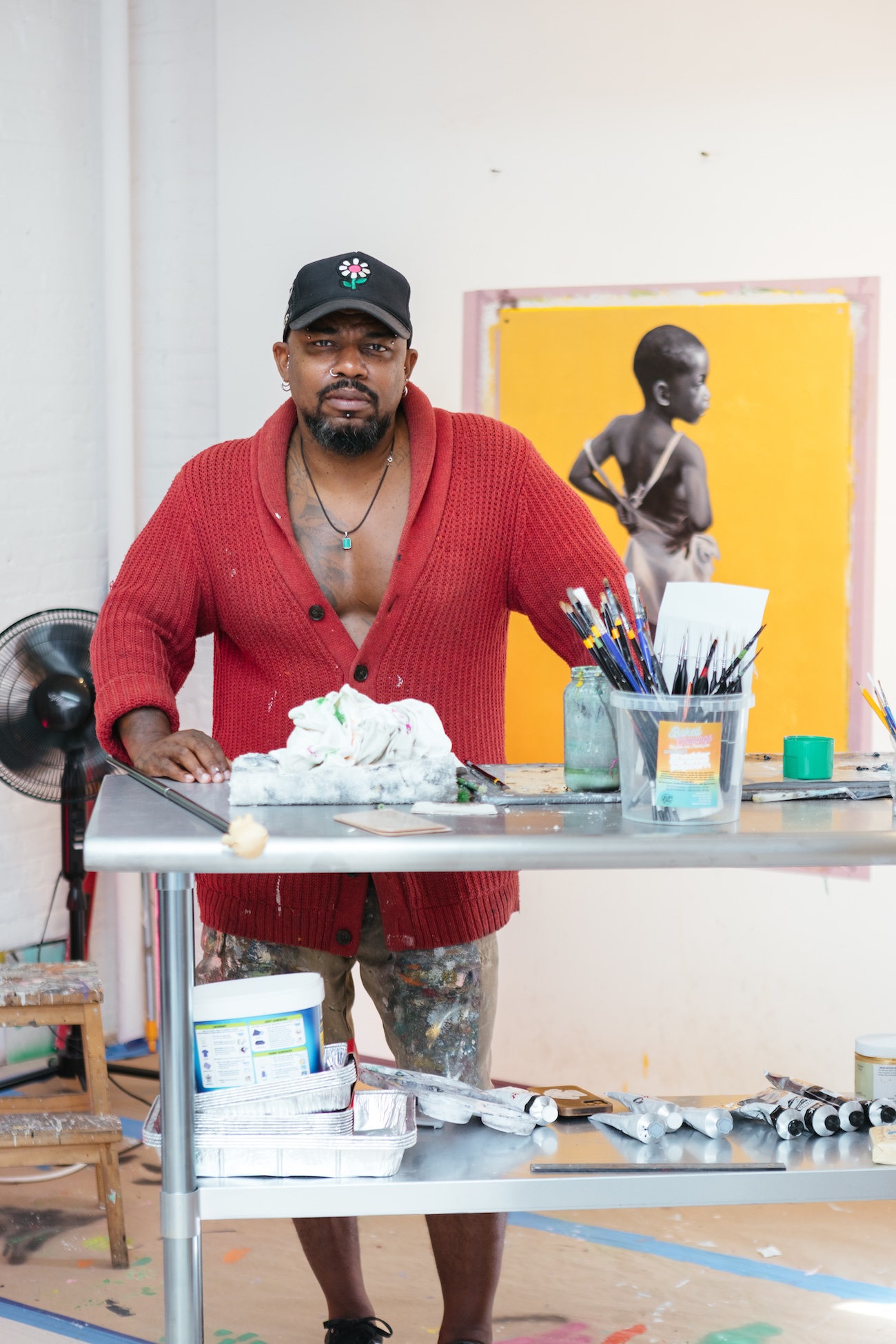
How did you begin creating art, and what led to the development of your personal style?
I was born in Haiti and raised in the United States, and my early life was shaped by movement, cultural duality, and the experience of navigating spaces where I was often unseen or misunderstood. As a child, art became a way for me to process the world before I even had the language to fully articulate what I was feeling.
Early in my career, abstraction gave me a language to explore emotion, movement, and psychological space without anchoring it to a specific body. That changed after the loss of a close personal friend. His passing profoundly impacted me, and abstraction no longer felt sufficient to carry the weight of what I needed to say. I turned to the figure as a way to honor him. Initially, it was an act of homage, but later, that shifted to ultimately expand into a broader meditation on Black life, presence, and humanity.
Over time, my style evolved toward restraint and clarity. I eliminated excess narrative and focused on the figure against solid fields of color, allowing posture, gesture, and stillness to carry meaning. That simplicity became essential. It creates space for emotional truth to surface.
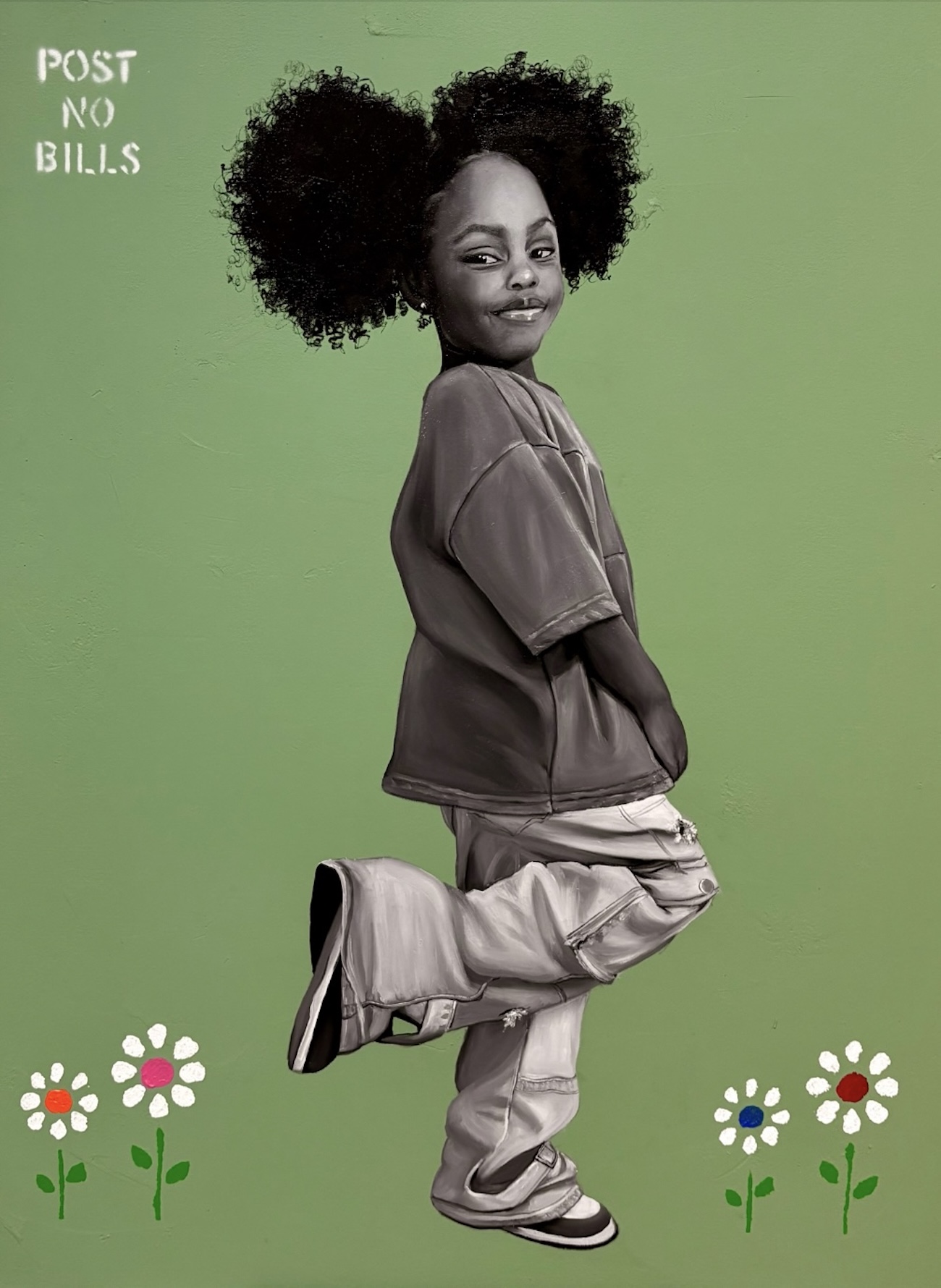
How would you describe your art to someone who has never seen it before?
My work is figurative. It can be considered realism, but it is not about realism for its own sake. I paint Black bodies, sometimes vulnerable and sometimes defiant, set against flat, uninterrupted fields of color. The figures are quiet, but they are not passive. There is a psychological tension in the stillness.
POST NO BILLS appears in the top left corner of every painting as a nod to New York City street culture and street art. It insists that the image not be covered or erased, that the Black body must be seen and remain visible, and it speaks directly to street-based visual language that has long shaped my practice.
I am interested in presence, what it means to be seen, to take up space, and to exist without performance. I aim for intimacy, asking the viewer to slow down and sit with the subject rather than consume the image quickly.
Give Us Our Flowers is a deeply introspective series. Can you share the inspiration and evolution of the collection? What themes can the audience look for within the works?
Give Us Our Flowers came from a place of exhaustion and honesty. It addresses the emotional toll of constantly pushing forward without acknowledgment. We’re celebrated only after struggle or loss. The title is a direct demand for recognition in the present, while we are here, living, feeling, and contributing.
The series evolved into a meditation on dignity, grief, self-worth, and rest, particularly as they relate to Black youth. Many of the figures are children or teenagers, positioned at moments where innocence, expectation, and resilience intersect. Themes of vulnerability, protection, identity formation, and emotional survival run throughout the work, alongside a tenderness toward both self and community that feels essential to the series.
Is there a piece from Give Us Our Flowers that best epitomizes the series? What is it, and why?
The piece that best epitomizes the series for me is the self-portrait. I believe every artist should create a self-portrait, because once you understand yourself, you begin to understand the why behind your entire body of work. That painting is a moment of complete honesty and serves as an anchor for the entire series.
While the series acts as a collective portrait rather than a hierarchy of individual works, the self-portrait grounds the larger narrative for me. It reflects the tension between strength and vulnerability that runs throughout the series and reinforces that this body of work is not observational, but lived.
You’ve spoken before about pouring your soul into your work. How do you balance creating something so personal with it ultimately being interpreted by others, and thus taking on alternative meanings?
Artists learn that once the work leaves the studio, it no longer belongs solely to us, and I’ve come to respect that. I put my truth into the painting, but I don’t try to control how it’s received. Everyone brings their own experiences, histories, and emotions into how they encounter the work, and the exchange becomes part of its life.
Is there a feeling or thought you hope they take away from your art?
What I hope people take away is a sense of recognition, whether they see themselves, someone they know, or an emotion they haven’t named yet. If the work creates a moment of joy or reflection, if it makes someone feel less alone, then it’s done what it needed to do.
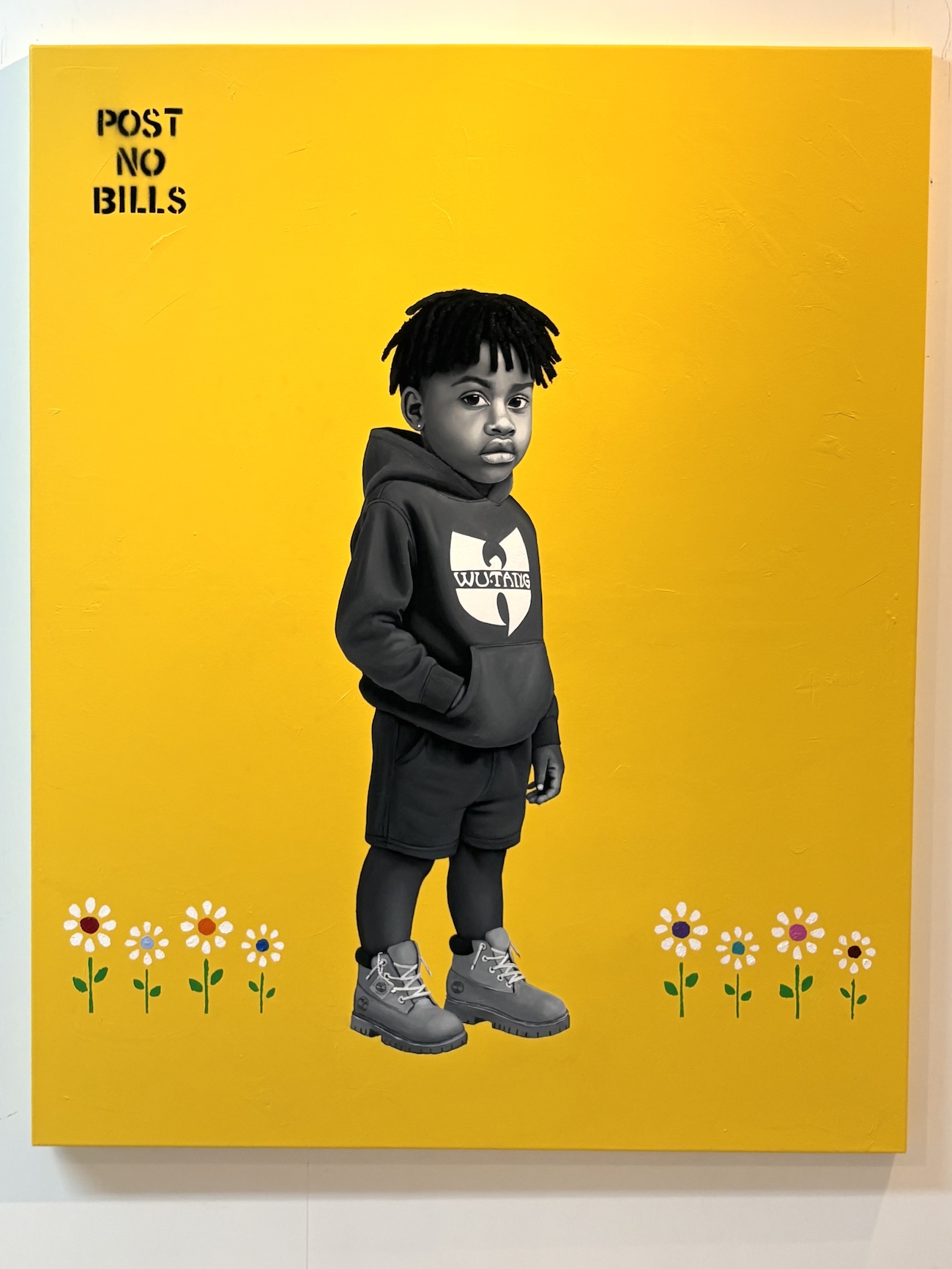
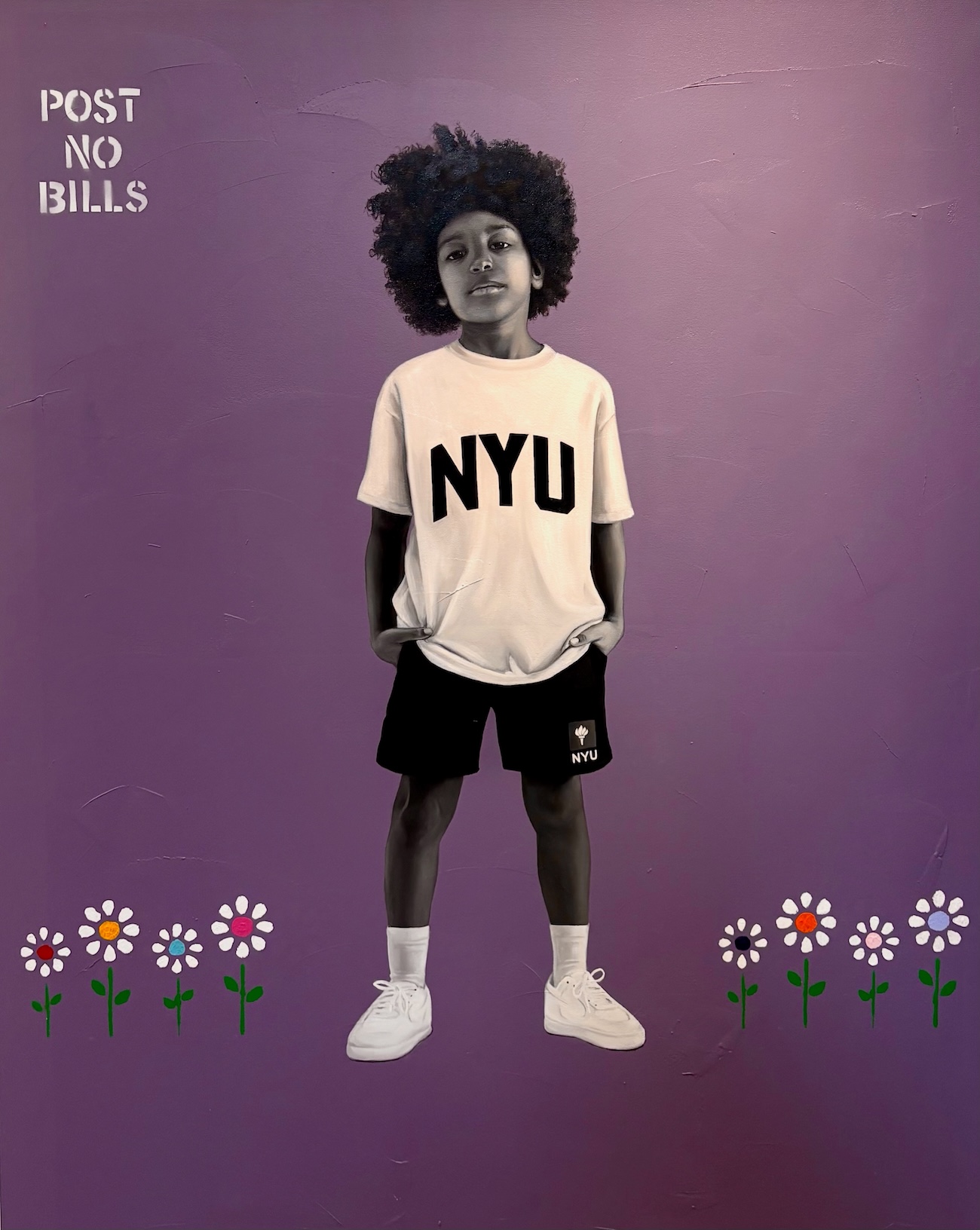
Your Higher Learning body of work extends from Give Us Our Flowers. Can you share about this chapter? What was the inspiration, and how do you see it relating to the larger narrative found in Give Us Flowers?
Higher Learning is a direct response to a political moment, particularly Donald Trump’s attacks on universities, immigrants, and the idea of education as a public good. At a time when institutions of learning and the people who rely on them were being openly undermined, I felt compelled to address what knowledge, access, and intellectual freedom mean, especially for Black and immigrant communities.
The series builds on the emotional layers of Give Us Our Flowers but shifts toward growth, awareness, and self-education. It focuses on what happens when you begin to question power, systems, and the narratives you have been taught to accept. The figure remains central, but there is a slight change in posture and energy. If Give Us Our Flowers is about being seen and honored, Higher Learning is about how we use that recognition to think critically, resist erasure, and claim space within institutions that have historically excluded us.
What are you working on next? Anything exciting you can share?
I’m continuing to expand the conversation started in these bodies of work, but I’m also allowing myself more experimentation, both formally and conceptually. I’m interested in pushing the figure into new emotional territory while considering what sculptural forms can add to the conversation. I’m also excited about opportunities to introduce the work to new audiences through exhibitions and projects that place it into dialogue with broader communities.
I’m excited about where the work is heading.