Mesopotamia has long been considered as the “cradle of civilization,” housing some of the world’s earliest complex societies, such as the Sumerians, Akkadians, Assyrians, Persians, and Babylonians. Though we’ve since developed a sophisticated understanding of these ancient civilizations, their food menus remain quite obscure, beyond “old world” staples like barley, wheat, sheep, goat, cow, and pig. A few years ago, however, an interdisciplinary team of researchers from Harvard and Yale managed to decode Cuneiform inscriptions from ancient Babylonia, revealing what are considered to be the oldest-known culinary recipes.
Dating back nearly 4,000 years, these recipes were inscribed on four tablets housed in the Yale Babylonian Collection at the university’s Peabody Museum. Three of the four tablets were produced no later than about 1730 BCE, whereas the fourth tablet belongs to the Neo-Babylonian period, over 1,000 years later.
“The tablets all list recipes that include instructions on how to prepare them,” the researchers write about the project in Lapham’s Quarterly. “One is a summary collection of 25 recipes of stews or broths with brief directions. The other two tablets contain fewer recipes, each described in much more detail.”
It is, of course, impossible to perfectly reproduce millennia-old recipes, particularly when the tablets on which they’re inscribed are partially damaged. Even so, the research team managed to compile an intriguing Babylonian menu, spanning different types of stews.
“Stews represent an early stage of a long tradition that is still dominant in Iraqi cuisine,” the team continues. “Today’s staple of the region is stew, aromatic and flavorful. These seem to be direct descendants of the Babylonian versions found on the culinary tablet with stew recipes.”
One stew, called pašrūtum or “unwinding,” is simple, encompassing cilantro, onion, leek, salt, and, before serving, some crushed-up sourdough. The result is “fairly bland,” but a “pleasant mild taste” of cilantro and onion still does surface. Puhādi, or “stew of lamb,” is similar in its simplicity and ingredients, but this time incorporates lamb and milk. The dish is especially delicious when served with the peppery garnish of crushed leek and garlic, according to the researchers.
Elamūtum, or “elamite broth,” is a more unusual offering when compared to modern Western cooking. In this recipe, milk is combined with sheep’s blood and dill, an ingredient not found in any other recipe encountered by the team.
“The mixture of sour milk and blood may sound odd,” the researchers say, “but the combination produces a rich soup with a slight tartness.”
The final recipe, Tuh’u, resembles a stew still made in Baghdad using white turnip instead of red beet. Here, leg-meat is used, alongside an assortment of herbs and beer, reproduced by students with barley and a days-long fermentation process.
“The Jews of Baghdad before their expulsion used red beet,” the team writes. “It is tempting to link the recipe to the continental European borscht with its close ties to the Ashkenazi community.”
Even with their intense historical and cultural value, the question remains: are these recipes actually good?
“Yes, they are, I would say—some of them,” Gojko Barjamovic, who put together the project’s research team, told NPR in an interview. “The food is not as foreign as you might imagine, and there are some basic elements that we share with this kind of cooking.”
To learn more about these recipes, read the team’s full article in Lapham’s Quarterly.
A few years ago, a team of researchers managed to decode nearly 4,000-year-old recipes from ancient Babylonian tablets housed in Yale’s Peabody Museum.
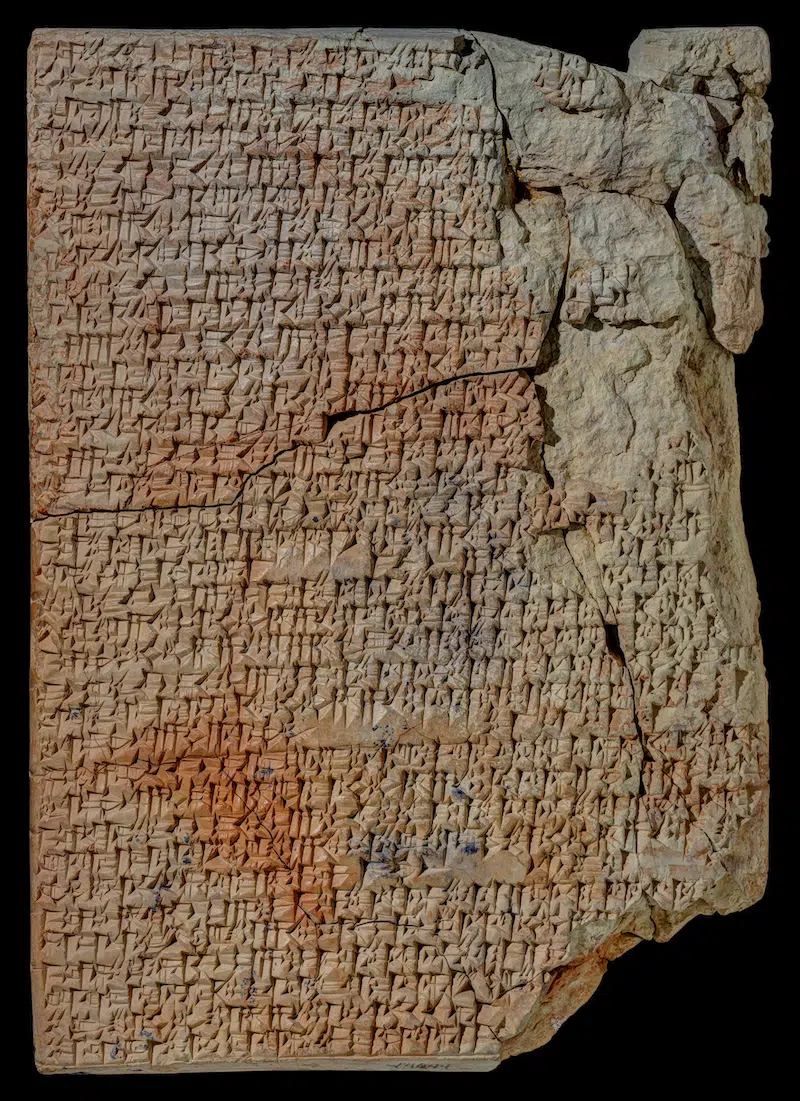
Cuneiform text containing culinary recipes from ancient Babylonia, part of the Yale Babylonian Collection. (Photo: Kwag1980 via Wikimedia Commons, CC 4.0)
The Babylonian recipes span a variety of stews, featuring ingredients like lamb, onion, cilantro, and even blood.
Sources: The Ancient Mesopotamian Tablet as Cookbook; Eat Like the Ancient Babylonians: Researchers Cook Up Nearly 4,000-Year-Old Recipes
Related Articles:
Explore the Oldest Existing World Map, Carved in Clay 2,600 Years Ago
Listen to the World’s Oldest Sheet Music, a Mesopotamian Hymn Over 3,000 Years Old
Researchers Discover the Earliest Recorded Kiss Was 4,500 Years Ago