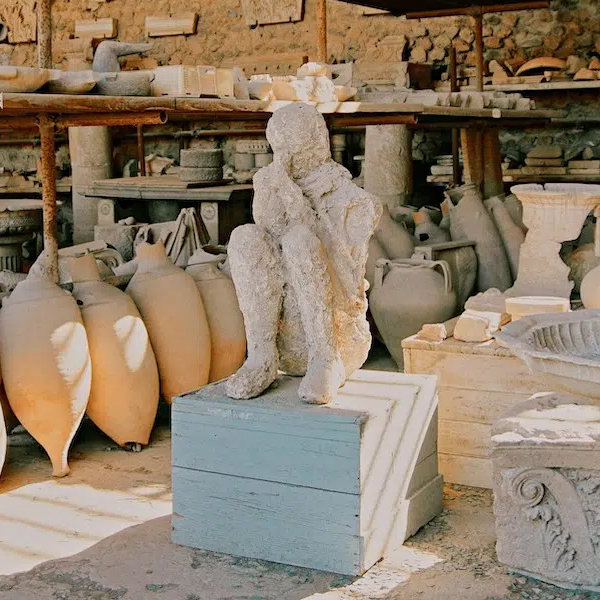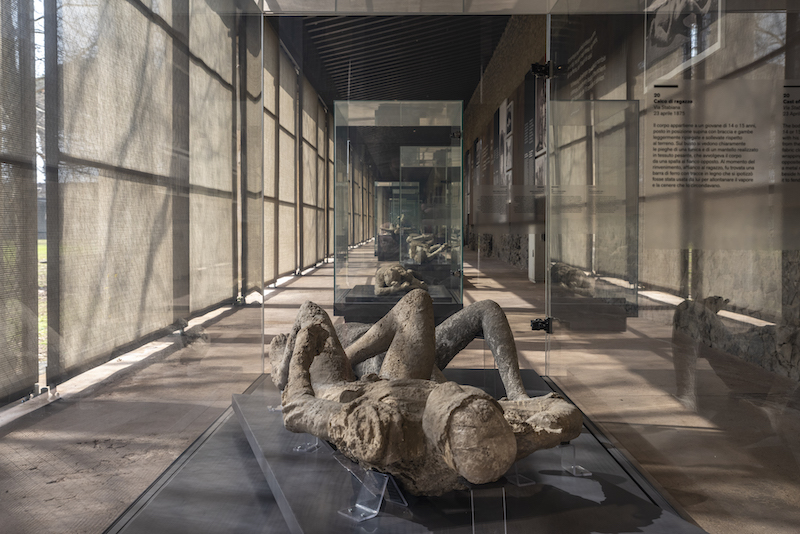
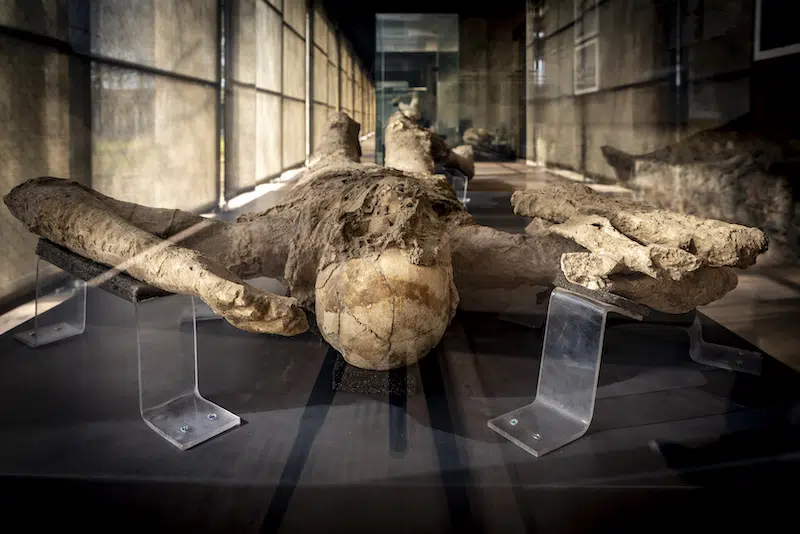
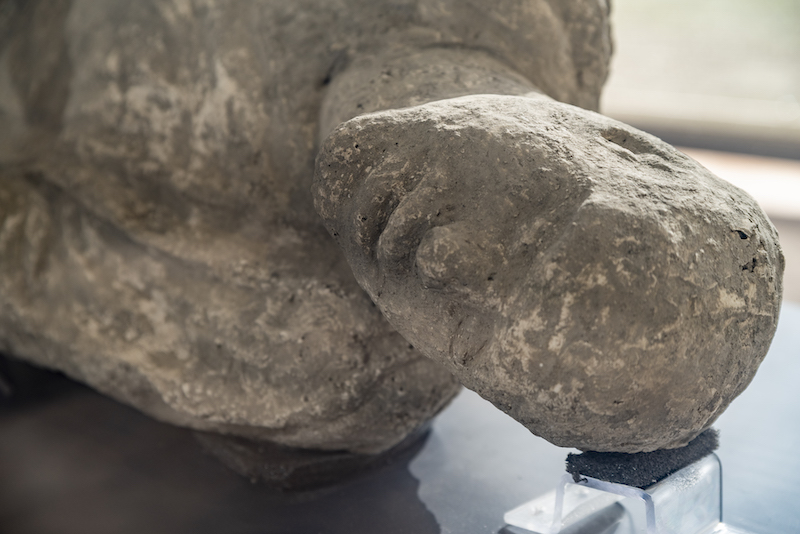
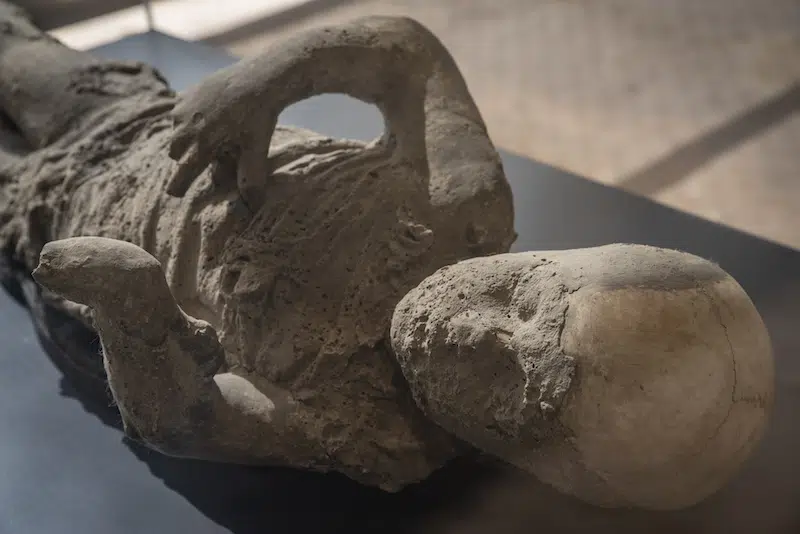
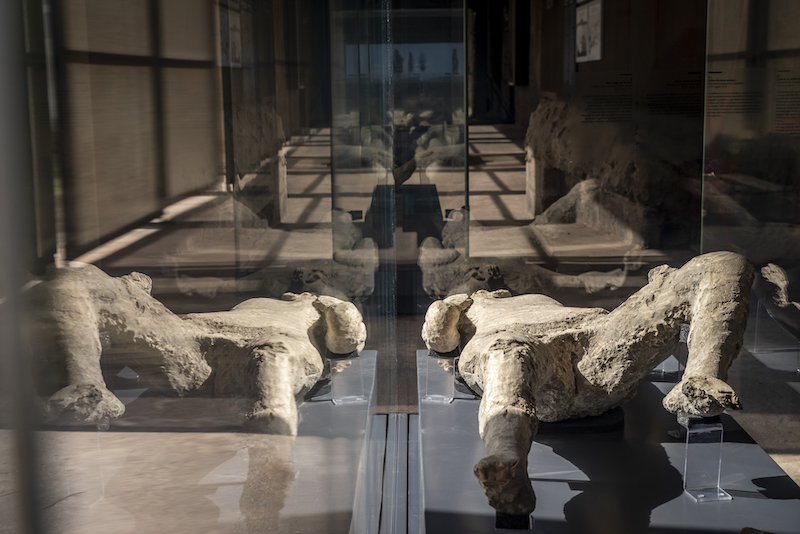
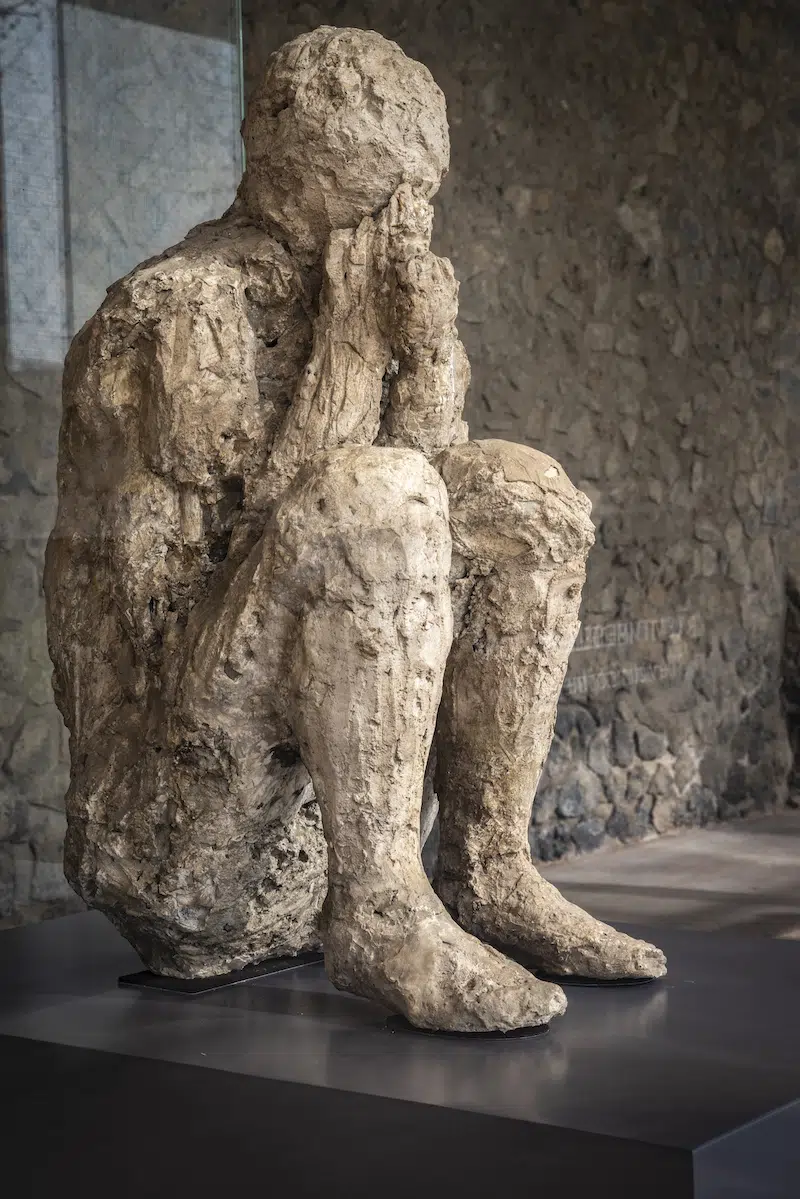
In Pompeii, the past does not feel distant. It lingers on the streets, in the walls, and now, more viscerally than ever, in the bodies of those who never escaped. A newly unveiled permanent exhibition at Pompeii Archaeological Park brings together more than 20 plaster casts of victims from the eruption of Mount Vesuvius in 79 CE. Displayed in the Palestra Grande, these figures capture the exact final moments of Pompeii’s residents—bodies curled, hands raised, faces obscured, each one fixed at the instant life was interrupted.
The figures on display are not sculptures in the traditional sense. They are impressions formed through a process first developed in 1863 by archaeologist Giuseppe Fiorelli. When Pompeii was buried under volcanic ash, the bodies of its victims eventually decomposed, leaving hollow cavities in the hardened material. By filling those voids with plaster, archaeologists were able to recover the exact forms of the individuals who died there, preserving everything from posture to facial expression and even folds of clothing.
What results is something uniquely powerful. It is not a recreation, but a direct record. Every cast is a physical imprint of a final moment, shaped by heat, panic, and instinct. Each body carries fragments of a story that was abruptly cut short. Some figures crouch low to the ground, as if shielding themselves from the oncoming surge. Others appear frozen mid-motion, their bodies tense with the effort to breathe or escape. In one especially striking example, a man lies back with clenched fists while a small child rests against him, their forms locked together in a moment that suggests both protection and desperation.
Walking through the exhibition, visitors encounter scenes that feel almost impossibly immediate. The eruption itself unfolded in stages. First came a prolonged fall of pumice and debris, collapsing roofs and trapping residents inside homes and buildings. Then, fast-moving pyroclastic flows, intense waves of heat, ash, and gas, swept through the city, killing those who remained almost instantly.
The exhibition is designed not just to inform, but to honor. Each cast is accompanied by contextual details, such as where it was found, what objects were nearby, and what researchers have learned through modern analysis. Advances in science now allow archaeologists to study the casts in new ways, uncovering information about age, health, and even diet. These insights help reconstruct not just how people died, but how they lived.
At its core, the show shifts the focus of Pompeii away from spectacle and toward empathy. The figures are no longer anonymous remnants of a disaster, but individuals whose final moments still resonate across time.
A new permanent exhibition in Pompeii brings together plaster casts of victims from the 79 CE eruption of Mount Vesuvius.
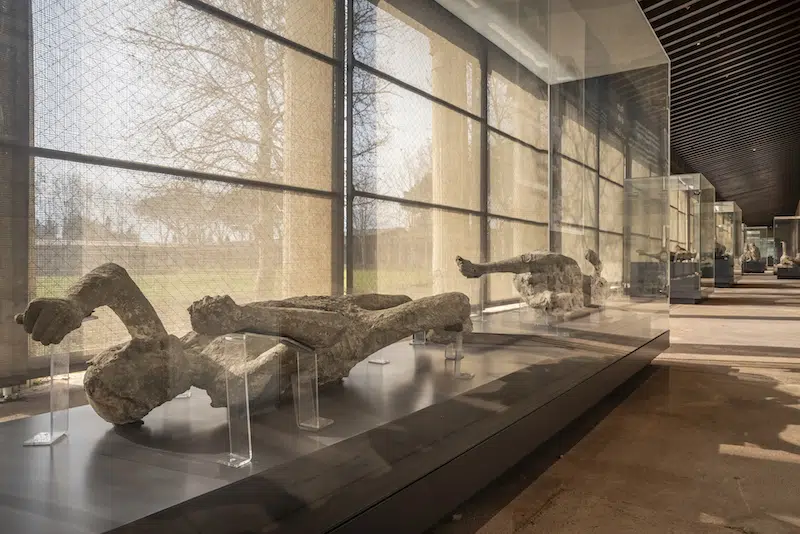
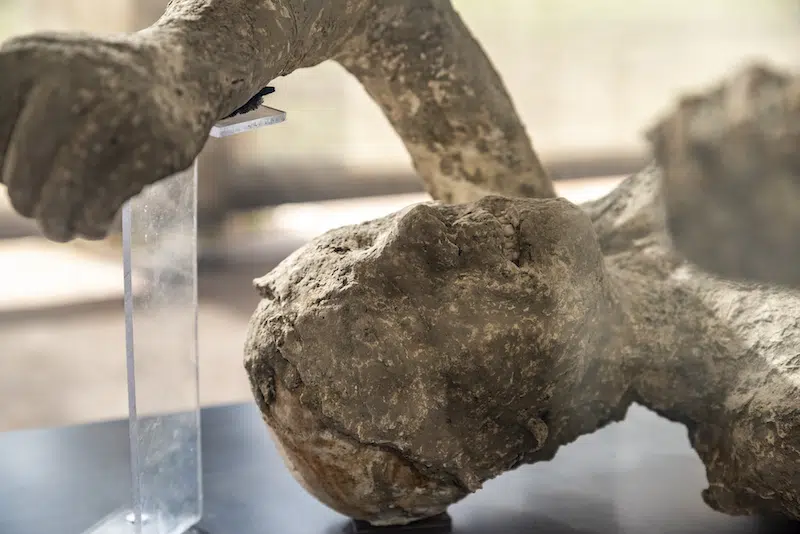
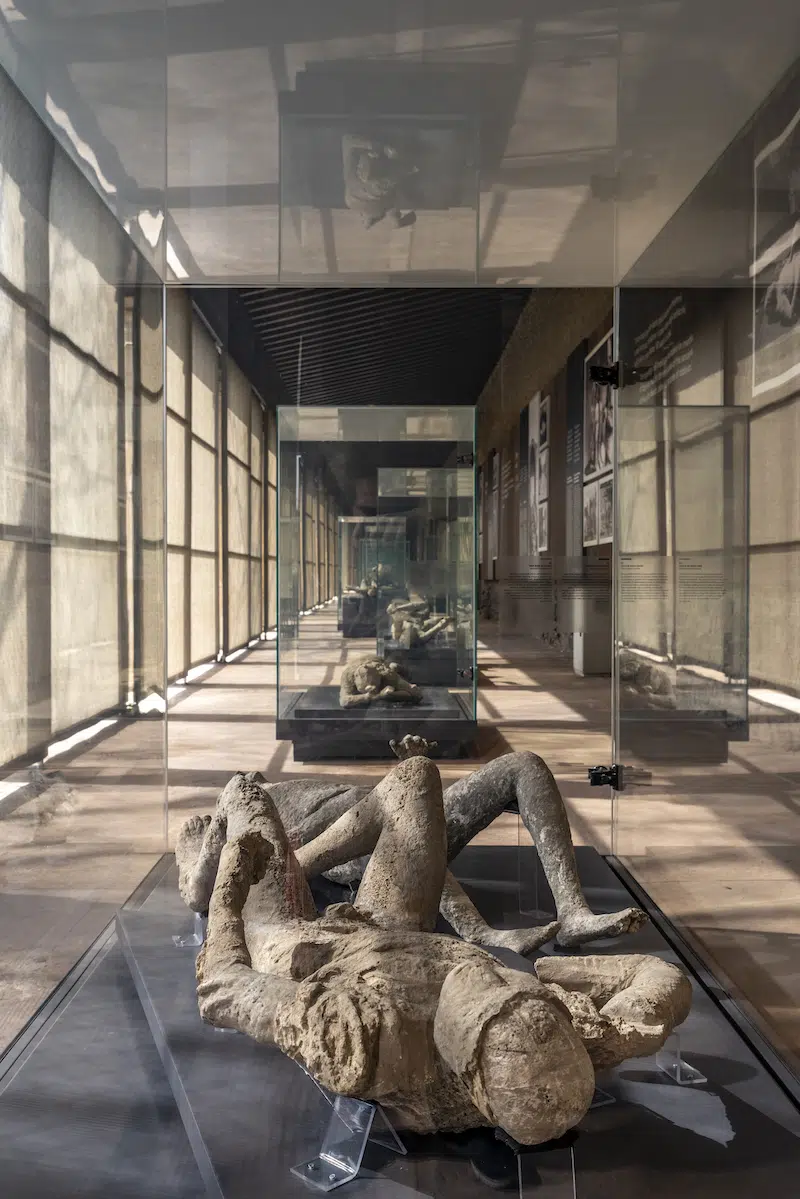
Using a 19th-century casting technique, archaeologists preserve the victims’ final moments, revealing how they reacted as the disaster unfolded.
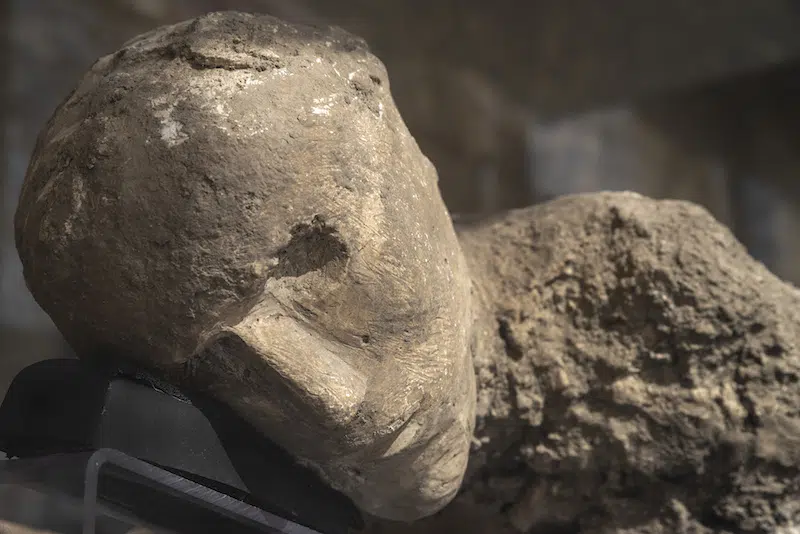
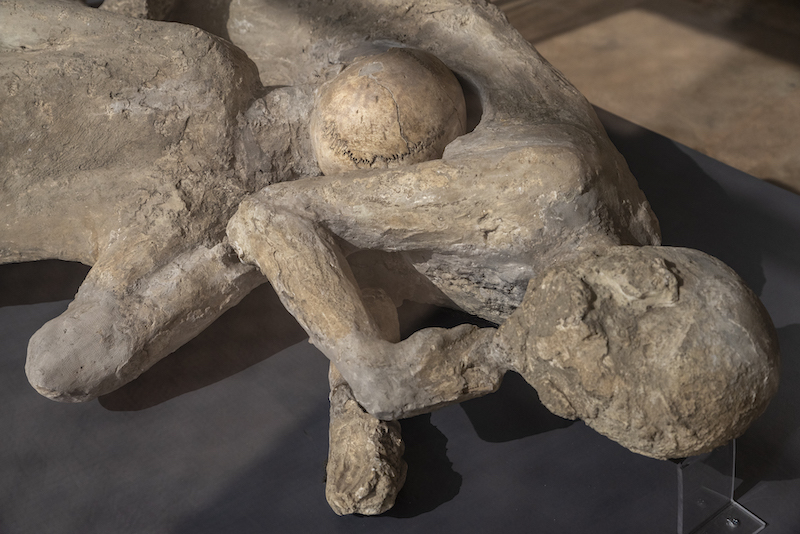
Today, these haunting forms offer insight into both the lives and deaths of Pompeii’s residents, transforming tragedy into a lasting historical record.
Pompeii Archaeological Park: Website | Instagram
My Modern Met granted permission to feature photos by Pompeii Archaeological Park.
Sources: Pompeii shows victims in their final moments in haunting new permanent display—capturing their horror and pain in plaster casts; Tragic Pompeii victims seen embracing in final moments before volcanic eruption in heartbreaking new exhibit; A new exhibit shows plaster casts of Pompeii victims frozen at the time of death.
Related Articles:
New Well-Preserved Paintings Discovered at Pompeii Amid Ongoing Excavations
Nearly Life-Sized Relief Sculptures in Exceptional Condition Discovered in Pompeii
Archeologists Discover “Tiny Home” in Pompeii Filled With Well-Preserved Frescoes
Long-Lost Renaissance Masterpiece by Famous Artist Andrea Mantegna Has Resurfaced in Pompeii