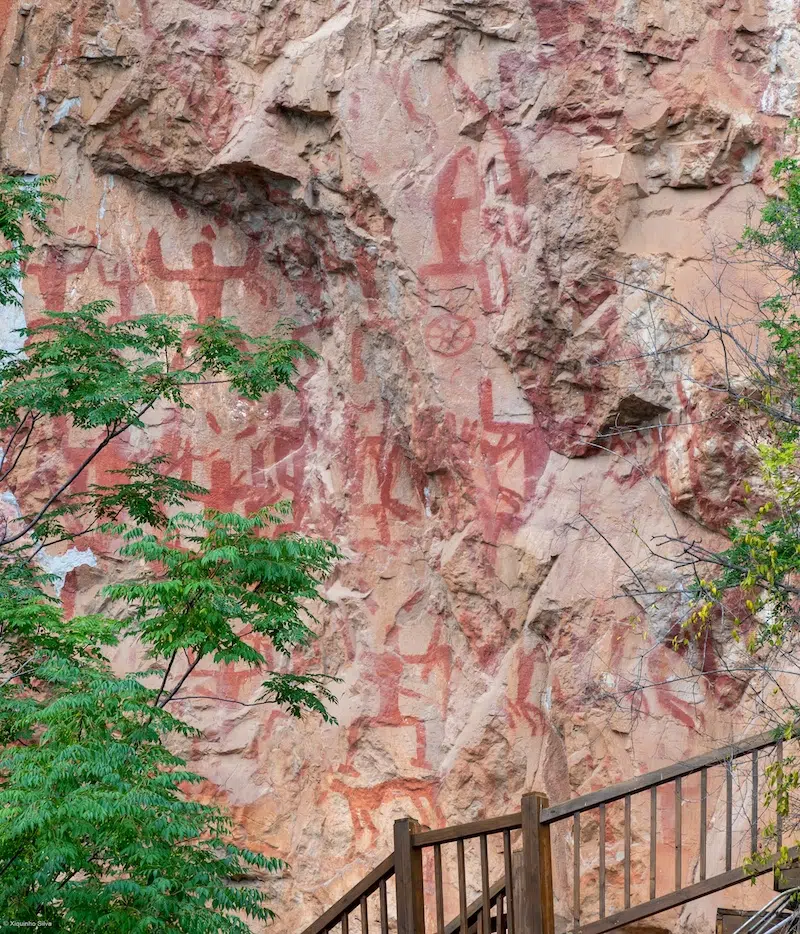
Few things survive the test of time, especially for nearly 2,000 years. But despite enduring rain, heat, wind, and humidity, this vibrant red rock art painted across the limestone cliffs of southern China has remained remarkably intact.
Created sometime between the 5th century BCE and the 2nd century CE, the paintings are collectively known as the Zuojiang Huashan Rock Art Cultural Landscape, named for their location in China’s Zuojiang River Valley. For years, researchers have wondered how the ancient paintings have retained their striking red color despite being exposed to the elements for centuries. Now, a new study suggests an unexpected ingredient may have helped preserve them: blood.
Published in the September 2026 issue of the Journal of Archaeological Science, the study analyzed five fallen fragments of rock art collected from three sites. Researchers examined the samples using several techniques, including high-powered microscopy, infrared spectroscopy, and protein composition analysis.
The paintings span more than 80 sites across roughly 160 miles and are believed to have been created by the Luoyue people, an ancient society that lived in what is now southern China. The Luoyue were a fisher-hunter-gatherer society that practiced matrilineality, meaning descent and property were traced through the mother’s side of the family.
The source of the blood adds another fascinating layer to the discovery. At one site, around 97% of the detected blood proteins were human, with the remainder coming from herbivorous animals including cows, sheep, goats, and antelopes. Another sample contained a more even mixture of human and animal blood. Researchers also detected prolactin-inducible protein and lactotransferrin in the human blood. Both can occur in higher concentrations in pregnant and lactating women, leading the team to suggest that some of the blood may have been collected during or following childbirth. If so, its inclusion may have carried meaning beyond its practical ability to preserve the paintings, given the Luoyue’s matrilineal society and beliefs about women and fertility.
The sprawling collection of rock art depicts human figures alongside animals, weapons, drums, bells, and other objects. Some of the imagery may also have had ritual significance, including depictions of pregnant women and sexual intercourse.
Blood itself, however, isn't solely responsible for the paintings’ distinctive red hue. The Luoyue artists appear to have used a two-step process to create their remarkably resilient artwork. First, they made a mortar from materials including slaked lime, calcium phosphate, and blood. They applied this mixture directly to the limestone cliffs as a base layer. While it was still partially wet, the artists painted over it using a mixture of water and locally sourced red clay rich in hematite, an iron oxide responsible for the pigment’s vivid color.
What may appear at first glance to be simple red figures painted onto stone was instead the product of a surprisingly sophisticated process. By combining locally available materials with an unusual organic binder, the Luoyue created images that endured long after the society that made them disappeared.
Researchers studying nearly 2,000-year-old rock art in southern China discovered that blood may have helped the vibrant paintings survive for centuries.
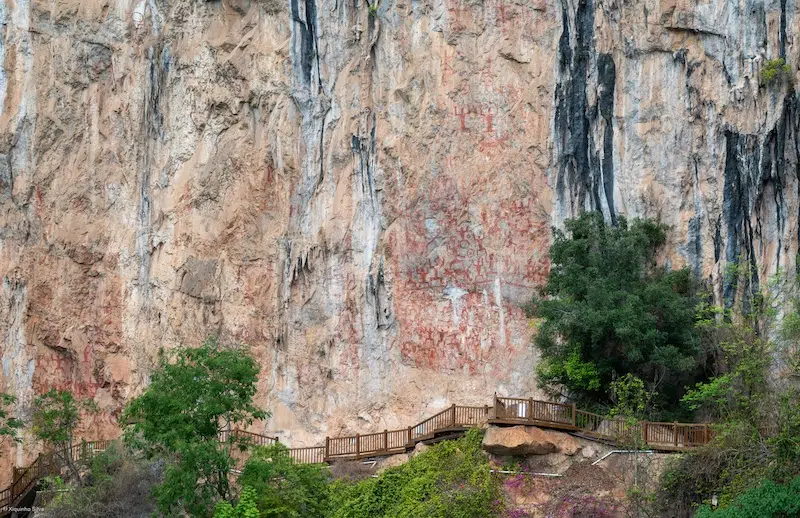
Source: Blood-induced biomineralized calcium carbonate used for binding in the Huashan rock art of Guangxi, Southern China
Related Articles:
3,200-Year-Old Ceramics Reveal What May Have Been the Ancient World’s First Desirable “Brand”
8,000-Year-Old Patagonia Cave Art Illuminates Ancient Climate Change
51,000-Year-Old Cave Art in Indonesia Is the World’s Oldest Figurative Art