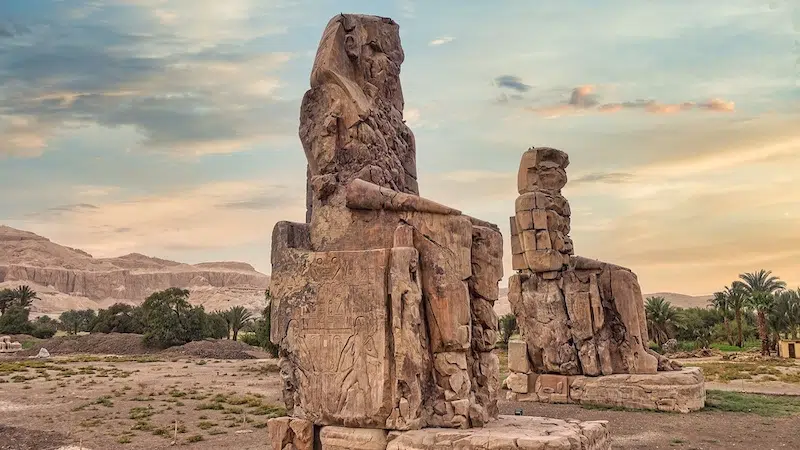
More than 1,200 years after they were damaged by an earthquake, the two alabaster statues of Egyptian pharaoh Amenhotep III—known as the Colossi of Memnon—have been partially restored. Egypt’s Ministry of Tourism and Antiquities recently unveiled the newly conserved, 30-feet-tall monuments at the entrance to the ancient king’s 86-acre burial site near Luxor.
King Amenhotep III ruled Egypt from around 1388 to 1349 BCE, during one of the civilization’s most prosperous and influential periods. The ninth pharaoh of the 18th Dynasty, he was so powerful that he was even worshipped as a deity during his lifetime.
The Colossi of Memnon were first built around 1350 BCE, more than 3,000 years ago, and watched over the king’s vast mortuary temple on the west bank of the Nile. They were both carved from Egyptian alabaster quarried at Hatnub in Middle Egypt, and depict Amenhotep III facing east, wearing the striped nemes headdress associated with both royalty and the gods.
Around 150 years after Amenhotep III died, an earthquake caused his tomb complex to collapse. Then another quake, in 27 BCE, struck the Colossi of Memnon, leaving the northern statue cracked in such a way that it began emitting “singing” sounds at dawn, drawing curious travelers to the site.
Major restoration efforts began in 1989 with a project led by Tokyo’s Waseda University, and later expanded through a partnership between Egyptian authorities, the German Archaeological Institute in Cairo, Johannes Gutenberg University Mainz, and the World Monuments Fund. According to German Egyptologist Hourig Sourouzian, the team has uncovered countless fragments of the Colossi scattered across the site. Since 2006, they’ve been carefully cleaning, restoring, and 3D-scanning the statues, piecing them back together using original fragments alongside modern supports designed to ensure long-term stability while staying true to the statue’s original form.
Today, the Colossi of Memnon still stand about 45 feet tall in their original locations. The statue on the right has an almost intact face, complete with a headdress and cobra symbol. The statue on the left has had its legs partly restored, along with smaller figures at its feet showing Amenhotep III’s wives, including Tiye, and his daughter Isis, who he also married. Carvings along the thrones depict the unification of Upper and Lower Egypt.
While working at the site, the experts also uncovered nearly 300 additional sculptures and fragments, including two standing royal statues carved from quartzite and around 280 pieces belonging to a lion-headed deity. The ancient Egyptians created art on an astonishing scale, which makes it especially exciting to see these long-damaged works brought back to life.
More than 2,000 years after they were damaged by an earthquake, the two alabaster statues of Egyptian pharaoh Amenhotep III—known as the Colossi of Memnon—have been partially restored.
The ninth pharaoh of the 18th Dynasty, Amenhotep III was so powerful that he was even worshipped as a deity during his lifetime.
Egypt’s Ministry of Tourism and Antiquities: Website | Facebook | Instagram | YouTube
Source: Ministry of Tourism and Antiquities
This article has been edited and updated. An earlier version miscalculated the time of the last big earthquake.
Related Articles:
After Two Decades, the Grand Egyptian Museum Has Finally Opened in Giza
The Netherlands Will Return Stolen 3,500-Year-Old Sculpture to Egypt
Ancient Relics Recovered From a Long-Gone Sunken City off the Egyptian Coast
4,000-Year-Old Handprint Discovered on Ancient Egyptian Clay Artifact