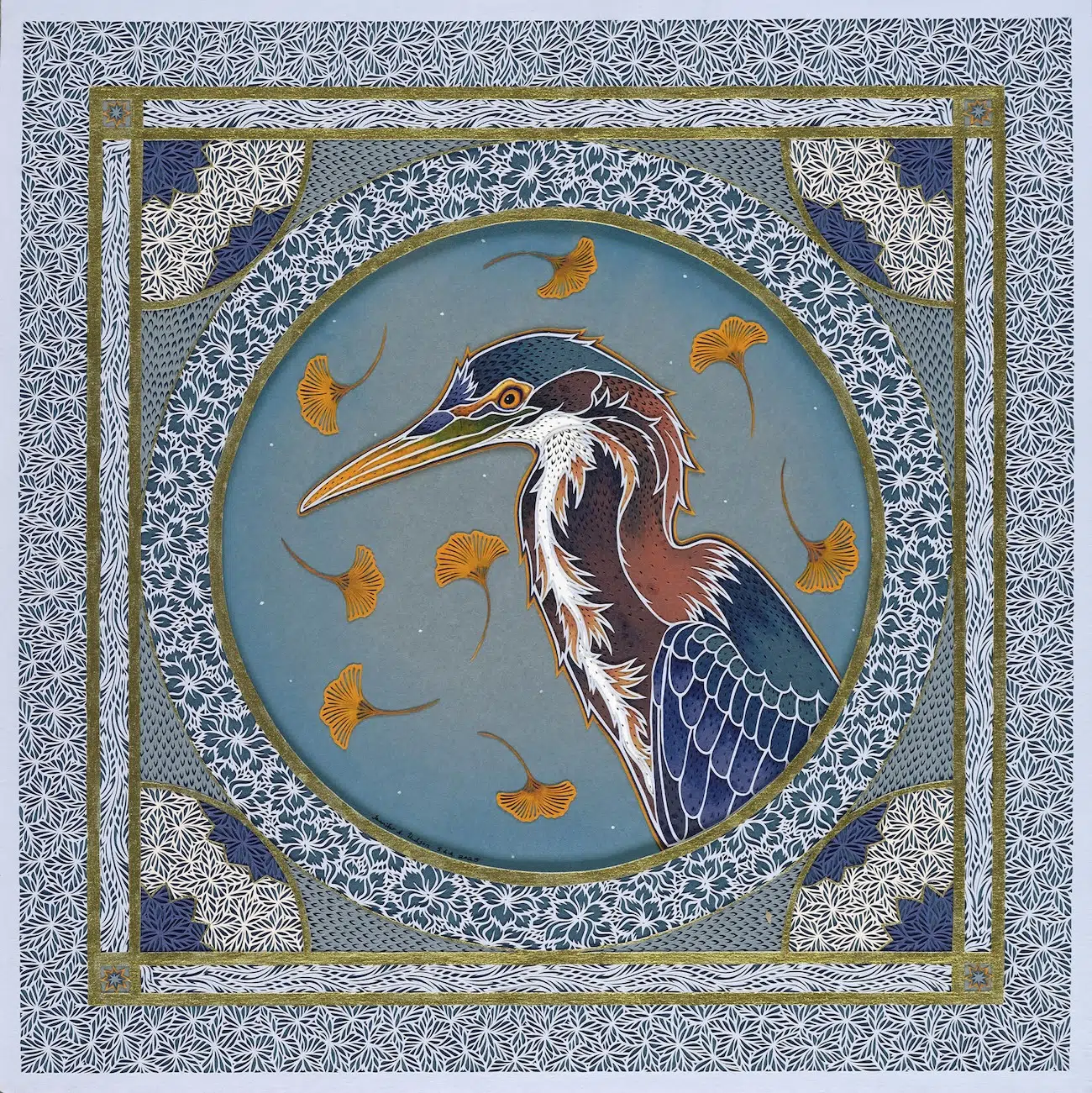
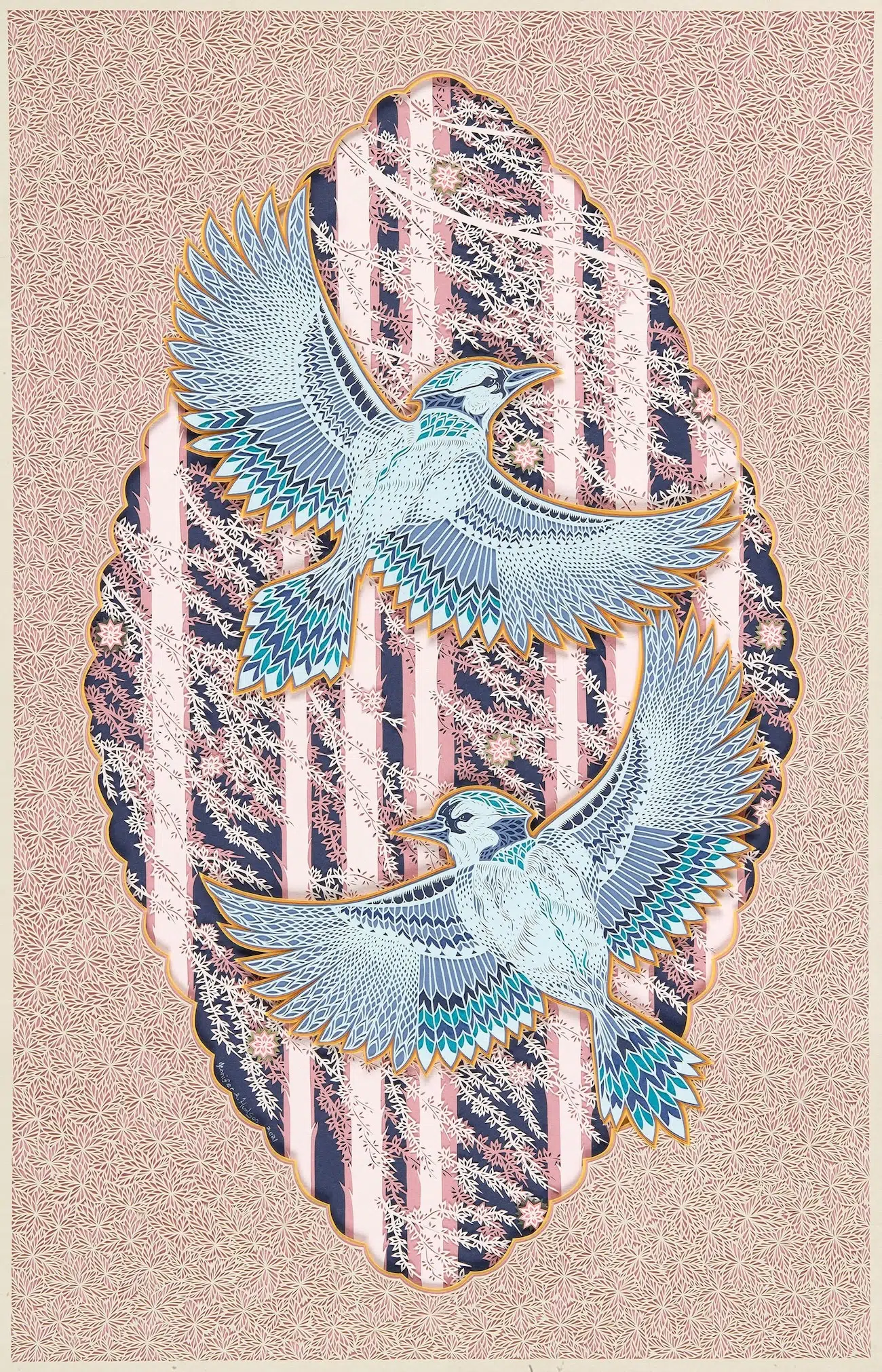
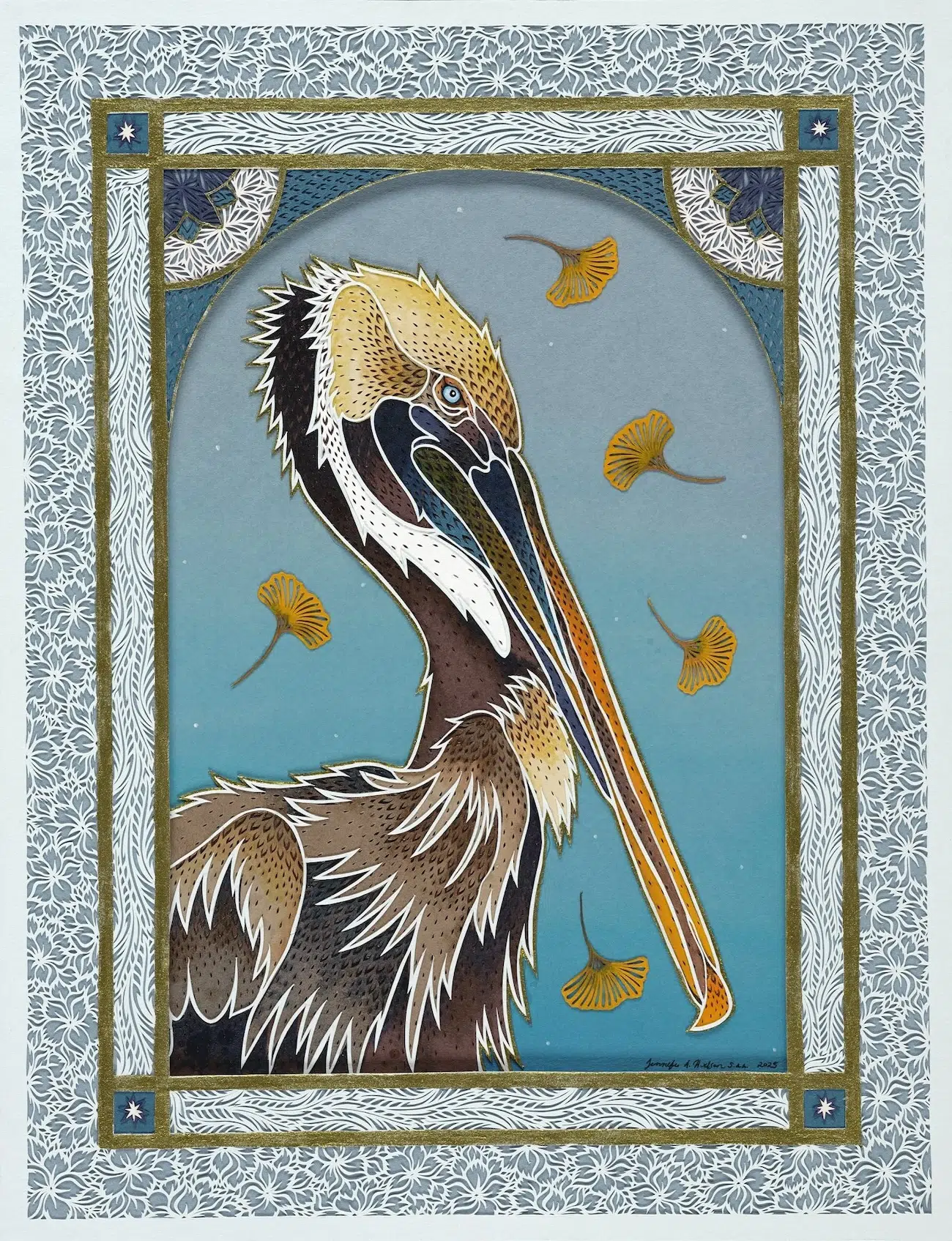
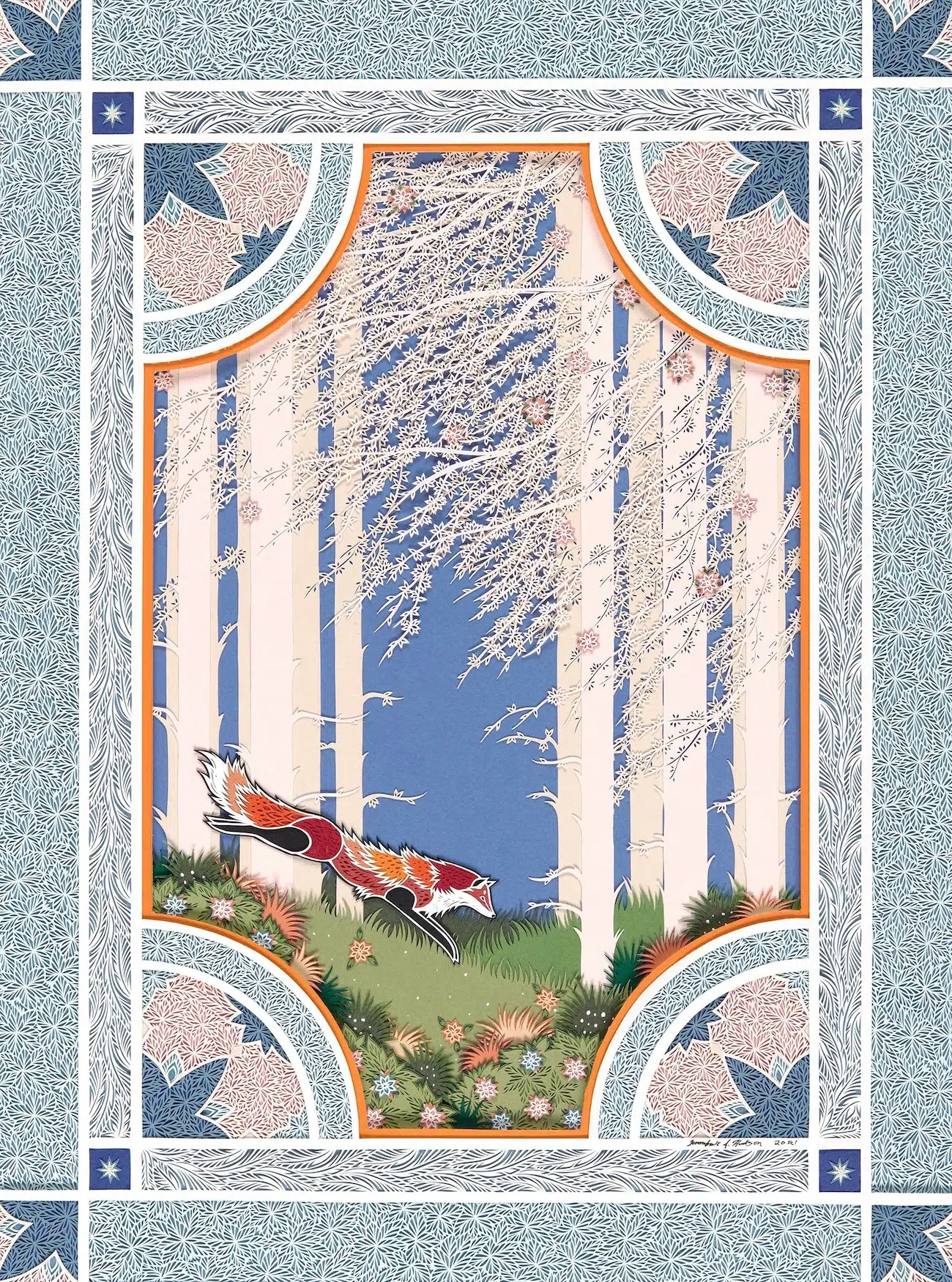
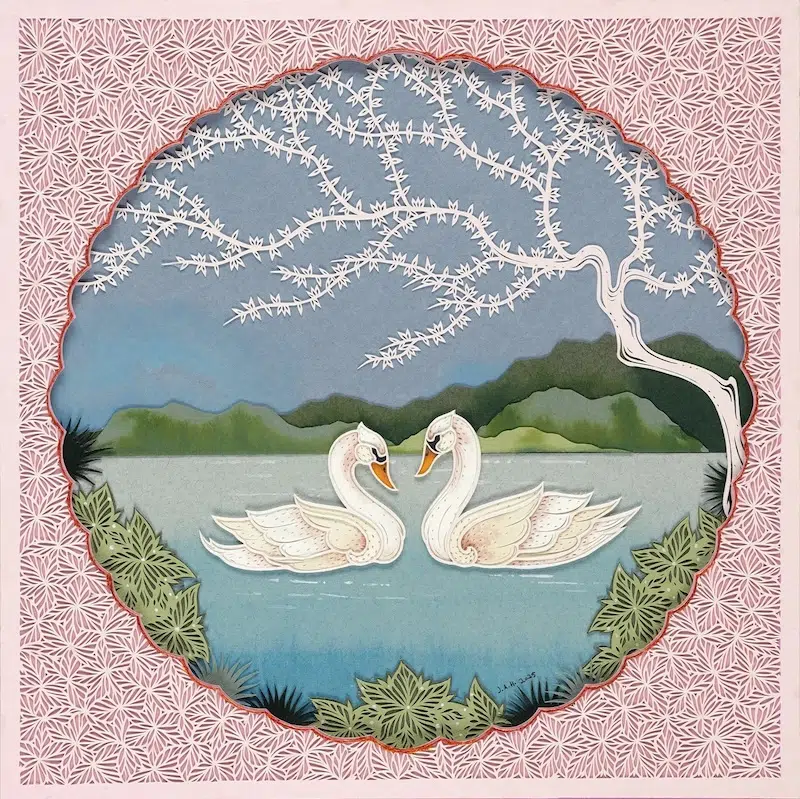
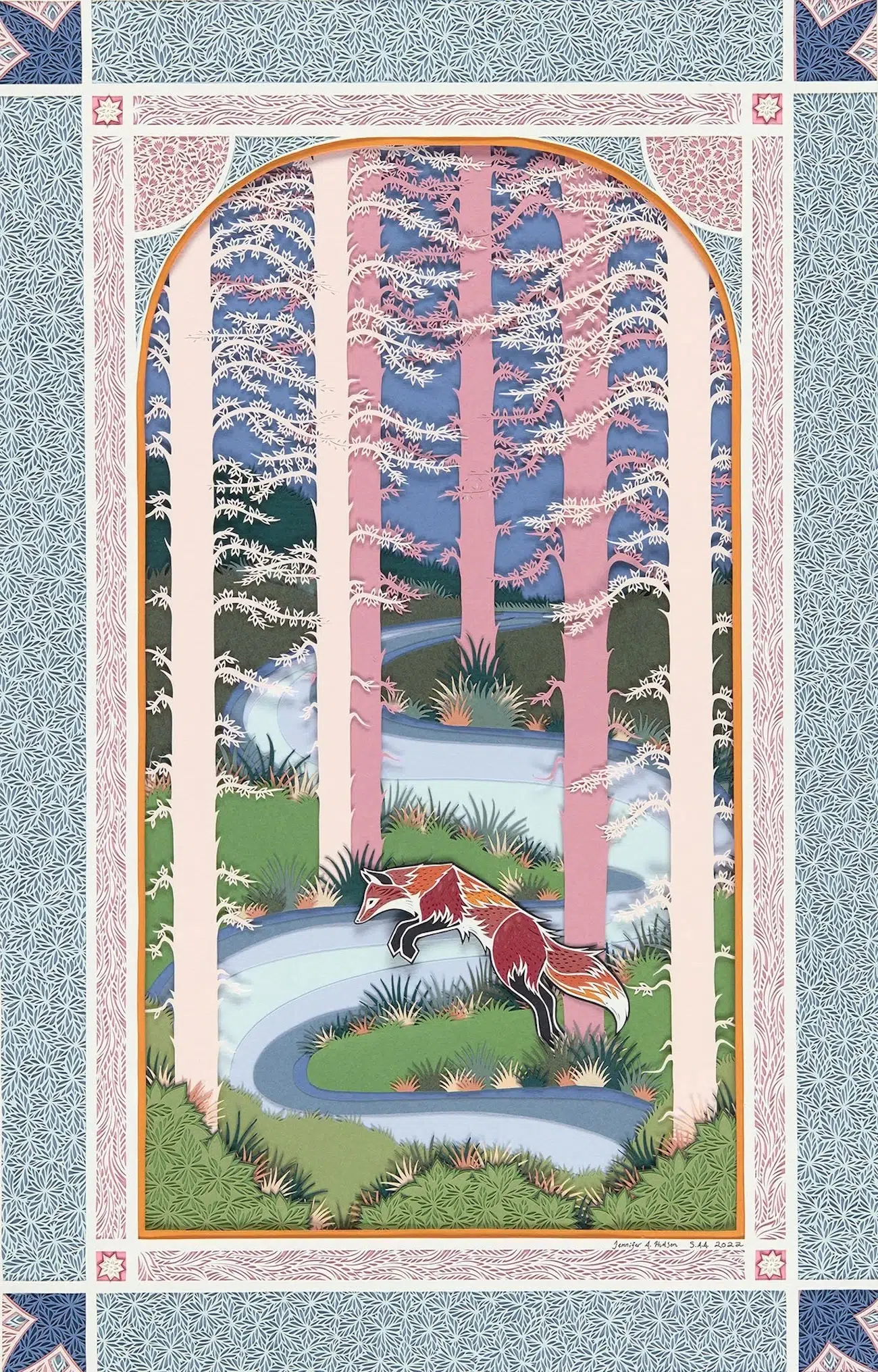
Drawing and painting are often thought of as lyrical forms of fine art, but so is cut paper. Henri Matisse famously referred to creating his late-in-life cut paper pieces as “drawing with scissors,” and the way an artist must move their hand to conjure and extract intricate shapes with care is nothing short of soulful. Artist Jen Hudson’s cut-paper creations highlight this beautiful art form. In pieces as detailed as they are whimsical, she produces multi-layered portraits of animals in outdoor environments surrounded by ornate frames.
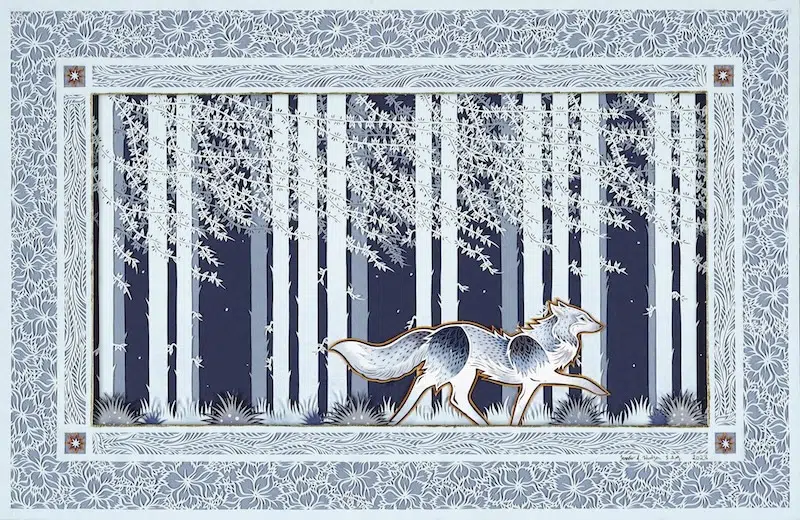
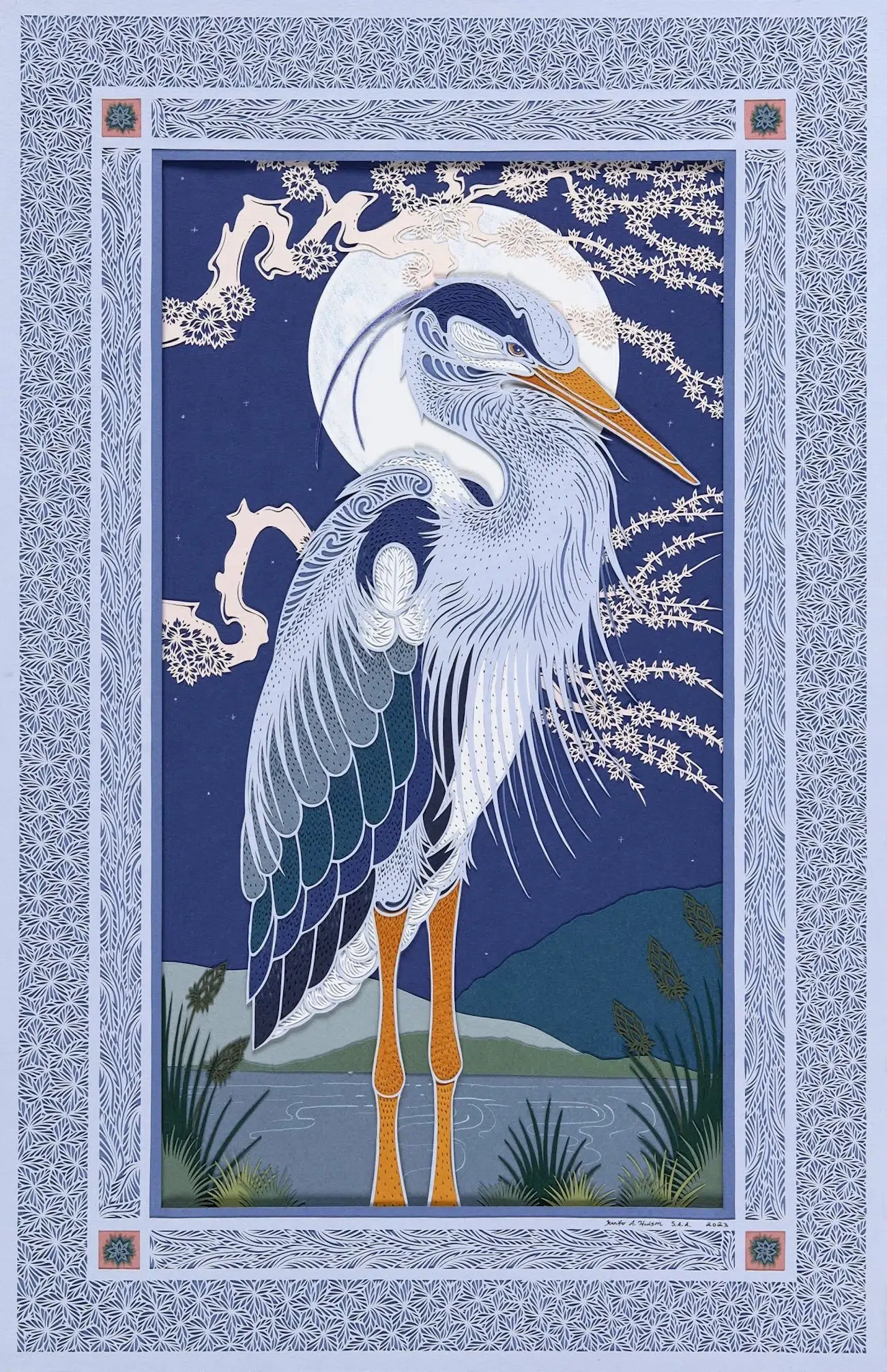
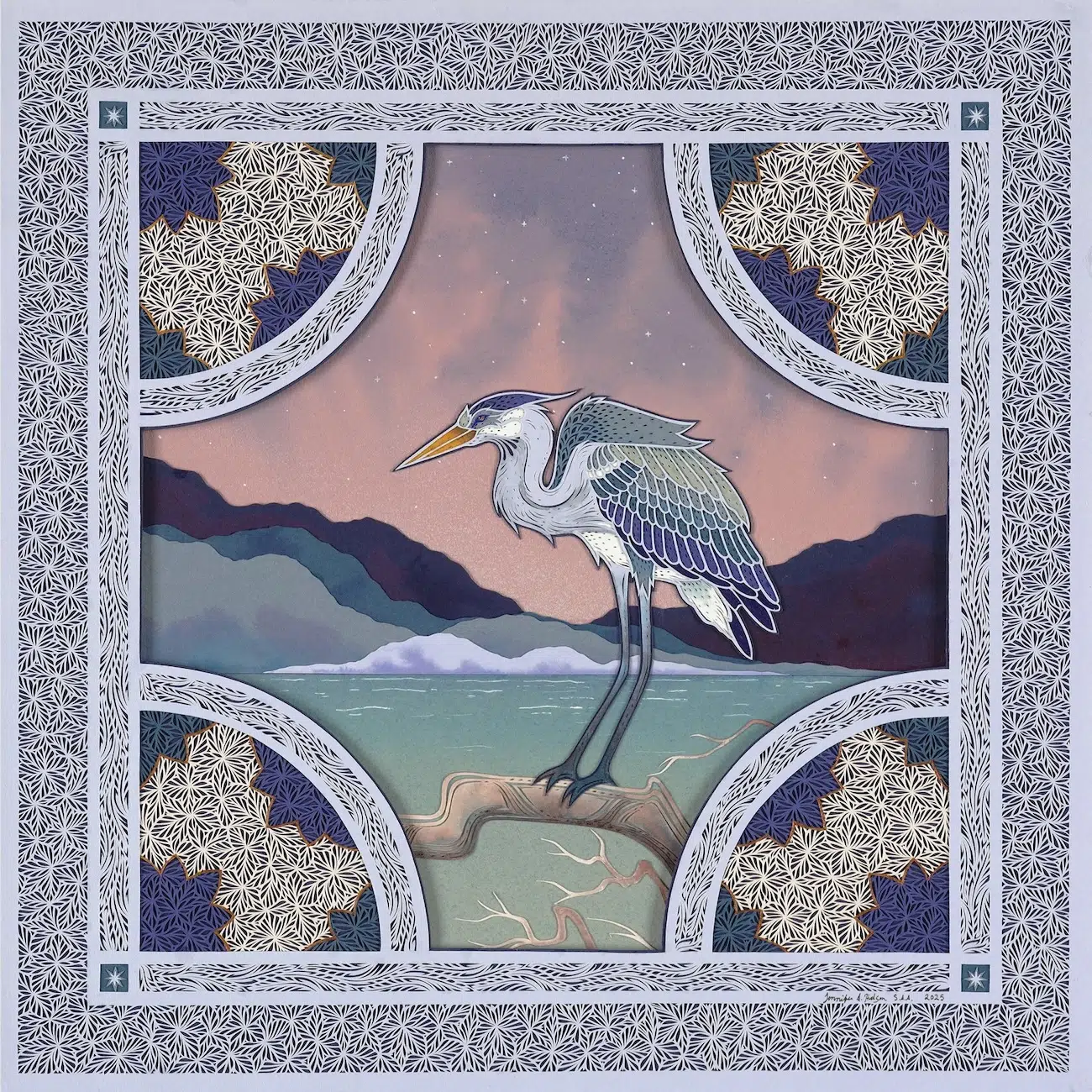
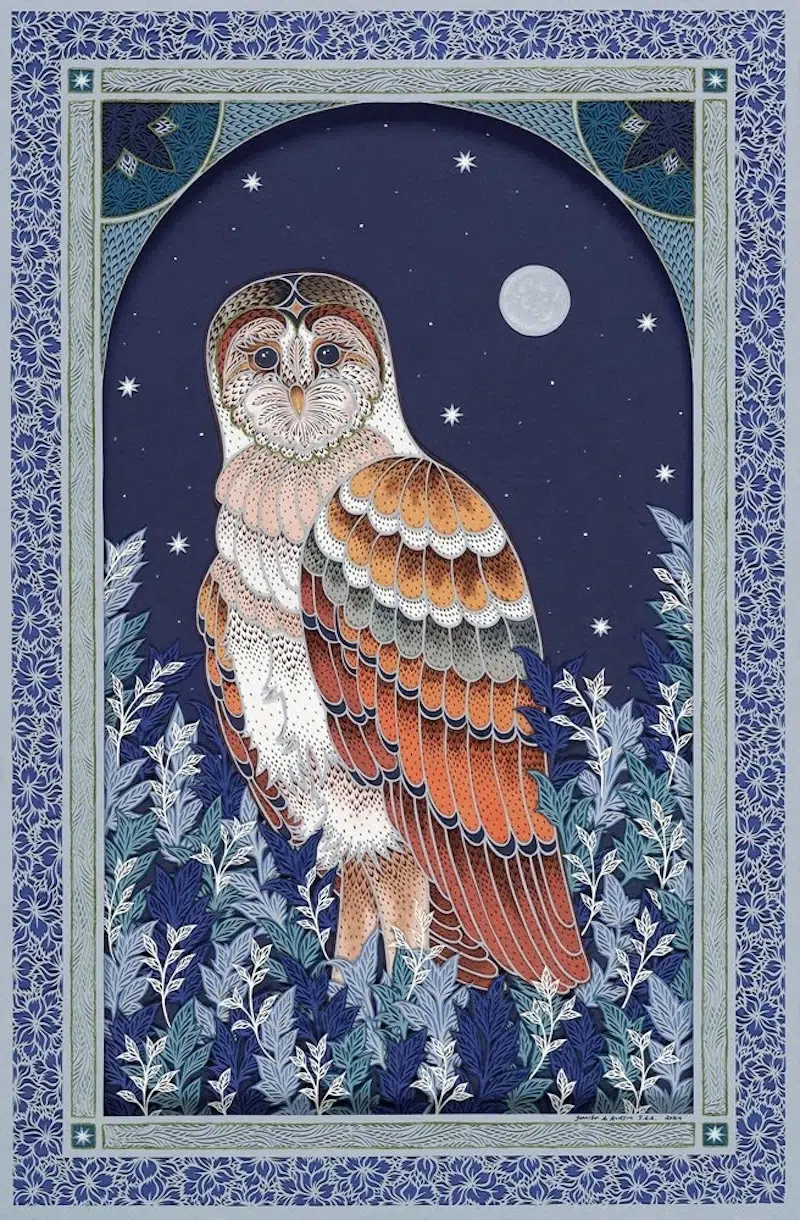
Working with sometimes as many as 20 layers of paper, Hudson cuts tiny shapes from her chosen material. In doing so, she creates texture; the pattern in a bird’s feathers or the flowing fur of a fox as it bounds across the forest floor. Her style of paper cutting uses the material to create outlines, giving the composition an illustrative quality that tells a moment in a story. Bright and idyllic, the scenes invite us into their world—one that is tranquil and wondrous, where things are always in bloom.
Each piece features a decorative border around the composition, like putting the most elaborate flourish to mark the end of a sentence. The frames are all created freehand without prior planning. It’s impressive, but for Hudson, the tiny repetitions are now part of how she moves. “I have developed a few different patterns that I really love making,” she tells My Modern Met, “and that I can make from muscle memory.”
My Modern Met spoke with Hudson about what led her to create cut paper art and how she views “mistakes” that occur when she works. Scroll down for our exclusive interview, which has been edited for length and clarity.
Can you tell us about your journey to creating cut paper art?
I always wanted to be an artist. I had been doing art since childhood, and my goal was to eventually go into a career as an illustrator. So I went to the Baltimore School for the Arts for high school to really hone my fine art skills and my technical ability. And I was really heavily focusing on painting as my main medium at that time.
In my last year of high school, I got really sick. And it took a while to get diagnosed, but I ended up being diagnosed with multiple forms of something called dysautonomia. I have POTS syndrome and Ehlers-Danlos syndrome, which started to inhibit the way that I create. It ended up becoming that painting was the only thing I was physically able to do because it didn’t use my hands really aggressively, and it didn’t use a lot of the other muscles in my body where I was having a lot of pain. Because painting was like the only thing I felt like I was physically able to do, I ended up getting really burnt out because it was all I was doing.
I kind of fell out of love with all mediums of painting. I started wanting to explore something that was more sculptural-based or more textile-based, a little bit more three-dimensional. But I couldn’t figure out how to do that in a way that my body would be capable of doing.
I had just purchased really beautiful drawing papers that I was intending to use as some form of background for my paintings. Because I was so burnt out on painting, I was scared to touch them because I didn’t want to ruin them. I had an X-Acto knife, and I had been on the edge of looking at different forms of art, and had come across paper cutting. I was like, that might be something I could try with these papers because I won’t be layering anything on top. I can really let the paper shine and do something small and really simple and see if that’s something that I’m physically able to do.
I set myself the task of just making a really simple design and just going for it, and just like, if it’s bad, it’s OK. And see if you can do that. And I ended up falling in love with it. That was around 2016, and since then, I’ve just been pushing it and trying to see how far I can take it.
Your pieces are so intricate, using 14 to 20 layers of paper per piece. Can you share a little more about your process?
The papers that I use are 160 GSM. They’re a little bit thicker than standard computer paper, maybe like two pieces of computer paper stacked together about the thickness. I use the Canson Mi-Tenete papers. They’re an archival pastel paper, but they’re the perfect weight for paper cutting.
And the decorative designs (like borders) are done completely freehand, right?
Yeah. Over the years of doing [paper cutting], I have developed a few different patterns that I really love making and that I can make from muscle memory. But when I’m building a show or when I’ve done solo shows, I view it as building a collection, like a fashion collection, of having repetitive motifs or designs that go together.
That’s where that idea came from. I really like these patterns, and I think that they showcase the paper well, and they’re good designs to get a variety of tones. But when these pieces are hanging all together in a room, they look like they belong together.
I try to choose patterns that relate to the subject matter or cuts that are similar to the cuts that I’m using when I’m creating the subject matter—whatever that might be, whatever type of animal that is—because I want the forms to echo each other. But I’m also looking at it as, what type of scene am I making? What time of year is it? What makes sense? I try not to put heavy floral motifs in winter scenes unless it’s a plant that would be growing at that time.
Most of my subject matter is native to where I live [Maryland]. I’m familiar with the subject matter, and I go to all different sorts of garden centers and see what’s in season, so what makes sense to be in this scene. Because a lot of my scenes are not necessarily drawing what’s right in front of me. I’m putting a bunch of different things together and creating a scene. But even with it being a little bit more whimsical, I still want it to make sense.
Paper cutting is a bit high stakes, because once it’s cut, you can’t necessarily put it back the way it was.
When I was painting, I was a watercolor painter. One of the first things you learn in watercolor is that people are afraid of watercolor because it’s staining the paper. So, you learn that if you make a mistake, there’s always a level you can adjust. And I feel like I took that mentality to the paper cutting of, well, if I make a mistake, there’s always a level you can adjust. It’s not like, oh, no, I messed up, and now I have to start over again. It’s like, OK, that happened. How do we design around it?
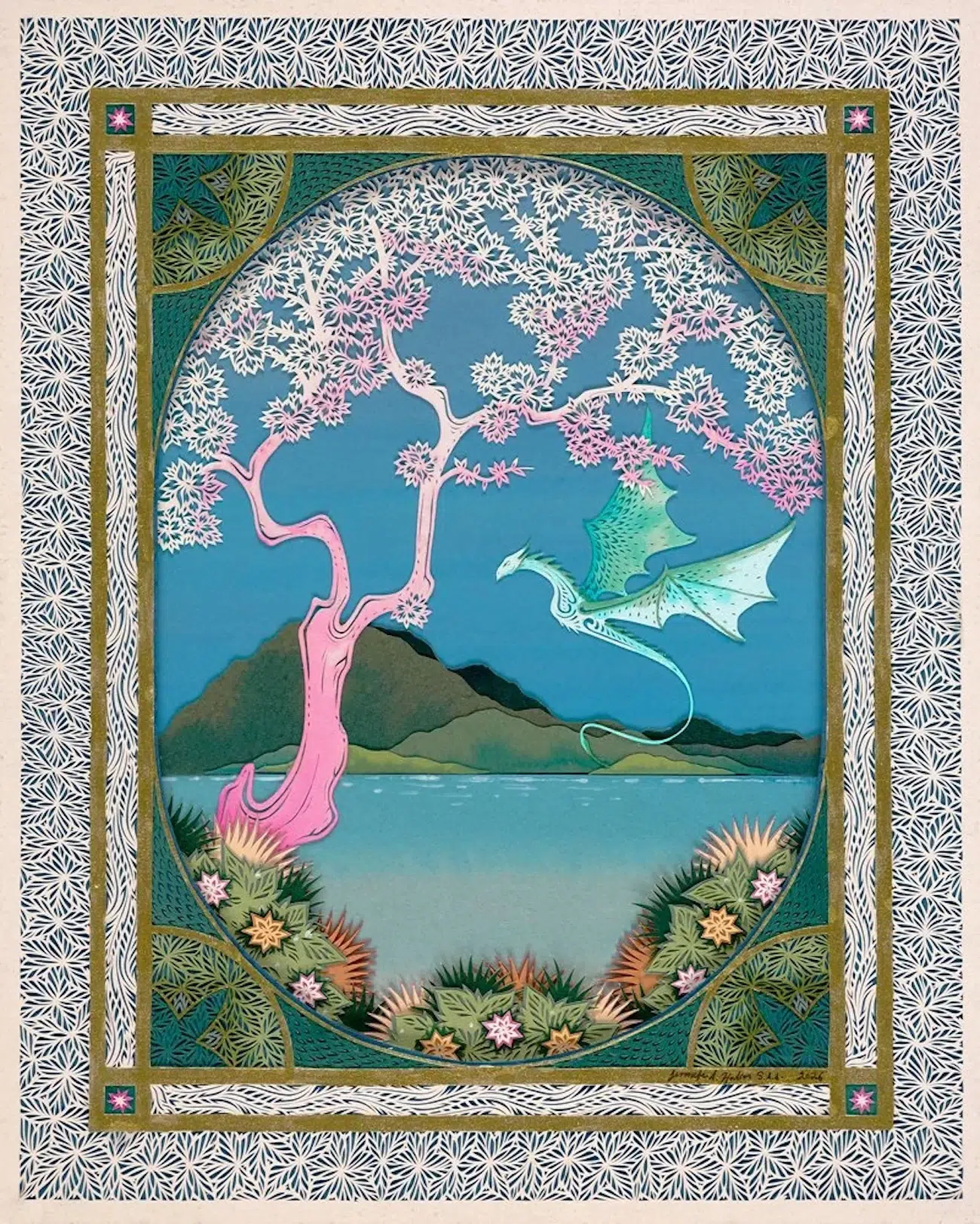
One of the first big pieces that I made back in 2018 was this huge 18-inch by 24-inch single-layer dragon. I had cut a border around the head of the dragon that, in my head, was going to work perfectly. I cut the whole thing and spent three days cutting this border around the head. And I looked at it, and because it was a single layer, it made the dragon illegible, and you couldn’t see it anymore. I was then like, OK, what do I do?
I came up with a solution of completely cutting the border out and then using a different color paper to recut that border and adhere that piece to the back of that piece. And that’s how I learned how to do color inlays. It was like a happy accident. It pushed my work further, and it was also a lesson to take a step back and think about it. So, don’t have a meltdown because you think you ruined your piece. Just think, “Okay, how do I design around this, and it ended up making the piece so much stronger?”
I also think that’s important. When I was teaching, I would tell my students you can’t view your mistakes as lost time because you’re still learning something.
Is there a piece that epitomizes all that you want to achieve so far with your work?
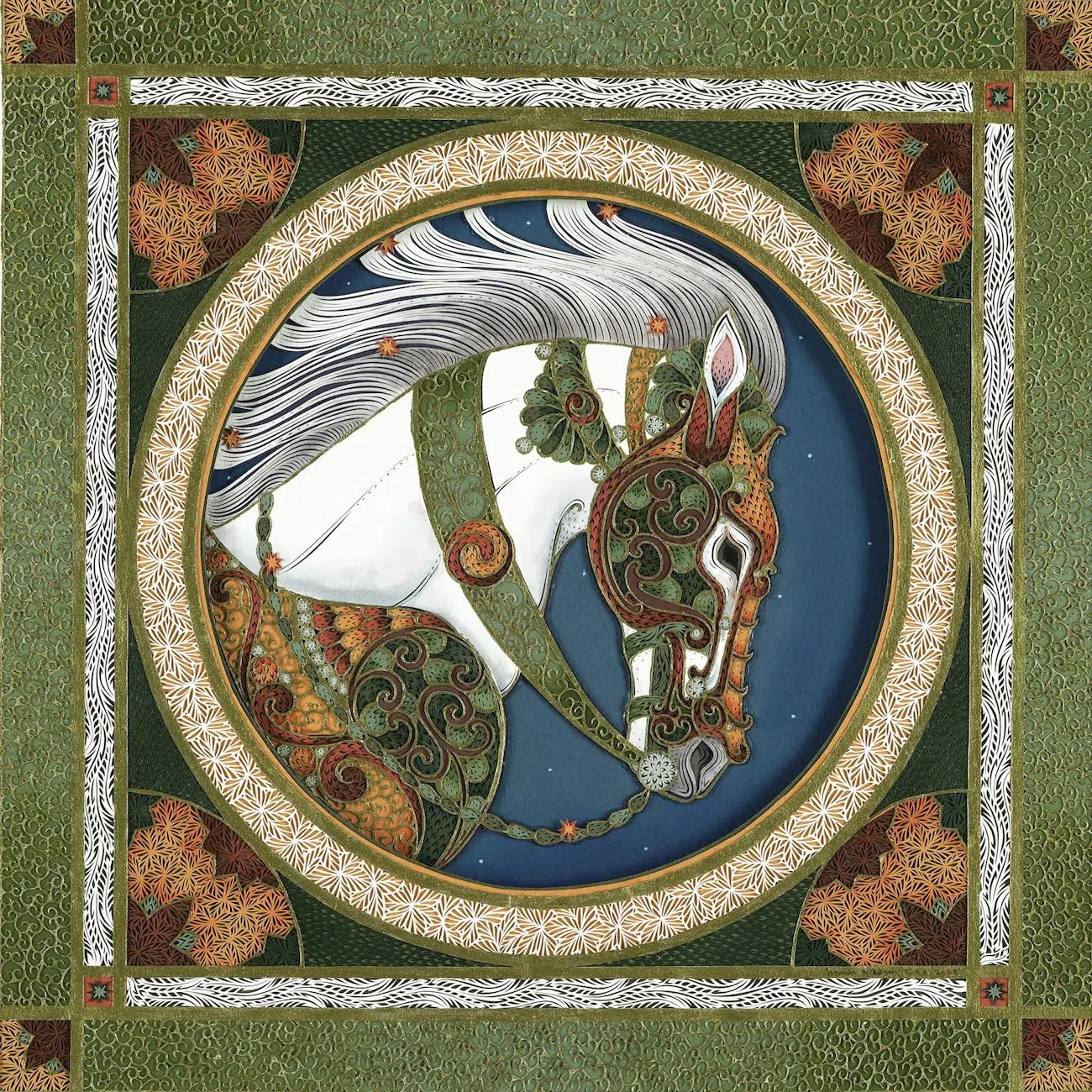
I’ve been making these jousting horses that are really, really intricate. My most intricate piece to date is currently on view at the Maryland Federation of Arts Circle Gallery in Annapolis. It’s the first jousting horse, with intricate color fills that are making up decorative armor, and I feel like that piece, and these horses that I’ve been making since then, combine my love of wildlife or animal life, and also the more whimsical background that I like to explore in my pieces.
Do you have any advice for people who are contending with a disability, or preventing them from doing the work they want?
Any amount of time you can put in is valuable, even if you’re only capable of doing 10 minutes that day, it’s still valuable. Don’t focus on having to make perfect work or the most incredible piece ever. The thing that got me into my whole paper-cutting journey was just starting simple and having the goal of just finishing it. And if it’s bad, you don't have to show anybody.
Jen Hudson: Website | Instagram
My Modern Met granted permission to feature photos by Jen Hudson.
Related Articles:
Artist Manually Creates “Double-Exposure” Portraits by Drawing on Hand-Cut Paper
Laser-Cut Paper Art Highlights the Stunning Intricacy of Living Organisms
Amazing Hand-Cut Paper Art Mimics the Delicate Effect of Lace
Luminous Paper Sculptures Are Hand-Cut Portals to Fantastical Worlds Informed by Memories