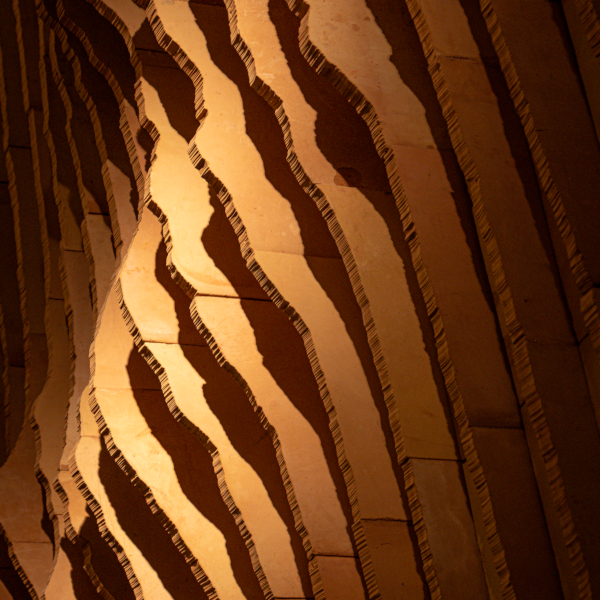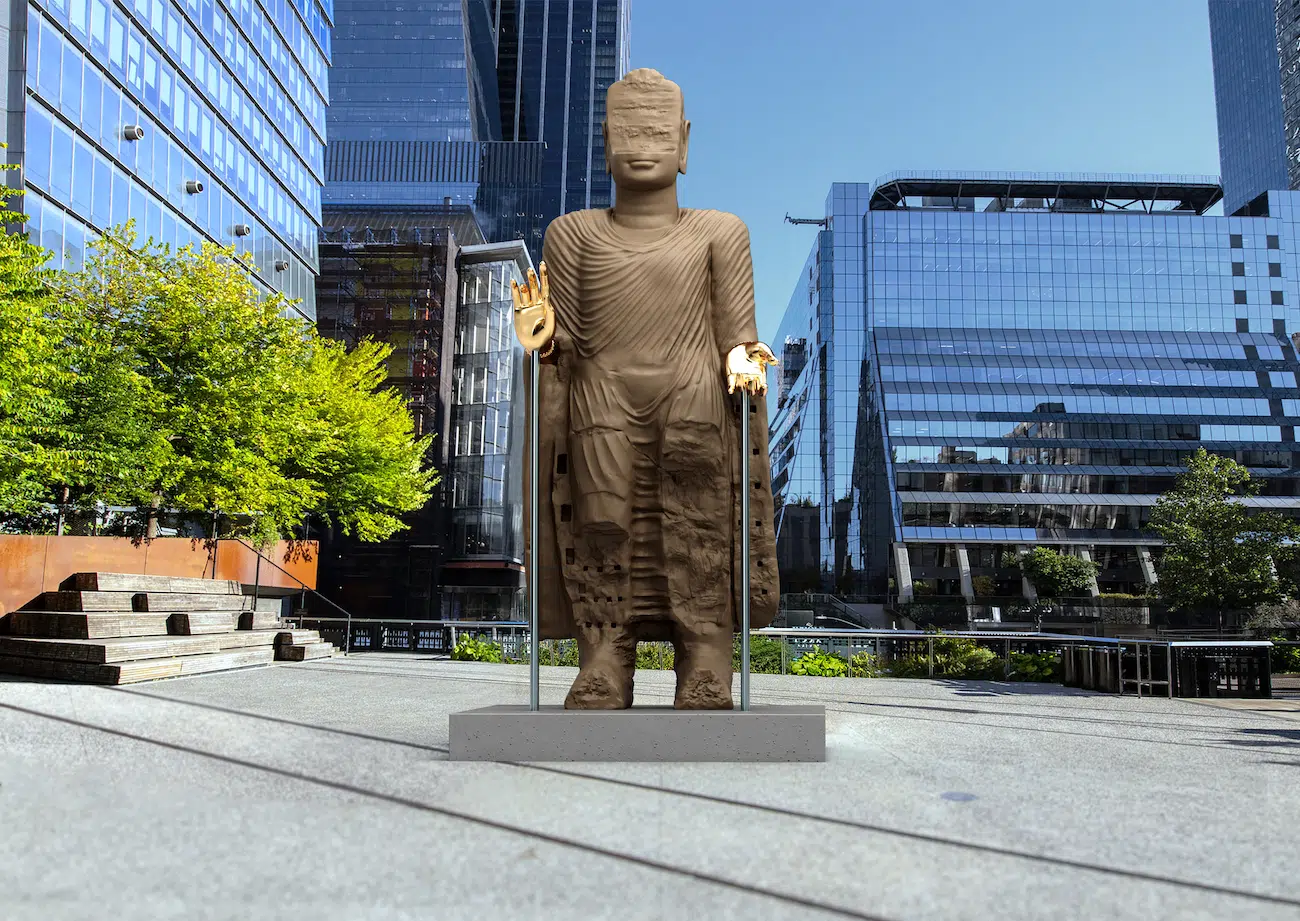
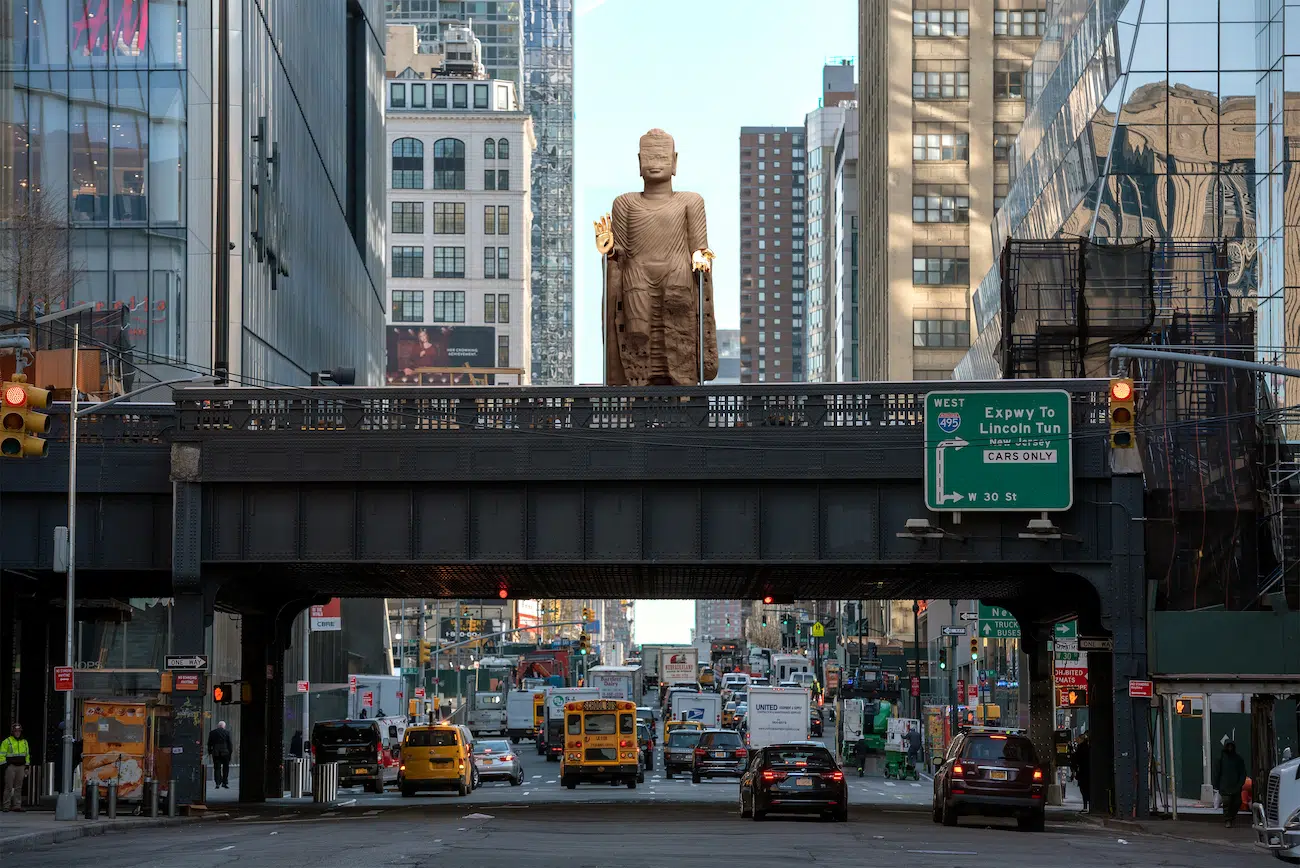
“The Light That Shines Through The Universe,” 2025/2026. Sandstone and mirror-polished stainless steel © Tuan Andrew Nguyen 2025. (Photo: Courtesy of the artist, James Cohan, New York, and High Line Art)
This spring, a towering sandstone Buddha will rise above Manhattan on the High Line Plinth. Created by Vietnamese-American artist Tuan Andrew Nguyen, the monumental sculpture is titled The Light That Shines Through the Universe. The installation will remain on view through fall 2027, offering a space for contemplation in one of New York City’s busiest public parks.
Nguyen’s work draws inspiration from the Bamiyan Buddhas, colossal 6th-century statues carved into Afghanistan’s cliffs. The Taliban destroyed those figures in 2001, an act that reverberated far beyond the region. Rather than reconstructing what was lost, Nguyen creates a new monument shaped by memory, absence, and imagination.
Nguyen based the sculpture on historical photographs and descriptions of the Bamiyan Buddhas. He intentionally avoided making an exact replica. Instead, he presents a reinterpreted form that acknowledges both destruction and endurance.
The artist titled the work after the Bamiyan Buddha’s local name “Salsal,” which translates to The Light That Shines Through the Universe. The phrase underscores the project’s central idea: even when physical objects vanish, cultural memory persists.
The sculpture, which stands 27 feet tall, is carved from light brown sandstone and a steel armature supports the massive form. Craftspeople in Vietnam fabricated the sculpture in four sections, which the team later shipped to New York for installation.
Unlike the original Bamiyan Buddhas, which were carved directly into rock faces, Nguyen’s sculpture is fully freestanding. This required a critical creative decision. Since the original statues had no backs, Nguyen designed one himself. By intentionally leaving the back less detailed than the front, the simplified surface invites viewers to imagine what is missing. It also emphasizes that history often reaches us incomplete.
One of the installation’s most powerful elements is its hands. The original Bamiyan Buddhas lost their hands long before their destruction. Nguyen reimagined them using melted brass artillery shells and scrap metal sourced from Afghanistan.
The hands form traditional Buddhist mudras, gestures associated with compassion and fearlessness. Their polished metal surfaces contrast sharply with the rough sandstone body. Nguyen leaves a visible gap between the hands and the figure, reinforcing the work’s themes of rupture and repair.
Installed above the city streets, The Light That Shines Through the Universe offers a moment of stillness amid urban movement. The buddha faces the skyline, engaging directly with its surroundings while remaining quietly self-contained. The High Line will also host meditation and wellness programming connected to the installation. These events extend the sculpture’s themes beyond visual experience and into shared reflection.
Rather than asserting authority or dominance, Nguyen’s sculpture asks viewers to slow down. It honors cultural loss without attempting to replace what history erased.
On the High Line Plinth, The Light That Shines Through the Universe becomes more than a monument. It acts as a reminder that memory, imagination, and empathy endure, even when stone does not.
A 27-foot-tall Buddha will sit on the High Line, reimagining a monument destroyed by violence as a space for reflection and healing.
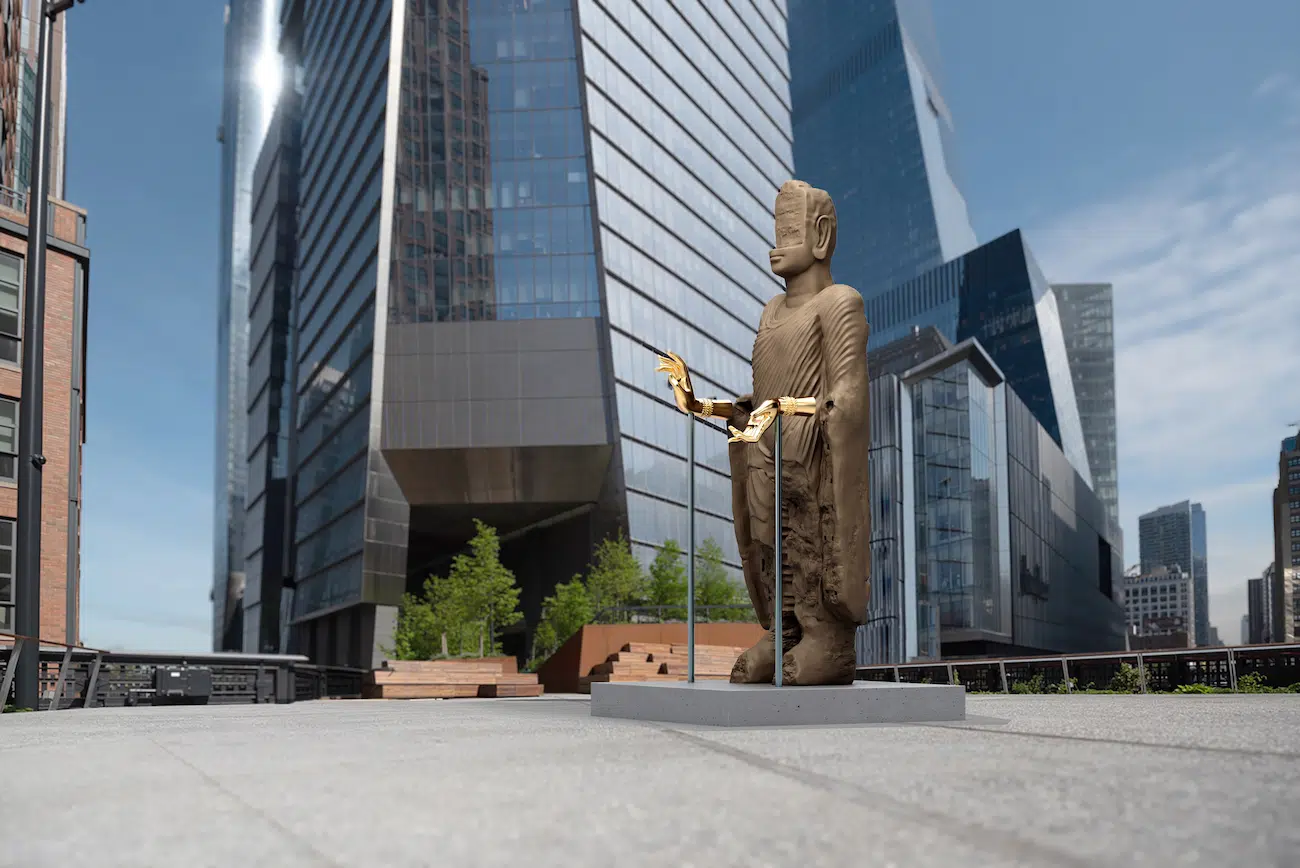
“The Light That Shines Through The Universe,” 2025/2026. Sandstone and mirror-polished stainless steel © Tuan Andrew Nguyen 2025. (Photo: Courtesy of the artist, James Cohan, New York, and High Line Art)
Artist Tuan Andrew Nguyen transformed sandstone and melted artillery shells into a sculpture designed specifically for the High Line Plinth, inviting viewers to pause, meditate, and remember.
“The Light That Shines Through The Universe,” 2025/2026. Sandstone and mirror-polished stainless steel © Tuan Andrew Nguyen 2025. (Photo: Courtesy of the artist, James Cohan, New York, and High Line Art)