Auras may still be scientifically unproven, but, according to recent research, we do emit a similar type of light, if only faintly. Published last spring in the Journal of Physical Chemistry Letters, the study reveals that all living systems produce a semi-visible glow that extinguishes upon death.
This biological phenomenon is called an ultraweak photon emission (UPE), and is the natural byproduct of cellular metabolism. During the metabolic process, cells create unstable molecules known as reactive oxygen species (ROS), which, as their levels rise, excite other surrounding molecules. This excess energy is also linked to oxidative stress, a cellular stress response that typically occurs during illness, stress, and even aging. In other words, the more oxidative stress an organism experiences, the more ROS it produces, and thus the more UPE it radiates.
“When an organism ceases living, it stops metabolizing and thus, the [UPE] ends,” Daniel Oblak, a physicist at the University of Calgary and one of the study’s authors, told BBC Science Focus.
To test this hypothesis, researchers compared emissions in living and dead mice, storing them in enclosures that eliminated external light and other interferences. Using advanced imaging techniques and cameras, the team discovered that the live mice emitted significantly more UPE, whereas the light had all but vanished in the euthanized group. While measuring the effects of temperature, injury, and chemicals on plants, researchers reached similar conclusions. Like mice, plants that experienced higher temperatures and injuries emitted more UPE, particularly in areas that sustained more damage than others.
Given these findings, Oblak believes that UPE can offer a non-invasive way to track the health of living beings. “[UPE] could be used to track the condition of a tissue—for example, for use in transplants—or the level of stress an organism is subject to, such as for monitoring crop or forest health,” he explained.
Still, UPE shouldn’t be mistaken for a stark beacon of light or even something like bioluminescence, which is visible to the naked eye. Rather, UPE is extremely low-intensity, and is between 1,000 and 1,000,000 times dimmer than what the human eye can perceive.
“UPE is so weak that it is not visible to the human eye and completely overwhelmed by other sources of light, unless you are in a completely dark room,” Oblak said.
This study provides a critical entry point into understanding UPE, but more research is needed to fully map out its possible applications. At the very least, though, we now know that we should take the phrase “the light of our lives” a little more literally.
A recent study revealed that all living things emit a faint glow, called an ultraweak photon emission (UPE), that extinguishes upon death.
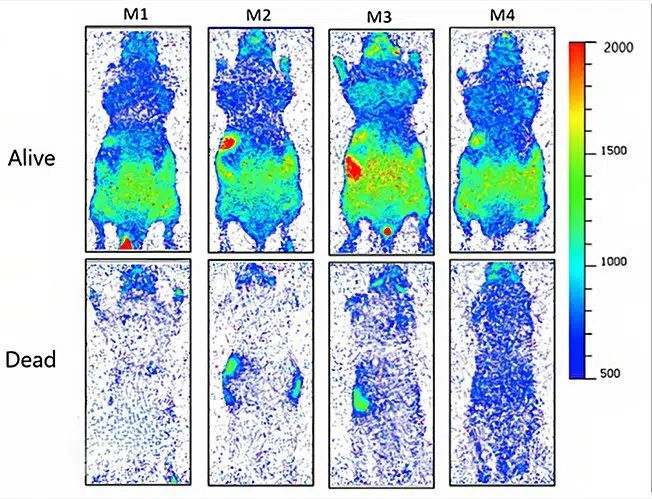
The four mice that were alive (top) emitted more UPE compared to the four euthanized mice (bottom). (Photo: Salari et al, “The Journal of Physical Chemistry Letters,” 2025)
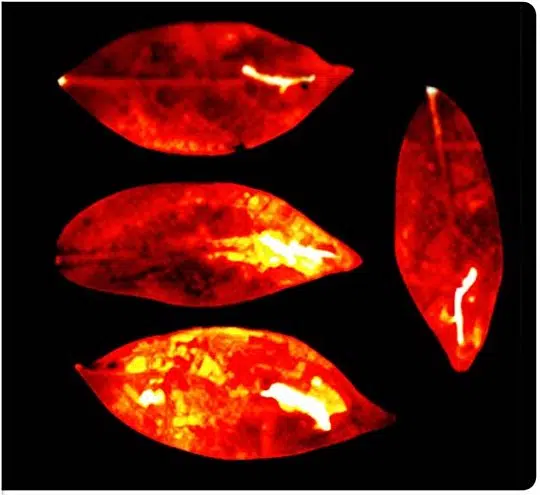
In areas where leaves had sustained more chemical damage and injuries, they emitted a more intense level of light. (Photo: Salari et al, “The Journal of Physical Chemistry Letters,’ 2025)
Sources: We Emit a Visible Light That Vanishes When We Die, Surprising Study Says; All humans emit subtle light until they die, study suggests; Living beings emit a faint light that extinguishes upon death, according to a new study; Imaging Ultraweak Photon Emission from Living and Dead Mice and from Plants under Stress
Related Articles:
We May Actually See Our Lives Flash Before Our Eyes as We Die
Scientists and Psychologists Agree That Life Gets Better Once You Start Practicing Gratitude
This 15-Minute Activity Is Proven To Reduce Anxiety and Improve Mental Health