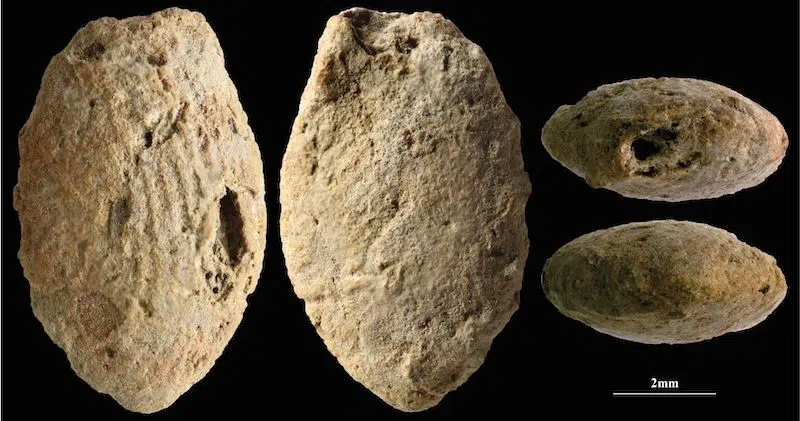
A butterfly clay bead from the Final Natufian period in Eynan-Mallaha (Upper Jordan Valley), colored red with ochre and marked with the fingerprints of the child (≈10 years old) who modeled it 12,000 years ago. Four other beads discovered in other villages were also modeled by children.
Long before pottery, agriculture, or permanent cities, humans were already shaping clay into meaningful objects. A new study published in Science Advances reveals that some of the earliest known clay ornaments, dating back 15,000 years, still carry the fingerprints of their makers.
Discovered at several prehistoric sites in present-day Israel, the collection includes 142 small clay beads and pendants created by the Natufians, people who lived in the Levant region from 13,000 and 9,700 BCE. This culture is known for being among the first to adopt a more settled way of life, living at a pivotal moment before the widespread rise of farming. Their artistic practices are now offering new insight into how early humans expressed identity and shared cultural meaning.
For decades, archaeologists believed clay only became culturally significant with the emergence of pottery in the Neolithic period. These findings challenge that assumption. The Natufian ornaments, formed from unfired clay and shaped into small disks, cylinders, and other forms, predate pottery by thousands of years. The number and variety of objects suggest that clay was already an established material for creative expression.
Many of the beads were coated with red ochre using an early slip technique, marking the earliest known example of this kind of surface decoration. The attention to detail points to a thoughtful and intentional process, even at this early stage.
Some of the most compelling evidence lies in the surfaces of the objects themselves. Around 50 fingerprints were preserved in the clay, allowing researchers to identify not only adult makers but also children and adolescents. This is the first time fingerprints have been used to directly connect individuals to the creation of Paleolithic ornaments.
Certain pieces appear to have been made for younger wearers, including a tiny ring measuring only about 10 millimeters (about 0.39 inches) in diameter. These details suggest that making ornaments was not limited to skilled specialists but was likely a shared activity across the community. It may have also played a role in passing down knowledge and traditions between generations.
The forms of the beads were often inspired by the natural world. Researchers identified 19 distinct types, many resembling plants such as wild barley and other important food sources. Traces of plant fibers found on some of the pieces indicate they were likely strung and worn, possibly as necklaces or other adornments.
Together, these discoveries point to a broader cultural shift. The use of clay for symbolic and decorative purposes appears to have begun well before the development of pottery and agriculture. As communities became more settled, new forms of expression emerged, reflecting the identity and environment.
Even without written language or permanent structures, these early makers left behind something deeply personal. Pressed into the surface of soft clay, their fingerprints remain as a direct and human connection across thousands of years.
Archaeologists discovered 15,000-year-old clay beads, pushing back the origins of artistic expression long before pottery existed.
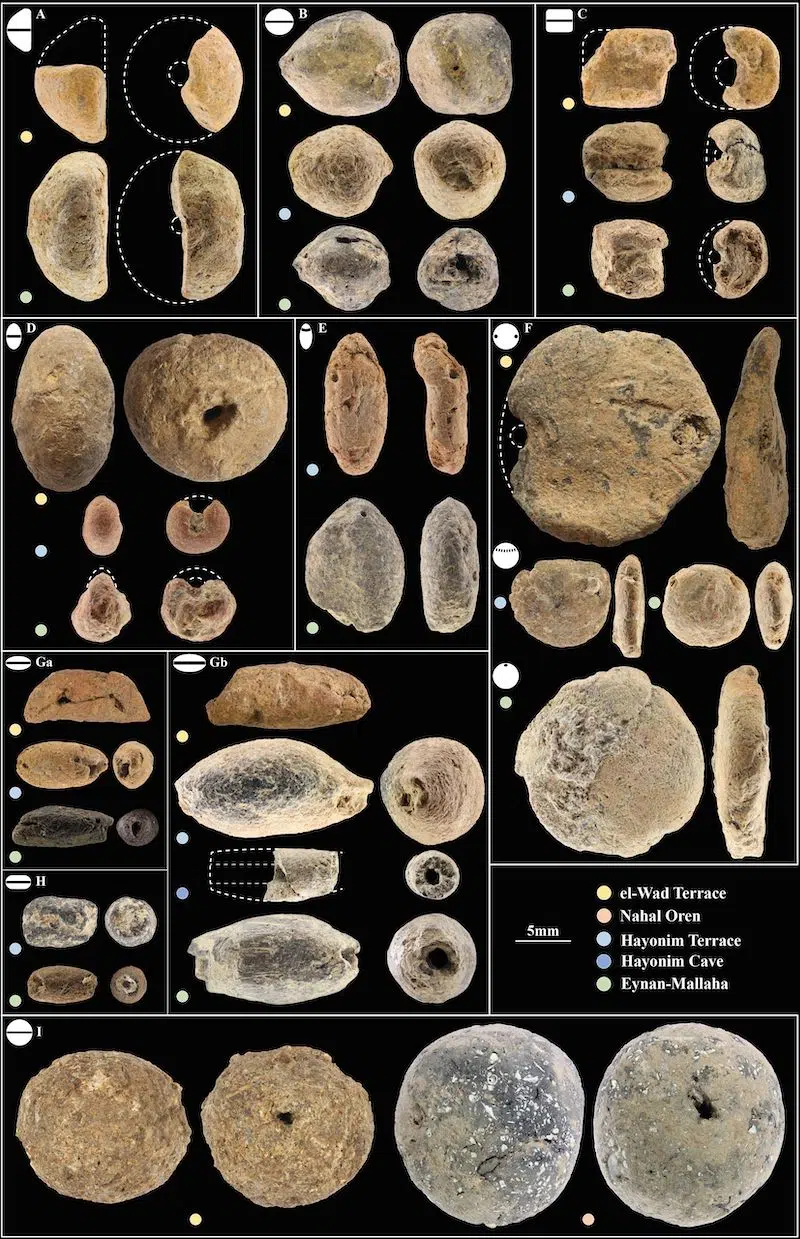
Sample of the stylistic diversity of Natufian clay ornaments found across the various sites studied. The presence of this ornamental tradition across different communities suggests that clay ornaments served as a common decorative motif in the Southern Levant.
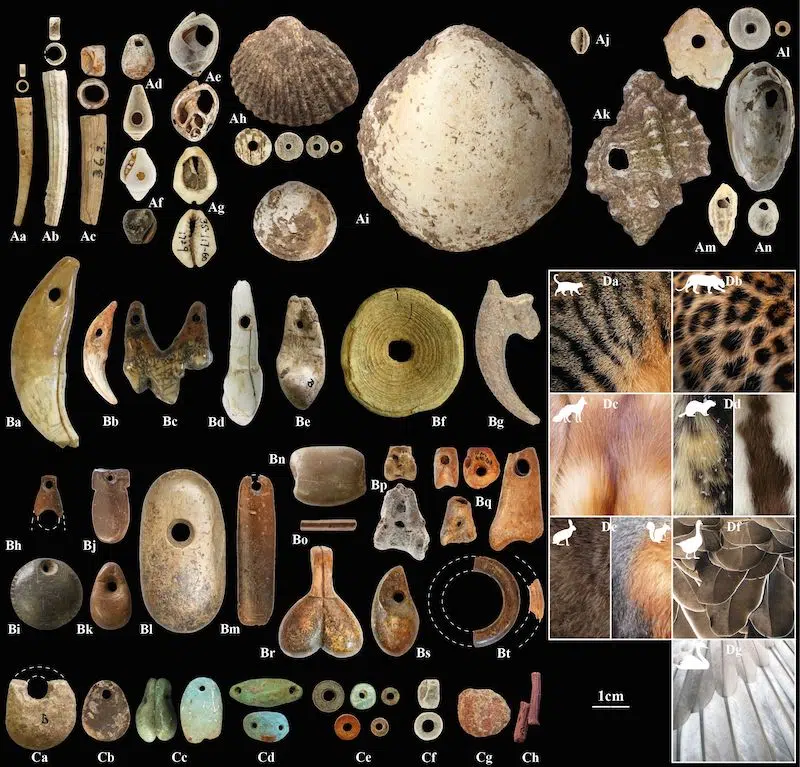
Sample of Natufian ornamental diversity, featuring ornaments made of shells (from the Mediterranean Sea, the Red Sea, freshwater sources, and fossil deposits), teeth (from hyenas, foxes, wolves, aurochs, and deer), bones (primarily from gazelles and birds), colored stones, ochre, and plant dyes, as well as furs and feathers. Across Southwest Asia, Natufian culture represents a laboratory of ornamental practices marked by unprecedented intensification and diversification. The emergence of clay adornments is part of this phenomenon of numerous techno-symbolic innovations that would influence the region’s ornamental practices during the millennia of the Neolithic transition that followed.
The preserved fingerprints on them reveal that children helped create some of humanity’s earliest known jewelry.
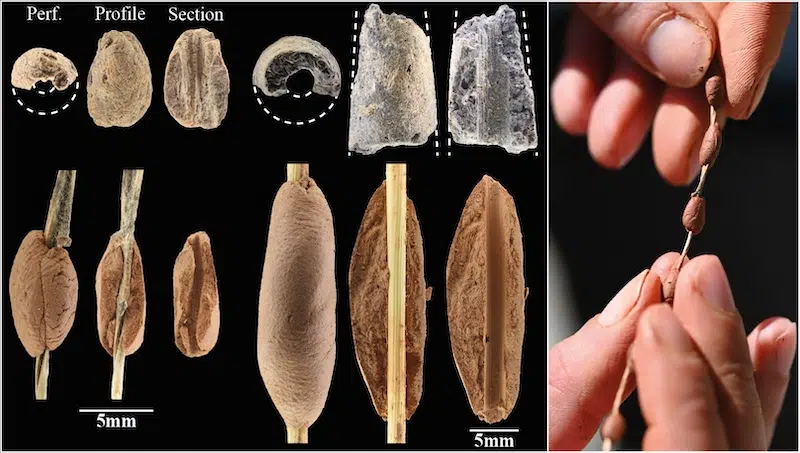
Techniques for modeling Natufian clay beads reconstructed through experimentation. Most beads were modeled directly onto plant fiber threads, while others were modeled onto wild cereal straw cores.
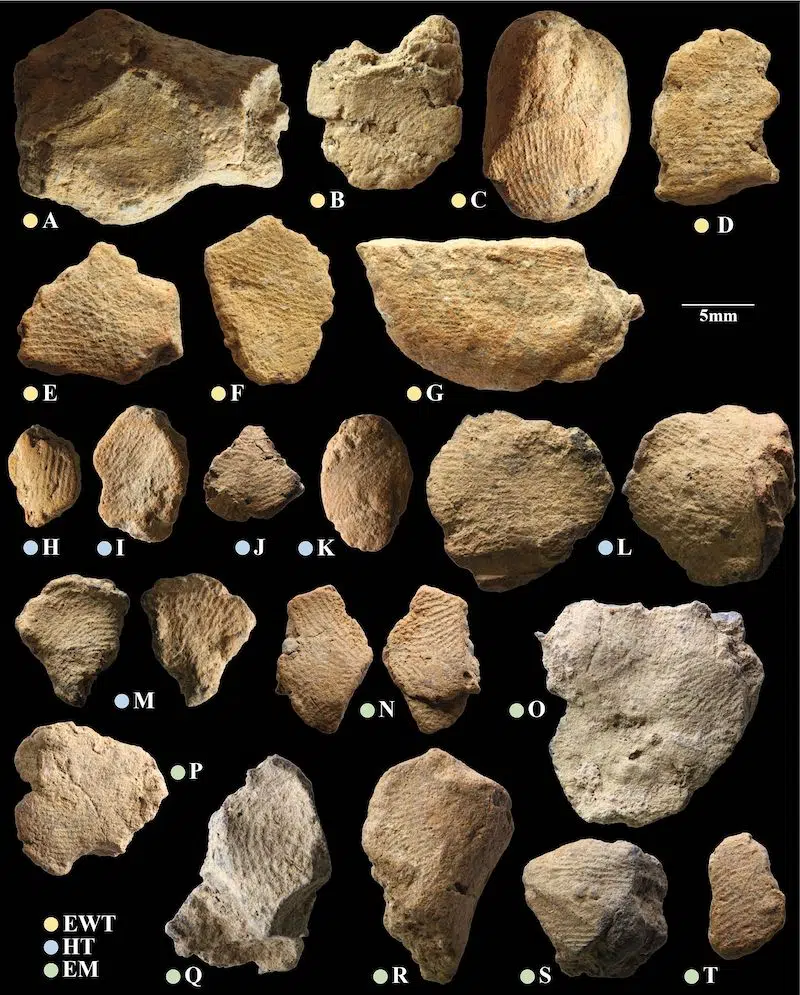
A sample of fingerprints from children and adults found on clay artifacts at the sites of el-Wad, Hayonim Terrace, and Eynan-Mallaha. The study presents the largest collection of Paleolithic fingerprints known today.
The ornaments suggest that identity, symbolism, and shared culture emerged alongside the first settled communities.
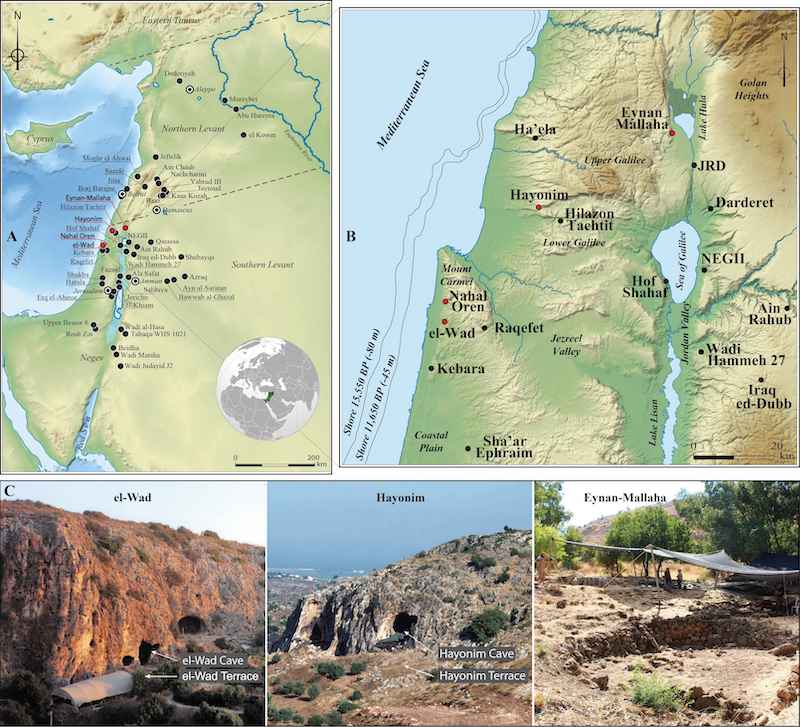
Map of the Levant showing the location of the four Natufian sites (in red) analyzed in this study. The site of el-Wad Terrace is excavated by the University of Haifa, Nahal Oren and Hayonim were excavated by the Hebrew University of Jerusalem and Eynan-Mallaha was excavated by the Centre de recherche français à Jérusalem and the Israel Antiquities Authority.
Source: Modeling identities among the first-sedentary communities: Emergence of clay personal ornaments in Epipaleolithic Southwest Asia
My Modern Met granted permission to feature photos by Laurent Davin.
Related Articles:
2,000-Year-Old Graffiti Tags From an Ancient Traveler Discovered in Five Egyptian Tombs
Archeologists Discover Neolithic Earthworks That Are 2,000 Years Older Than Stonehenge
Researchers Examine Centuries-Old Flip-Flop Sandals on an Ancient Roman Mosaic
40,000-Year-Old Symbols Carved in Bone May Reveal the Origins of Written Language