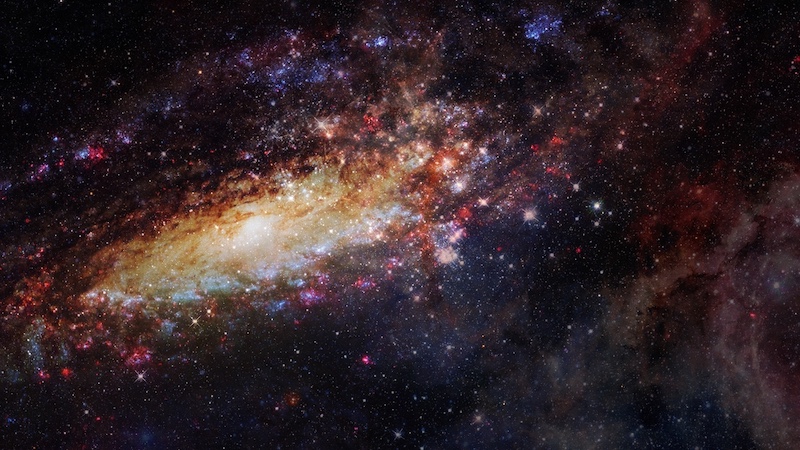
The sheer scale of the universe is difficult to comprehend, but a new 2D map featuring a catalog of nearly 4 billion objects helps put things a little more in perspective. The 5.6-trillion-pixel DESI Legacy Imaging Surveys map comprises 263,407 telescope exposures that together reveal the positions and brightness of billions of stars, galaxies, and other celestial objects.
More than 160 scientists contributed to collecting the data over 13 years, combining observations from three ground-based sky surveys with additional data, including observations from NASA’s WISE mission. Together, the images cover roughly 75% of the sky, creating an incredibly detailed picture of the cosmos. The data also helped scientists create the largest high-resolution 3D map of the universe ever made, which is now being used to measure the effect of dark energy on the expansion of the universe.
The new 2D map is available to everyone online and builds upon previous releases from the DESI Legacy Imaging Surveys. It allows you to jump to a specific celestial object using a search bar, like the 51 Peg, a sun-like star 50 light-years away, or Messier 87, a nearby galaxy at a distance of 53 million light-years. “Most of the objects you see in this image are galaxies approximately half-way across the visible universe,” says Legacy Survey. “Each one of these galaxies is composed of a few hundred billion stars.”
NOIRLab describes the map as a “deep photograph of the sky,” since it reveals where galaxies and stars are located and how bright they appear. “Explorations of our Universe always start with images of the night sky. The DESI Imaging Legacy Surveys are just one step in this venerable human tradition,” says Arjun Dey, NSF NOIRLab astronomer and co-lead of the Legacy Surveys. “For our team, these data are fundamental to the investigation of the expansion history of the Universe and the formation of our galaxy. But the skies belong to everyone, and this survey gives everyone the chance to marvel at their wonders.”
In April 2026, DESI, the Dark Energy Spectroscopic Instrument, completed its originally planned five-year survey ahead of schedule, mapping more than 47 million galaxies and quasars (galaxies with massive black holes in the center) in 3D. However, the work isn’t over yet. Observations are continuing as scientists gather even more data to learn more about how the universe has evolved and better understand the nature of dark energy.
Check out the incredible 2D map of the universe on Legacy Survey’s website.
Sources: Scientists Release Biggest 2D Map of the Universe; FAQ: Legacy Survey Sky Images
Related Articles:
Astronomers Make a Discovery That Challenges Our Notions of the Universe
Detailed Milky Way Map Shows Hidden Parts of Our Galaxy
Incredible Sky Map Details Over 900,000 Stars, Galaxies, and Black Holes
Astronomers Reveal Stunning Thousand-Color Photo of Nearby Galaxy