In the summer of 1997, a revolution rolled through the United States and Canada under a chorus of female voices. For years, the music industry had clung to an unspoken rule not rooted in data, but in prejudice, that no two women could play back-to-back on a lineup because it wasn’t “profitable.” That belief shaped radio playlists, tour bills, and who was allowed to take up space on stage.
But backstage, guitar in hand, Sarah McLachlan stood fueled by rage and exhaustion, and asked a simple but radical question: why not prove them wrong?
A year earlier, in 1996, McLachlan tested the idea with a grassroots tour featuring herself and Paula Cole, and the reception was electric. They named the show Lilith Fair, borrowing from the myth of Lilith. It is said in Jewish folklore, Lilith was Adam’s first wife who refused to submit. That name wasn’t just poetic; it was a declaration.
Soon after, the idea expanded into something far larger. Alongside co-founders Dan Fraser and Terry McBride of Nettwerk Music Group, as well as New York agent Marty Diamond, McLachlan set out to build a festival designed with a single goal in mind: to give women a platform built on their own terms.
The results were immediate and astounding. When Lilith Fair officially launched in 1997, it sold out almost every date. By the end of the summer, the tour had grossed more than $16 million and became the highest-grossing traveling festival of the year, outpacing even Lollapalooza.
Lilith Fair was a confluence of many sounds. Across both the main stages and the more intimate side stages, audiences heard artists from a kaleidoscope of styles—folk and blues, hip-hop and rap, rock and soul. Legends like Sheryl Crow, Tracy Chapman, Indigo Girls, Sinéad O’Connor, Missy Elliot, and Paula Cole formed a lineup that challenged the industry’s narrow assumptions about what women in music could sound like and who audiences were willing to listen to.
Despite its success, Lilith Fair was far from universally embraced. Critics dismissed the festival with mocking labels and sometimes outright hostility. On talk shows and radio, detractors reduced it to clichés like “mom music,” minimizing both its artistic range and cultural significance.
In some cases, the backlash turned more severe. Bomb threats over Planned Parenthood booths underscored how a space centered on women could become a flashpoint for broader cultural tension.
Lilith Fair ran from 1997 to 1999, drawing millions of fans and raising millions of dollars for charity. Although the original tour eventually ended, its influence did not. Years later, the festival continues to be revisited as a turning point in music history.
In 2025, the documentary Lilith Fair: Building a Mystery returned to that era, featuring artists from the original tours and reflecting on themes of sexism, community, and creative autonomy.
Today, new festivals and artist-driven events carry forward Lilith Fair’s underlying mission. By centering women, gender minorities, and diverse voices, they build on the foundation McLachlan and her collaborators laid decades earlier. Ultimately, Lilith Fair did more than reshape summer tour lineups. It cultivated ideas about audiences, artistry, and who gets to lead the chorus.
When music executives said women couldn’t share a stage, Sarah McLachlan decided to build her own, known as Lilith Fair.
What began as a small experiment quickly became one of the highest-grossing tours of the 1990s.
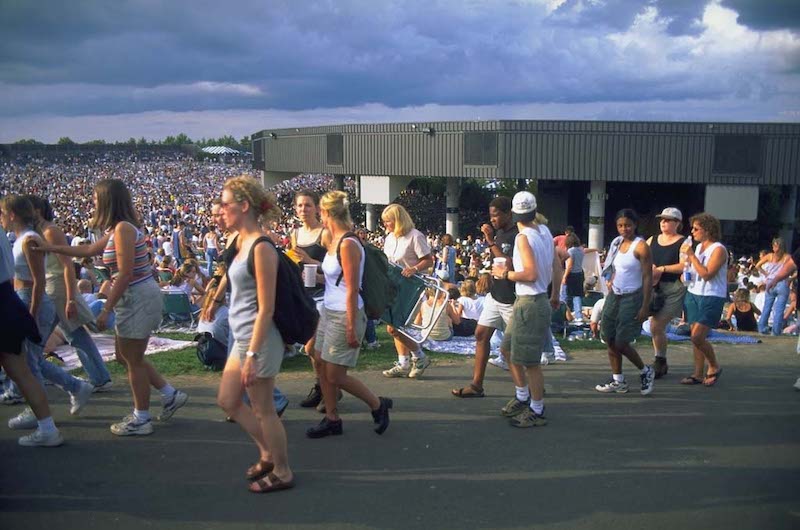
The Lilith Fair festival stage, at the Tweeter Center in Mansfield, MA, Sept. 22, 1998. (Photo: Jason Philbrook, CC BY-SA 2.5, via Wikimedia Commons)
As the festival grew, it became both a cultural lightning rod and a symbol of collective power. Even after the final tour ended, Lilith Fair reshaped how women claimed space in the music industry.
Source: The Groundbreaking History Of Lilith Fair, The 1990s Music Tour That Featured Only Female Artists. In the 1990s, music executives told Sarah McLachlan that concert lineups and radio stations wouldn’t feature two women in a row because it was not profitable.
Related Articles:
These Larger-Than-Life Sculptures Are Like Mystical Goddesses of Music Festivals