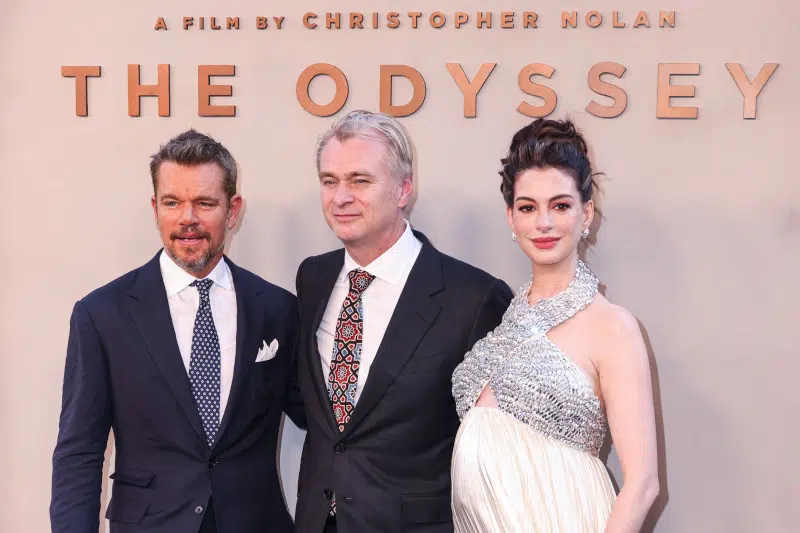
Filmmaker Christopher Nolan’s The Odyssey has made over $700 million worldwide, becoming the fourth-highest grossing movie of the year after only 12 days in theaters. It was also the fastest movie to reach 1 million watched on Letterboxd, doing so in only six days after its release. With fans scrambling to get tickets to see it in IMAX 70mm, the largest and highest-resolution analog projection format in cinema, and even selling out showings at 3 a.m., the success of the film has made waves in the movie industry.
But what has drawn all these people to the movie theaters? From daring to adapt one of the most complex stories of all time to audiences seeking a fresh alternative to tired franchises and even more tired live-action remakes, movie lovers were eager to spend their money and time on a film driven by passion and not by profit alone.
“It never gets any easier, because I make films for audiences and the audience tells me what it likes,” Nolan told The Guardian about making the film. “They finish the film. I don’t have anything to hide behind. I can’t just be like: ‘Oh, people don’t get it.’ Those aren’t the films I make. What does the audience make of it? Do they turn up? Do they like it if they do turn up? By the way, I don’t think I’d be doing my job right if I wasn’t petrified every time I put a film out, because you’re trying to challenge yourself, you’re trying to take risks.”
One of the most commended elements of the film, and one of the most contrasting with other blockbusters, is the use of practical effects instead of CGI—an effort only made possible by production designer Ruth De Jong. Virtually every scene was shot on location, except for some minor reshoots, which took the production around the world. This included filming on open seas on a Viking ship sourced from Norway; building a 60-foot puppet of Polyphemus, which was then transported up the Greek foothills and into an actual cave; and using 7-foot-tall stunt doubles for the towering Laestrygonians, who played opposite to 5-foot-tall stunt people to create a dramatic height difference enhanced by forced perspective.
The time and work put into the film particularly moved actor Tom Holland, who plays Telemachus, and had never seen such a deployment. “I remember walking down this beach for half an hour, and I’m just seeing Greek soldier, Greek soldier, Greek boat, Greek soldier, the Trojan wars, Greek boat, Greek soldier for…. I don’t know if I’m exaggerating, but it felt like miles,” Holland told GQ. “And I’m saying to the PA: ‘Where is the crew? I haven’t seen any evidence of a film set. This is more reminiscent of a reenactment than it is a film set.’”
As such, the experience influenced how Holland approached his next project, Spider-Man: Brand New Day. The movie is the latest from Marvel, which has recently been panned for championing green-screen, CGI-heavy franchise features that have increasingly lacked soul. “I was really able to lay down the law and say, ‘We are not going to come to set and figure it out,’” Holland added. “‘We need to know why we are making this movie beyond the fact that it’s Spider-Man 4 and they make loads of money and we’re going to just have a big summer. Why are we making this movie?’ And [director] Destin [Cretton] was super instrumental in that, but it was just really great to constantly be calling up the studio and [producers] Amy [Pascal] and Rachel [O’Connor], who I love, and be like, ‘Well, Chris is doing it this way. This is how I think we should be doing it.’”
In an age when typing a simple prompt into an AI assistant can generate a strikingly realistic video, the true value of a feature film lies in the human effort behind it—the years of craft, collaboration, and vision that no algorithm can replicate. Not every studio is willing to invest in that cost when the bottom line is calling the shots. But with The Odyssey packing theaters and earning glowing reviews across the board, there’s renewed hope that powerful producers will keep betting on ambitious, human-driven productions. The road may be more challenging for everyone involved, but as this film proves, the results are all the more worth it.
Sources: ‘At times I felt I’d bitten off more than I could chew’: Christopher Nolan on sweeping the Oscars, making The Odyssey – and getting a puppy; Inside the Making of The Odyssey With Matt Damon, Tom Holland, Robert Pattinson, and Christopher Nolan; 7 Most Impressive Practical Effects In The Odyssey; ‘The Odyssey’ Surpasses $700 Million Globally After 12 Days in Theaters
Related Articles:
Autumn Durald Arkapaw Makes History as the First Woman to Win the Oscar for Best Cinematography
Beautifully Haunting Film Poster for Guillermo del Toro’s ‘Frankenstein’
‘Superman’ Movie’s Krypto Sparks 500% Surge in Dog Adoption Interest
How Two Films About the Same Subjects Came Out in the Same Year