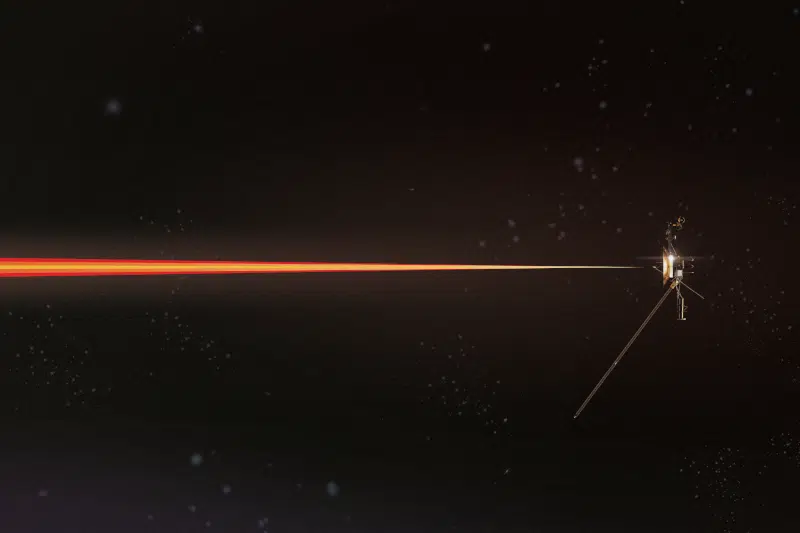
Voyager 1, depicted in this artist’s concept, reached one light-day from Earth on Nov. 18, 2026. (Photo: NASA/JPL-Caltech)
NASA’s Voyager 1 has made history. After nearly 50 years of travel, the spacecraft has reached one light-day from Earth. Launched Sept. 5, 1977, Voyager 1 is humanity’s farthest-flying spacecraft, traveling through interstellar space at about 38,000 mph. Voyager 1 achieved the milestone on Nov. 18 at 5:16 a.m. EST.
Light-days, like light-years, measure distance, not time. To make sense of the vastness of space, scientists measure the amount of time it takes light to travel. According to NASA, light travels at about 186,000 miles per second in a vacuum. For comparison, sunlight passing Earth reaches the moon in 1.3 seconds. As such, a light-day measures the distance light travels in 24 hours, which is roughly 16.1 billion miles.
Mission engineers confirmed the light-day milestone using trajectory calculations and the probe’s carrier signal, which conveys data to Earth. Since Voyager’s radio signal travels at the speed of light, the astronomers in charge of the probe at NASA’s Jet Propulsion Laboratory heard from the probe 24 hours after achieving this feat.
Voyager 1, and its twin, Voyager 2, launched in 1977, are the only probes built by humankind to ever go beyond our solar system. In 2012, Voyager became the first spacecraft to reach interstellar space after leaving the heliosphere, the bubble of particles and magnetic fields created by the sun that deflects cosmic radiation.
In addition to scientific instruments, Voyager 1 carries a Golden Record. Like a message in a bottle in an expansive ocean, the golden disc includes images and sounds from Earth, as well as inscriptions that show our planet’s location to any advanced civilization that may come across it.
“Voyager 1 crossing the light-day threshold is yet another historic feat on an extraordinary voyage of discovery,” says Dave Gallagher, JPL director. “Above all, this milestone stands as a testament to the exceptional teams who built, programmed, and fly these spacecraft today, and who have overcome countless challenges to keep them connected to Earth across the vastness of space. As NASA pushes toward new frontiers in human and robotic exploration, Voyager and the people behind its success continue to inspire us to reach farther and dream bigger.”
Sources: NASA’s Voyager 1 Makes History Reaching One Light-Day From Earth
Related Articles:
NASA’s Voyager 1 Spacecraft Has Resumed Communications With Earth From 15 Billion Miles Away
NASA Picks Up “Heartbeat” Signal and Reconnects With Lost Voyager 2
NASA Releases Hi-Res Mars Panoramas of Honeycomb Landscapes and a Sand-Capped Butte
NASA Announces Artemis III Crew Members Going to Space in 2027