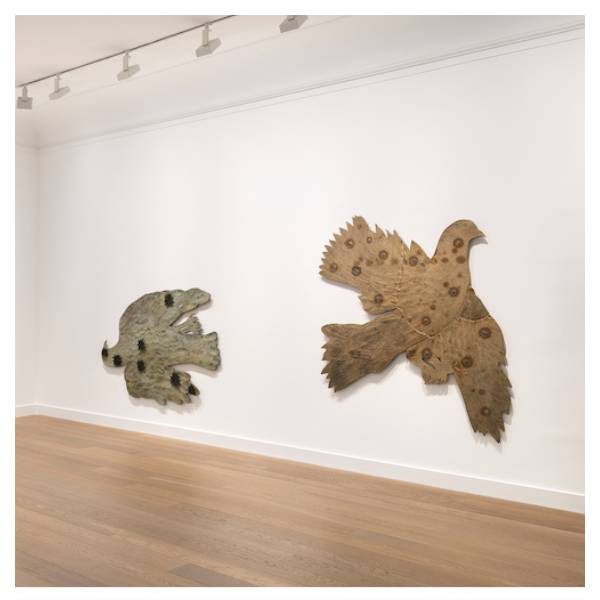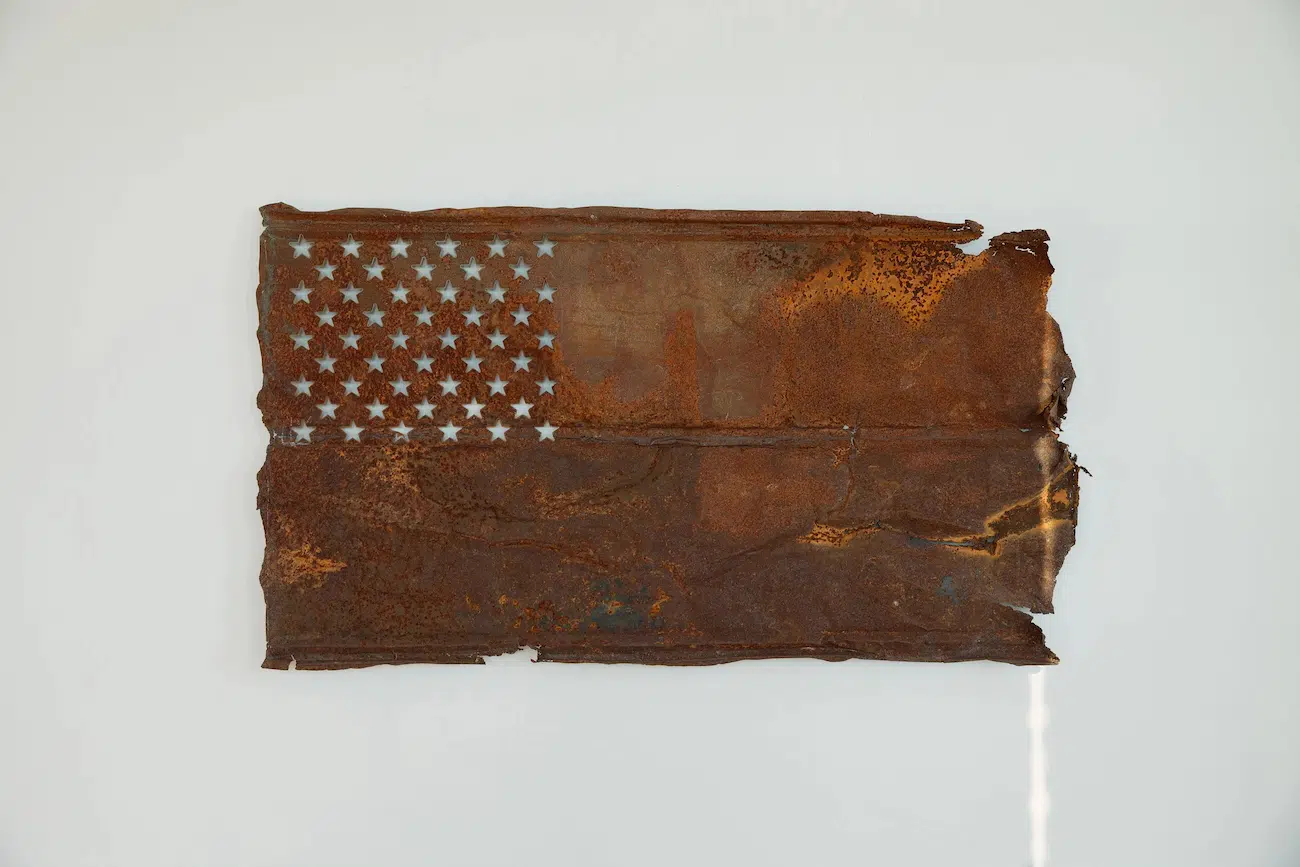
The United States recently celebrated its 250th anniversary, and Charleston artist Fletcher Williams III is marking the occasion with a new solo exhibition titled 250 Years from Mr. Freedman. Presented in conjunction with the United States’ semiquincentennial, the exhibition centers on a series of sculptural wall reliefs made from the salvaged tin roof of a burned Freedman’s Cottage in Charleston. Williams transforms this material into a meditation on memory and inheritance, using it to anchor a fictional figure, Mr. Freedman, whose life spans centuries and moves between Charleston and the broader American South.
Through this invented protagonist, Williams weaves together Revolutionary War histories, Black Loyalist narratives, and Lowcountry folklore. Each relief functions as a fragment of Mr. Freedman’s evolving story, positioning Charleston as a key site within the American Revolution while questioning how history is recorded, preserved, and retold.
Recurring motifs drawn from the Lowcountry landscape and American iconography—birds, palmetto roses, stars, and vernacular building materials—link local tradition with national symbolism. Together, the works frame history not as a fixed narrative, but as something continuously shaped through lived experience and collective memory.
The exhibition marks the culmination of nearly a decade of work. Williams salvaged the tin roof in 2017 and held onto it until the semiquincentennial provided a conceptual framework for the project, allowing him to transform the material into a larger meditation on how the past persists in the present.
250 Years from Mr. Freedman is currently on view at Storehouse 8, Suite 207, Navy Yard Charleston in North Charleston, South Carolina until July 14, 2026. The exhibition runs Thursday through Sunday from noon to 5 p.m. with free admission.
My Modern Met recently had the opportunity to speak with Williams about the origins of 250 Years from Mr. Freedman, his decision to build the exhibition around a fictional protagonist, and how salvaged materials allow him to connect Charleston's architectural history with stories that continue to shape the present. Scroll down to read our exclusive interview.
What inspired you to create 250 Years from Mr. Freedman, and why did the 250th anniversary of the United States feel like the right moment to tell this story?
This exhibition actually began nearly a decade ago when I salvaged the tin roof and kept it stacked against the wall in my studio while I made other work that critiques American identity through ideas of patriotism, the American Dream, property, labor, boundaries, preservation, and the myths we build around the nation.
250 Years from Mr. Freedman represents a shift in that conversation. Earlier works often questioned American symbols. This exhibition doesn't ask for a response or validation. It proceeds from the assumption that Black life, memory, celebration, and authorship already belong within the American story. The 250th anniversary simply created the right moment to contribute another chapter.
Charleston doesn’t have a history problem. It has a storytelling habit. We tend to return to the same stories because they’re familiar, marketable, and beautifully preserved. The city’s buildings have been remarkably well preserved. The stories have been preserved more selectively. I’m interested in preserving the lives, rituals, folklore, and everyday practices that unfolded inside and around it.
As a Charleston native, my relationship to the city isn’t observational—it’s participatory. I didn’t learn Charleston solely through tours or archives. I learned it by growing up here, making palmetto roses, salvaging historic materials, walking these neighborhoods, and participating in traditions that continue to shape the city today.
Mr. Freedman is my addition to Charleston’s narrative. Mr. Freedman is a version of history. A version of freedom, a version of liberty. The exhibition begins from presence rather than absence. It imagines the ceremonies, celebrations, and folklore that emerge once liberty is understood as something lived rather than simply promised or denied.
I’ve held onto that roof for nearly a decade because I knew, I believed there was a right time and purpose. Decades, or now centuries, of weather, labor, tradition, and everyday life live in that roof. I simply gave one possible series of memories a form.
Why did you choose to tell this history through the fictional character of Mr. Freedman, and what does fiction allow you to explore that historical records alone cannot?
Sometimes realism can’t fully express the significance of a person, place, or event. Fiction enlarges memory. That’s what Mr. Freedman allows me to do.
Your reliefs are made from the tin roof of a burned Freedman’s Cottage in Charleston. What drew you to this material, and how did its history shape the works that emerged from it?
Back in 2017, when I was in my early scavenger days, I walked onto a property in downtown Charleston after noticing a pile of scrap wood and metal. At the time, I was always keeping an eye out for materials for sculpture. While I was poking around, the property owner walked up thinking I was the contractor he was supposed to meet. We started talking and I learned the pile of metal was the roof of a Freedman’s Cottage. By the end of the conversation, he offered me the entire roof. I guess he trusted I’d do something meaningful with it. I’ve had the tin ever since. I’ve used it in several bodies of work, including my 2020 installation at the Aiken-Rhett House, where it appeared in works like Homestead (work yard installation) and Gift to a Gardener (a second-floor piazza installation where the tin represented bodies beneath a palmetto rose shroud).
What is your process for finding these materials, and how do you decide when they hold the right story to become part of a sculpture?
I’m looking for materials that already carry cultural or historical significance—objects rooted in the architecture and everyday life of the American South. I’m especially drawn to vernacular materials like corrugated tin, picket fences, lattice, palmetto, rebar, and expanded steel because they already belong to a place. They’re recognizable before they become sculpture.
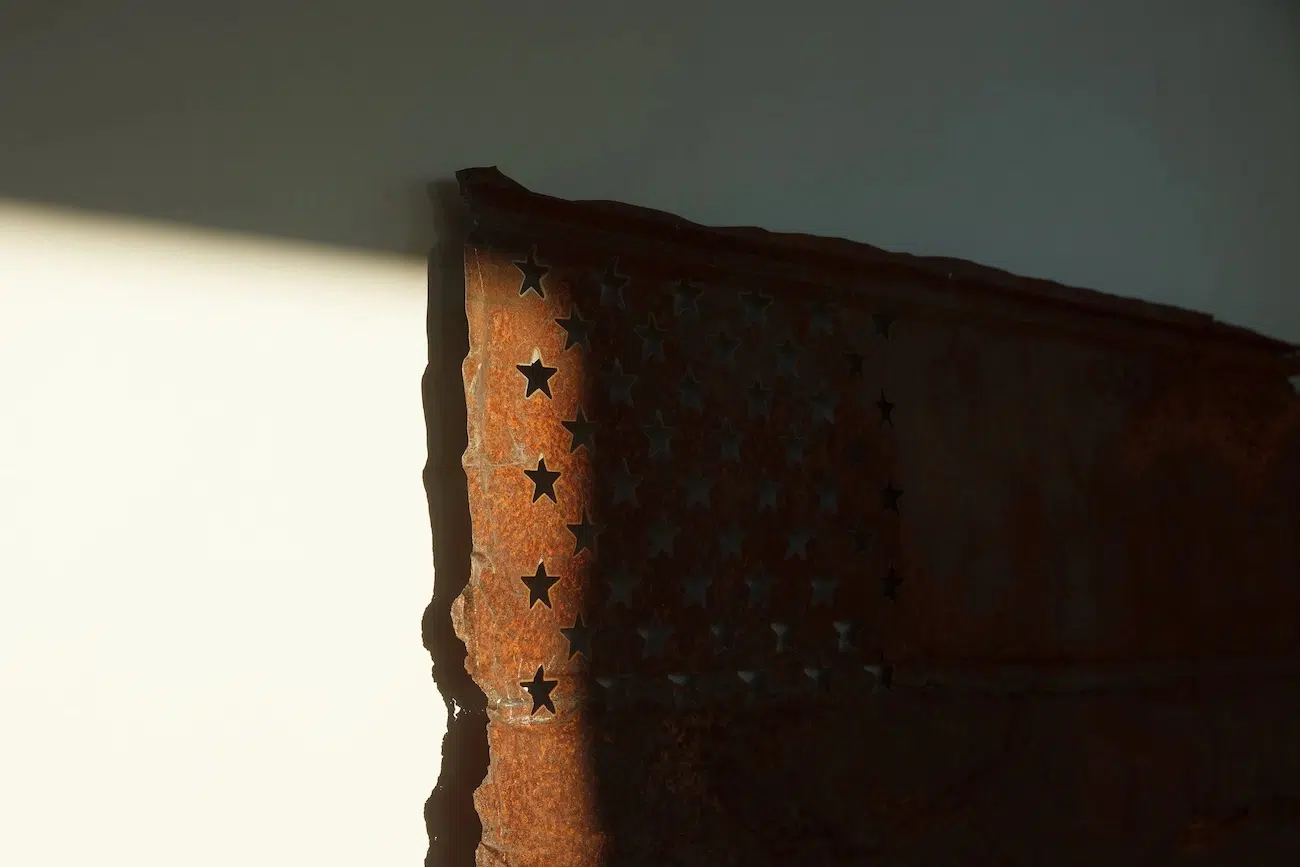
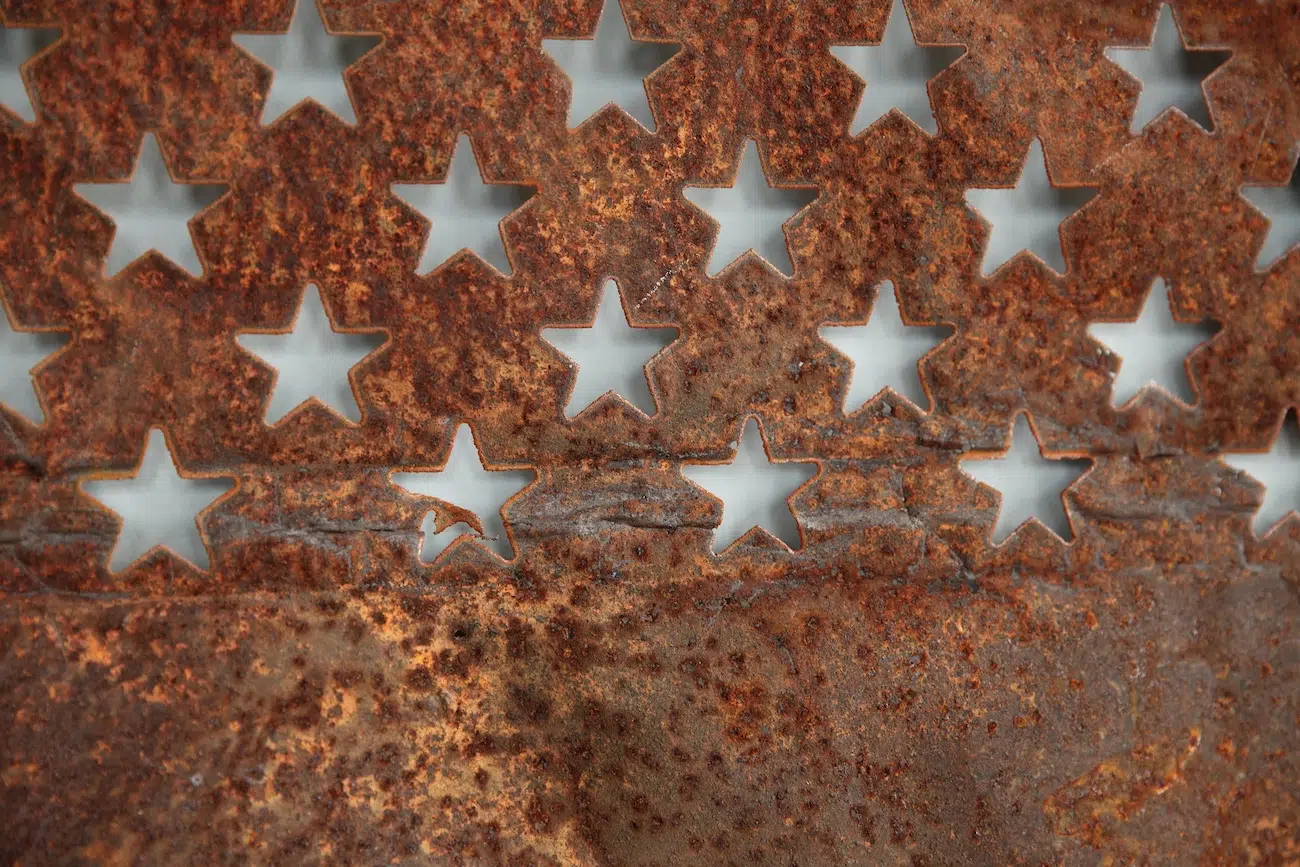
I also look for materials that are open to reinterpretation. I don’t want an object that’s already saying exactly one thing. I’m interested in materials that can operate as metaphor while still retaining their original identity. A rusted roof is still a roof, but it can also become a page, a monument, a landscape, a flag, or a bird.
Your work brings together Revolutionary-era history, Black Loyalist narratives, and Lowcountry folklore. How did you research these histories, and how do you balance historical accuracy with artistic interpretation?
The research is fairly broad. It begins the way most historical research does—with books, podcasts, documentaries, films, and visiting local historic sites—but it doesn’t stop there. Some of the most meaningful insights came from conversations with fellow Charlestonians, young and old, spanning multiple generations.
The Revolutionary War didn’t happen as a single event. It unfolded over years, across landscapes, and alongside ordinary lives. While I was reading about battles and political movements, I was just as interested in the quieter moments happening beside them—the meals, the celebrations, the work, and the conversations.
As a Charleston native, I feel I have both the proximity and the responsibility to speak from within that landscape. I’m not interested in illustrating history as much as contributing to the folklore that grows around it. The documented history remains intact. My role is to describe the color, atmosphere, and mythology that history alone can’t fully capture.
Mr. Freedman became the figure around which that world could grow. I surrounded him with a landscape, a ceremony, and a visual language rooted in Charleston’s architecture, traditions, and memory. History establishes the foundation. Folklore gives it a living voice.
What aspects of Charleston’s history do you hope viewers come away with a deeper understanding of after experiencing the work?
History isn’t confined to monuments, battlefields, or historic houses. 250 Years from Mr. Freedman asserts that those everyday objects, places, and people deserve commemoration too.
Many of your sculptures feature recurring symbols drawn from the Lowcountry’s architecture, landscape, and mythology. How did you develop this visual language, and are there particular motifs that carry special significance within 250 Years from Mr. Freedman?
I was born here. I grew up in North Charleston. I’ve spent years making palmetto roses, salvaging historic materials, working inside historic sites, and paying attention to the architecture, traditions, and everyday rituals that shape the city.
Over time, those things became my lexicon. The crow, the Charleston Eagle, the palmetto rose, the hog, the stars, and the pit all belong to the same landscape because they’re part of the Charleston I know.
After completing 250 Years from Mr. Freedman, what new questions about history, place, or material are you most interested in exploring next?
My practice has always grown out of participating in the city—its architecture, preservation, foodways, traditions, folklore, and everyday rituals. Living here has taught me that the most meaningful stories aren’t always found in extraordinary events. They’re embedded in ordinary practices that are repeated, inherited, and carried forward over generations. Charleston continues to change, my relationship to it continues to evolve, and my work evolves with it. 250 Years from Mr. Freedman is an ongoing conversation with the place I call home.
View this post on Instagram