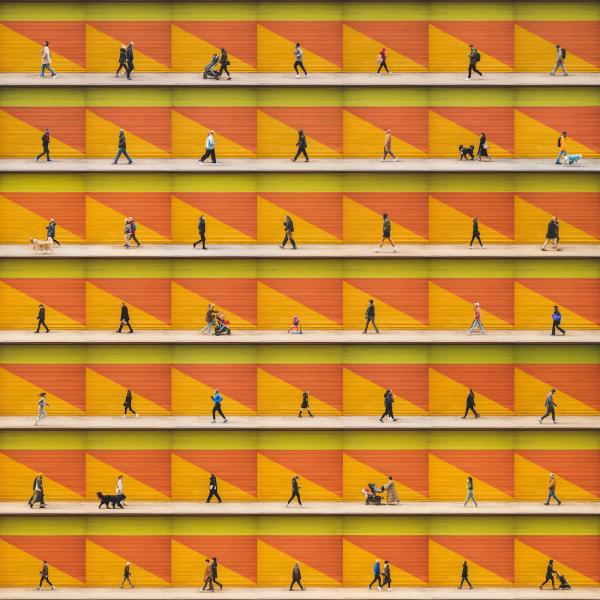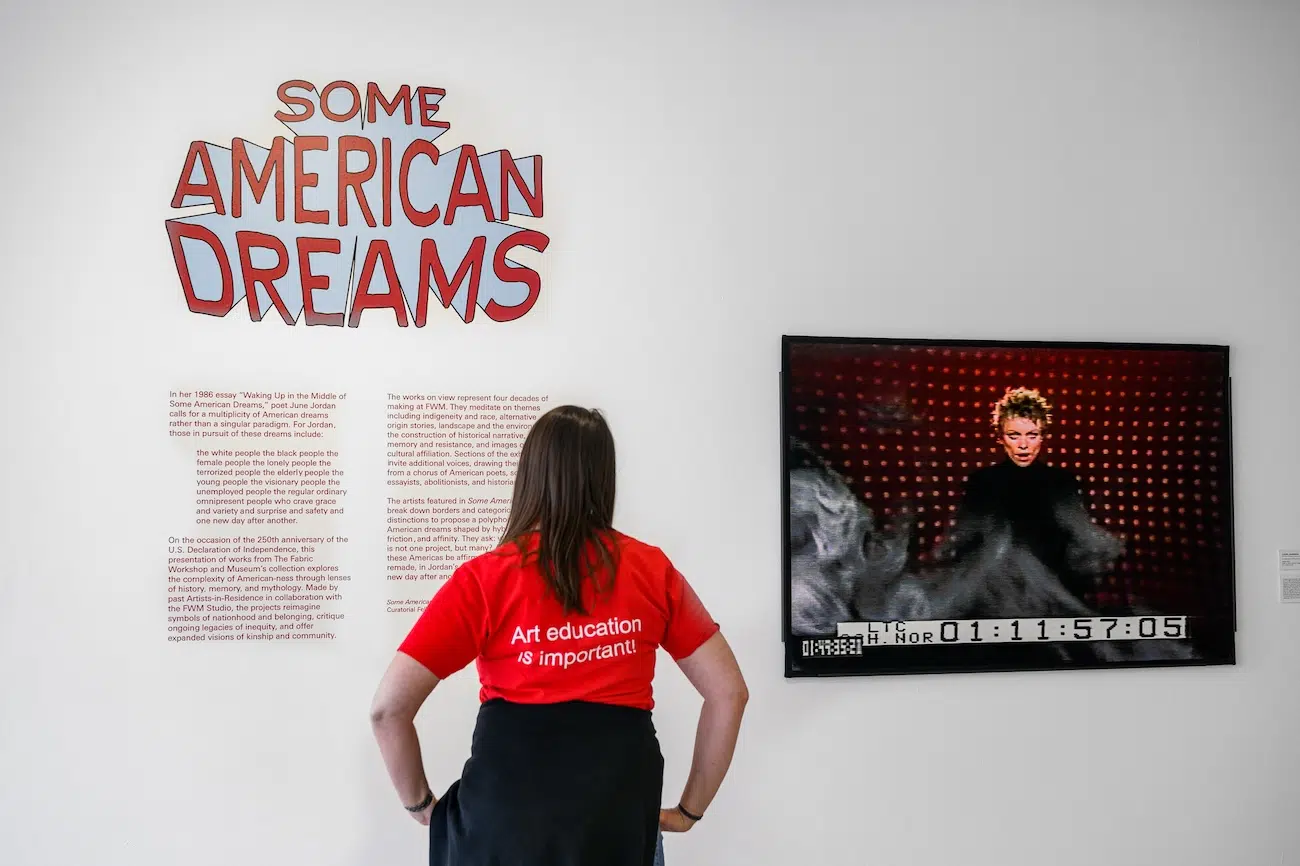
At right: Laurie Anderson, “Frame,” 2000.
Some American Dreams (installation view), 2026. The Fabric Workshop and Museum. Photo credit: Constance Mensh.
The year 2026 marks the 250th anniversary of the U.S. Declaration of Independence, and Philadelphia, Pennsylvania, is a particularly special place. It is, after all, where the document severing the country’s ties to Great Britain was signed. Cultural institutions are marking this event with special exhibitions and programming, each in a unique way. The Fabric Workshop and Museum (FWM) has done so through its exhibition titled Some American Dreams.
Some American Dreams features 27 pieces by 20 artists in a variety of media. Working in furniture, sculpture, textiles, clothing, video, and photography, the pieces in the show span four decades of making at FWM. That’s right—making. The institution operates differently from many other places, as the contemporary art museum is devoted to both creating and preserving works of art. It has an Artist-in-Residence Program that supports creatives at all stages of their career, allowing them to collaborate with FWM on new materials and media. It helps push their work forward, giving them the time and space to properly do so.
Now on view until June 14, 2026, Some American Dreams contains works by artists completed while in residence at FWM. Hilde Nelson, FWM curatorial fellow, looked through the collection to build out the show, ultimately proposing the question of, “What if ‘America’ is not one project, but many?” And, in doing so, how might these Americas be “affirmed, resisted, or remade?”
My Modern Met had the opportunity to speak with Nelson about curating the show and what visitors can expect to see—especially in the dialogue happening between the works, which sometimes are at odds with one another.
Scroll down to read our exclusive interview, which has been edited for length and clarity.
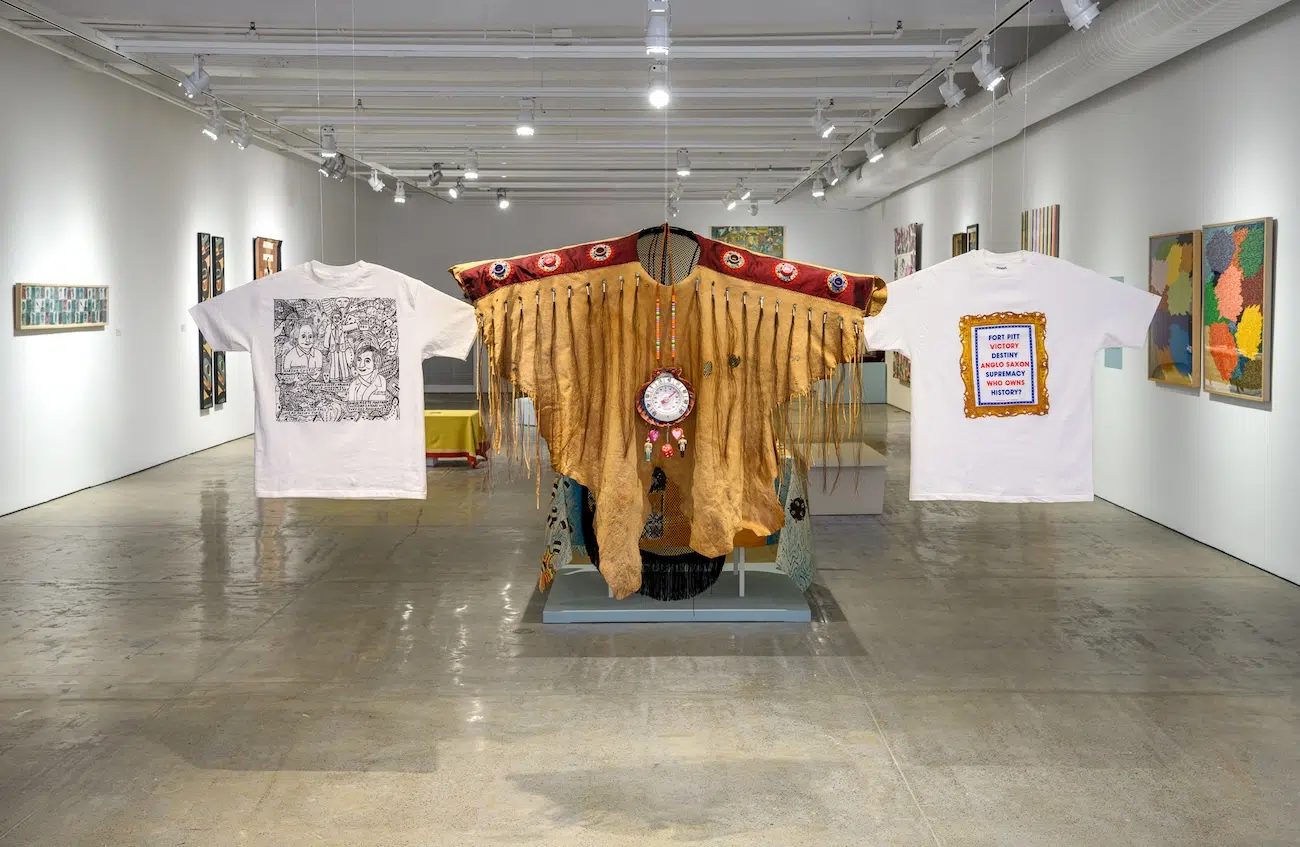
Garments from left to right: Rev. Howard Finster, “George Washington Meets Martha Custis,” 1984; James Luna, “High Tech War Shirt,” 1997–1998; Hock E Aye Vi Edgar Heap of Birds, “Who Owns History,” 1992.
Some American Dreams (installation view), 2026. The Fabric Workshop and Museum. Photo credit: Constance Mensh.
What’s your background, and how did you become associated with The Fabric Workshop and Museum?
I am currently the curatorial fellow here at the Fabric Workshop. At the same time, I’m a PhD candidate in the History of Art at Bryn Mawr College. My academic work focuses mostly on contemporary time-based media, especially film and video, and my dissertation will be about feminist film and video. But before that, I worked as the curatorial assistant for contemporary art at the Dallas Museum of Art, where I curated the first solo museum exhibition of the painter Naudline Pierre.
Before that, I got my master’s at Williams College in the history of art, and I also did some curatorial work and curated a show at the Williams College Museum of Art. I’ve had experience working in institutions, both tiny and giant. But this is my first institution that has had a studio component and is fundamentally based on the studio practice and artist residencies. So that’s been a real treat and shaped how I approach the work.
The collection comprises long-term collaborations between the studio and the artists in residence. The curatorial process is not necessarily hugely different, but the kind of works that you have to work with has that really interesting sort of inception and development process.
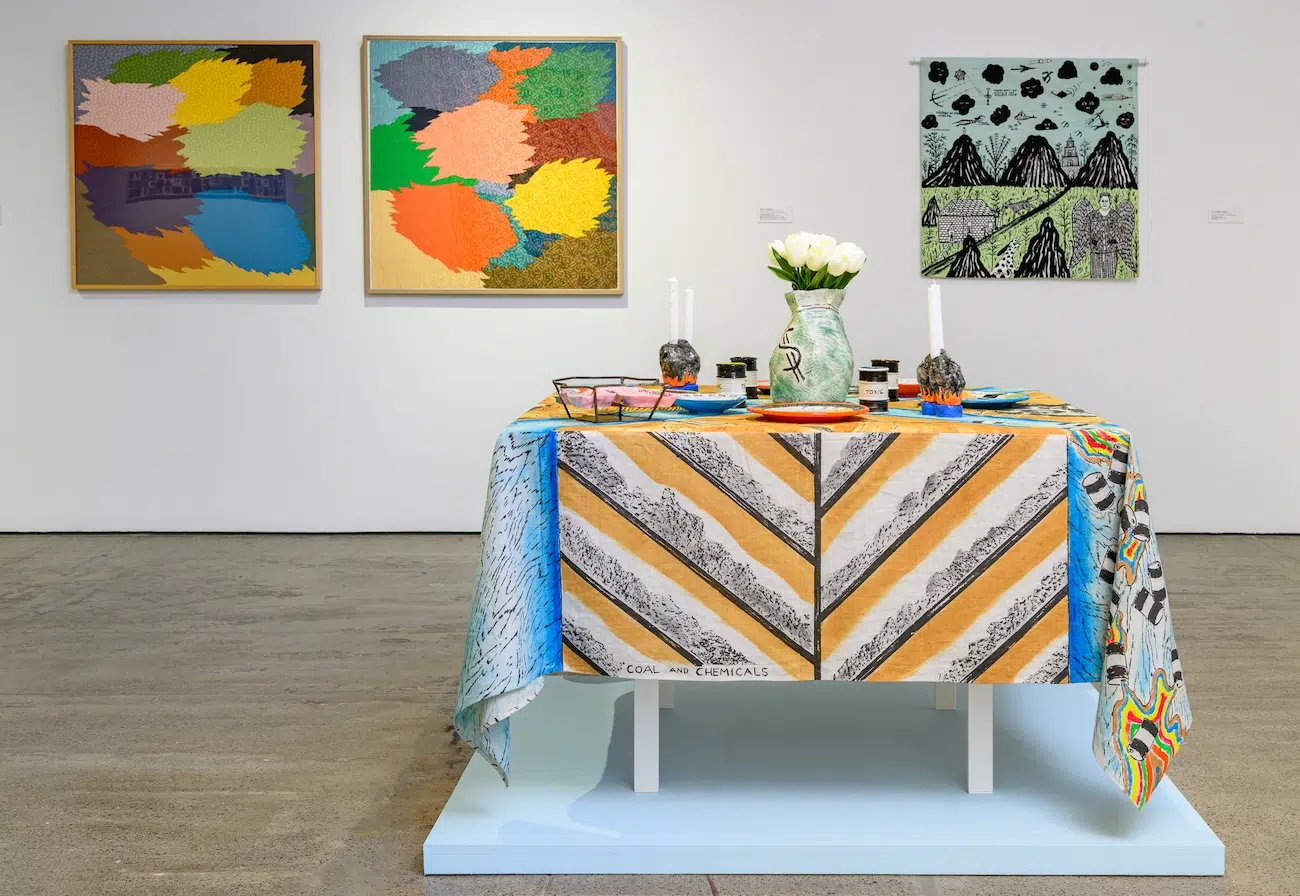
From left: Hock E Aye Vi Edgar Heap of Birds, “Neuf Series #36” and “#38,” 1992; Becky Howland, “Toxicological Tablecloth,” 1984; and Rev. Howard Finster, “Road to Eternity,” 1984.
Some American Dreams (installation view), 2026. The Fabric Workshop and Museum. Photo credit: Constance Mensh.
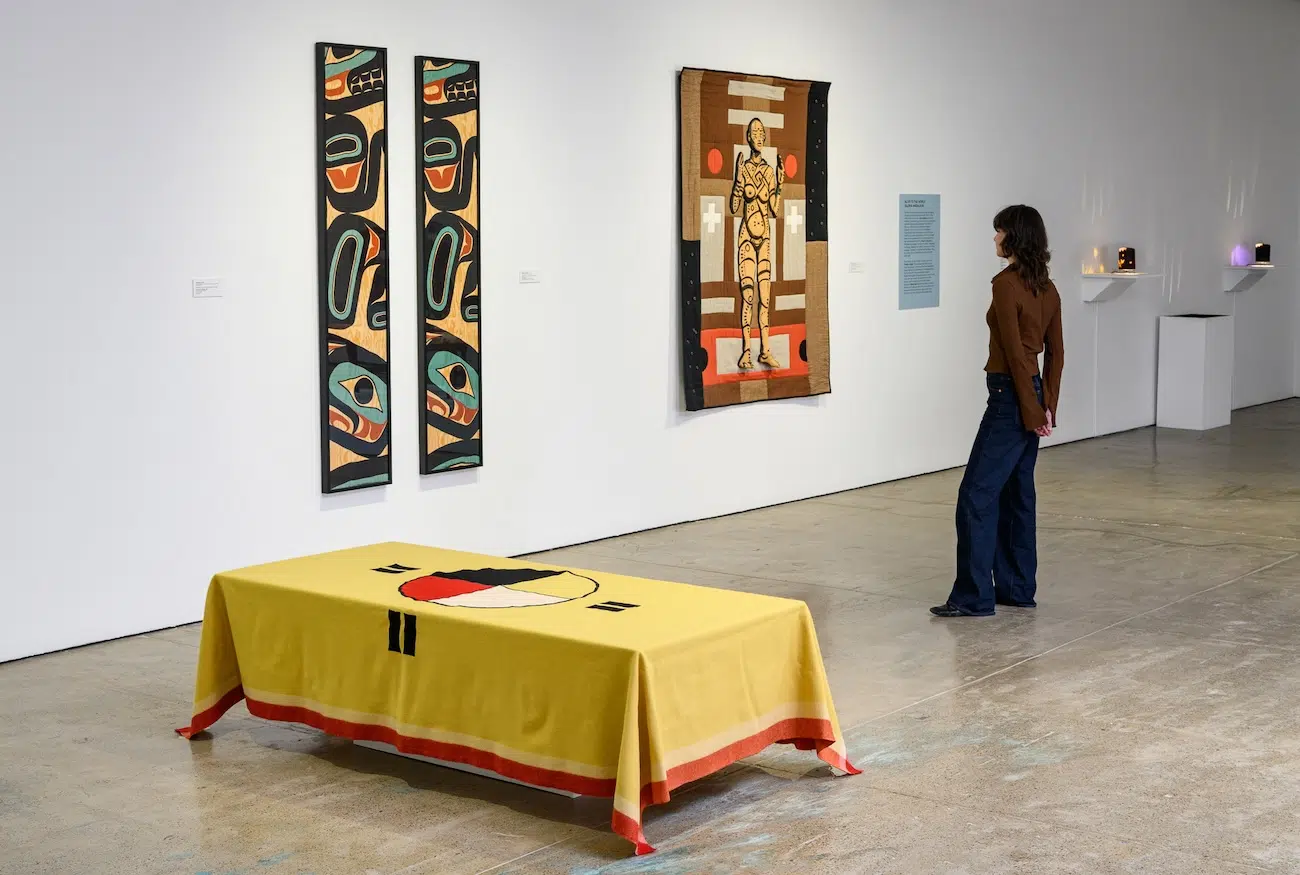
Some American Dreams (installation view), 2026. The Fabric Workshop and Museum. Photo credit: Constance Mensh.
How did the concept for Some American Dreams come about?
None of the works in the show are new commissions. I was given the prompt to work with, like many institutions around Philadelphia, which are responding to the 250th anniversary of the Declaration of Independence. I was asked to look through our collection and think about how the Fabric Workshop might respond to meeting that historical moment. And so the works in the show, the oldest work is from 1983, and the newest work is from 2022, which, in some ways imperfectly, but almost sort of captured the breadth of the Fabric Workshop’s history.
The Fabric Workshop was founded in 1977, so works from the beginning up till now. And what I found really useful in thinking about this project is, rather than thinking about what constitutes American art—who is an American artist?—I came at it more from the perspective of how artists are thinking about questions of Americanness and the American project. And so in that way, I was very lucky because so much of this gets to be very artist-driven and the kinds of questions that they’re asking.
Because of the time period I had to look at, and the historical breadth, so many of the artists were thinking about major political moments in the United States, but also thinking about broader questions: how we talk about history and how we talk about memory. Several of the works from the 1990s, when you’re having the NEA wars and the 1993 Whitney Biennial, raise questions about how art addresses questions of gender and race.
In a lot of ways, I got a nice insight into thinking about how artists are considering these questions of nationhood, of belonging, of markers of identity, of the landscape in relationship to the environment. As I was going through our collection, I was less interested in thinking solely about how artists are incorporating aspects of responding to the founding fathers or things like that. There are works in the show that do that, and I think that’s an important component of the show. One of the first works you see is Donald Lipski’s giant American flag rendered in all white.
An important part of the exhibition is how artists are directly taking on and reworking these kinds of symbols. But in a lot of ways, I was also hoping to come at it a little more obliquely, and how artists are, in some ways, thinking beyond the boundaries and borders of the United States as a nation to think about how artists are interested in stories of the Americas that are far older than 250 years, or who are thinking about the Americas as a broader sort of geographical region.
I think the collection was able to provide that in these kinds of conversations with each other. Obviously, these artists are not necessarily having a moment of creation, but I think they speak to these preoccupations that come up over time. And that was what really led to the thematic idea of Some American Dreams.
Who’s an American? That’s not really the purview of the show. The show is to say that these things are always sort of in fractured tension with each other.
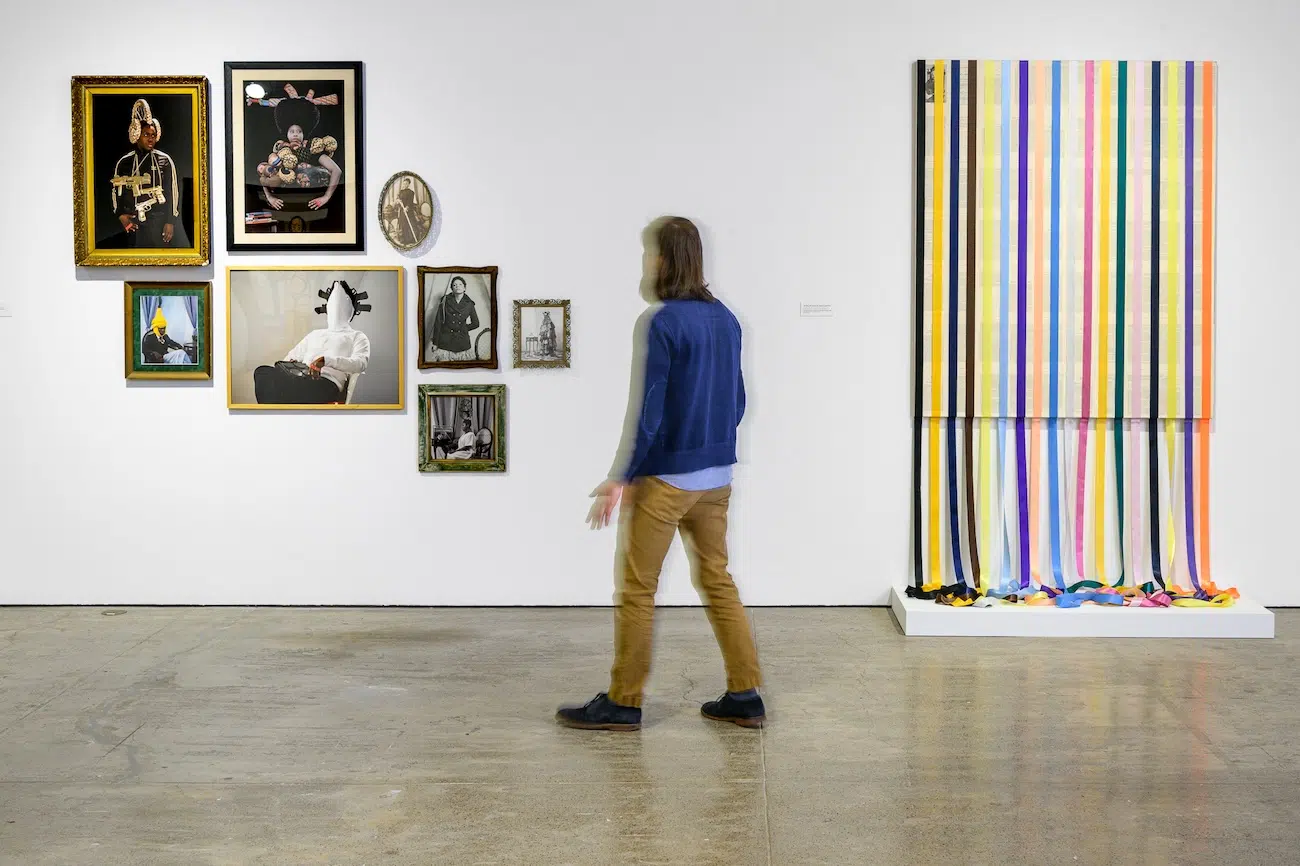
From left: Robert Pruitt, “Untitled Photographs,” 2011; Tim Rollins and K.O.S., “Incidents in the Life of a Slave Girl (After Harriet Jacobs),” 1999.
Some American Dreams (installation view), 2026. The Fabric Workshop and Museum. Photo credit: Constance Mensh.
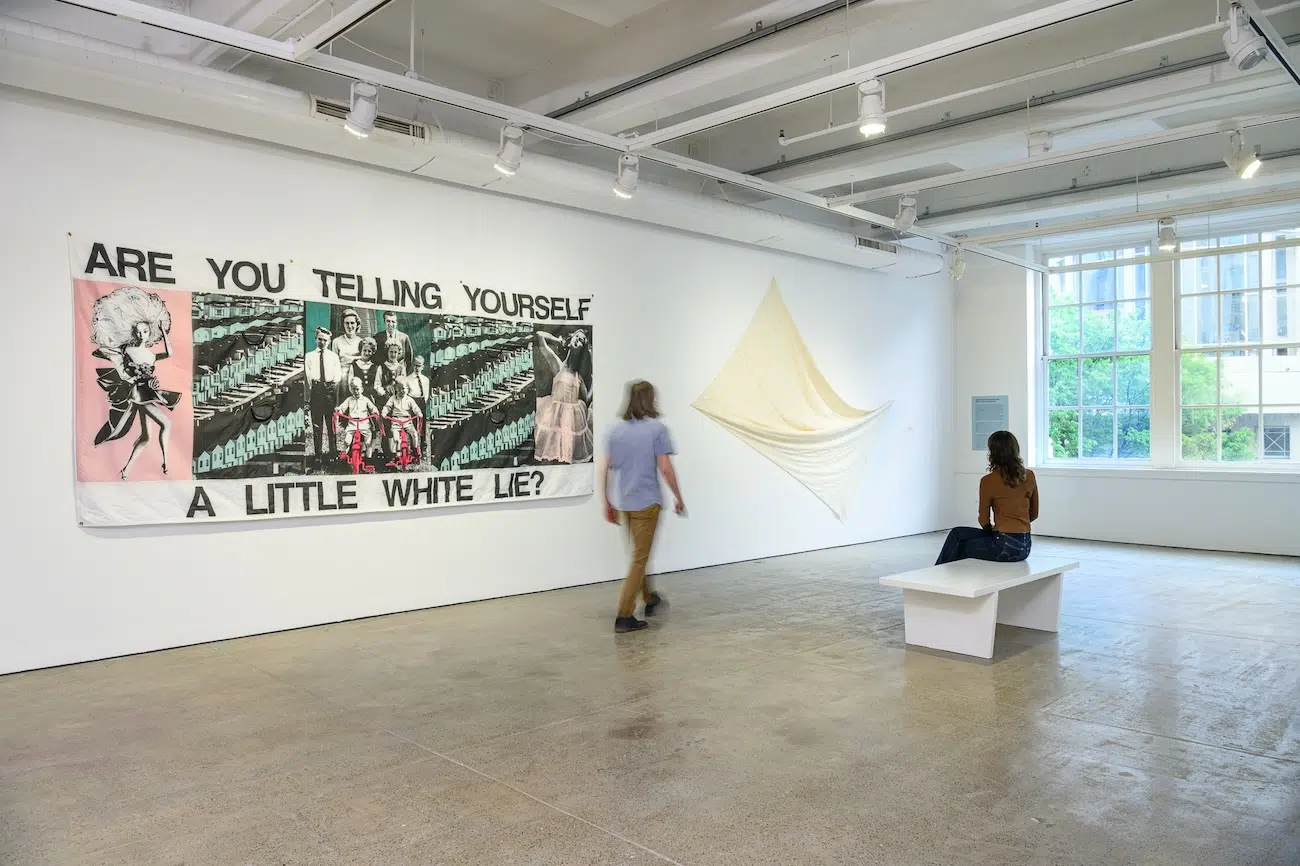
From left: S.A. Bachman, “Are You Telling Yourself a Little White Lie?,” 1988; Donald Lipski, “Who’s Afraid of Red, White and Blue #37,” 1990.
Some American Dreams (installation view), 2026. The Fabric Workshop and Museum. Photo credit: Constance Mensh.
Where did the title come from?
I ran into the essay, Waking Up in the Middle of Some American Dreams by June Jordan. That essay really encapsulated a lot of the things I was kind of thinking about, looking at the collection, and wanting to prioritize ideas of collectivity and coalition against individualism. So I think in some ways, I found the perfect thing to bury with the ideas I was already having about, like, what is the chorus?
How can we bring in these many voices, who are sometimes in alignment and sometimes in contention? And how can that be a more productive or a more expansive way of thinking about Americanness and reckoning with what that project or projects are in this moment?
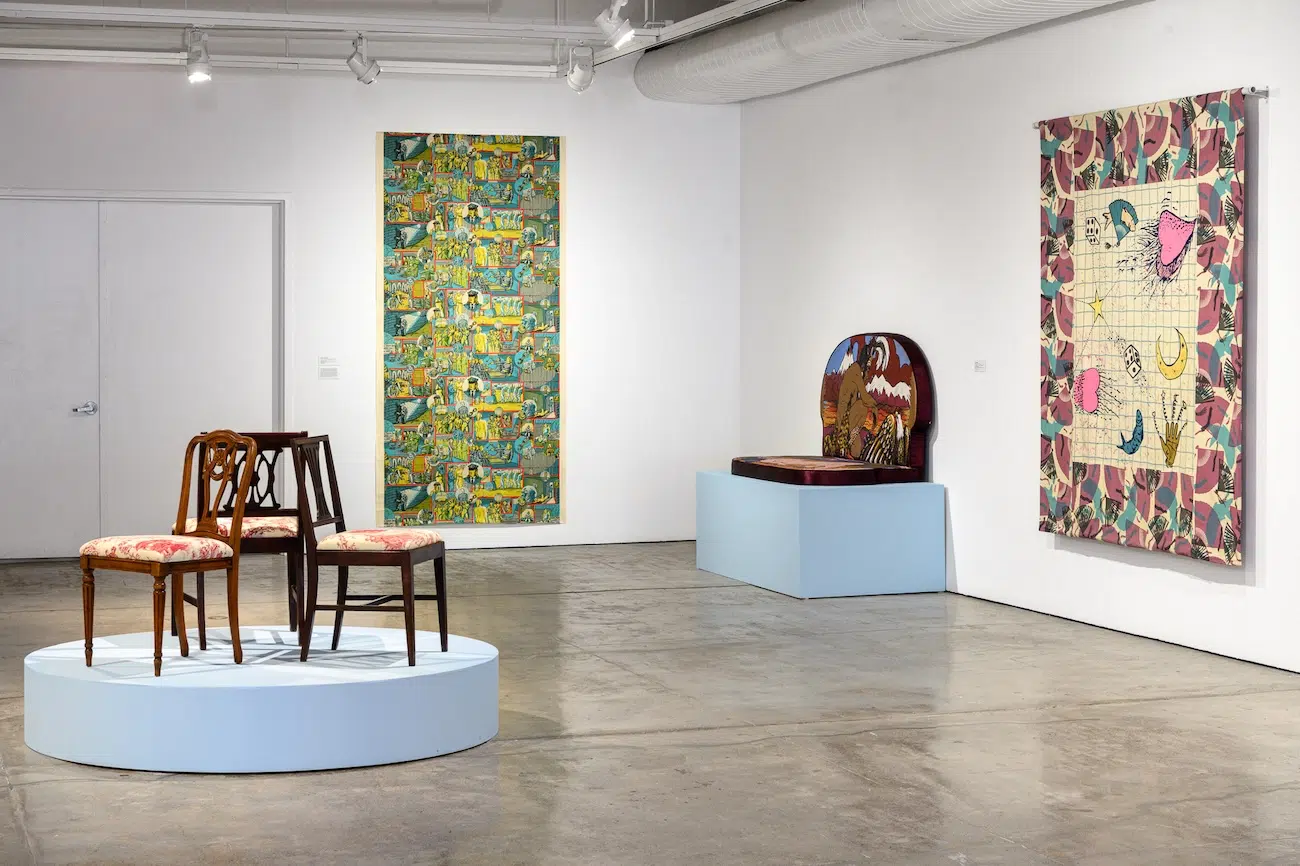
From left: Nicole Eisenman, “Gray Bar Hotel,” 2003; Renée Green, “Mise-en-Scène: Commemorative Toile,” 1992; Luis Jiménez, “Low Rider Backseat,” 1983; Betye Saar, “Takin’ a Chance on Luv,” 1984
Some American Dreams (installation view), 2026. The Fabric Workshop and Museum. Photo credit: Constance Mensh.
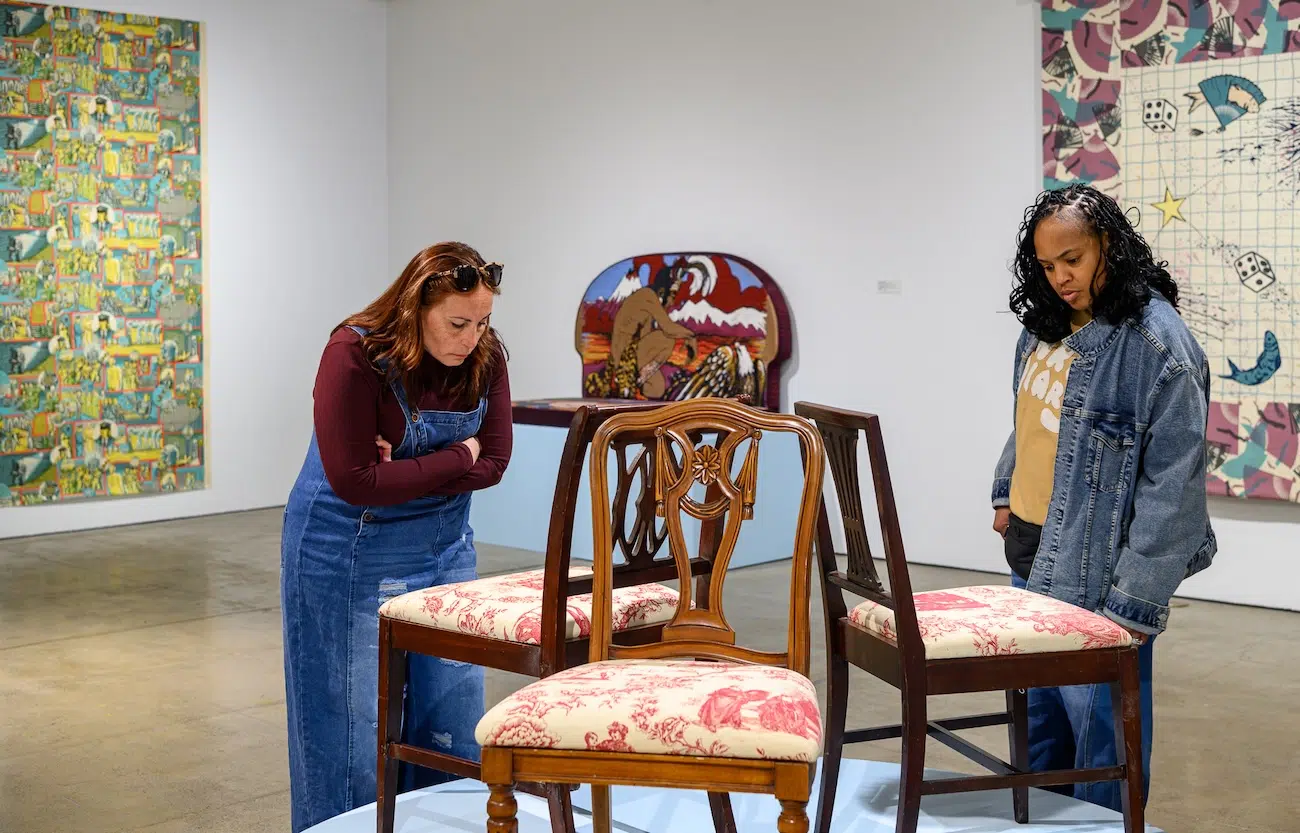
From left: Nicole Eisenman, “Gray Bar Hotel,” 2003; Renée Green, “Mise-en-Scène: Commemorative Toile,” 1992; Luis Jiménez, “Low Rider Backseat,” 1983; Betye Saar, “Takin’ a Chance on Luv,” 1984
Some American Dreams (installation view), 2026. The Fabric Workshop and Museum. Photo credit: Constance Mensh.
Are there some works in the show that you feel are opposed to one another?
Probably the most obvious one, or the one that I think comes up most frequently in some ways, is a group of shirts. One of the nice things about the Fabric Workshop is that, in the early days, to give you some context on the institution, the goal was to teach artists how to screen print on fabric. So do large repeat pattern yardages.
Since then, it’s expanded beyond that, and artists work in a number of different mediums. But textiles are kind of the bread and butter, obviously, with the fabric workshop. So what’s really great is that we have everything in the exhibition, from a duvet cover to a blanket to t-shirts. So there’s a grouping of three t-shirts that are suspended in the middle of the gallery.
I think it’s important to say, too, that this is not to say some artists have a good view or some have a bad view. I think if anything, it’s more about how these artists are thinking, sometimes about the same stories in very different ways. And to acknowledge the value that those stories have for the teller and for the receiver.
So, in that, I wanted to pair a shirt we have by Reverend Howard Finster, who was a self-taught artist, largely based in Georgia. His shirt is George Washington meets Martha Custis. It’s interesting and honestly kind of a confounding shirt in many ways, because it’s the representation of Martha Custis Washington, both as a young woman and an older woman, and in this sea of fantastic creatures, there’s this sort of unnamed man holding a Bible. It’s this strangely ecstatic image, but it’s also a kind of celebration. [Howard] made many works that feature George Washington. I believe his first work featured George Washington, who was kind of a personal hero for him. So, I think that work in many ways is like a celebration of this founding family, this sort of revolutionary love. On the other side of that, paired it with Edgar Heap of Birds’ Who Owns History?, which is a shirt that, on the front, lists a series of phrases that are drawn from a plaque marker that used to be at Fort Duquesne in Pittsburgh. It’s no longer there, but it celebrated the British General Forbes for instituting Anglo-Saxon supremacy on this continent. And so for him, he’s asking, who owns history, who’s telling these stories, for whom does, who would celebrate Anglo-Saxon supremacy, and who doesn’t.
In the middle of those works, there is a work called High-Tech Warshirt by James Luna. I should mention, too, Edgar Heap of Birds is Cheyenne and Arapaho. James Luna was of Ipai and Puyukitchum descent and of Mexican descent. So I think questions of lineage are also very pervasive throughout the show. His work incorporates a Sunbeam thermometer, and the form evokes garments that are affiliated with the Ghost Dance movement, which was a historical movement in the late 1880s, early 1890s, a millenarian and religious spiritual movement that spread across the Plains tribes and became a means of resisting the American government. It’s probably most famously associated with the massacre at Wounded Knee. So, I think that work is an important mediator between these stories because it’s thinking about, on the one hand, [how] historical violence is very much core to the story of America. And on the other hand, I think that James Luna’s work is important for arguing that Indigeneity is not limited to the past, and that Indigenous life very much continues into the present, the contemporary moment.
Those works are situated in a conversation to open up these questions as opposed to saying, you know, like, to open up these questions about how we perceive these histories and who can tell them.
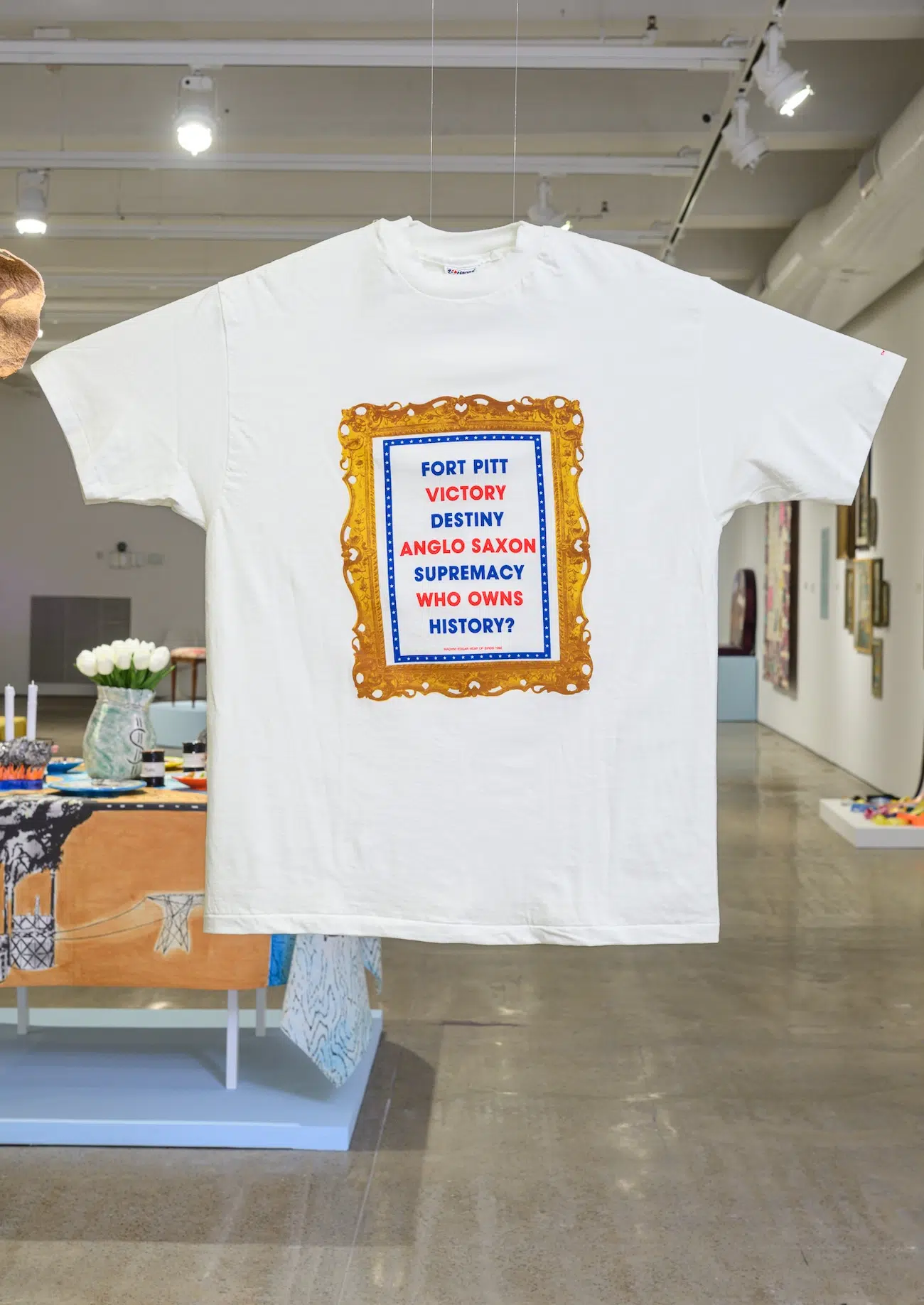
Hock E Aye Vi Edgar Heap of Birds, in collaboration with The Fabric Workshop and Museum, Philadelphia. “Who Owns History?,” 1992. Pigment on cotton t-shirt, 32 x 38 ½ inches. Photo credit: Constance Mensh.
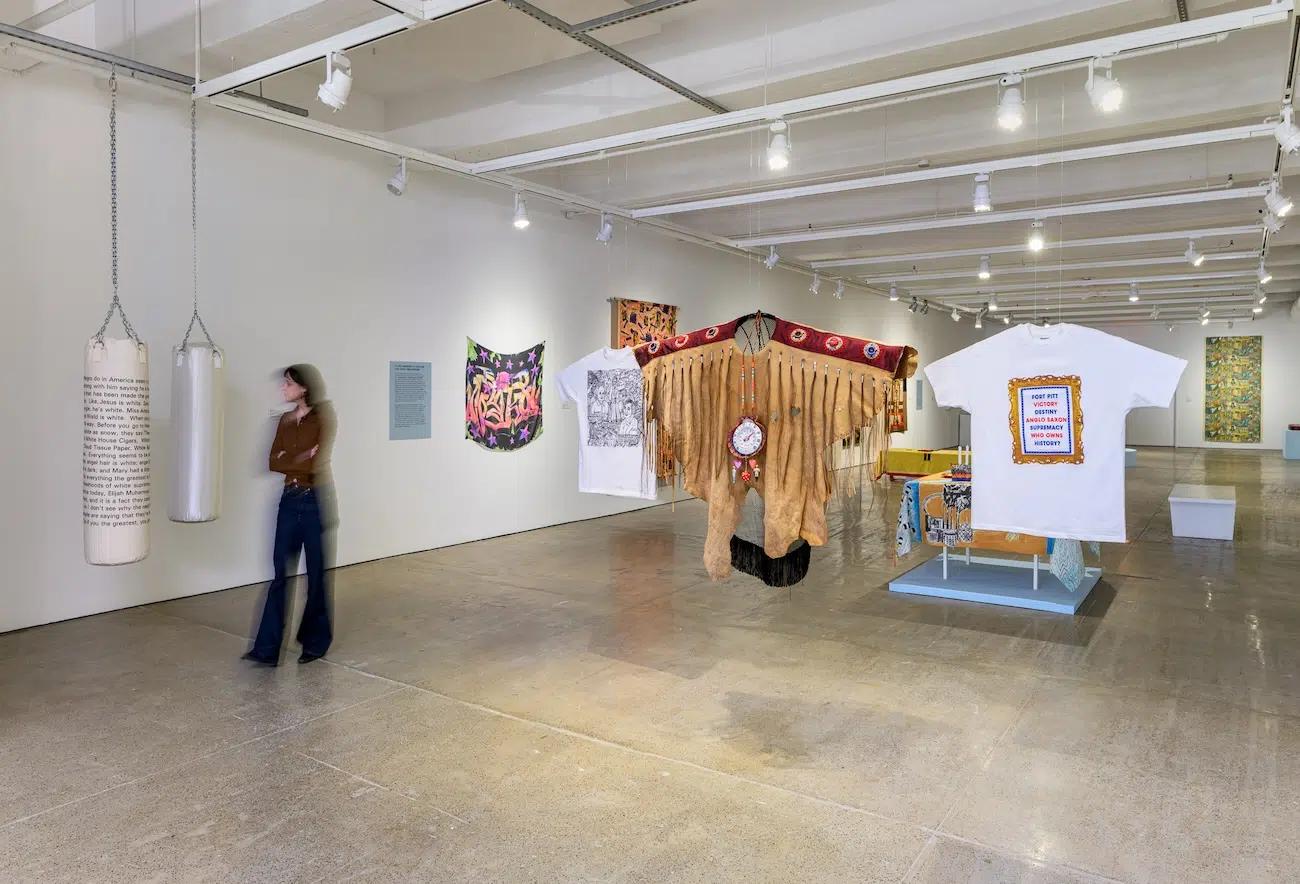
Some American Dreams (installation view), 2026. The Fabric Workshop and Museum. Photo credit: Constance Mensh.
What are the hopes you have as visitors move through the show?
It’s not a huge show, and we don’t have giant sections. But the works are divided into six different sections, and each title is drawn from a phrase or writing from essayists, abolitionists, and songwriters. I really wanted to prioritize this polyvocal experience. I think it’s important that the show reflects that any exhibition is the product of many voices. And so for me, that’s the some American dreams, right?
The section Sharp White Background (Zora Neale Hurston) is thinking about whiteness as both a formal quality and a kind of identity, and thinking about gender and race in that way. The section with the shirts is The Past Was Not History (Michel-Rolph Trouillot), which is a line from Silencing the Past.
[There’s a section] thinking about landscape, a section about other kinds of signaling belonging or signaling identity that are beyond Americanness, and a section thinking about images of resistance and the complications of resistance. They were meant to think thematically about how these works were in conversation with each other. But I also think it’s important to say that in many ways, they’re very porous.
These conversations are seeping across what may seem like a boundary in a section. And in all of these, you can make these cross-conversations across the gallery. That’s an advantage of having everything in one fairly open gallery. You have numerous sight lines that you can spot something across the room and be thinking about it, even if it’s not directly next to the work that it’s in conversation with.
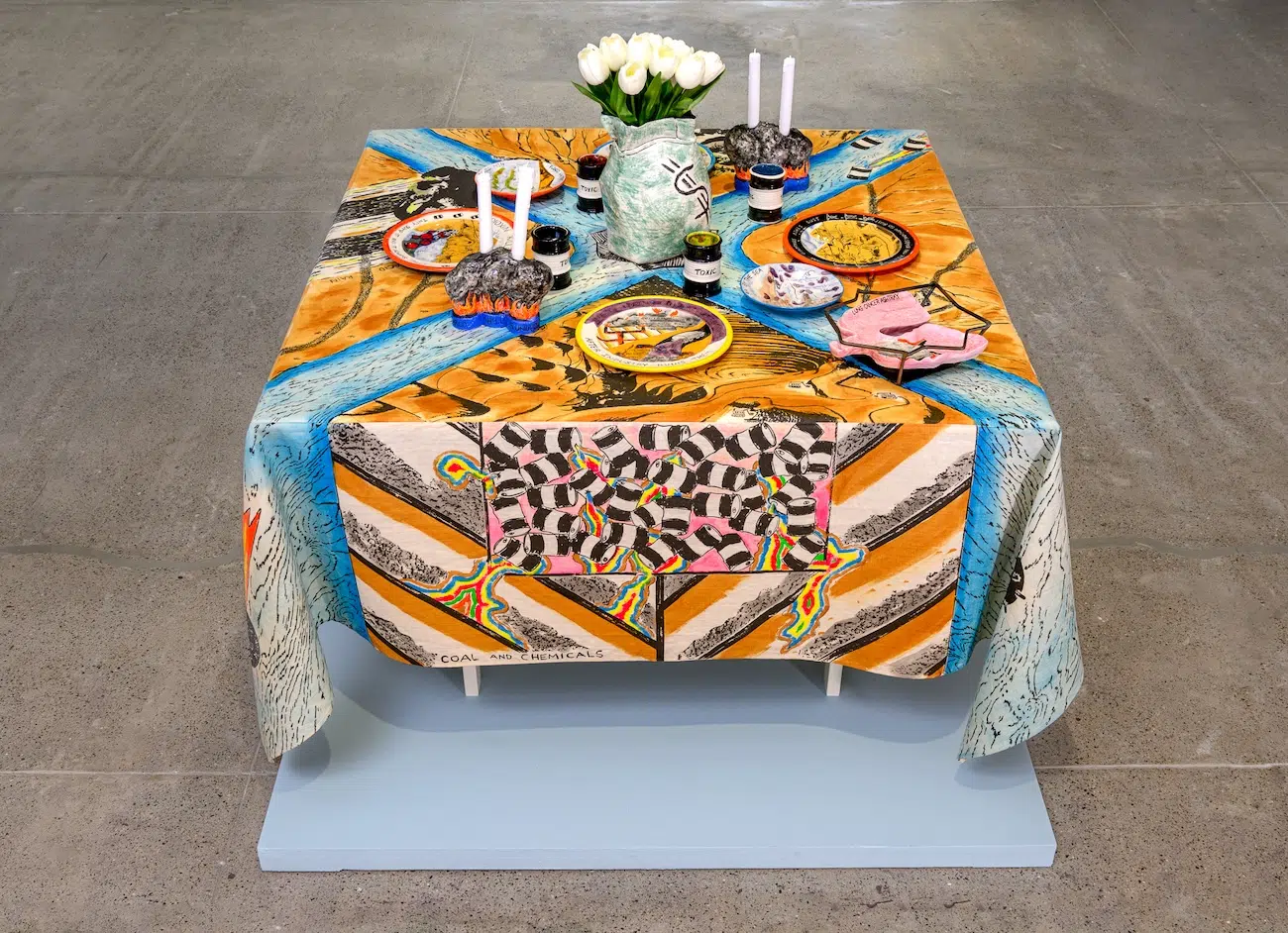
Becky Howland, in collaboration with The Fabric Workshop and Museum, Philadelphia. “Toxicological Tablecloth,” 1984. Pigment on linen, glazed ceramic, and metal. Tablecloth: 85 x 85 inches; cups: 4 x 2½ x 2 ½ inches; plates: 7 inches diameter; candleholders: 5 ½ x 7¼ x 4 inches; ashtray: 1¼ x 9 x 8 ¾ inches; vase: 10 ¼ x 5 x 5 inches. Photo credit: Constance Mensh
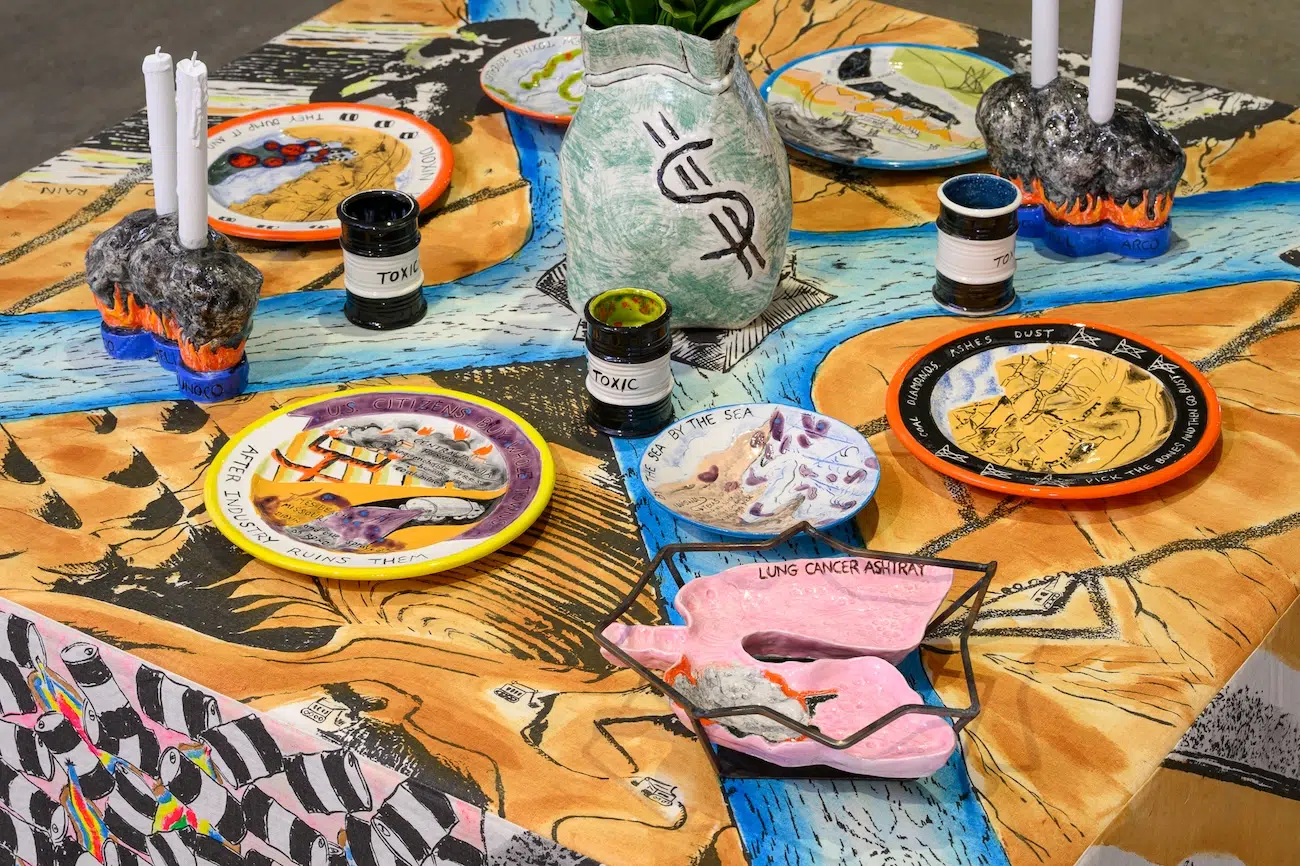
Becky Howland, in collaboration with The Fabric Workshop and Museum, Philadelphia. “Toxicological Tablecloth,” 1984. Pigment on linen, glazed ceramic, and metal. Tablecloth: 85 x 85 inches; cups: 4 x 2½ x 2 ½ inches; plates: 7 inches diameter; candleholders: 5 ½ x 7¼ x 4 inches; ashtray: 1¼ x 9 x 8 ¾ inches; vase: 10 ¼ x 5 x 5 inches. Photo credit: Constance Mensh
As we wind down, is there anything that we haven't talked about that you feel is important for the audience to know?
What has been really exciting about seeing the works out is that these artists are playing with form and material in really exciting ways. And I think if you are familiar with the practices of some of these artists, it can be really exciting to see them do something completely different. Imagine having Kara Walker’s Magic Lanterns out that invert her use of the silhouettes. But she’s still thinking in light and shadow, just in a totally different way, right?
Or artists who haven’t really worked in painting and are now producing these beautiful silk scarves. I think if you’re familiar with that, it’s exciting to see what they’ve done. And if you aren't, like, this is such an interesting way to be introduced to these artists’ work, because I think it traces almost 50-ish years of artistic production.
I’m really hoping that there’s something for everybody in terms of whether you are deeply, intimately familiar with these artists’ practice or if it’s brand new to you. It’s been really exciting to pull out artists who haven’t been on view in a while and to have people here at the studio who are like, “Oh, I haven’t seen this in 20 years,” or, you know, “Oh, I worked on this project ages ago.” I think it’s been really thrilling.
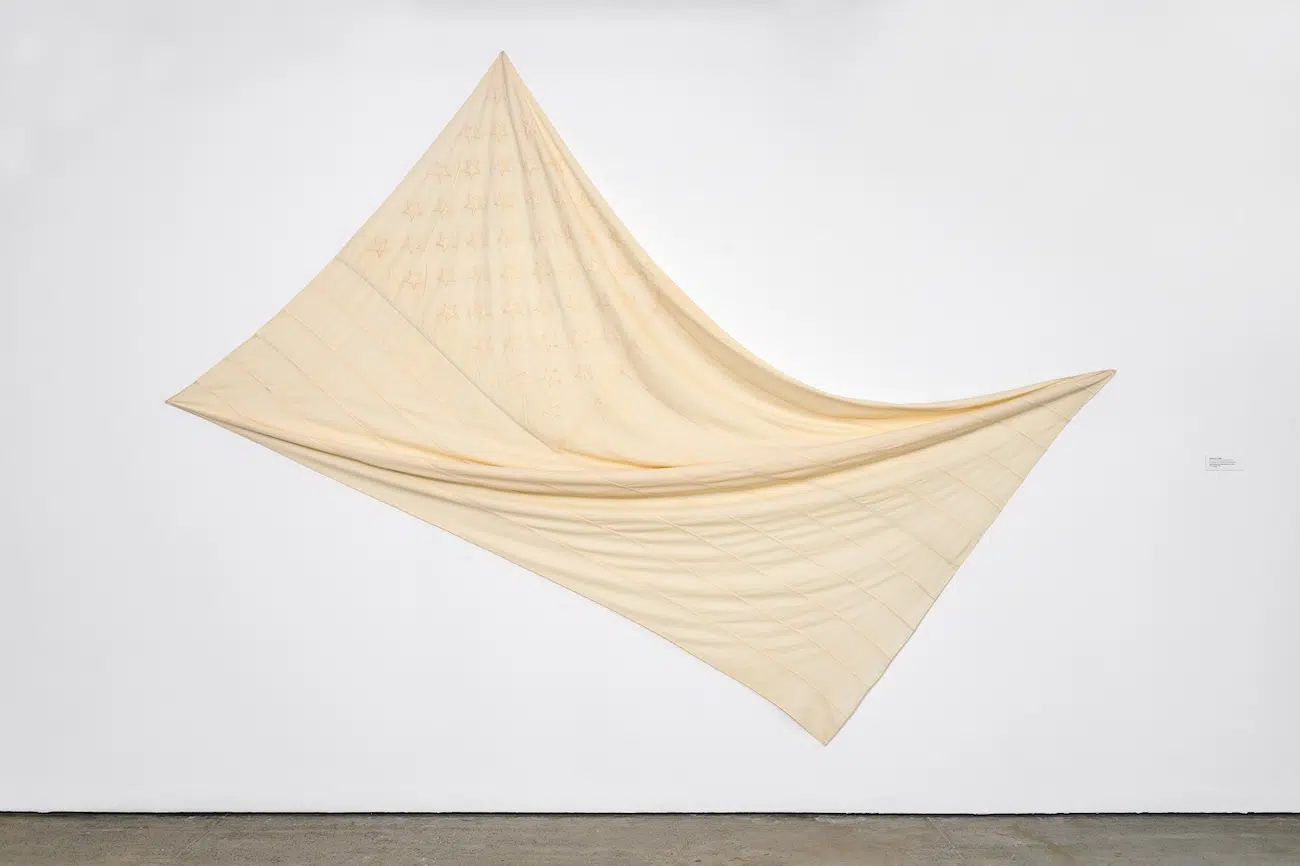
Donald Lipski, in collaboration with The Fabric Workshop and Museum, Philadelphia. “Who's Afraid of Red, White and Blue #37,” 1990. White wool gabardine, 71 x 115 inches. Photo credit: Constance Mensh
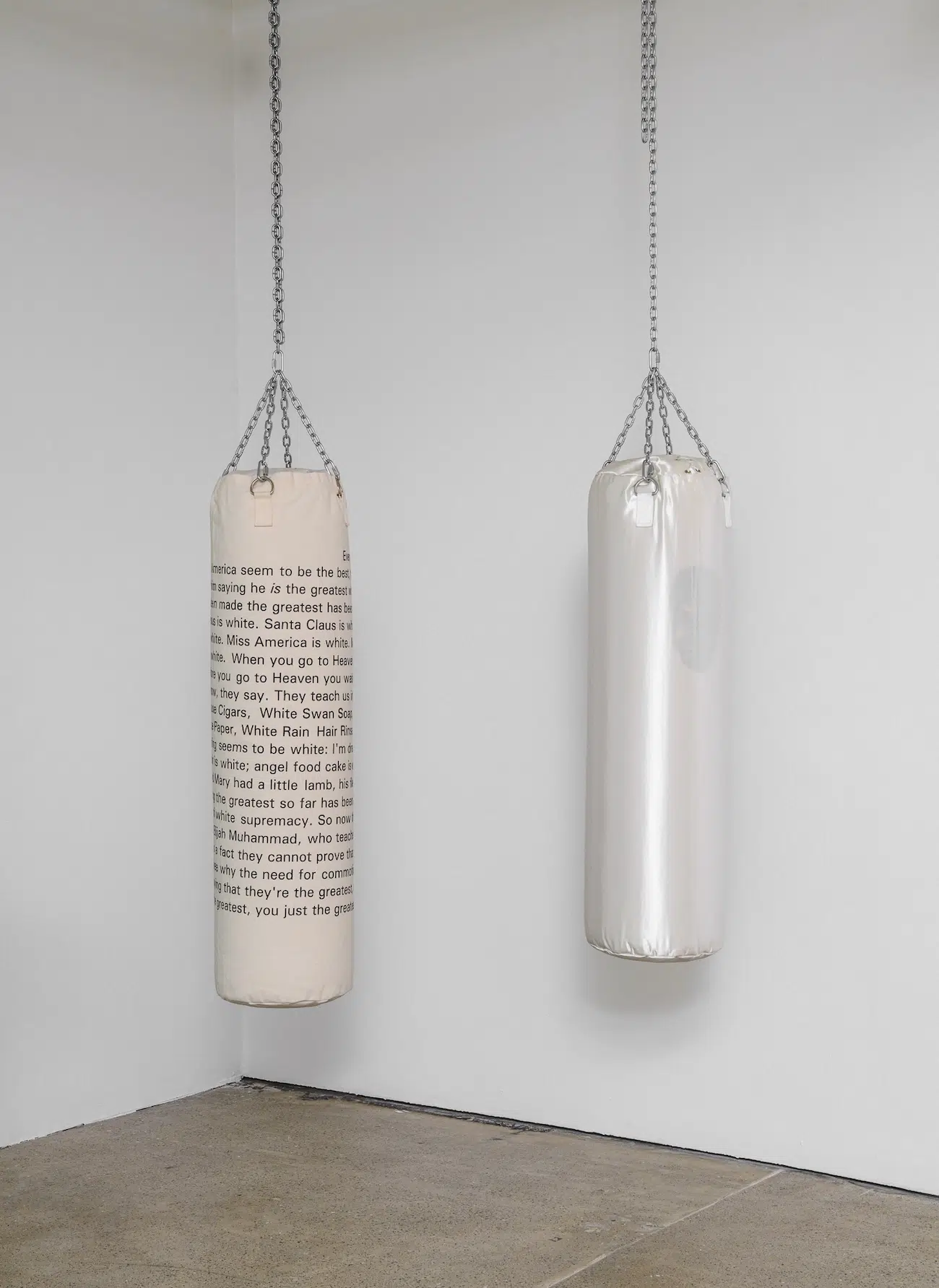
Glenn Ligon, in collaboration with The Fabric Workshop and Museum, Philadelphia. “Skin Tight (Muhammad Ali Text),” 1995; “Skin Tight (Muhammad Ali’s Head),” 1995. Cotton canvas, leather, satin, vinyl, pigment, and metal chain, 47½ x 13 inches diameter. Each an edition of 7. Photo credit: Constance Mensh.
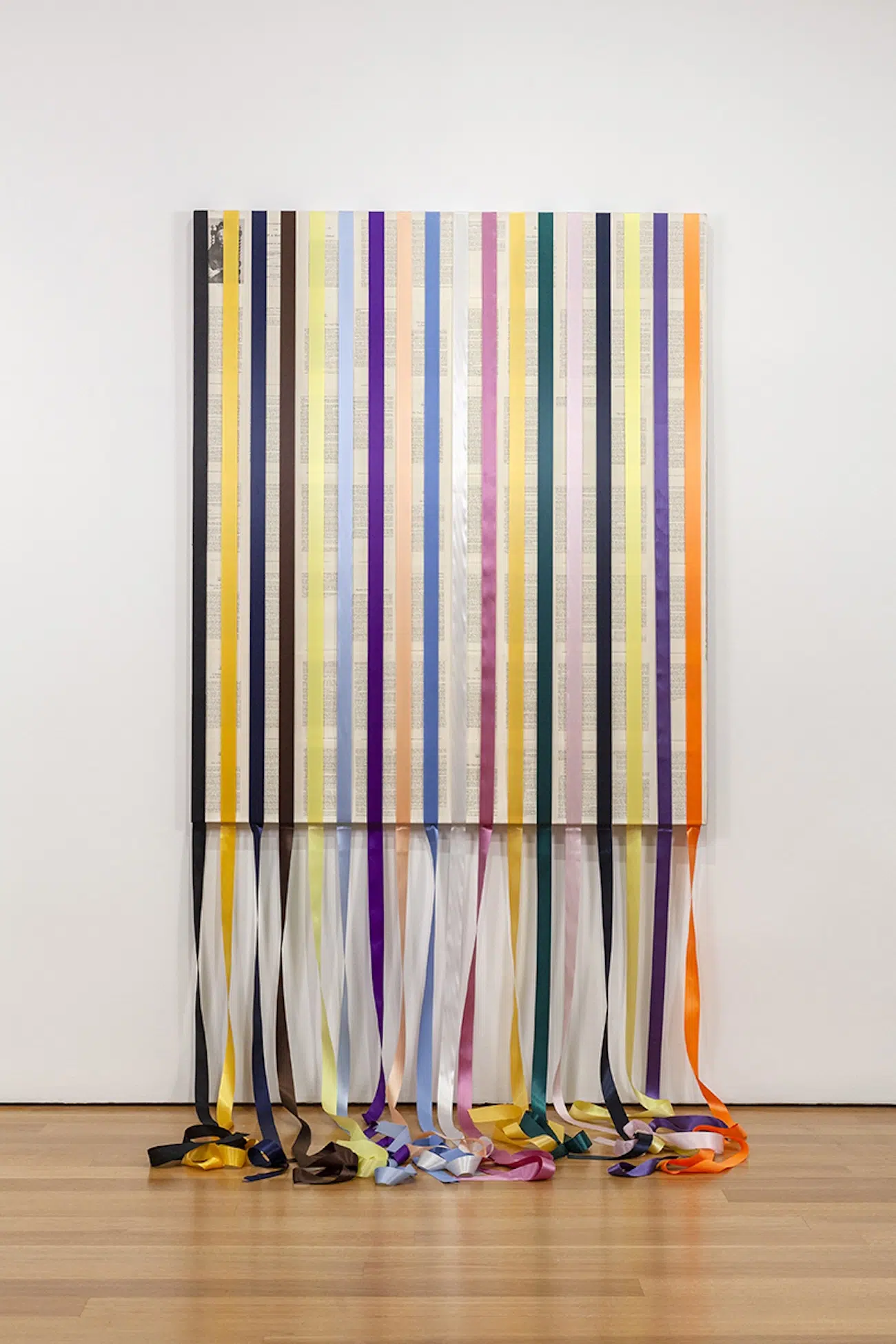
Tim Rollins and KOS, in collaboration with The Fabric Workshop and Museum, Philadelphia. “Incidents in the Life of a Slave Girl (After Harriet Jacobs),” 1999. Satin ribbons and book pages on linen, 63 x 53 inches. Photo credit: Carlos Avendaño.
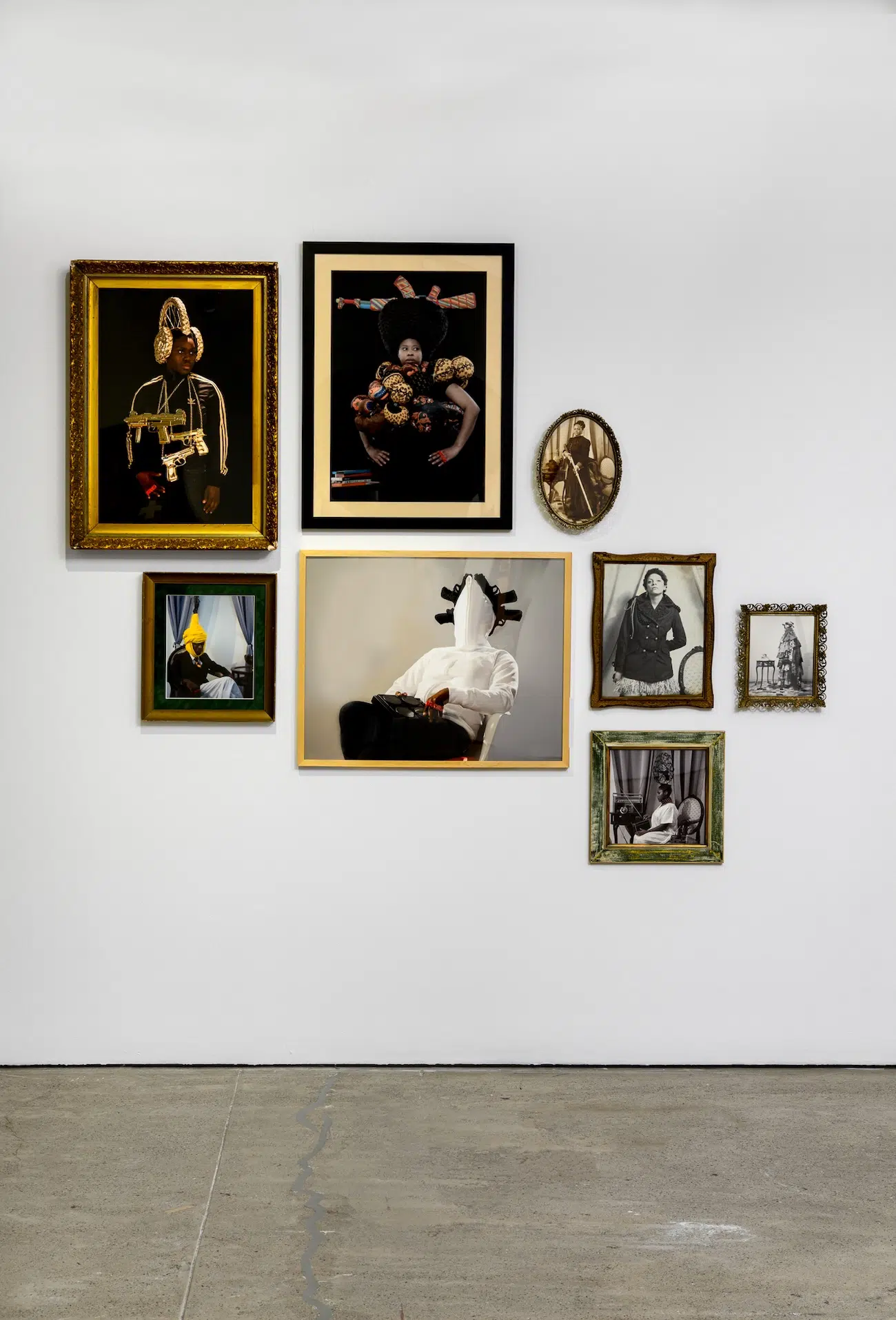
Robert Pruitt, in collaboration with The Fabric Workshop and Museum, Philadelphia. “Untitled Photographs,” 2011. Archival pigment prints on rag paper, dimensions variable. Photo credit: Constance Mensh.
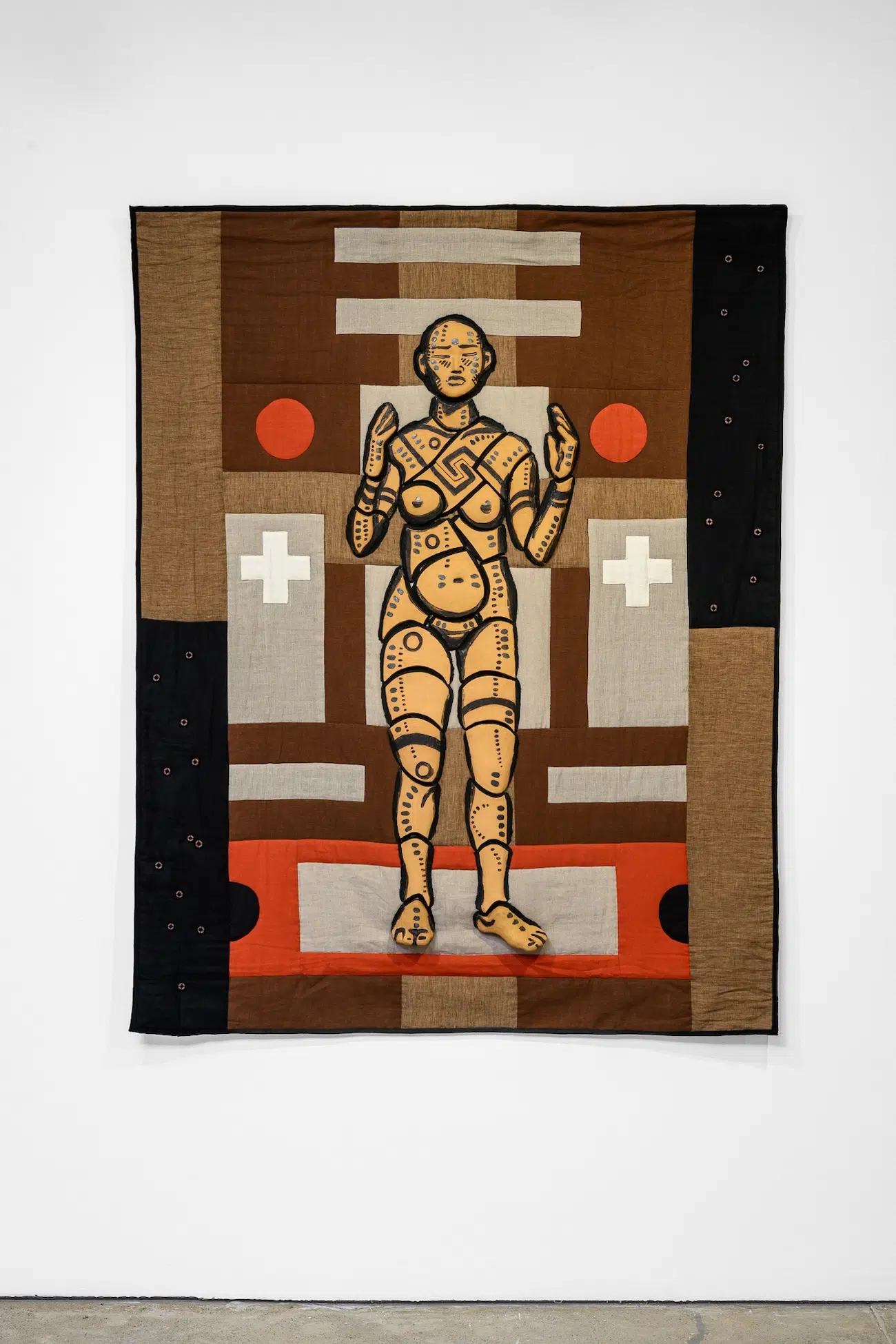
Rose B. Simpson, in collaboration with The Fabric Workshop and Museum, Philadelphia. “Tonantzin,” 2022. Linen, cotton, clay, and thread, 70 x 55 x 3½ inches. Photo credit: Constance Mensh.