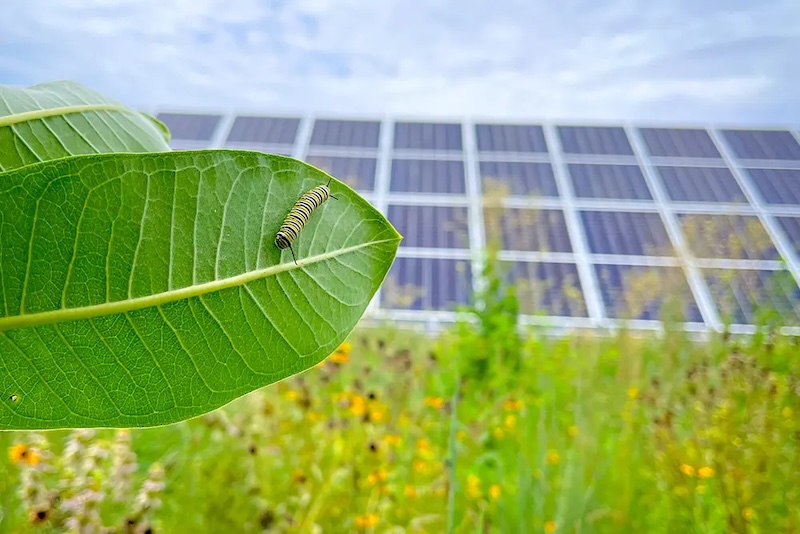
Photo: Lee Walston / Argonne National Laboratory
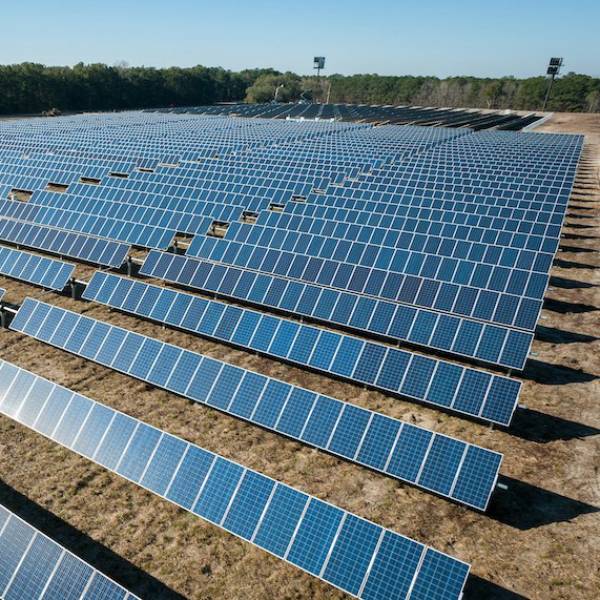
As humans contend with the ongoing climate crisis, many are taking action to help bolster our fragile world. One way is to increase biodiversity, which is seriously threatened by habitat destruction. In one study, however, researchers rehabilitated agricultural land and brought new life to it. Even better, they did it all at solar farms, which provide eco-friendly power. It shows that green energy and habitat restoration can go hand in hand.
The findings were documented in a 2023 journal article titled If you build it, will they come? Insect community responses to habitat establishment at solar energy facilities in Minnesota, USA. To start, scientists at Argonne National Laboratory and the National Renewable Energy Laboratory planted native flowers and grasses at two solar farms in southern Minnesota in 2018. They then studied the sites over five years (2018 to 2022) to learn how insect communities responded to the new habitat.
To evaluate the data, researchers looked for three key things: changes in flowering plant abundance and diversity over time; changes in insect abundance and diversity over time; and pollination services in the solar-pollinator habitat, compared with pollinator visitation to nearby agricultural fields.
The habitats responded well. Scientists found increases over time for all habitat and biodiversity metrics. These included floral rank, flowering plant species richness, insect group diversity, native bee abundance, and total insect abundance, most notably in the bee population, which increased more than 20-fold. And the boost didn’t stop at the areas around the solar panels. More bees visited nearby soybean fields, indicating a “rising tide” effect in which an increase in bees in one area helps lift other places, even unintentionally.
“Our observations highlight the relatively rapid (<4 year) insect community responses to grassland restoration activities,” the article authors write, “and provide support for solar-pollinator habitat as a feasible conservation practice to safeguard biodiversity and increase food security in agricultural landscapes.”
The findings suggest that habitat-friendly solar sites can help conserve biodiversity, even when accounting for the land used by large, ground-mounted solar panels. If strategically placed, they can provide biodiversity benefits while mitigating the otherwise expected loss of habitat.
You can read the entire article on IOPscience.
Two Minnesota solar farms planted native flora beneath the panels, and it did amazing things to the local biodiversity.
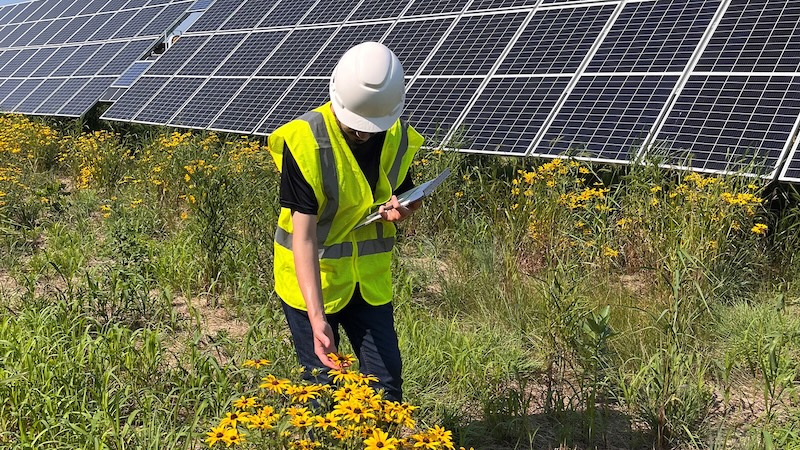
Photo: Lee Walston / Argonne National Laboratory
Source: Two Minnesota solar farms turned the ground beneath their panels into habitat, and native bee abundance rose more than 20-fold
Related Articles:
Solar Energy Becomes a Larger Power Source Than Coal in the U.S. for the First Time
Japan Is Making History by Harnessing Solar Power From Space
Enormous Solar Farm Will Replace Former Coal Plant in Pennsylvania