View this post on Instagram
With news of wildfires, food shortages, and natural disasters around the world, it’s fair to assume the worst for our future. But, there’s a growing number of artists, designers, architects, and communities that are choosing to redirect their climate anxiety towards radical optimism. Solarpunk is a growing design and social movement that boldly envisions what our future could look like if we live in harmony with nature and use technology for the greater good.
The Origins of Solarpunk
“Solarpunk” is a term that was first coined in 2008 in a blog post titled “From Steampunk to Solarpunk,” by author John Robert. He suggested the idea of an economy based on renewable energy featuring sailing cargo ships. The word “solar” represents renewable energy and sustainability, and “punk” represents resistance to resigning to a dystopian version of the future.
Solarpunk is an optimistic response to earlier genres like cyberpunk and steampunk. While cyberpunk imagines dystopian futures shaped by corporate power, advanced technology, and artificial intelligence, steampunk combines futuristic inventions with the Victorian-era aesthetics and steam-powered machinery of the Industrial Revolution. Solarpunk, on the other hand, offers a different, much more optimistic perspective. It’s all about imagining a world powered by clean energy, where realistic technological innovation helps create more intentional, sustainable communities that exist in harmony with nature.
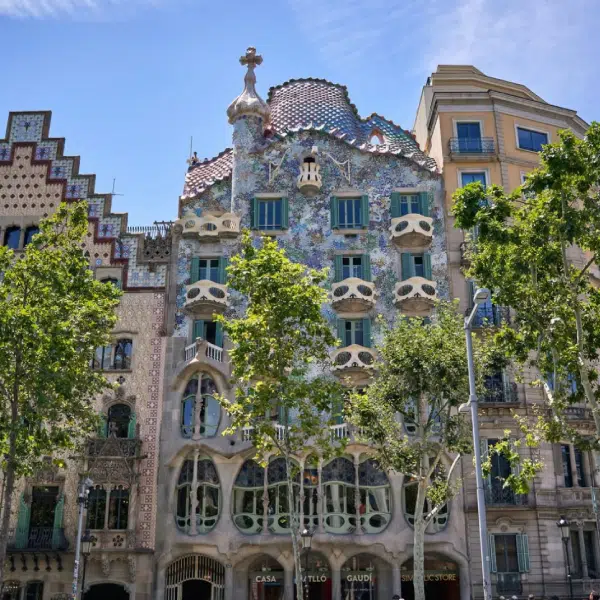
This hopeful philosophy inspired artist Olivia Louise, who is widely credited with helping shape what Solarpunk looks like today. In 2014, she shared a series of illustrations on Tumblr imagining cities overflowing with greenery, renewable energy, stained glass windows, and nature-inspired fashion. Her artwork helped define an aesthetic that combines the flowing curves of Art Nouveau architecture with solar panels and plant-covered buildings. Since then, artists around the world have embraced the Solarpunk style, creating concept art of a futuristic world that we’d be lucky to live in.
View this post on Instagram
Real-World Examples of Solarpunk
Solarpunk is about much more than beautiful illustrations. It’s really about using renewable energy, sustainable technology, and thoughtful design to tackle the climate crisis. The movement invites people to imagine what’s possible when humans and nature thrive together.
Architecture is one field where the Solarpunk movement is already taking shape, with designs that are either under development or already enriching the places where people live.
The Earthship by Michael Reynolds
Although the term Solarpunk wasn’t coined until 2008, many of its architectural ideas have been around for decades. One of the best examples is the Earthship, a eclectic, self-sufficient home developed by American architect Michael Reynolds in the 1970s.
Built from recycled materials such as old tires, glass bottles, and aluminum cans, Earthships are designed to operate almost entirely off the grid. They generate their own electricity through solar panels, harvest rainwater, treat wastewater on-site, and use passive solar design to maintain comfortable indoor temperatures year-round.
Reynolds envisioned Earthships as a way for ordinary people to take control of their own housing, energy, and water needs while reducing their impact on the planet. Decades before Solarpunk emerged as a movement, his homes demonstrated that architecture could work with nature rather than against it.
Today, hundreds of Earthships have been built around the world, proving that many of Solarpunk’s defining principles, like renewable energy, self-sufficiency, and regenerative living, are already possible.
Jian Mu Tower by Carlo Ratti Associati
One of the best-known practical examples of the Solarpunk movement is the Jian Mu Tower by Carlo Ratti Associati. Named after the mythical jian mu tree from Chinese folklore that connects heaven and earth, the proposed “farmscraper” incorporates a vast vertical hydroponic farm into its facade, combining high-density urban living with local food production. Although widely featured in architectural portfolios and design publications, the tower remains a visionary concept and has not yet been built.
Rotterdam Rocks! by MVRDV
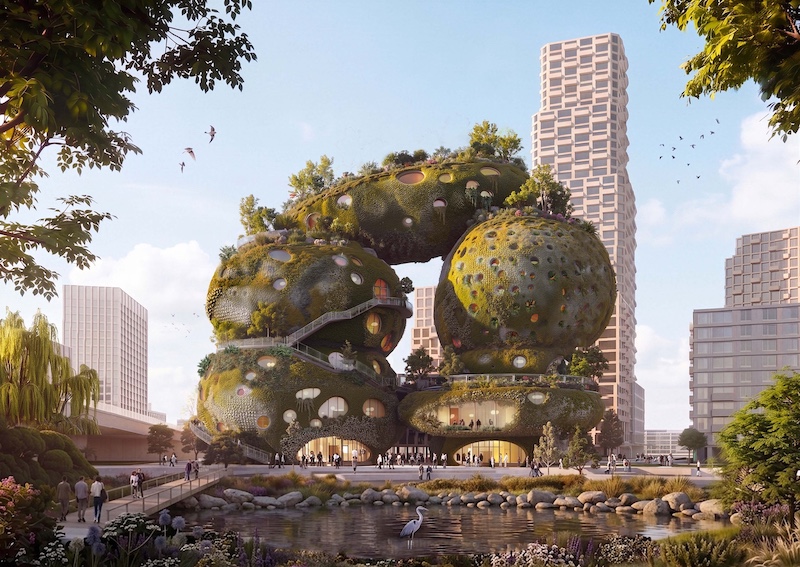
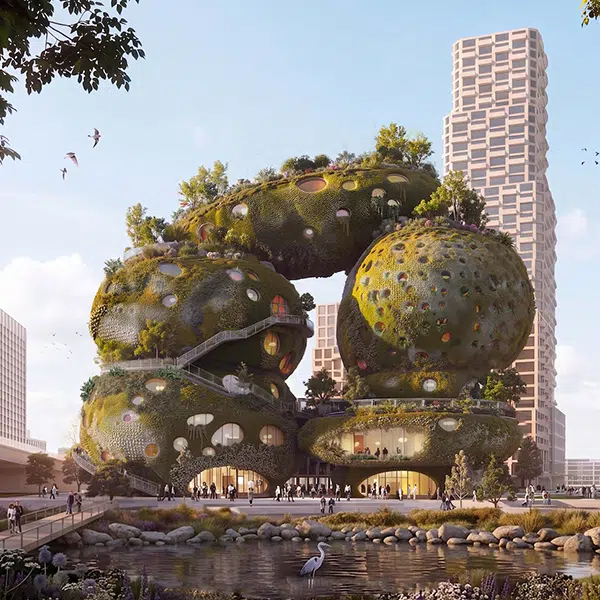
Other Solarpunk-inspired architectural projects are already much closer to becoming a reality. Rotterdam-based architecture firm MVRDV recently won the Shift International Architecture Competition with Rotterdam Rocks!, a “bioutopia” with a porous facade covered in soil and plant life. The 30,000-square-meter (322, 917-square-foot) climate-focused landmark is designed to create a thriving urban ecosystem, offering refuge for birds, insects, and other species in the heart of the city. Its lush concept art looks as though it’s been lifted from a futuristic graphic novel, but the project is already approved to move forward and is planned as the first in a series of similar landmarks across six continents.
Park Nova by PLP Architecture
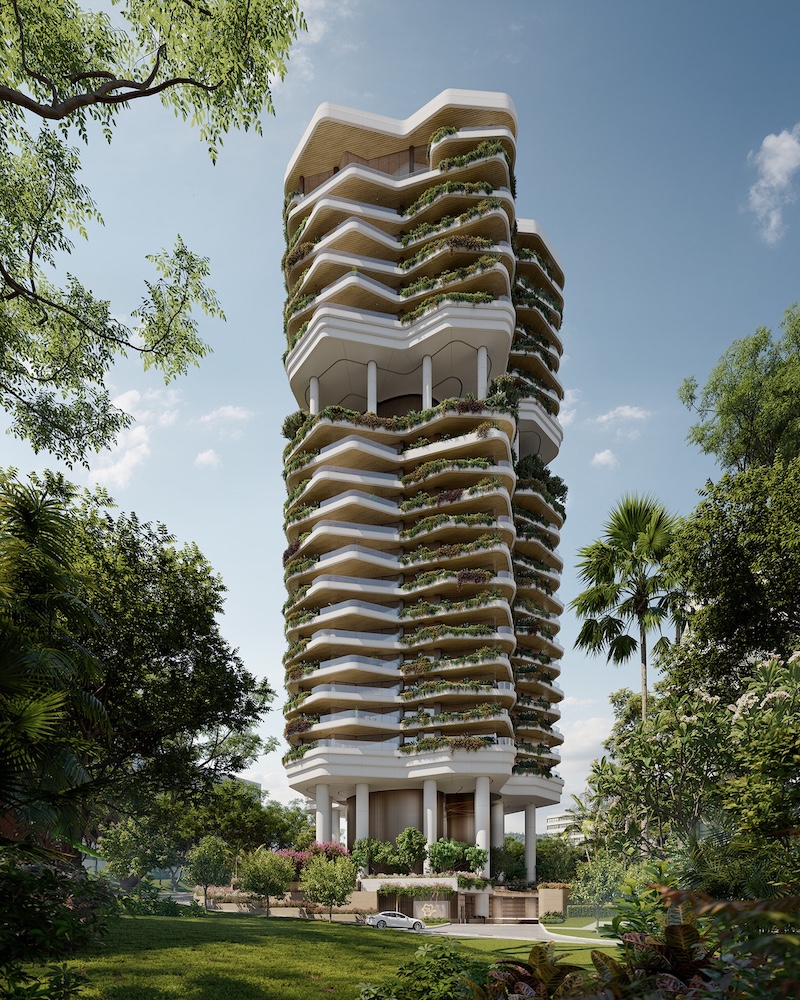
In Singapore, Park Nova by PLP Architecture shows how Solarpunk ideas can be translated into luxury housing—and it already exists. Designed as a biophilic vertical enclave, the tower is wrapped in terraces abundant with plant life. The greenery helps reduce heat, improve air quality, encourage biodiversity, and reinforce Singapore’s ambition to weave nature into every layer of the urban environment. Every apartment has access to its own garden-like terrace, giving residents their own outdoor space despite living in a high-rise.
Gardens by the Bay in Singapore
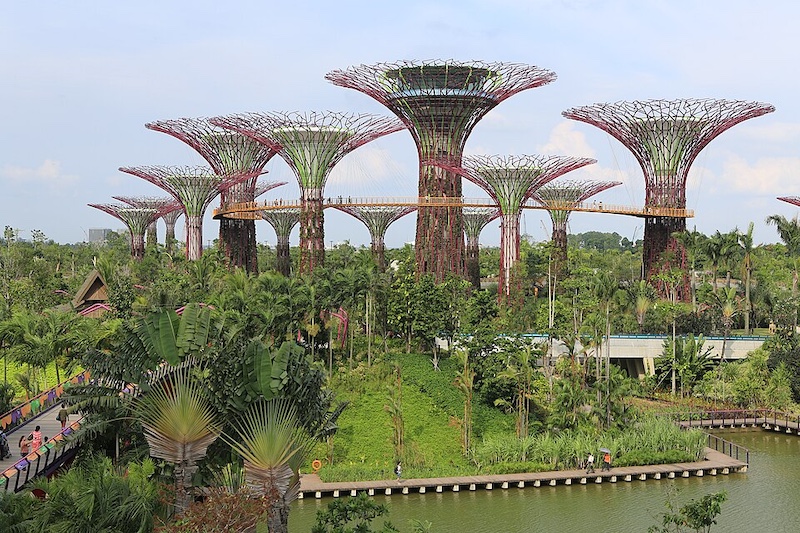
In Singapore, the stunning Gardens by the Bay offers a real-life example of what city parks around the world could look like in the future. Open since 2011, the 105-hectare (nearly 260-acre) public space blends high-tech engineering with nature. It features the world’s largest glass greenhouse called the Flower Dome, a 35-meter (almost 115-foot) indoor waterfall in the Cloud Forest, and towering, eco-friendly Supertree Grove vertical gardens that glow at night. The 25-to-50-meter (82-to-164-foot) tall structures also feature solar power generators and air vents. And the entire park is home to over 1.5 million plants from every continent except Antarctica.
Bosco Verticale by Boeri Studio
The Bosco Verticale is a complex of two residential skyscrapers designed by Boeri Studio and located in the Porta Nuova district of Milan, Italy. The futuristic structures are like their own vertical forests, home to 480 large and medium trees, 300 small trees, 11,000 perennial and covering plants, and 5,000 shrubs. The diversity of plants helps to develop the microclimate which produces humidity, absorbs CO2 and particles, produces oxygen, and protects against radiation and noise pollution.
Can we actually create a Solarpunk future?
The ideas behind Solarpunk are certainly appealing, especially to those who believe people and the planet should come before profit. But turning that vision into reality would require far more than green architecture and renewable energy—it would demand a fundamental shift in how governments, corporations, and societies think about progress.
“Solarpunk is really the only solution to the existential corner of climate disaster we have backed ourselves into as a species,” says Michelle Tulumello, a Solarpunk art teacher in New York state. “If we wish to survive and keep some of the things we care about on the earth with us, it involves a necessary fundamental alteration in our world view where we change our outlook completely from competitive to cooperative.”
Whether or not a true Solarpunk future is achievable, the movement has already succeeded in something amazing—it’s given people hope. With Solarpunk-inspired projects already underway, it continues to inspire artists, architects, designers, and urban planners to rethink how our cities and communities could coexist with nature. These pioneers remind us that the future isn’t fixed, but something we can work towards improving.
View this post on Instagram
Related Articles:
10 Futuristic Design Concepts That Will Change the Way We All Live
Lush Vertical Garden Tower Will Bring City Dwellers Closer to Nature
Former Military Camp in Baghdad To Be Transformed Into Urban Sustainable Forest
Japan Is Making History by Harnessing Solar Power From Space