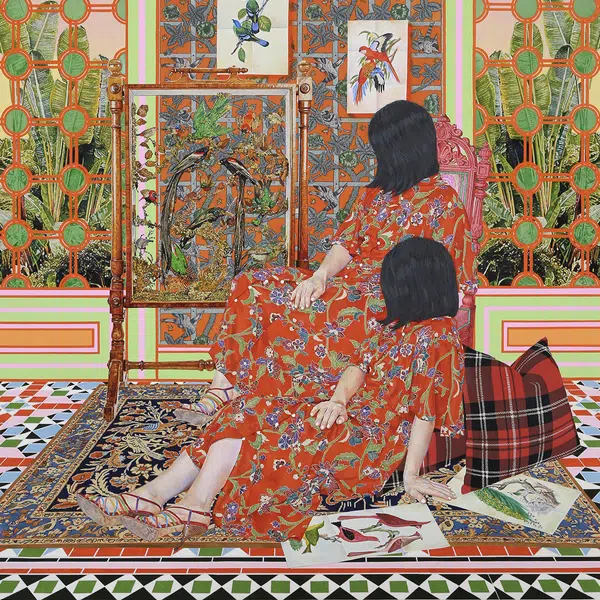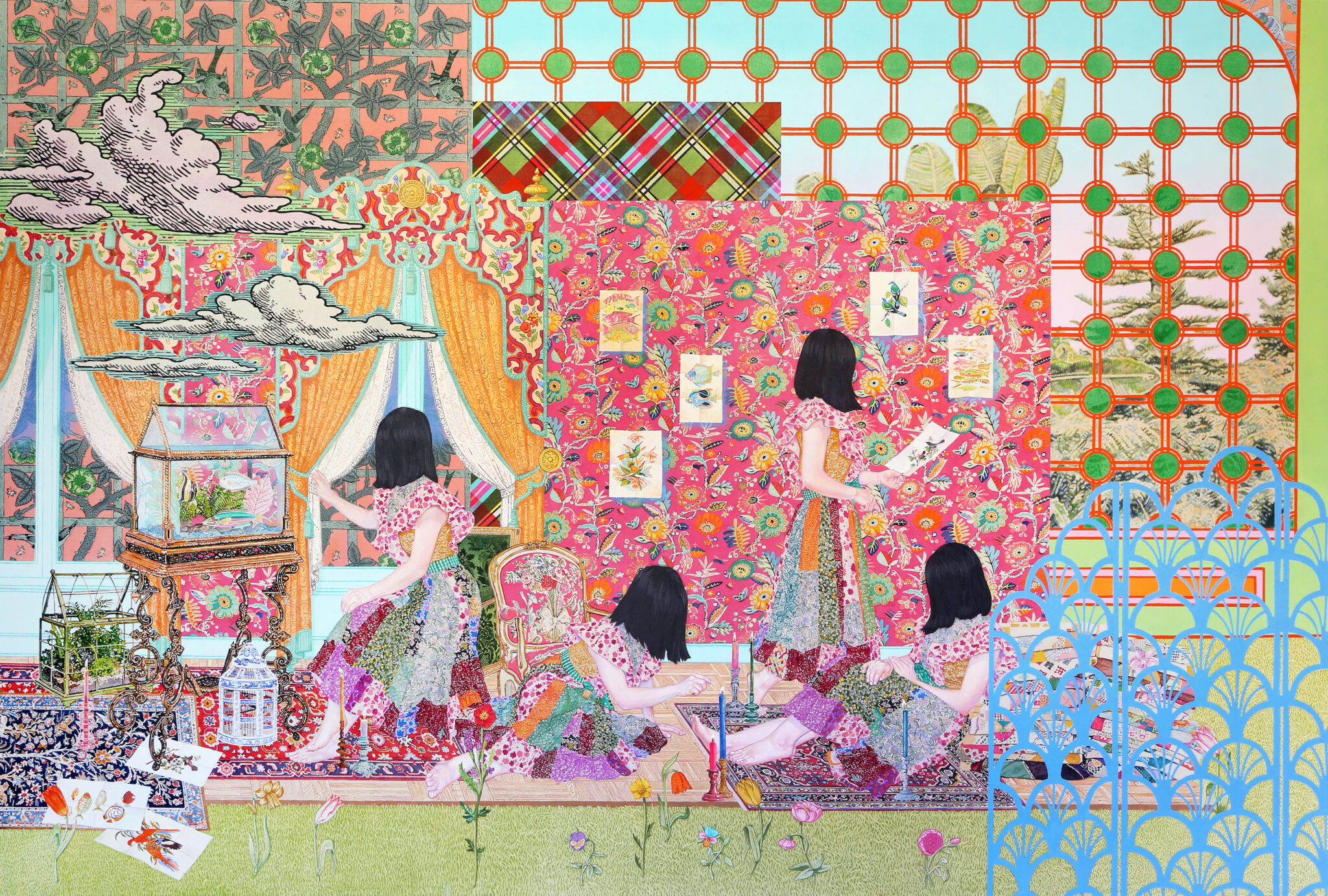
“Closely Glazed Space #3,” 2025. Acrylic on raw canvas, 51.3 x 76.38 in. (Photo: courtesy of the artist)
Within Naomi Okubo’s artistic universe, women often remain faceless. This isn’t because they lack identity; it’s more so because they function as mirrors. And, given that the Japanese artist considers them to be mirrors, it naturally follows that they solely exist within glass-like settings. Okubo’s newest painting continues this line of inquiry, this time plunging women into a translucent greenhouse.
Titled Closely Glazed Space #3, the painting depicts four women dressed in intricate garments, whose patterns practically vibrate with color and texture. Surrounding the figures are several ornamental panels, botanical drawings, and an enormous pane of glass, through which a lush forest can be seen. The entire canvas demands attention with its bold palette, sumptuous details, and idiosyncratic storytelling, prompting questions about who these women are and why they’re enclosed within a greenhouse. Avoiding our view, Okubo’s subjects are meant to be admired, and yet they exist just beyond our grasp, their faces turned away from us and refusing acknowledgement.
In some ways, it’s as though we are observing specimens through a delicate sheet of glass. That sensation is intentional, reflecting Okubo’s enduring interest in greenhouses as symbols of both containment and protection.
“In a greenhouse, plants gathered from many different places are carefully maintained under controlled humidity and temperature,” Okubo tells My Modern Met. “The greenhouse is a motif I have been working with in recent years, drawn by its historical and cultural background. At the same time, it also functions as a metaphor for the home as a closed, protected space.”
Inside this greenhouse, living beings are cared for in exchange for their captivity. That idea is echoed throughout the composition, whether it be through aquariums filled with fish or cages stuffed with birds. After all, as the artist herself explains, “fish and birds are beings that humans can only keep when confined.” Still, Okubo suggests there’s a flicker of hope. Toward the bottom of the canvas, a girl fidgets with a candle, her finger delicately hovering over the flame.
“The candles scattered throughout the work are rendered as symbols of freedom, quiet beacons of release from oppression,” Okubo explains.
Closely Glazed Space #3 fits neatly within the artist’s wider artistic language, which is packed with surreal objects, evocative figures, and a dazzling level of precision. No matter how beautiful, though, all of these elements are inseparable from an underlying anxiety: that of enclosure. It’s a theme that speaks to conformity but, at the same time, comfort. Who are we, as viewers, to deny Okubo’s subjects a protected space, one free from uncertainty?
“I value the aspects of painting that cannot be fully explained in words—the sense of play, the openness, and the spaces left for interpretation,” Okubo remarked in a recent interview with us. “Some decisions are made simply through considerations of composition or color balance, so elements that carry meaning and those that do not coexist within the same picture plane.”
To learn more about the artist, visit Naomi Okubo’s website and follow her on Instagram.
In her most recent painting, Closely Glazed Space #3, Naomi Okubo explores themes of confinement and protection through the image of a greenhouse.
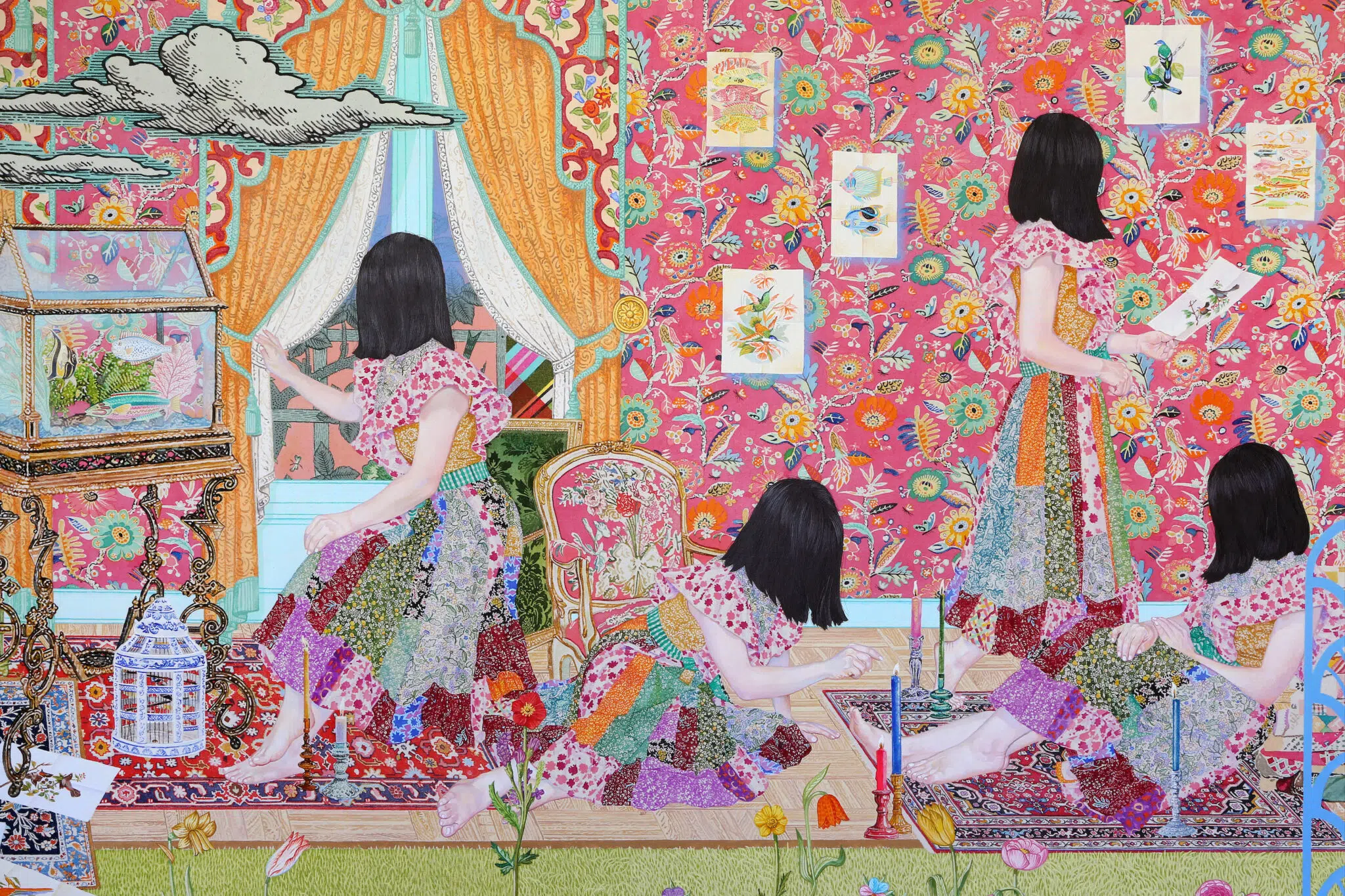
Detail, “Closely Glazed Space #3,” 2025. Acrylic on raw canvas, 51.3 x 76.38 in. (Photo: courtesy of the artist)