At first glance, Pieter de Hooch’s Figures in a Courtyard looks like a quiet scene of everyday life. Sunlight washes across the brick courtyard. A woman raises a glass while a man smokes a long clay pipe; nearby, a young girl approaches with glowing coals. Yet the gathering once had another participant: a soldier, whose disappearance altered the painting’s entire social dynamic.
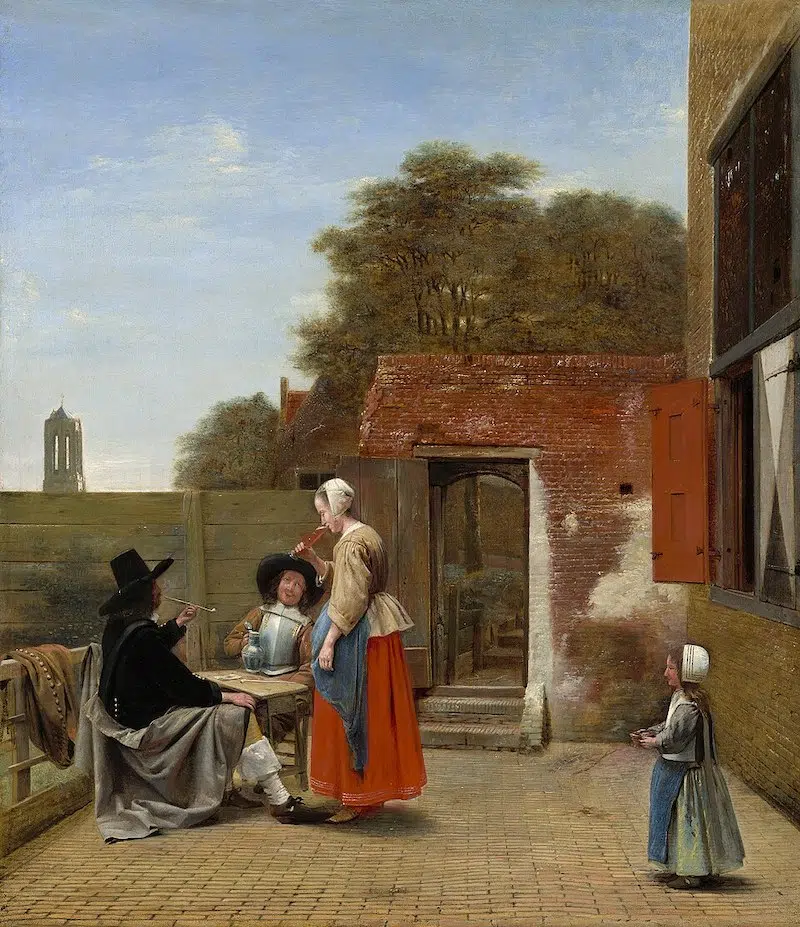
Conservation at the Mauritshuis in The Hague has now restored the missing figure, bringing the original drinking game back into view. De Hooch painted the work around 1658–1660, during his productive Delft period. He became known for turning ordinary interiors and courtyards into sophisticated studies of light, perspective, and human interaction.
Architecture structures the scene. Brick walls and wooden fencing lead the eye through the courtyard, while the Nieuwe Kerk tower appears in the distance.
The figures bring the space to life. Two soldiers sit at a narrow table. One soldier smokes; the other grips a ceramic tankard. On the right, a young girl carries a brazier filled with hot coals for lighting the men’s pipes. Small details like these ground the painting in the rituals of 17th-century Dutch life. The scene also includes a woman standing beside the men, holding a tall glass. It is a pass-glass, a vessel designed for drinking games. Players drank to a marked ring before passing it along. Anyone who stopped above the line had to continue drinking.
The intact version of the composition at the National Gallery of Art makes the game unmistakable. There, the second soldier sits across the table with his tankard, apparently ready to refill the woman’s glass. His presence changes the mood. What initially appears to be a casual drink becomes a moment of shared amusement.
The soldier disappeared from the Mauritshuis painting sometime before 1822. At some point, someone painted the wooden fence in the background over his figure. Later examination revealed traces of the original beneath the altered surface: parts of his clothing and hand remained visible. The National Gallery’s version provided a crucial reference for reconstructing the lost figure.
The soldier’s return does more than complete the composition. It restores the interaction at the heart of the painting. Without him, the woman’s raised glass seems incidental. With him, it becomes part of a game. The tankard and pass-glass establish the exchange; the pipes and brazier extend it into the surrounding space.
This understated storytelling is central to De Hooch’s genre painting. In Figures in a Courtyard, he takes the familiar subject outdoors, where geometry and sunlight become as important to the composition as the figures themselves.
After centuries behind a painted fence, the soldier has finally returned to the table. What once appeared tranquil now reveals itself as a lively glimpse of 17th-century leisure.
Pieter de Hooch’s 17th-century Dutch painting Figures in a Courtyard once showed two soldiers playing a drinking game before one was painted out of the scene.
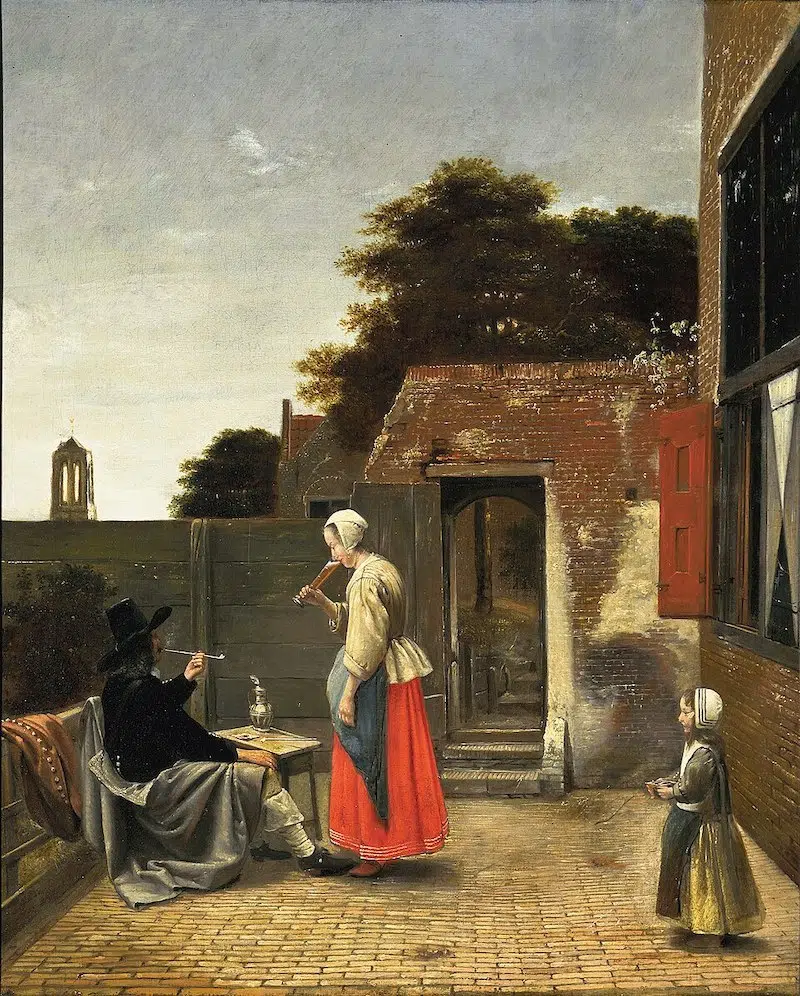
Pieter de Hooch, “A Man Smoking and a Woman Drinking in a Courtyard,” 1658-1660. (Photo: Wikimedia Commons, Public domain)
Conservation at the Mauritshuis has now restored the missing soldier and revealed the playful exchange at the heart of the painting.
Source: This Dutch Painting Showed a 17th-Century Drinking Game Until Someone Smudged Out a Player, Spoiling the Fun. A Museum Just Restored the Imbibing Soldier
Related Articles:
Vanitas: Paintings by the Dutch Old Masters Inspired by Life and Death
17th-Century Painting by Old Master Found in Barn Attic Sells at Auction for Over $7 Million
Why Rembrandt Is Considered One of Art History’s Most Important Old Masters