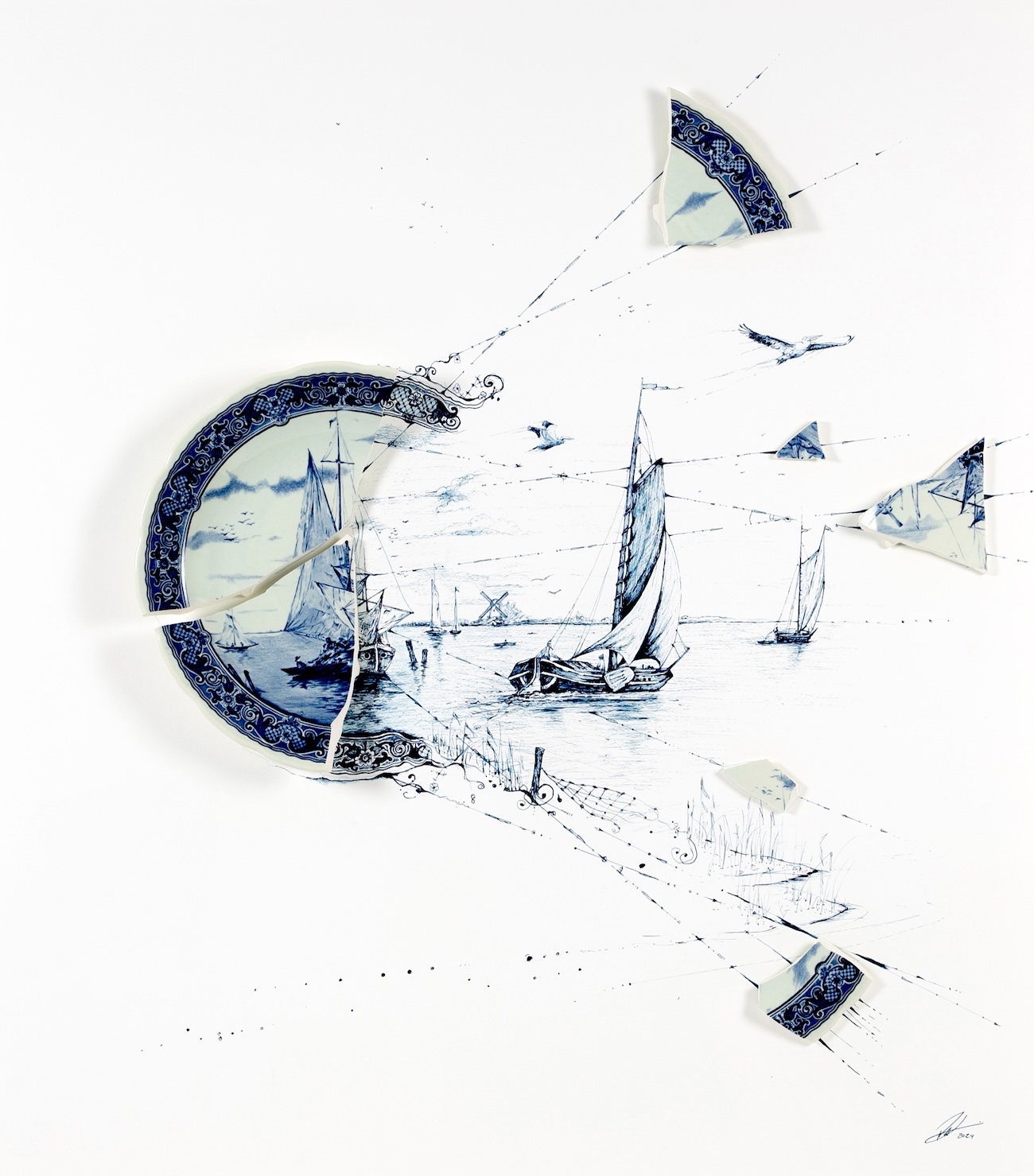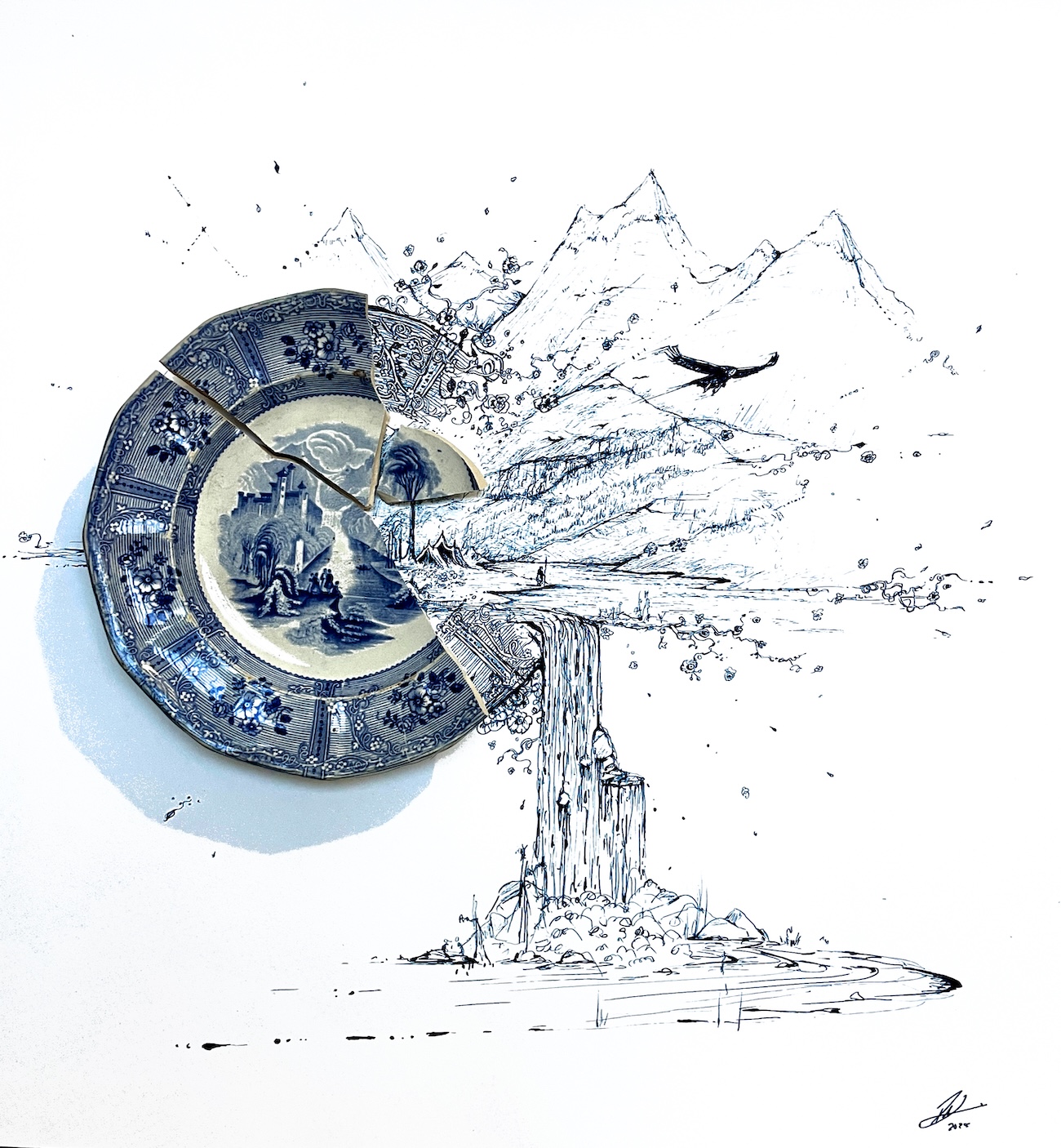
“Fragmented in Blue with Blossoming Flight to the Peaks”
Artist Rob Strati’s work begins when a dish shatters into pieces. Deep fragments in illustrative porcelain serve as the starting point for his drawings, which appear to bloom from the fractured shards. A plate, for instance, featuring a bucolic farm-life composition is extended to “reveal” more of the scene. In the broken spaces, and beyond the dish’s circular shape, a whole inky tableau plays out: ducks float along a stream as a deer looks on. Strati’s drawings are as energetic as the force behind the one that broke the plate, with loose, gestural strokes that also provide contrast to the visual heaviness of the real object.
The ongoing body of work is called Fragmented, and it began by chance. Strati’s wife accidentally broke a plate from his late mother-in-law, and rather than throwing the pieces away, the artist kept them and realized that they could tell a new story. The series, similar to the Japanese art of kintsugi, demonstrates that a fracture doesn’t have to mean the end. Rather, it’s just another chapter in the tale; one both new and familiar, that honors its history and celebrates its future—breaks and all.
My Modern Met spoke to Strati about his work, including how he comes up with his illustrations, and what’s next for him. Scroll down to read our exclusive interview.
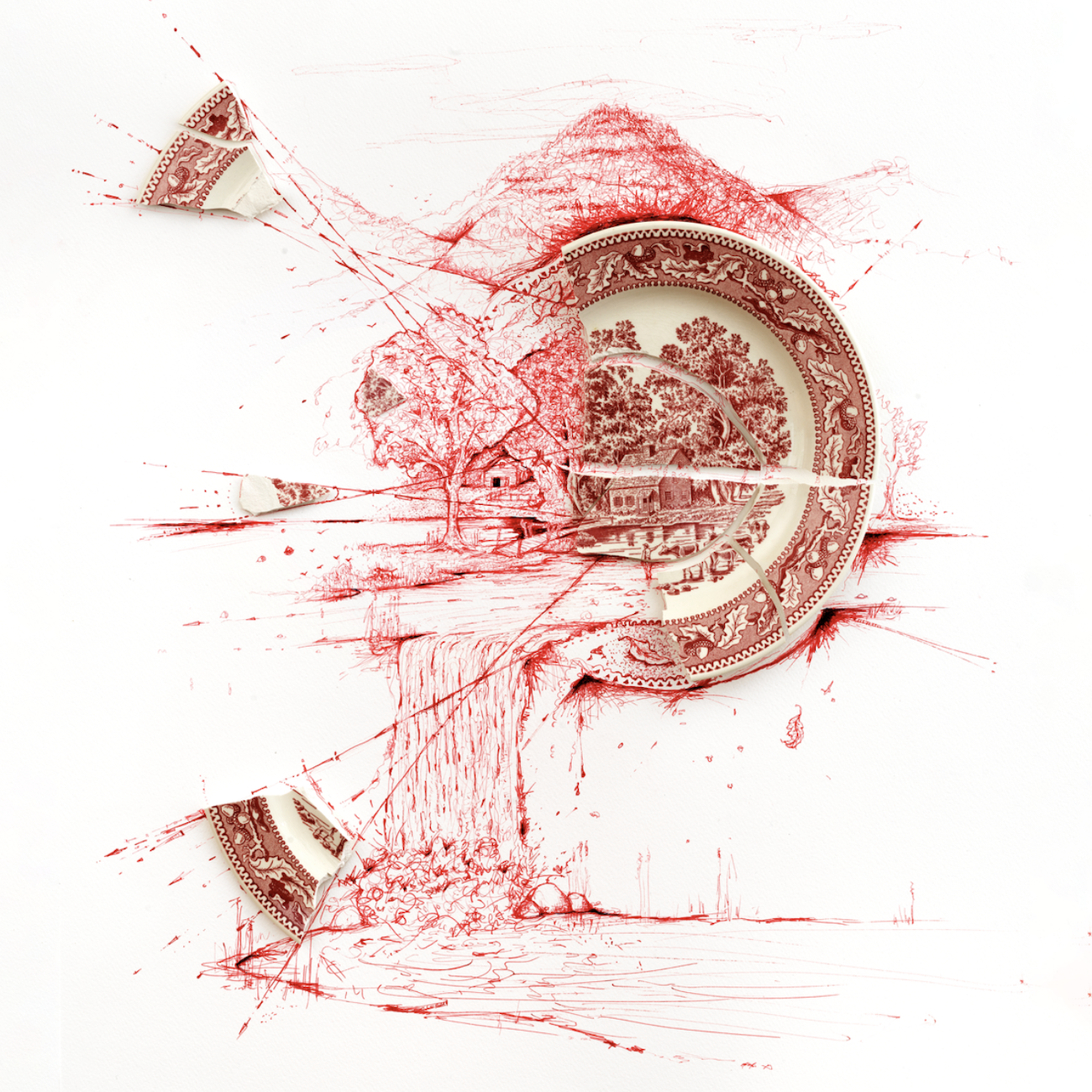
“The Fall and Forest”
How did you first become interested in art?
I feel I have always been connected to art, but one thing I often think about is how I grew up spending summers on Cape Cod. My family was originally from Boston but had moved to Ohio, so every summer meant a 14-hour drive east with my parents and sister. There was a lot of time to simply be, to look out the window, sketch, invent things, and dream up worlds. I think that kind of unstructured time was important to me. My family also has a long history with Provincetown going back generations, and my parents would tell stories about the Cape and the creative lives people had built there. There was always an appreciation for that way of living, the artists, writers and unconventional people in those cottages and communities. Art never felt like something separate from life, it actually felt like one of the most valuable ways to live a life.
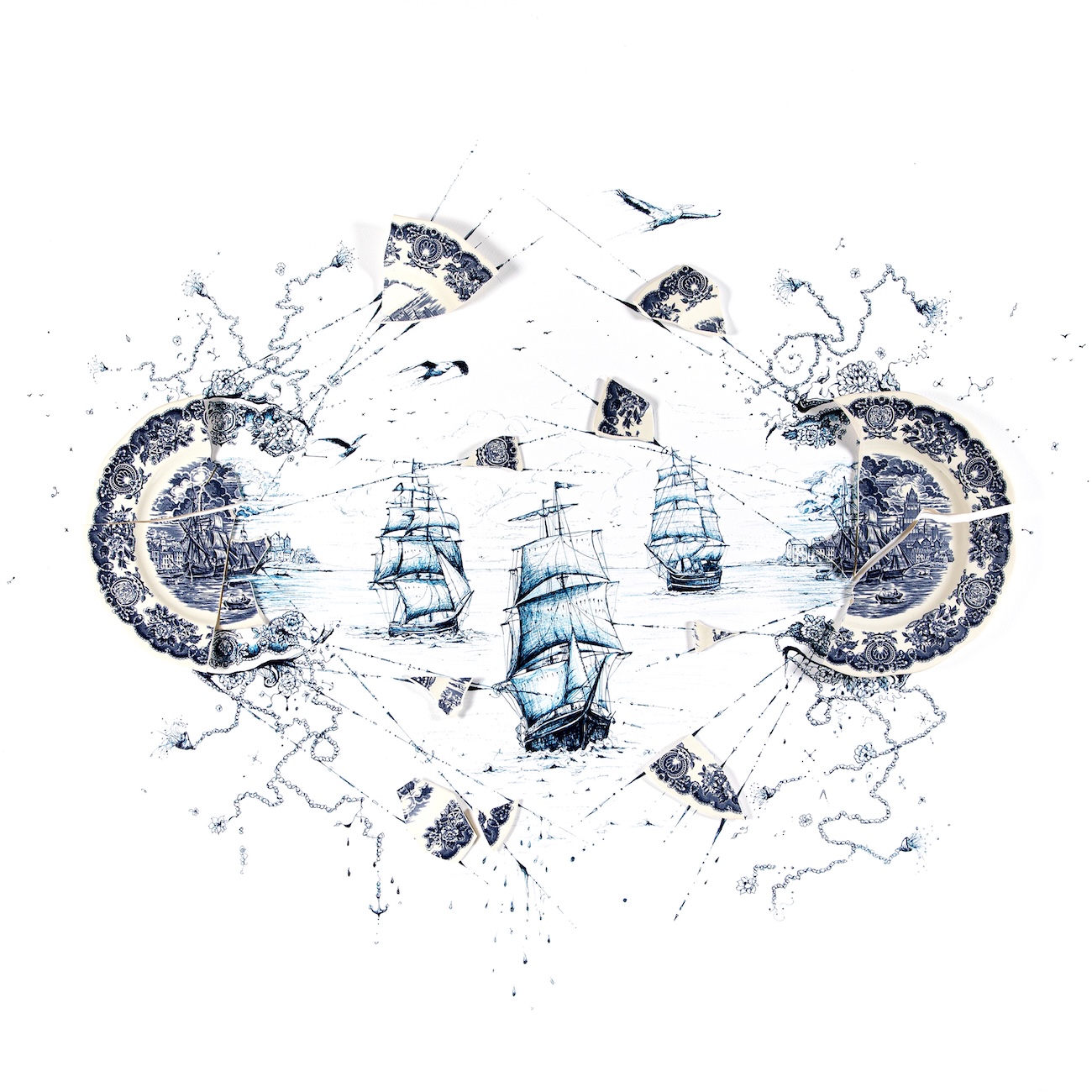
Fragmented sounds like it was a bit of happenstance. What were you working on before you started the series? How do you think that lent itself to your current series?
Before Fragmented, I had been making installation works that stretched across exhibition spaces and dealt with the information that exists between things, the invisible relationships between objects, actions, memory and ideas. I was also making digital works that looked like abstract schematics or diagrams, often with lines and structures expanding outward from a central point—inspired by archeological digs or architectural plans.
When Fragmented began, I honestly didn’t see much connection between those earlier works and what I was doing with the broken porcelain. Some friends came to the studio, though, and immediately saw it. Once they pointed it out, it became obvious. The earlier work was already concerned with what happens when something is mapped in new ways, and with structures expanding beyond their original center. The drawings in Fragmented do something similar, the plate becomes a kind of starting point, almost like the center of a map or an ancient ruin, and the drawing imagines what might continue beyond it.
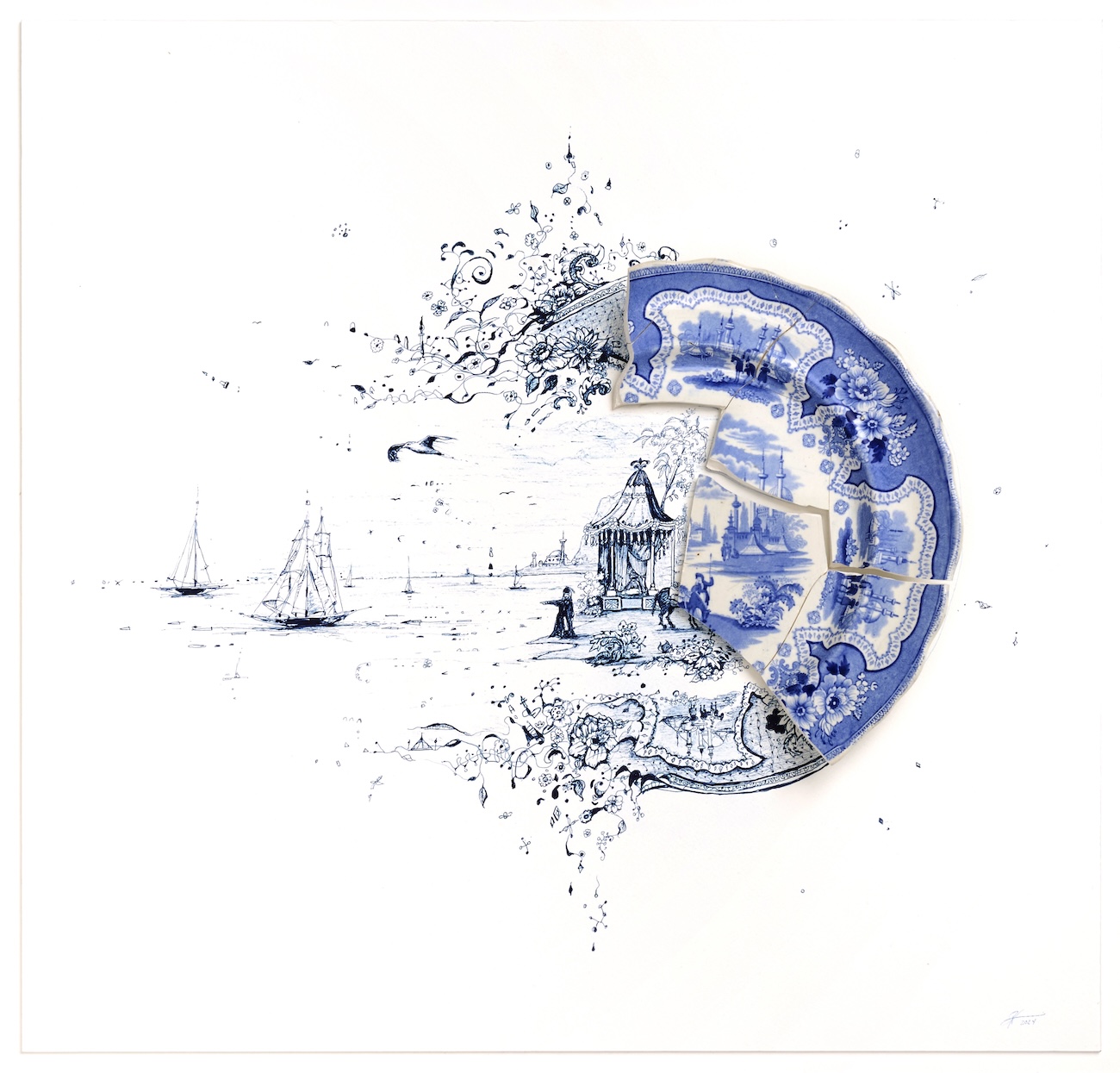
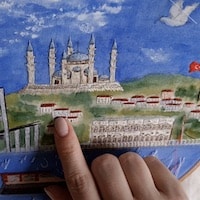
“Fragmented in Blue with Minarets and Ships”
Fragmented speaks to some of the ideas of kintsugi, the Japanese art of repairing something with gold to give it a new story. Did kintsugi inspire you at all?
The beginning of the series was so spontaneous that I wasn’t consciously thinking about kintsugi. I had always admired wabi-sabi and the idea that imperfection and flaws are beautiful, but it wasn’t at the forefront of my thinking when the first plate broke.
At one of the first art fairs where I showed the work, someone mentioned kintsugi, and I immediately saw the connection. Both practices begin by honoring the broken form. But from there they move in different directions. Where kintsugi brings the fragments back together and makes the cracks sacred through the use of resin and gold adhesions, I allow what is broken to unfold into something new, freeing what was inside to become something related, but different.
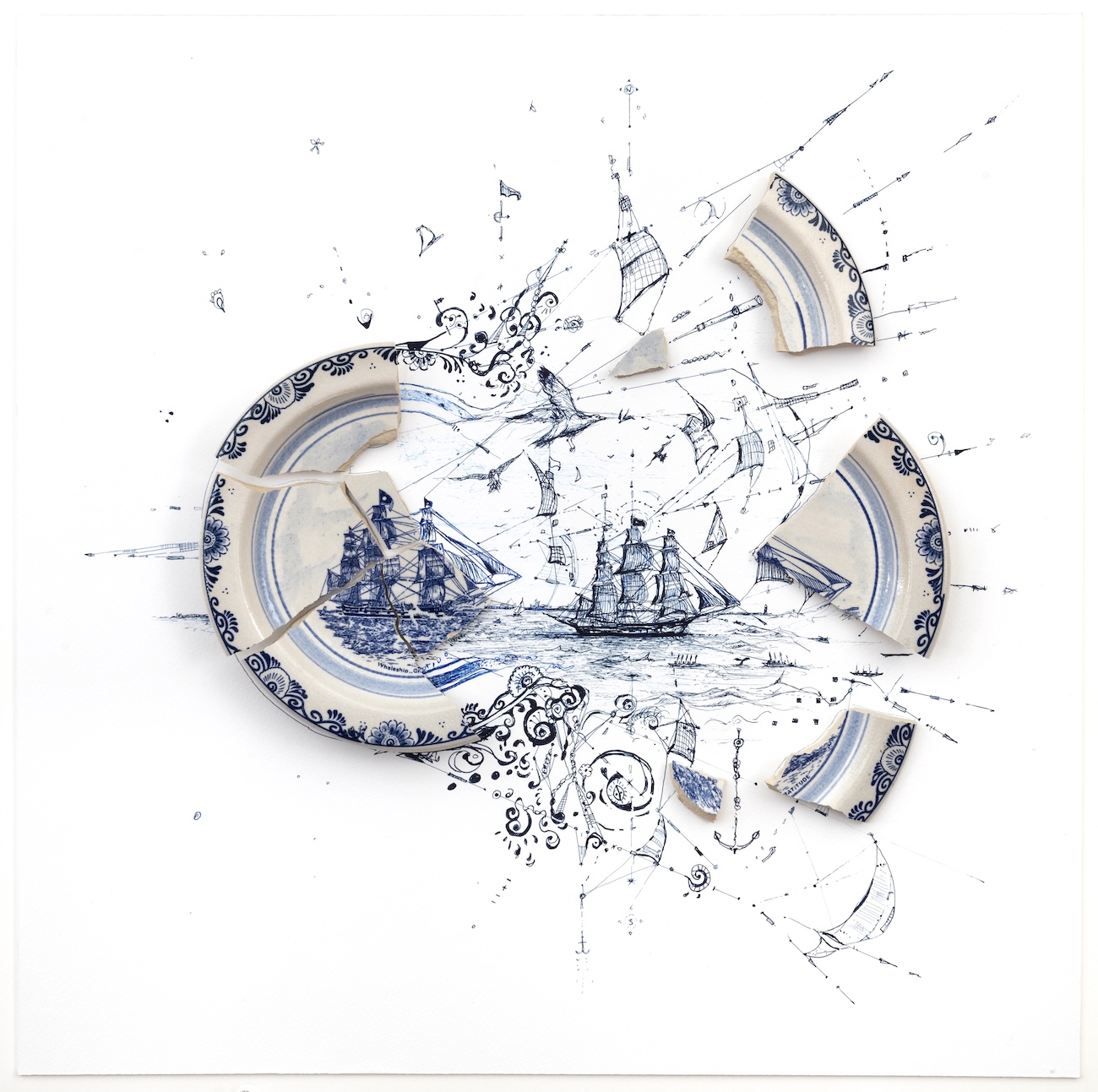
“Fragmented in Blue with Sailing Ships”
The plates quite literally burst into new compositions. It’s as if the illustrations have been set free. How do you come up with the drawing side of Fragmented, from ideation to execution?
I generally don’t map out the finished drawing beforehand. I begin with the narrative already contained in the plate. I look at the characters, landscape, decorative motifs and overall style, and that becomes my starting point.
Initially I try to mimic the original artists, but once the drawing moves beyond the border of the original plate, I have to imagine the world that might exist beyond it. That is where the process becomes much more intuitive. I imagine, rework, research, make references and allow one decision to suggest the next.
Also, I think equally important is that I use areas of open space very deliberately because I want the viewer to participate. You can follow the details, connect different elements and begin constructing your own narrative. I love watching people look at the works and seeing when they start to gesture at certain areas and talk about what is there and what could be there.
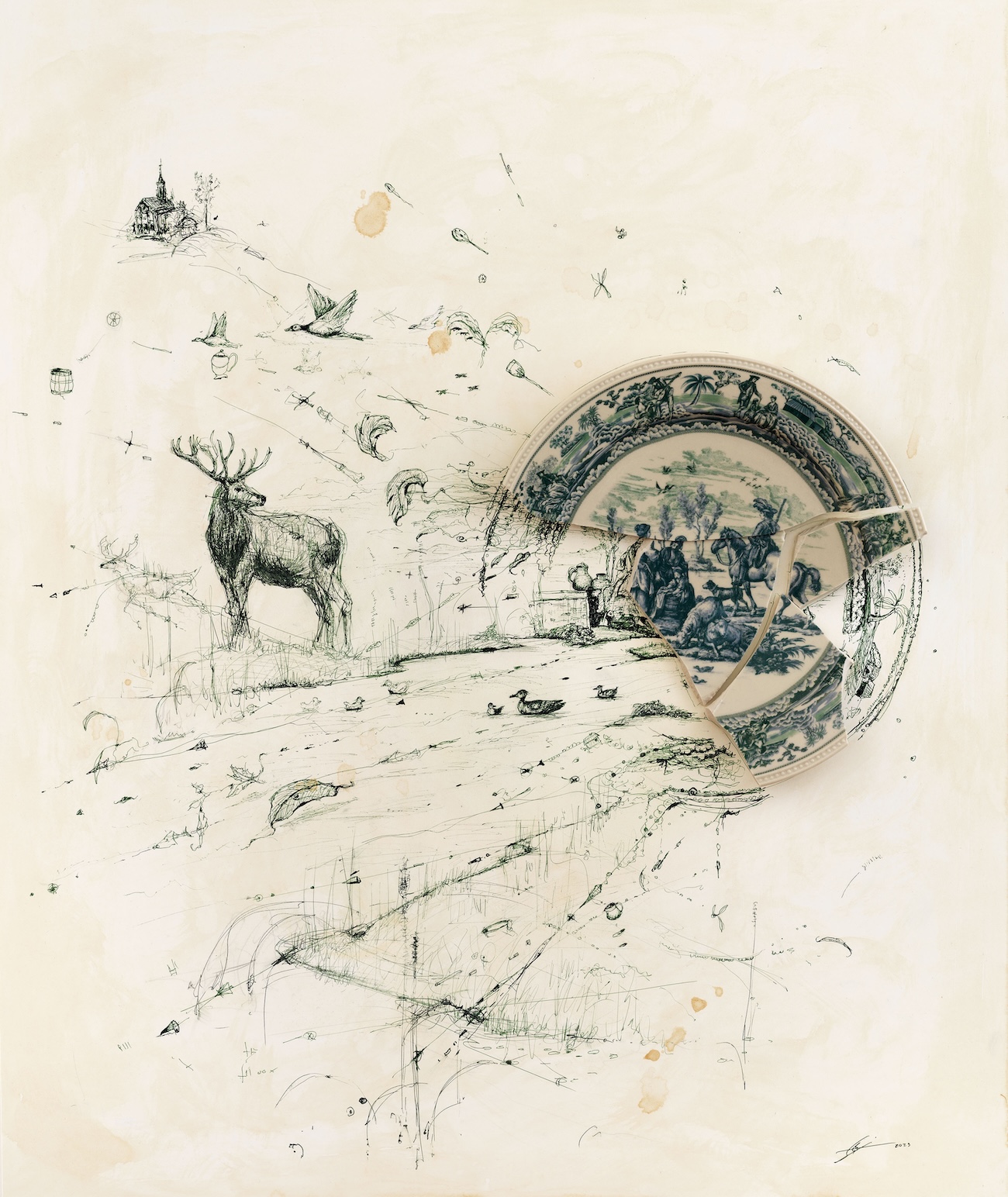
“Fragmented in Green with Stag and Stream”
You are giving up control, to a certain extent, in your work, as you can’t predict how the plate breaks. How has that changed how you work overall?
I love that part. I think of John Cage and the notion of chaos and how he incorporated it into his musical compositions. That surrender of control has been one of the most important things the series has taught me. I pick the plate and I can choose the moment when it breaks, but after that I have to respond to something I didn’t control.
Also, I will start the drawing without knowing exactly how it will all evolve. If there are “mistakes” in what I am doing I use it and come up with something I might not have expected.
I think that allows the subconscious to enter the process in a way that is difficult to force. When a piece is finished, I can sometimes look at it and recognize ideas, memories, or associations that I didn’t consciously set out to put there. The work is definitely a balance between control and accident.
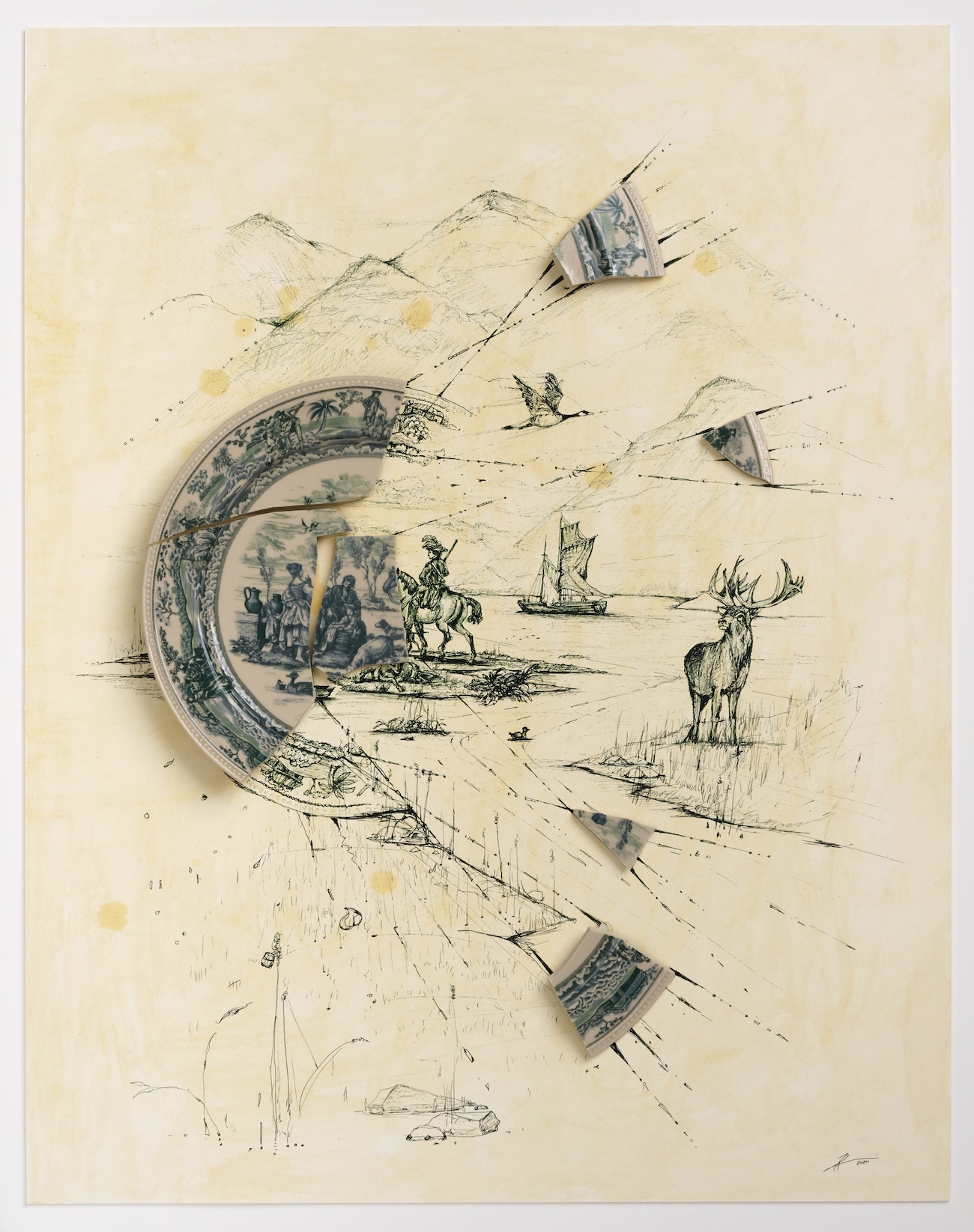
“Fragmented in Green with Stag and Ship”
What are you working on now? Anything exciting you can tell us about?
The next several months are very busy for me. On September 18, 2026, I’m opening a two-person exhibition, Fragmented Horizons, at Studio Shop Gallery in Burlingame, California. In October, I have an exhibition opening with Miart Gallery in London.
I’m excited about a book I’ve been developing around the Fragmented series with an essay by Glenn Adamson, that we’re hoping could launch during Art Week in New York in November. It will be available at galleries and on my site, Porcelain Projects.
I was recently on the podcast Cultivated by Caryn, hosted by podcaster and journalist Caryn Antonini. For December, she and I are in the early stages of developing an art-and-culinary experience in Palm Beach with Adelson Galleries.
I’ll also be presenting new work at Art Miami in December with Fremin Gallery.
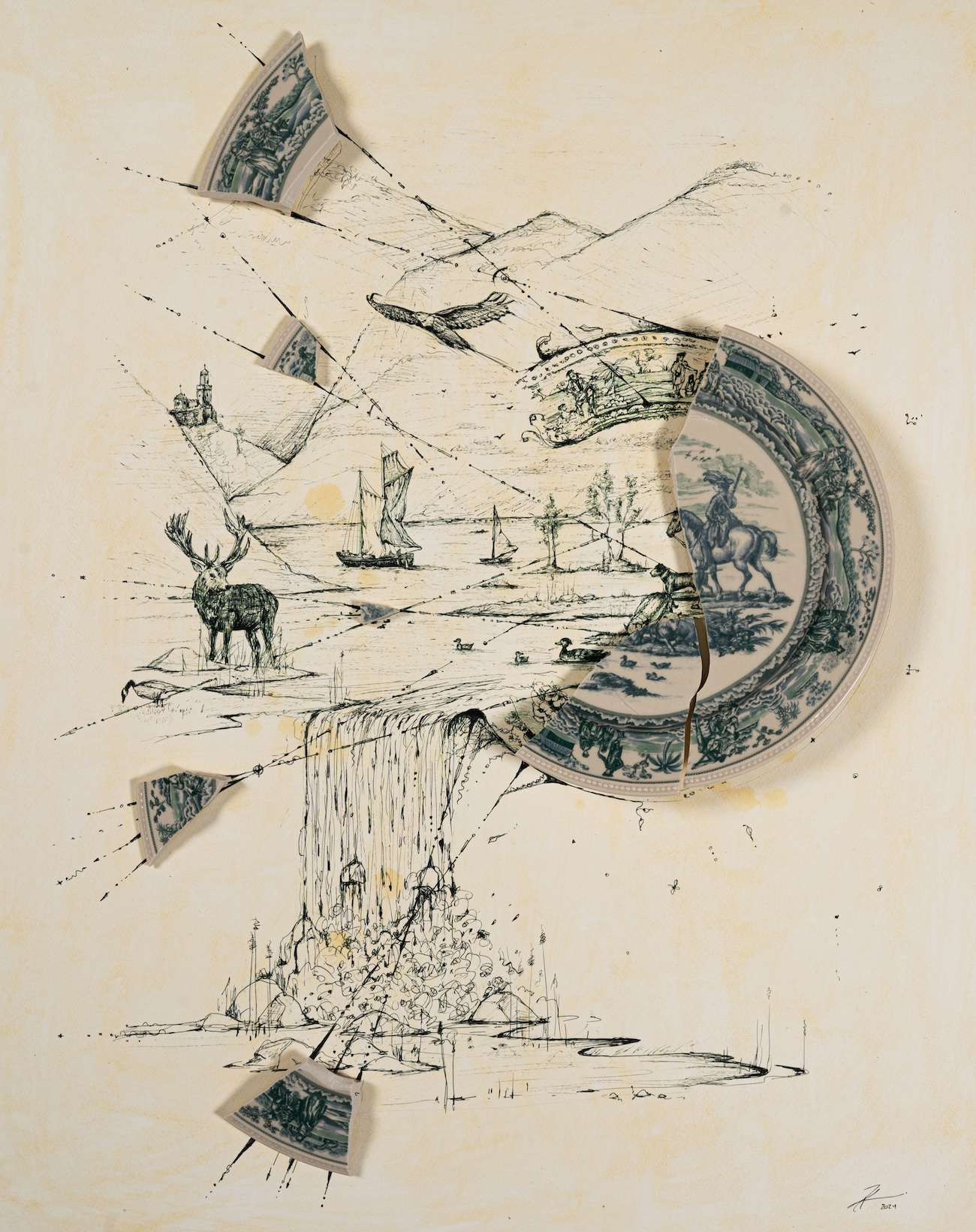
“Fragmented in Green with Mountain Echos”
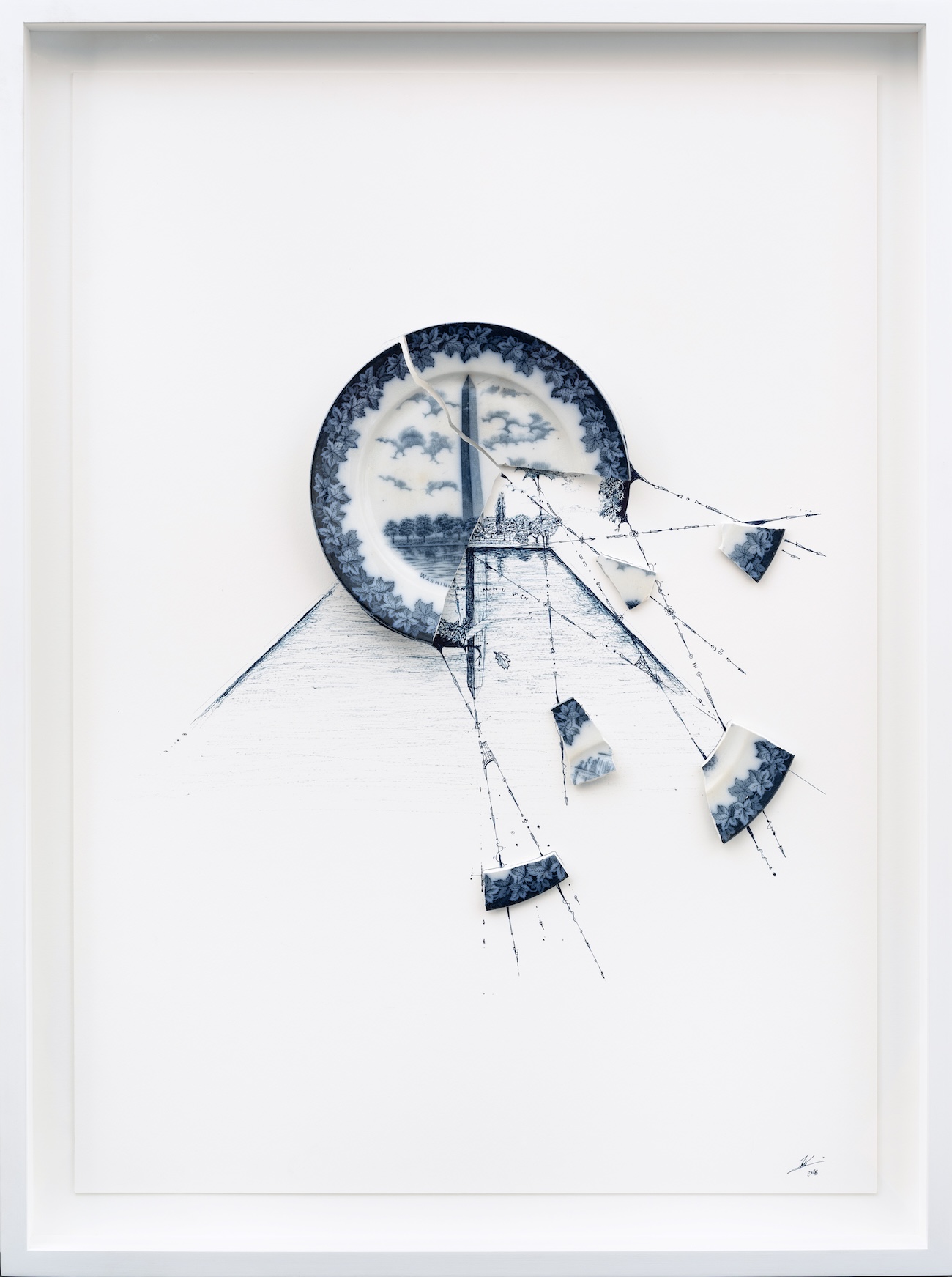
“Reflecting”