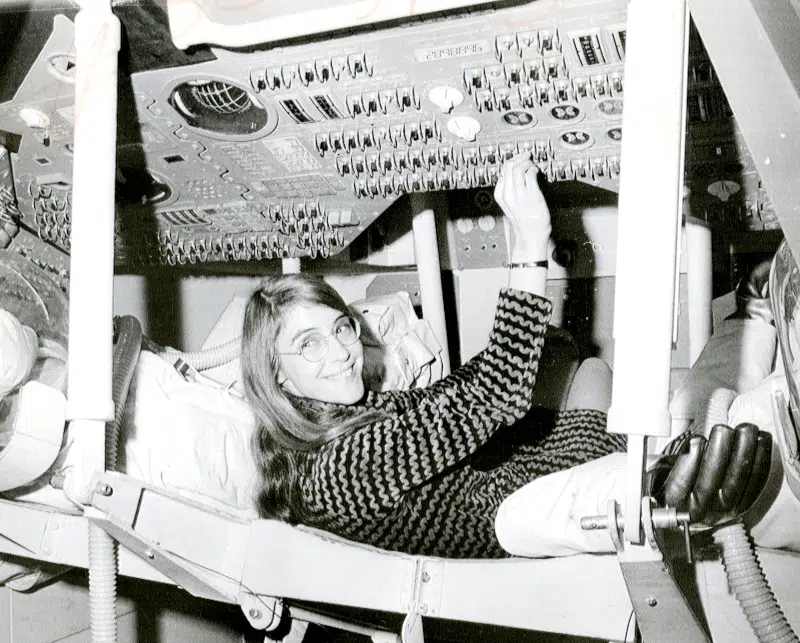
Margaret Hamilton, lead Apollo flight software engineer, in the Apollo Command Module. (Photo: NASA via Wikimedia Commons, Public domain)
Margaret Hamilton, a computing pioneer whose software was key in taking the Apollo 11 astronauts to the moon, has died at age 90. Her death was announced by the Massachusetts Institute of Technology (MIT), where she worked for over a decade. According to the reports, she passed away on September 30 from an undisclosed cause.
Born in Paoli, Indiana, in 1936, she studied mathematics at the University of Michigan before transferring to Earlham College. There, she got a degree in mathematics with a minor in philosophy, inspired by her poet father. In 1959, she took a job at MIT, where she learned how to code from working in the meteorology department for Edward Norton Lorenz, founder of modern chaos theory.
In 1965, her husband saw an advertisement by the The Instrumentation Lab at MIT in the newspaper, announcing they were looking for people to develop software to “send man to the moon,” as they had won the contract from NASA to build the onboard flight software for the Apollo program. Driven by her interest in innovation, Hamilton applied and became first programmer for the Apollo project at MIT.
Her work would prove invaluable in taking the astronauts safely to the moon and back. Hamilton developed critical onboard software, making it more resistant to errors and accidents. One of the failsafes she introduced was inspired by her 4-year-old daughter Lauren, who was playing with an Apollo command module simulator while Hamilton worked, crashing the simulator altogether. This prompted her to program backstops to prevent an astronaut from having the same issues in space.
Hamilton’s careful additions ended up having a real-life application on the mission. “One example of the value of Hamilton’s software work occurred during the Apollo 11 mission,” says NASA. “Approximately three minutes before Eagle’s touchdown on the moon, the software over rode a command to switch the flight computer’s priority processing to a radar system whose ‘on’ switch had been manually activated due to a faulty written operations script provided to the crew. The action by the software permitted the mission to safely continue.”
Beyond her work on the Apollo missions, Hamilton is credited with coining the term “software engineering,” when the job was in its earliest stages and wasn’t as respected as other engineering disciplines. “When I first came up with the term, no one had heard of it before, at least in our world,” she said. “It was an ongoing joke for a long time. They liked to kid me about my radical ideas. It was a memorable day when one of the most respected hardware gurus explained to everyone in a meeting that he agreed with me that the process of building software should also be considered an engineering discipline, just like with hardware.”
In 2016, Hamilton received the Presidential Medal of Freedom from President Barack Obama for her contributions to the Apollo missions. In a later interview with The Guardian, she offered some words of advice to women who want to pursue a career in coding: “Don’t let fear get in the way and don’t be afraid to say ‘I don’t know’ or ‘I don’t understand’—no question is a dumb question. And don’t always listen to the so-called experts!”
Olivier de Weck, the Apollo program professor and interim head of the MIT Department Aeronautics and Astronautics, honored Hamilton upon her passing. “To say Margaret Hamilton was a pioneer—to say she was ahead of her time—would be a dramatic understatement,” de Weck said via a statement. “She was a software engineer at a time when that field was in its infancy, and she not only developed advanced code herself but also led a team in using that nascent technology to develop one of the most complex systems humanity had ever achieved.”
Margaret Hamilton, a computing pioneer whose software was key in taking the Apollo 11 astronauts to the moon, has died at age 90.
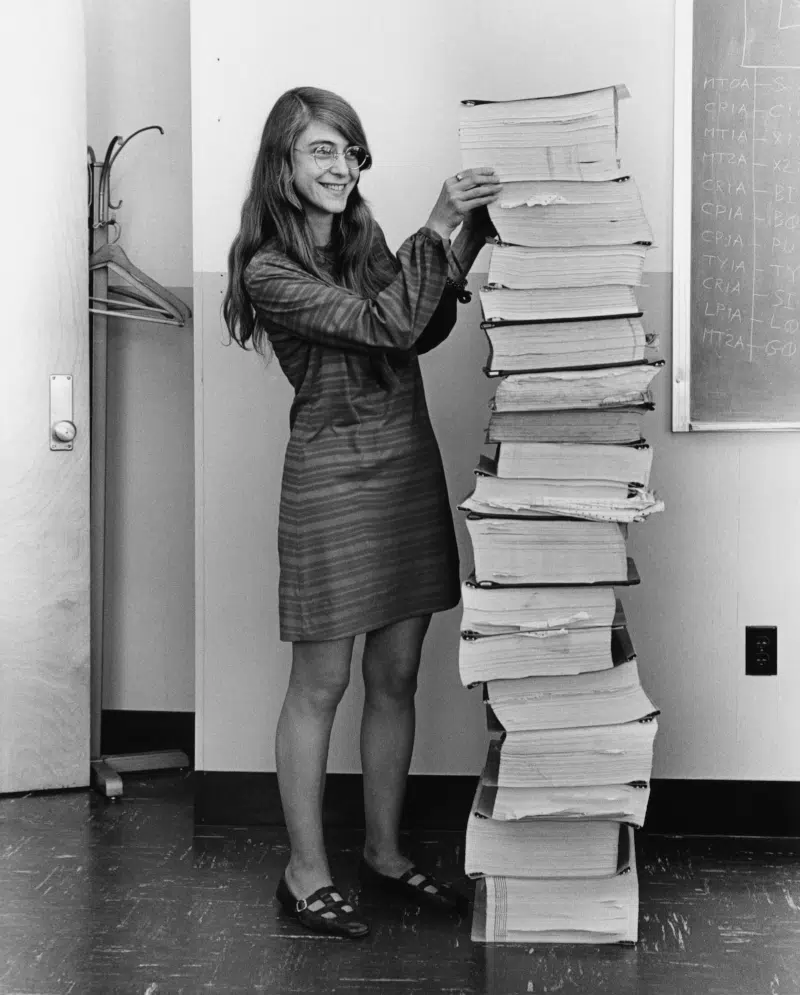
Margaret Hamilton shown in 1969 standing beside listings of the software developed by her and her team for the Apollo program’s Lunar Module and Command Module. (Photo: Draper Laboratory via Wikimedia Commons, Public domain)
Sources: Margaret Hamilton: ‘They worried that the men might rebel. They didn’t’; Margaret Hamilton, whose software helped land Apollo astronauts on the moon, has died; NASA HONORS APOLLO ENGINEER
Related Articles:
RIP Jim Lovell: NASA Astronaut Who Led the Safe Return of Apollo 13 Dies at 97
Remastered Images Celebrate Nasa’s Iconic Apollo Missions From 50 Years Ago
RIP Gloria Steinem: Feminist Trailblazer and Journalist Dies at 92
These Remarkable Photos of Planet Earth Were Taken 50 Years Apart by NASA