At an estimated 194 years old, Jonathan the Aldabra giant tortoise has outlived generations of humans and become the oldest known living land animal. He’s even exceeded his species’ average life expectancy of 80 years. Though the special care he receives from professionals has certainly aided his extended life, something else must be making this tortoise special.
Jonathan was brought to the British-controlled island of St Helena off the coast of Africa in 1882. He was given to the island’s governor as a gift and has resided at the Plantation House, the governor’s home, ever since. He arrived already full-grown and thus estimated to be at least 50 years old. His current 194-year age is a conservative estimate; he could actually be over 200 years old already.
Either way, researchers needed to get a cheek swab to learn more about the anomalous reptile. (Though a blood sample would’ve been more accurate, it would have put him at risk for infection.) After analyzing his DNA and epigenome (the on-and-off switches of genes), the research identified 287 unique genetic variants that may have contributed to his extraordinary age.
Areas of the genome linked to things like DNA repair, mitochondrial function, insulin regulation, and cancer suppression, which all stood out as especially youthful, compared to those of 5-year-old Aldabra tortoises. This is significant evidence because it corresponds with findings from supercentenarians.
“Our cells start doing the wrong things, and we get cancers, for example,” study coauthor Justin Gerlach, a biology fellow at the University of Cambridge in the United Kingdom, told CNN. “But Jonathan has still got the genetic controls of a much younger animal.”
Gerlach adds, “We don’t know whether that’s because he is exceptional, or whether actually that’s what giant tortoises do. But it does mean that their bodies are much fitter than we would expect for their age, compared to what would happen with humans.”
Jonathan’s species has made an incredible comeback after once being pushed near extinction in the 19th century, when there were fewer than 1,000 left. It’s lucky Jonathan was presented as a gift, otherwise, he would likely have been used for food, as many of his kind were. They now outnumber people on Aldabra Atoll: 122,000 humans to a staggering 180,000 tortoises.
Meet Jonathan, an Aldabra giant tortoise and the oldest known living land animal in the world.
Jonathan is an estimated 194 years old, which exceeds his species’ average life expectancy by almost 120 years.
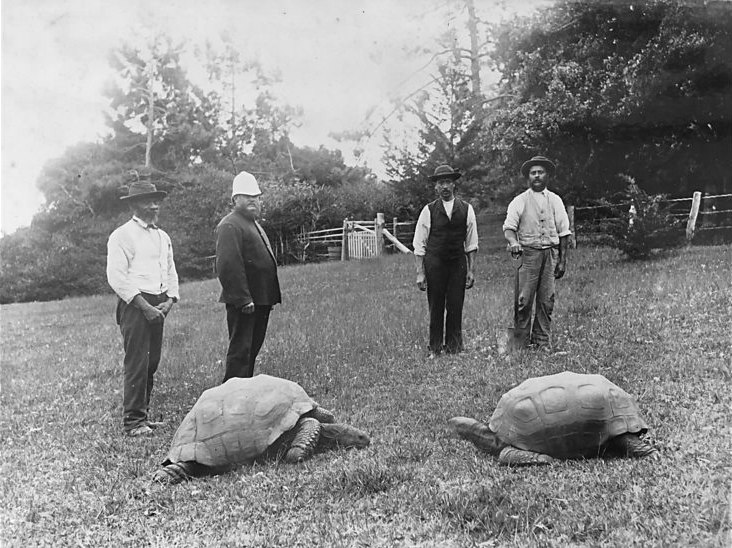
Two giant tortoises photographed on the grounds of Government House, St. Helena. The tortoise on the left is Jonathan, estimated to have hatched in 1832 and still living as of 2026. (Photo: Unknown photographer via Wikimedia Commons, Public domain)
Scientists were curious about how this Guinness World Record-holding tortoise could live to be so old.
View this post on Instagram
So, a team of researchers took a cheek swab and analyzed Jonathan’s DNA and epigenome.
They found that Jonathan has 287 genetic markers relating to DNA repair, mitochondrial function, insulin regulation, and cancer suppression that are uniquely youthful.
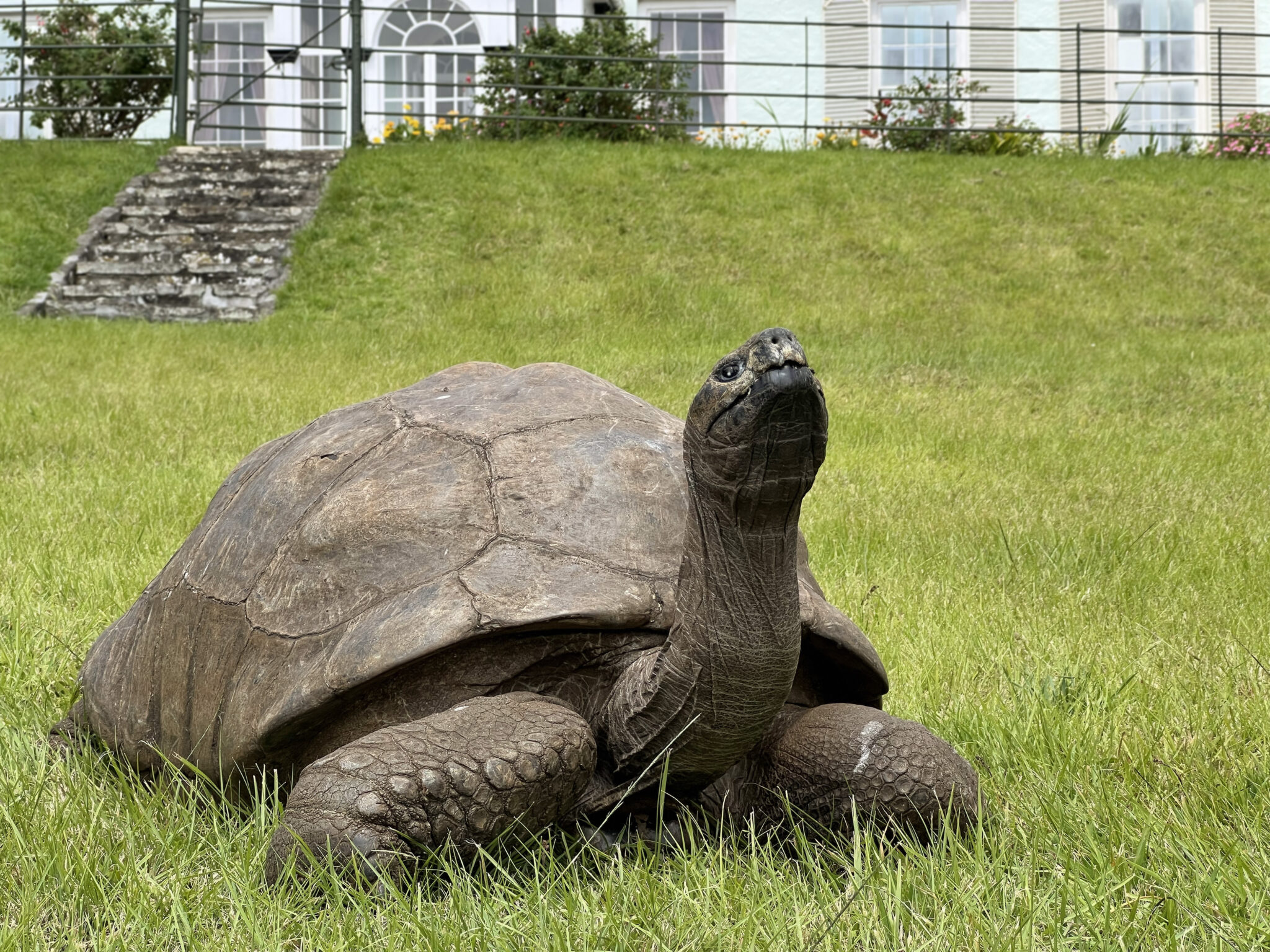
Jonathan, on the lawn of Plantation House on the island of St. Helena, who holds the Guinness World Records, for being the world's oldest living land animal. (Photo: Kevin Gepford via Wikimedia Commons, CC BY-SA 4.0)
Sources: Epigenetic insights into extreme longevity in the world’s oldest terrestrial animal, Jonathan, Jonathan the 194-year-old tortoise could help humans live longer, Scientists Took a Cheek Swab From the World’s Oldest Tortoise. His DNA Could Reveal Hints to Longevity
Related Articles:
11-Year-Old Dinosaur Lover Becomes Guinness World Record Holder for World’s Youngest Museum Curator
Galapagos Tortoise Celebrates 135th Birthday by Becoming Father for the First Time
After Nearly Going Extinct, Famed Giant Tortoises Return to the Galápagos Islands