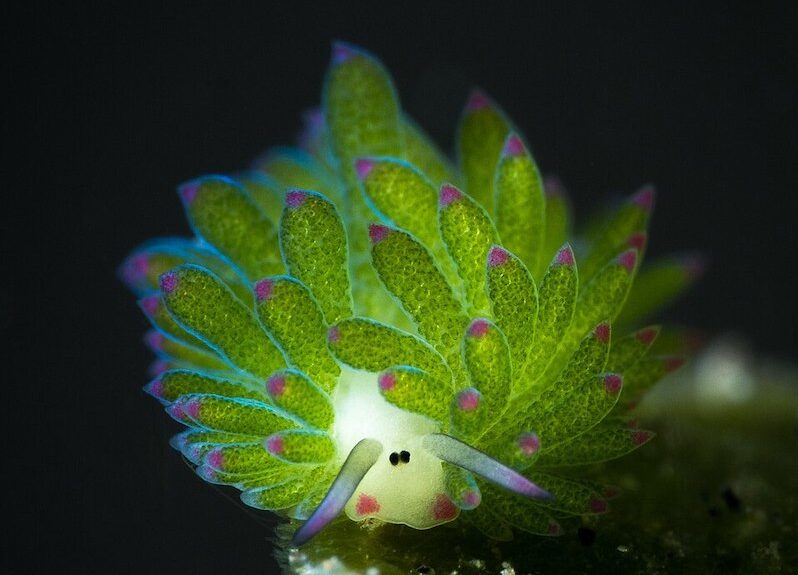
At roughly the size of a grain of rice, the leaf sheep hardly seems like the sort of animal capable of winning an international popularity contest. Yet the minute marine creature, Costasiella kuroshimae, has taken the top spot in The Guardian’s 2026 Invertebrate of the Year competition. Competing against nine other remarkable species in a global public vote, its victory celebrates more than an unusually photogenic sea slug. The leaf sheep possesses one of the strangest biological adaptations in the animal kingdom: it can retain functional chloroplasts from the algae it eats, allowing its body to harness solar energy.
The Invertebrate of the Year competition, now in its third year, celebrates the extraordinary diversity of animals without backbones. Organized by The Guardian, the annual public vote invites readers to choose their favorite from a shortlist of 10 unusual species. This year, the tiny leaf sheep beat all other nominees, including the Patagonian moscardón bumblebee, which placed second, and the horseshoe crab, which came in third.
The leaf sheep belongs to Sacoglossa, a group of small, shell-less sea slugs that feed on algae. Scientists first described C. kuroshimae in 1993 after finding it near Kuroshima, an island in Japan’s Ryukyu Islands. The species also occurs in tropical waters around the Philippines and Indonesia.
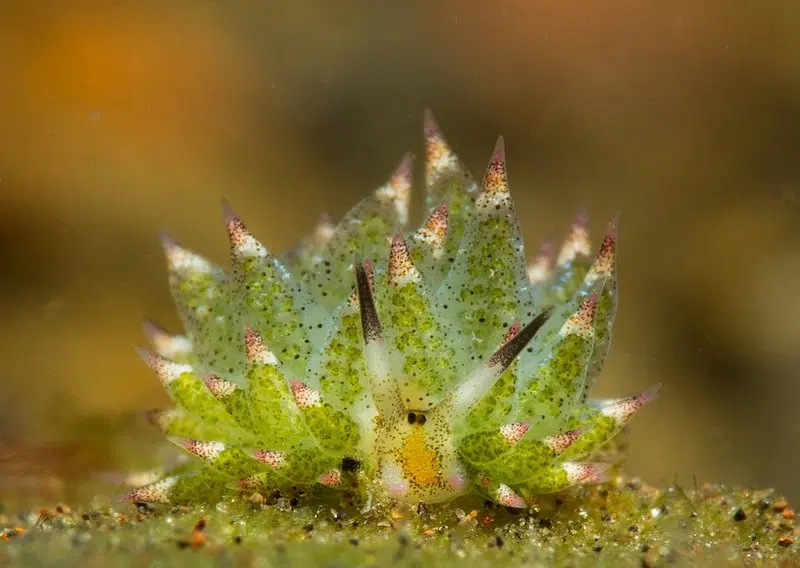
The sea slug itself has a very distinctive appearance: branching structures called cerata cover its back, giving it a leafy silhouette. These structures also help the animal breathe and contain the remnants of the algae it consumes.
That diet gives the leaf sheep an unusual advantage. Rather than completely digesting the algae, C. kuroshimae can retain some of its chloroplasts, the structures that allow algae and plants to convert sunlight into energy. The process, known as kleptoplasty, allows the sea slug to temporarily harness energy from sunlight using cellular machinery it acquired from its food.
The adaptation also gives the leaf sheep its vivid green color, making it look almost like a tiny piece of vegetation drifting through the water. At only a few millimeters long, it could easily disappear among the algae it eats. Under magnification, however, its delicate cerata and unusual green tissues reveal an animal with a remarkable ability to borrow one of nature’s most fundamental processes.
The leaf sheep may be tiny, but its unusual biology makes it a remarkable example of how animals adapt to their environments.
The tiny leaf sheep (Costasiella kuroshimae) has been named Invertebrate of the Year 2026 after winning a global public vote.
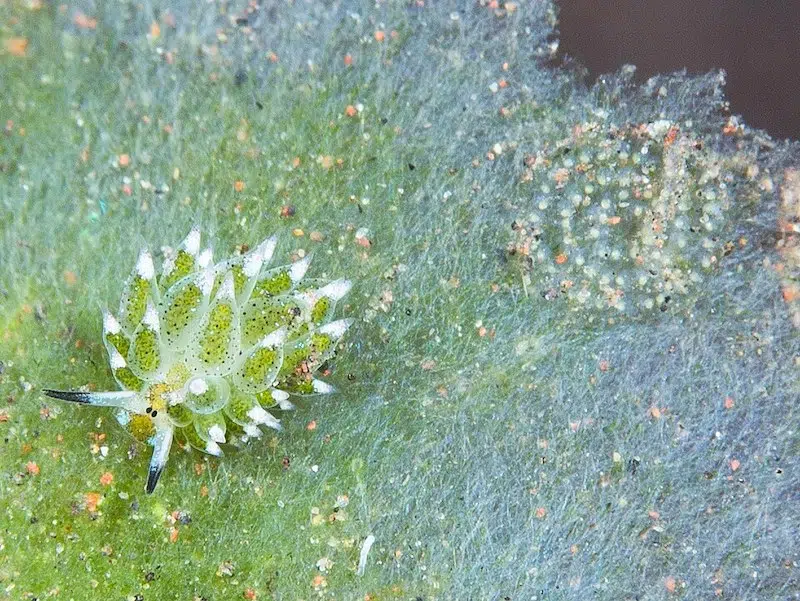
Just a few millimeters long, this sea slug can keep chloroplasts from the algae it eats, allowing it to capture energy from sunlight in a rare process called kleptoplasty.
View this post on Instagram
Sources: Winner of Invertebrate of the Year 2026 crowned – and it is the size of a grain of rice; ‘You’d want one as a pet’: the irresistibly cute solar-powered sea slug
Related Articles:
Hypnotic Videos of Insects Crawling on Tiny Worlds of Blooming Flowers
Photographer Travels To Remote Forests of Indonesia To Capture Images of Rare Insects
Weevil Balancing on a Grain of Rice Wins the Nikon Small World Contest
Macro Photography Highlights Beauty of Extinct and Endangered Insects [Interview]