Photo: Matthew Sherman
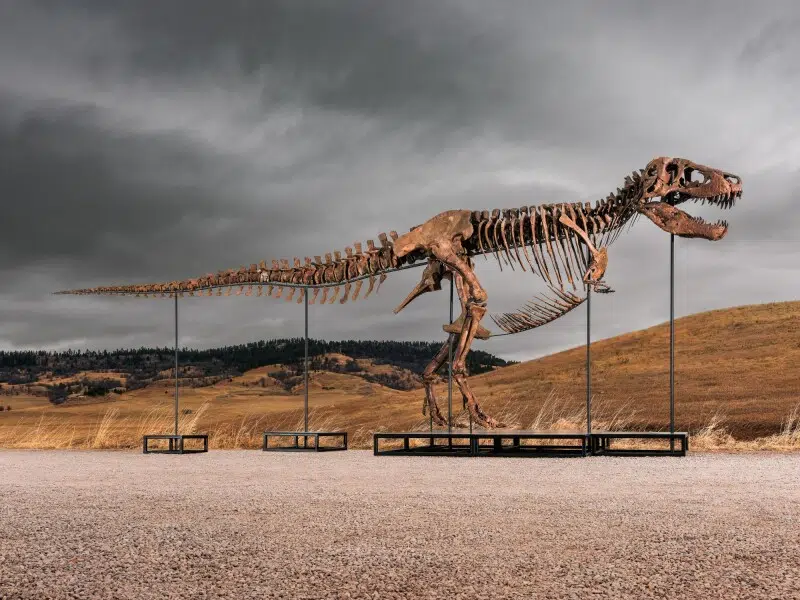
A Tyrannosaurus rex fossil named Gus just started in one of the most talked about auctions in recent years. Sold for $50.1 million to an anonymous buyer at Sotheby’s, the skeleton has become the most expensive dinosaur ever. But while Gus has made history, the sale has scientists concerned, as it marks the latest episode of prehistoric fossils being turned into hot luxury collectibles for the super rich, further pricing out museums and academic institutions who need these specimens for research and education.
The 67-million-year-old fossil was sold as part of Sotheby’s “Geek Week” which also featured items like a fully operational Apple-1 computer and objects from Buzz Aldrin’s personal collection, like a pen and broken switch from the Apollo 11 Lunar Module. Having sold for over $50 million, resulting in an approximate $43 million before premiums, the T-Rex broke the previous auction record for a dinosaur fossil of $44.6 million set in 2024 by the Stegosaurus Apex, also sold by Sotheby’s. In 2025, a juvenile Ceratosaurus was sold for $30.5 million, surpassing its original estimate $4-6 million given its smaller size.
Found in a South Dakota, Gus is named after Gary “Gus” Licking, owner of the ranch where the dinosaur was unearthed between 2021 and 2023. Sadly, Licking died a year after the excavation process began, so he never got to see the dinosaur in full. Gus stands about 38 feet long and 12.5 feet tall. Most impressively, the fossil consists of 183 fossil bone elements, making it approximately 63% complete by bone count. This makes Gus one of the most complete T-Rex specimens ever discovered.
“Gus is the culmination of years of rigorous excavation and preparation under some of the most challenging field conditions imaginable, and years of exacting study, documentation, and research,” says Sotheby’s Vice-Chairman and Worldwide Head, Science & Natural History, Cassandra Hatton. “Tyrannosaurus rex is the most iconic pre-historic species in the fossil record, and Gus stands firmly among the greatest examples ever found.”
Aware of the criticism, Hatton has also pointed out that commercial fossil hunters often unearth dinosaurs that might otherwise never be excavated. It has also been brought up that loans from private collectors are possible, such as billionaire Ken Griffin lending Apex to the American Museum of Natural History in New York for four years.
Still, academics agree that this is far from a perfect solution. “The problem is that a privately owned fossil can be recalled from a museum at any moment back into an owner’s home, so the principles of availability and replicability are not guaranteed,” Dr. Thomas Carr, a vertebrate paleontologist and associate professor at Carthage College in Wisconsin told The Guardian.
“A private collection has no guarantee that a fossil will stay in a collection for all time, whereas a public trust’s mission is to maintain, conserve, and curate its collection indefinitely,” Carr explains. Additionally, the paleontologist says, “Fossils need to be available to test previous observations and to make new insights; the fossils are the data so they must always be available for study.”
“The current trend towards dinosaur fossils being marketed and sold like rare artworks at vast prices by auction houses is very concerning, as is the idea of buying dinosaur fossils as a status symbol or a commodity,” Richard Butler, a vertebrate paleontologist at the University of Birmingham asserts. “A fossil not in a recognized museum collection cannot be studied and is therefore lost to research.” Studies are also not performed just one time. As new technologies appear, scholars try new approaches to better understand these creatures, and independent researchers corroborate the results reached by their peers.
Butler also adds, “Fossils have been bought and sold for hundreds of years, but prices are increasingly out of the reach of museums, much to the detriment of science.”
Sources: Gus, Apex, Sue and the Ceratosaur: Sotheby’s Most Thrilling—and Complete—Dinosaurs at Auction; Sale of multimillion-dollar T rex skeleton is big headache for scientists; $50 Million Dinosaur Sale Smashes Auction Record. Three Palaeontologists Told Us Why That’s Potentially Catastrophic For Science And Education
All images via Sotheby’s.
Related Articles:
Paleontologists Discover New Dinosaur Species in Sahara Desert
Fossil of Extinct North American Rhino Offers Evidence Challenging Our Knowledge of Arctic History
Young Boy Discovers 140-Million-Year-Old Marine Fossil While Digging in His Yard
Three Young Boys Discover Rare Tyrannosaurus Rex Fossil While on a Hike
Engineers Develop T-Rex Leather Handbags Made From Dinosaur DNA