Izanami 03
Contemporary artist Richard Nadler lives and works in Munich, Germany, creating richly layered images that blur the boundaries among AI-generated art, textile craftsmanship, and traditional artistic practice. From vibrant domestic interiors to psychedelic forests and chrome-clad samurai, Nadler creates worlds that feel simultaneously digital and tangible.
Nadler left behind his career in London’s banking sector to pursue his craft, following in the footsteps of his grandfather and mother, who were both painters. His father, an avid collector of African art, took Nadler on many visits to Japan. This influence shines through in his pieces. His 2023 collection, Yamabushi Horizons, evokes the rolling mountains of Japan through shapes and strokes inspired by childhood visits, and his 2025 collection, See No Evil, Hear No Evil, Speak No Evil, depicts three women in traditional Japanese dress interacting with technological objects, seeking to explore “technology as both tool and cage.”
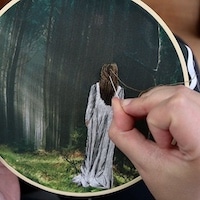
Nadler uses his own models to generate AI art that is so complex it feels like you could reach through the screen and touch it, something he noticed attendees doing at his exhibits. It was then that he began incorporating embroidery into his practice, adding a textural, tactile element. Many of his collections are available as large-scale embroidered pieces by Maison Vangart, a textile design studio
“The embroidered works carry painterly gestures, algorithmic structures, and material density converging into a single physical surface,” Nadler explains. “Something that holds both control and chance, fixed in time through millions of stitches.”
My Modern Met had the chance to speak with Nadler about his practice, inspirations, and what’s next for him. Read on for an exclusive interview with the artist.

Izanami Islands 01
Your work often evokes deeply emotional, cinematic scenes that feel rooted in memory, longing, and human experience, despite being created with the aid of machine learning. How do you maintain a distinctly human voice in art that incorporates AI?
There’s a misconception that AI art is about writing a prompt and generating an image instantly. For me, the process is the opposite. Every series begins with what I think of as an initial human phase, where the structure, tension, and meaning of the work are established before the algorithm sees anything. The machine then expands that idea, but it doesn't originate it. If that initial phase were missing, the work would lose its direction and become purely generative rather than authored.
I also rebuild and retrain a custom diffusion model from scratch for each new body of work, trained on my own material, my own references, the specific atmosphere of the series. These models aren’t neutral. They carry structure, bias, and visual memory. By starting from scratch each time, I can define a new visual logic that's specific to what that chapter is about.
What stays consistent across everything is not a model. It’s a way of thinking about composition, density, texture, and rhythm. AI is like a brush or a camera. What matters most is the idea and the feeling behind the work. That comes from me. Not from the machine.
The model changes. The authorship doesn’t.

ArchiTextures 04
What inspired you to combine AI with traditional craft?
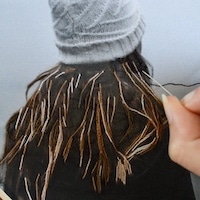
It happened the other way around. The embroidery wasn’t added to the work. It was recognized in it. Early on, my digital outputs began to develop a density that resembled stitched surfaces. It emerged through the way I was building and training the models. I leaned into it, refined it, almost pushed the image to behave like textile. Only later did I realize this wasn’t a visual effect but a consistent language. The collaboration with Vangart in Lyon was then a natural continuation, a way to translate something that already existed digitally into material form.
There’s also something I love about the meeting itself. I come from the digital art world, so for me there is still something almost magical about taking a very new technology and translating it back into an old-school, medieval medium. I love when two different worlds get together and merge.

ArchiTextures 03
Why is embroidery an important part of your practice?
Because the work needed somewhere to land. At exhibitions of my digital pieces, viewers kept reaching out to touch the screens, not always knowing why. That moment always stayed with me. If someone is trying to touch something, it means they’re being pulled in by something. The embroidery was the answer to a question the audience was already asking with their hands.
It also traces back to my father. He worked with the finest materials he could find, Kashmir cloth, marble, fine suit fabric. He’d press cloth into my hands as a child and say: just touch it. The finest touch available. That sensibility never left me. So when the digital work started behaving like textile, and viewers started reaching for it, the move into hand-and-machine embroidery in Lyon wasn’t a leap. It was a recognition.

Yamabushi’s Horizons 01
Growing up in the Bavarian countryside and traveling to Japan had a profound impact on your aesthetic. How do these two cultural landscapes coexist in your art?
They are two halves of the same inheritance.
Japan was where my father worked. I visited him there during school holidays. The mountains, the shrines, the high-speed trains, the Sakura. He used to point the blossoms out to me during our travels. He taught me to look.
Bavaria is where I grew up, in Penzberg, next to a forest, close to the Alps. October there is my favorite time. The Indian summer. The forests turn into glowing reds, golds, and warm tones, and even when the air is already cold, the color creates a sense of warmth. You can smell the damp earth and the fallen leaves. In those moments you can really feel how color changes the emotional temperature of a place.
Japan gave me a sensitivity to material, detail, and atmosphere, a place where slowness and attention are still valued. Bavaria gave me weight, ground, the climate of being somewhere. The work carries both. They’re not in opposition. They’re in conversation.

Yamabushi’s Horizons 05
Which of your collections feels most personal to you, and why?
Yamabushi’s Horizons probably comes closest. It’s inspired by the philosophy of the Yamabushi mountain monks, the idea that mountains symbolize the challenges we face in life, and that through light, color, and scale, those obstacles can be transformed into something hopeful. Growth and strength often emerge from the hardest paths.
But the deeper reason is that the series is rooted in memories of traveling through mountains with my father. His presence and perspective continue to shape how I experience those landscapes. Every time I return to that body of work, I’m returning to him.

ArchiTextures 10
What do you hope viewers feel when they encounter your work for the first time?
I hope they slow down. From a distance, the work reads as a coherent image. But as you move closer, it begins to dissolve into layers of detail, structure, and micro-decisions, built from thousands, sometimes millions of elements that only reveal themselves over time. The eye can’t capture everything at once, so it has to travel.
What I hope happens in that traveling is a shift, from looking at something to experiencing it. From observing to disappearing. The work is not something you consume. It’s something you disappear into.
If someone gives the work that kind of attention, even for a few minutes, that’s the highest form of recognition I can receive. Because the work only fully exists in that moment of attention.

See No Evil 01
Are there any artists, movements, or experiences that are inspiring you right now?
Gerhard Richter, consistently. His work moves between control and chance in a way I find deeply compelling, a constant tension between intention and unpredictability, between something constructed and something that emerges. That dialogue is very close to how I think about my own practice with generative systems.
I keep returning to Japan, too. Not just as subject matter, but as a way of working. There is a sensitivity to material, detail, and atmosphere there that resonates with everything I’m trying to do.
And honestly, the thing that excites me most right now is the meeting point between very old craft and very new tools. Embroidery is essentially a medieval medium. I’m working with a technology that didn't exist five years ago. I love when those two worlds collide, when the most contemporary process I can find ends up producing something whose final form requires weeks of patient, traditional, human work.

HabiTextures 05
What are you working on next?
Larger physical works. Specifically, translating the architectural series into embroidery at scale.
The architectural pieces started with a New York exhibition where I found myself standing among skyscrapers, completely overwhelmed, looking up. I began asking what happens inside these buildings. The image that came to me was cutting a building in half like an onion to reveal the interior. A vertical society, a social melting pot. So many emotions, so many things going on at once: business, feelings, hard feelings, love, all of it stacked into one structure. I don’t see it as positive or negative. It’s just a reminder of how we live now.
That work has lived mainly as digital pieces so far, and as a few smaller embroideries. What I’m working toward now is bringing the towers, the bridges, the megastructures into Vangart’s machines at real scale. Pieces where the building stands almost human-sized in front of you, and where every window, every figure, every interior layer is held in millions of stitches. At a distance, you read the structure. Up close, you find the lives inside it.
Beyond embroidery, I’m also thinking about architectural integration. Works that don't just hang in a space but become part of it. The conceptual ground stays the same: something generated, something made, not as a contradiction but as a continuous spectrum.
A chapter isn’t finished when I decide it is. It’s finished when it stops resisting me. This one is still resisting, which is exactly where I want to be.

HabiTextures 04

HabiTextures 10
Richard Nadler: Website | Instagram
My Modern Met granted permission to feature photos by Richard Nadler.
Related Articles:
How This Artist Pivoted Into Surreal Sculpture After Decades of Photography [Interview]
20-Year-Old Artist’s Surreal Sculptures Blur the Line Between Human and Machine
Artist Reimagines Famous Portraits Using a Pixel-Like Painting Technique