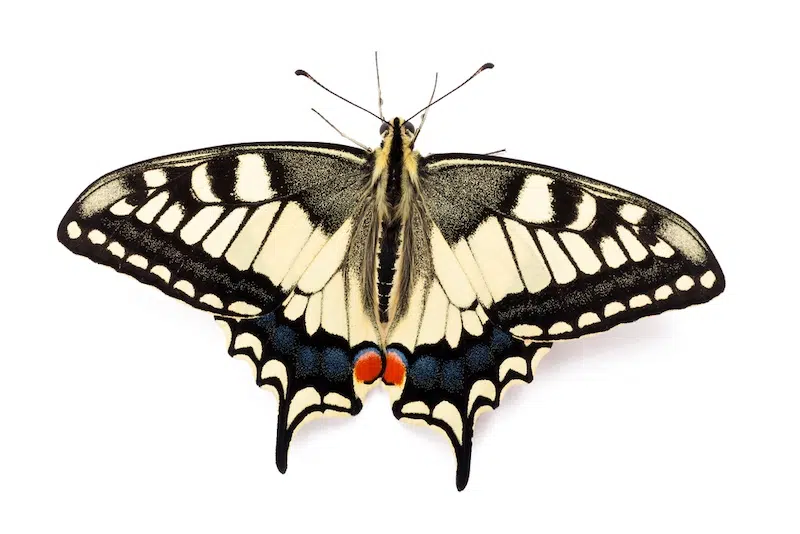
Jo Nagai from Kobe, Japan, has been fascinated by insects since he was old enough to explore the outdoors, but Asian swallowtail butterflies have always been his favorite. After raising the butterflies by hand, the curious 10-year-old noticed that they would often return to him after being released into the wild. The behavior made him wonder if butterflies could remember experiences from their caterpillar stage, despite undergoing complete metamorphosis. Over the next two years, the second grader designed an experiment that proved those early memories could survive the transformation.
Nagai began by reaching out to Dr. Martha Weiss, a renowned entomologist at Georgetown University, who had previously studied whether moths could retain memories from their caterpillar stage. He wrote a four-page letter by hand explaining the observations he’d made so far and asking for her advice on how he could adapt her moth experiment for his butterflies. By working together, the university professor and elementary school student found a way to simplify a complex laboratory experiment so it could be carried out by Nagai at home.
Nagai needed to create a memory to determine if it carried through to when the caterpillars became butterflies. The young scientist used a mild electrical pulse from a muscle therapy device to teach a group of caterpillars to associate the smell of lavender oil with the vibration. Although harmless, the caterpillars in the control group learned to dislike the smell of lavender.
Once the caterpillars transformed into butterflies—a process that completely restructures their bodies and nervous systems inside the chrysalis—it was time to test whether the insects would remember their dislike of lavender. Nagai then tested the butterflies in a Y-shaped maze. One arm carried the scent of lavender, while the other contained no odor. The untrained butterflies chose each path in roughly equal numbers, but the butterflies that had been trained as caterpillars overwhelmingly avoided the lavender.
The surprising results showed that the memory they had formed before metamorphosis had survived into adulthood. But Nagai didn’t stop there. He went on to test the offspring of the trained butterflies to see whether those memories could be passed from one generation to the next. Remarkably, even though the young butterflies had never experienced the vibration training themselves, they instinctively avoided the scent of lavender. His findings provided compelling evidence that learned memories can be inherited across generations in swallowtail butterflies—and maybe even other species.
Nagai—who wants to be a vet when he grows up—presented his 33-page research report at the International Congress of Entomology in Kobe in 2024, where Dr. Weiss traveled to Japan to meet him in person for the first time. His presentation drew the attention of researchers from around the world, many of who were amazed that such a significant contribution to the field had come from an elementary school student.
Find out more about Nagai’s impressive research in the video below. There’s also a podcast—titled Caterpillar Roadshow—about Nagai and Dr. Weiss’ collaboration by Signal Hill, created by Weiss’ daughter.
1o-year-old Jo Nagai designed an experiment that proved caterpillar memories could survive metamorphosis, and even pass down to offspring.
Source: Genius 10 Year Old's Research Shocks Scientists Around the World
Related Articles:
Scientists Solve the Mystery of How Butterflies Flew 2,600 Miles Without Stopping
Monarch Butterflies Are Now Classified as an Endangered Species
Listen as Millions of Monarch Butterflies Make One of the Rarest Sounds on Earth
14-Year-Old Is Named “America’s Top Young Scientist” for Developing Soap To Treat Skin Cancer