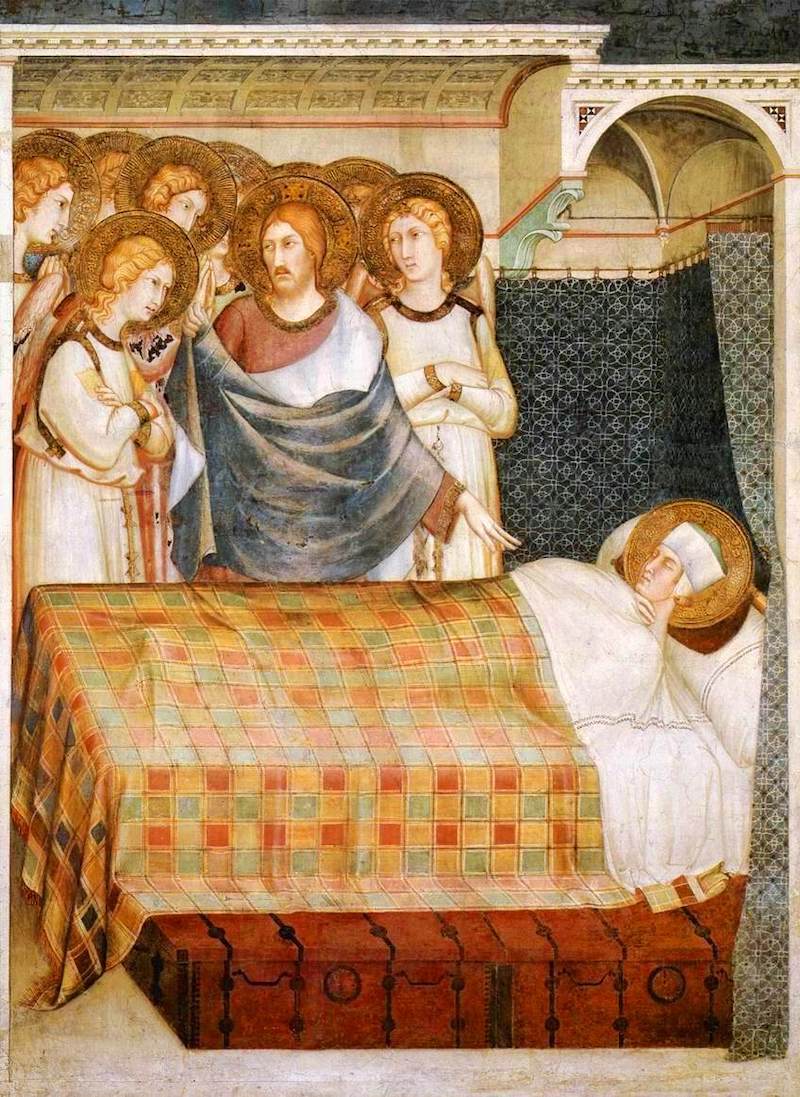
“The dream of St. Martin” by Simone Martini, 1322-1326 (Photo: The Yorck Project via Wikimedia Commons, Public domain)
Today, sleeping around eight hours a night is the norm, but this routine wasn’t always the case. During the Middle Ages, people often slept in two distinct shifts, known as the first sleep and the second sleep. The theory comes from Roger Ekirch, an American historian who specializes in historical sleeping habits. His book, At Day’s Close: Night in Times Past, argues that before artificial lighting, most people would go to bed around sunset and wake up again around four hours later.
Historians like Ekrich discovered mentions of biphasic sleep in journals, literature, and medical writings from the 15th to the 18th centuries. It was considered a natural and healthy sleep pattern, influenced by the natural rhythms of day and night. From around midnight until the early hours of the morning, people would wake up to read, pray, or even socialize. Then, they would head back to bed for their second sleep from around 3 a.m. until daylight.
Although historians believe this nocturnal routine was common during that time, it wasn’t for everyone. “Not everyone, of course, slept according to the same timetable,” Ekirch explains. “The later at night that persons went to bed, the later they stirred after their initial sleep; or, if they retired past midnight, they might not awaken at all until dawn.”
Ekirch’s research suggests that sleeping in two shifts was common around the world. “The French priest André Thevet, on traveling to Rio de Janeiro, Brazil in 1555, reported that the Tupinamba Indians ate whenever they had an appetite, ‘even at night after their first sleep they get up to eat and then return to sleep,’” he wrote. “In the early 19th century, residents of Muscat, the capital of Oman, were said to retire early, lying ‘down before 10 o’clock,’ so that ‘before midnight their first sleep’ was ‘usually over.’”
Just like today, people in the Middle Ages had all sorts of ideas about how to get a good night’s sleep. Ekrich reported that in medical books of the time, authors advised people to sleep on their right side during “the fyrste slepe” for better digestion, then “after the fyrste slepe turne on the lefte side.”
As we gain a better understanding of circadian biology, ancient practices like segmented sleep could be making a comeback. Many health experts suggest sleeping in two shifts may even be a more “natural” and healthier alternative to the modern eight-hour sleep, especially for those dealing with insomnia, stress, or anxiety.
Source: How did people sleep in the Middle Ages?
Related Articles:
How Illuminated Manuscripts Were Created During the Middle Ages
Doctor Reveals the “Worst Sleeping Position” for a Peaceful Slumber
Sleep Study Shows Two Nights of Bad Sleep Ages You Four Years