Many ancient cultures around the world regarded death as a transition to another plane of existence, rather than a definite end. As such, their funeral rites prepared the deceased for whatever came ahead. For example, the Chancay culture, which thrived in modern-day Peru from about 1000 to 1532 CE, wrapped their dead in mummy bundles made of rich textiles to keep them warm and protected. They also placed wooden masks, also known as “false heads,” on them, which served as a symbol of the deceased’s identity and tended a bridge between the living and the dead.
“Since bodies were usually buried in an upright fetal position (with head on knees), when wrapped with layers and layers of lavish textiles, the mummy bundles did not have a clear head to act as a focal point for veneration,” says The Walters Art Museum collection in Baltimore. “Therefore, ‘false heads’ of wrapped textiles were created for the top of such bundles, and in some cases wooden masks, showing a stylized face, were tied on to such bundles.”
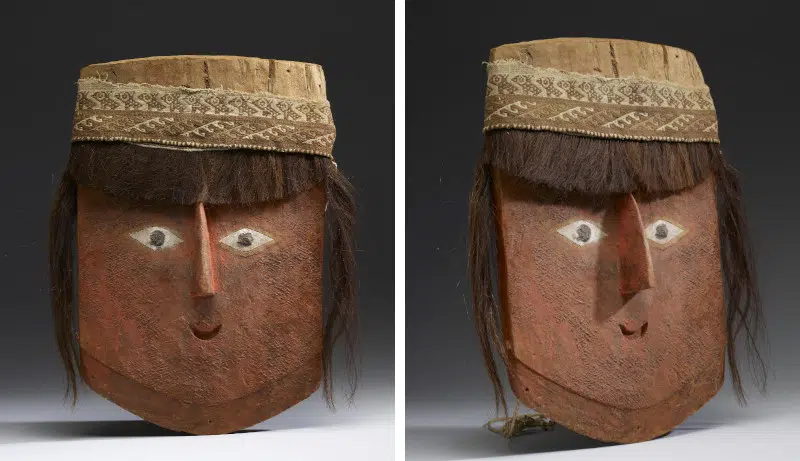
One such mask has made it to The Walters Art Museum. Estimated to be at least 1,000 years old, the artifact has some unique elements seldom found in other cultures. The Chancay funeral masks often feature a “wig,” which in this case covers the forehead and hangs down on either side of the face. Using polarized light microscopy, the museum determined in 2017 that the wig was most likely made of human hair.
In addition to the “wig,” the mask also boasts a headband, which showcases the ornate textiles the deceased were bundled in. According to the museum, these headbands were meant to evoke the turban-like head coverings worn by the Chancay people, further carrying their heritage into the afterlife.
The mask itself was painted a brick red shade with cinnabar, a toxic pigment that contains mercury. To the Chancay people, this color symbolized purification and commemoration. As for the facial features, the museum explains that these were not portraitlike, and instead were very simplified with wide, diamond-shaped eyes and long straight noses. However, this particular mask encapsulates yet another mystery. A patterned impression on the mask indicates that it was later wrapped in even more textiles.
Beyond the mummy bundle, this culture’s dead were also buried with textile dolls, wooden carvings, and ceramic figures named Cuchimilcos, which are believed to represent protective spirits or ancestral guardians. Ultimately, these additions show not only the artistic feats of the Chancay, but also the devotion they had for their late loved ones.
Sources: Unveiling Ancient Secrets: Pre-Columbian Burials of South America; Mummy Mask with Wig at The Walters Art Museum
Related Articles:
Peru Unveils Details About a Recently Unearthed Archeological Site From 3,800 Years Ago
Researchers Use Laser Technology To Reveal Tattoos on 1,200-Year-Old Peruvian Mummies
Ancient Rock Art Depicts Psychedelic Music and Dance in Peru
Astonishingly Painted Throne Room Is Found by Archeologists in an Ancient Peruvian Site