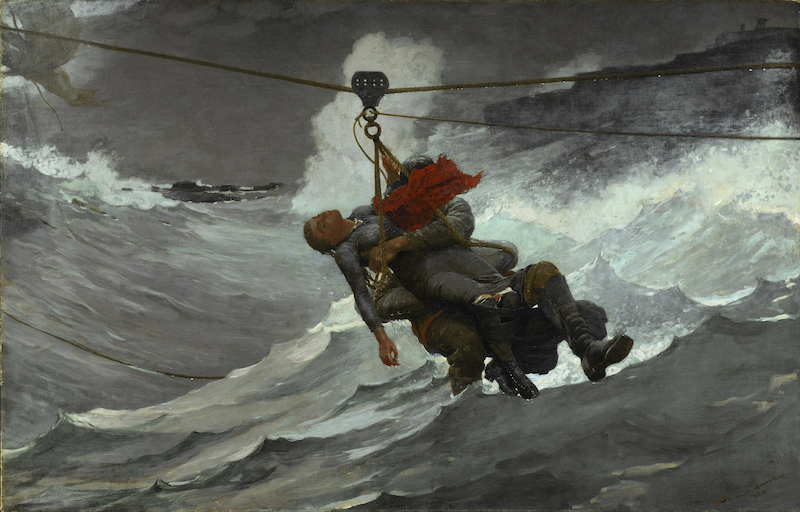
Winslow Homer (United States, 1836–1910), The Life Line, 1884, oil on canvas, 28 5/8 x 44 3/4 inches. Philadelphia Museum of Art. The George W. Elkins Collection, 1924, E1924-4-15
This summer, the Portland Museum of Art (PMA) brings Winslow Homer’s story full circle with Winslow Homer: Painter, Etcher, on view through October 18, 2026. The exhibition gathers a rarely seen collection of his etchings from museums across the country and reunites them, for the first time in decades, with the paintings and watercolors that inspired them. Mark Bessire, the museum’s director, framed the show in exactly those terms during a press event: for him, this exhibition marks Homer’s own homecoming.
The Maine coastline is built on texture. A rocky shoreline and wicked waves crash along granite walls. There are rocks worn smooth by centuries of tide, weathered shingles on old fishing shacks, the churn of white water against dark stone, and fog that softens every edge until the whole landscape looks etched rather than painted. Homer’s work captures it all. He spent decades painting fishermen, storms, and the rugged coastline, and his work is why so many people, in Maine and far beyond, still recognize themselves in it.
Homer’s etchings translate the coast’s roughness into pure line and shadow. The fine crosshatching mimics spray breaking off a wave, and the dense, worked passages of ink, with scraped and burnished highlights, catch light the way sea foam does. The medium itself seems suited to Maine, a place where nothing is smooth and nothing stays still for long. Standing in a gallery surrounded by work that never left this coast in spirit, even when it traveled the country in shipping crates, the viewer understands the homecoming the museum describes.
Homer settled in Scarborough, Maine, in the early 1880s, and it was there that he began reworking some of his strongest paintings into etched form. He collaborated with Brooklyn-based printer George W. H. Ritchie, who prepared copper plates and shipped them north to Homer’s studio. Homer incised his designs onto the plates by hand, then sent them back to New York, where Ritchie pulled proofs and returned them to Maine for review. The plates and proofs traveled this loop repeatedly, carrying Homer’s revisions across the distance until he considered the image resolved.
That process turns the exhibition into something more than a display of finished prints. It becomes a study of return, of an artist sending his own hand out into the world and calling it home again and again until the work matched his vision. The exhibition leans into that rhythm by presenting multiple states and proofs of individual etchings side by side, so viewers can trace exactly how a composition tightened, darkened, or shifted with each pass through the studio and the print shop, the way tide and weather slowly reshape a shoreline.
The result of five years of research, the exhibition is organized by Ramey Mize, Associate Curator of American Art at the PMA, and stands as the first major show devoted entirely to Homer’s etchings. That timeline reflects the scale of the undertaking: tracking down individual proofs and states scattered across public and private collections, then bringing them back together in the place Homer called home. Mize has been clear that Homer cannot be understood as a painter who dabbled in etching or an etcher who happened to paint. He worked in both at once, letting each medium sharpen his sense of the other. A painting could suggest to him a strong etching, and an etching could just as easily reveal a composition worth returning to in oil. Standing in front of the paired works, that logic plays out panel by panel, the same wave or the same gesture rendered in an entirely different register depending on which tool was in his hand.
Some of Homer’s most iconic compositions, including The Life Line (1884) and Eight Bells (1887), began as oil paintings before he reconsidered them in etched form. Other works moved in the opposite direction, with an etched study eventually pointing him toward a new painting or watercolor. Perils of the Sea demonstrates this exchange clearly: a watercolor from 1881 gave rise to an etching Homer completed in 1888, and the exhibition places both works together so audiences can weigh the differences in mood, texture, and light that each medium produces.
Bringing this body of work back to Maine carries its own resonance for anyone who calls this coast home. Many of these etchings and proofs live permanently in collections scattered across the country. Gathering them in Portland, near the granite and surf that shaped them, completes a kind of circuit that mirrors the one Homer built with Ritchie a century and a half ago: work sent out, returned, and finally settled where it started.
For anyone who thought they knew Homer through his paintings alone, this exhibition offers a chance to see the artist thinking in an entirely different register, one line at a time, in the very landscape that shaped both mediums. Winslow Homer: Painter, Etcher runs through October 18, 2026, at the Portland Museum of Art.
Winslow Homer spent decades painting the rocky Maine coastline that shaped his reputation, and this exhibition marks his own homecoming, bringing rarely seen etchings back to the landscape that inspired them.
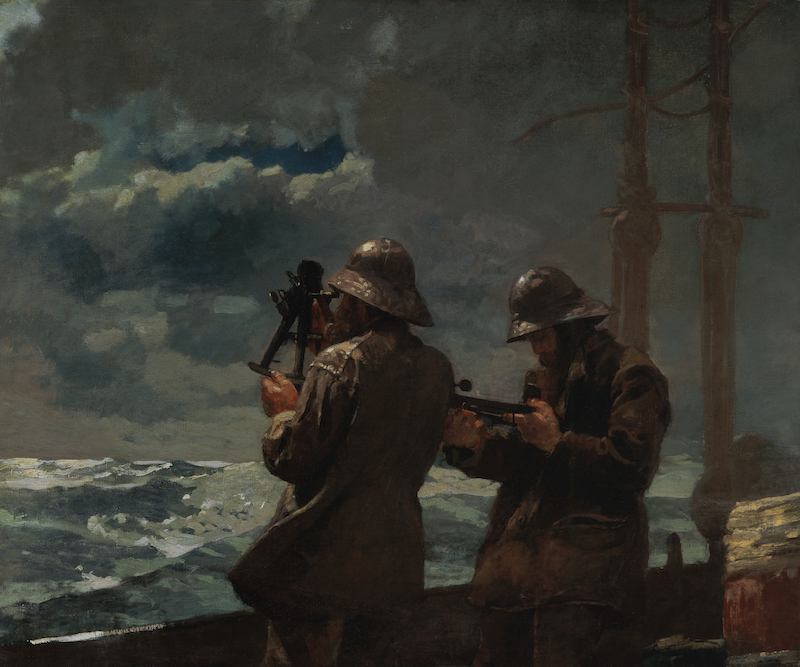
Eight Bells, 1886. Oil on canvas. 25 3/16 in. x 30 3/16 in. (63.98 cm x 76.68 cm). Addison Gallery of American Art, Phillips Academy, Andover, Massachusetts, gift of anonymous donor, 1930.379
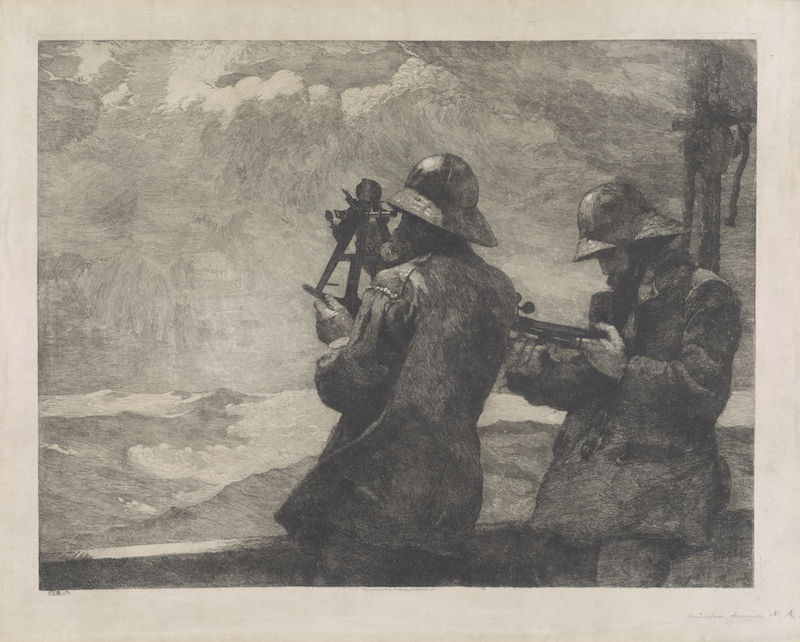
Winslow Homer (United States, 1836–1910), Eight Bells, 1887, etching and drypoint with scraping, stopping out, burnishing, and selective wiping in black ink on parchment, image: 18 3/4 x 24 1/4 inches; sheet: 23 1/2 x 29 1/2 inches. Portland Museum of Art, Maine. Museum purchase with support from the Peggy and Harold Osher Acquisition Fund and partial gift of Mr. and Mrs. Vaughan W. Pratt, 2014.3. Image courtesy Pillar Digital Imaging
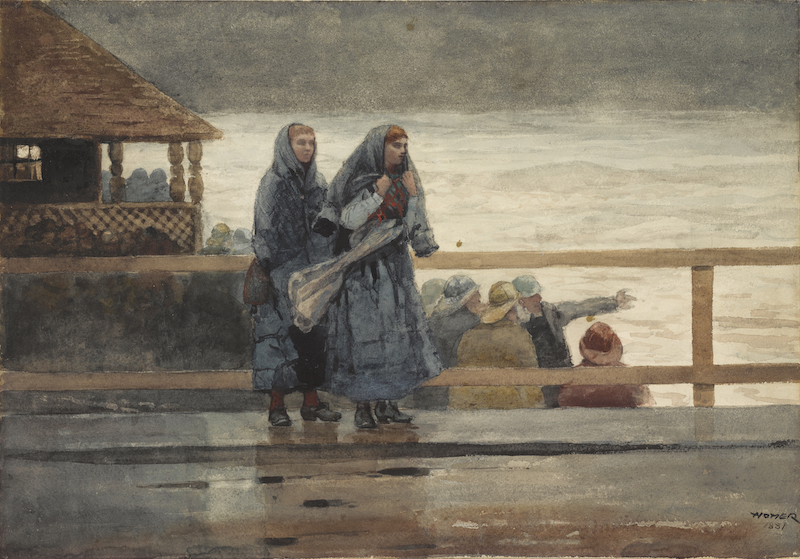
Winslow Homer (United States, 1836–1910), Perils of the Sea, 1881, watercolor over graphite on cream wove paper, sheet: 14 5/8 x 20 15/16 inches. Clark Art Institute, Acquired by Sterling and Francine Clark before 1955, 1955.774
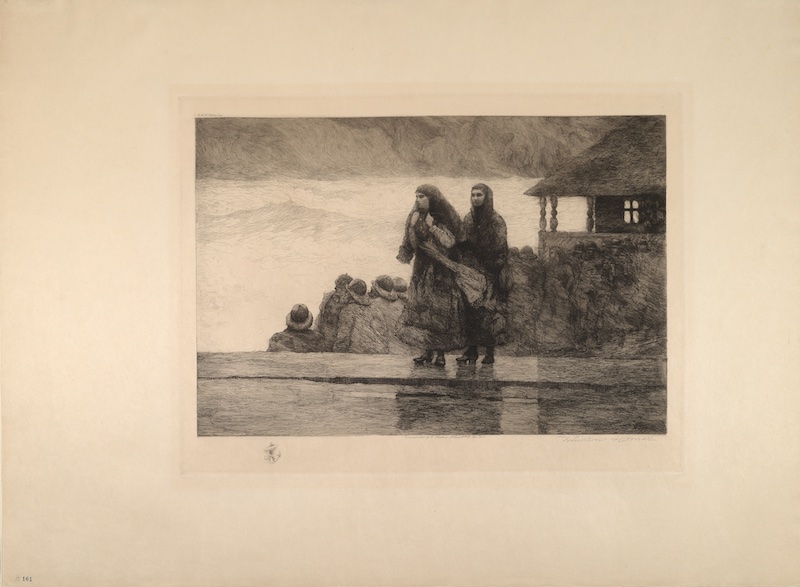
Winslow Homer (United States, 1836–1910), Perils of the Sea, 1888, etching and drypoint with scraping, stopping out, burnishing, and selective wiping in black ink on beige, moderately thick, slightly textured traditional Japanese handmade wove paper; Japanese Vellum, image: 13 11/16 x 20 1/4 inches, sheet: 25 3/8 x 34 1/2 inches. Portland Museum of Art, Maine. Museum purchase with support from Elizabeth and Robert Nanovic, 2024.39. Image courtesy Petegorsky/Gipe Photo
Working from his Prouts Neck studio, Homer shuttled copper plates and proofs back and forth with Brooklyn printer George W. H. Ritchie, refining each etching’s texture until its crosshatched lines echoed the granite and sea just outside his window.
![Winslow Homer (United States, 1836–1910), Mending the Tears [unfinished, second proof], 1888, etching and drypoint with scraping, stopping out, burnishing, and selective wiping in black ink on beige, moderately thick, slightly textured traditional Japanese handmade wove paper; Japanese Vellum, image: 15 1/4 x 21 3/8 inches, sheet: 16 1/2 x 22 inches. Bowdoin College Museum of Art, Brunswick, Maine. Gift of the Homer Family, 1964.69.201](https://mymodernmet.com/wp/wp-content/uploads/2026/07/winslow-homer-portland-museum-art-5.jpg)
Winslow Homer (United States, 1836–1910), Mending the Tears [unfinished, second proof], 1888, etching and drypoint with scraping, stopping out, burnishing, and selective wiping in black ink on beige, moderately thick, slightly textured traditional Japanese handmade wove paper; Japanese Vellum, image: 15 1/4 x 21 3/8 inches, sheet: 16 1/2 x 22 inches. Bowdoin College Museum of Art, Brunswick, Maine. Gift of the Homer Family, 1964.69.201
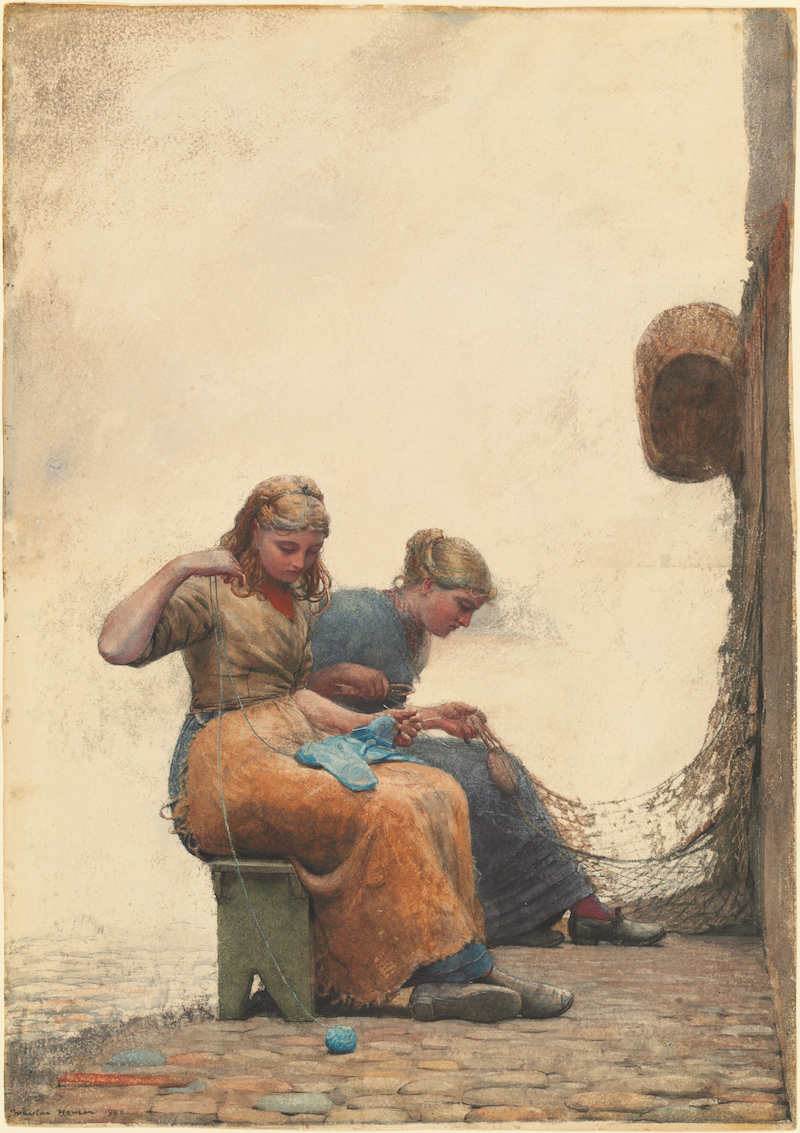
Winslow Homer (United States, 1836–1910), Mending the Nets, 1882, transparent and opaque watercolor over graphite on wove paper, 27 3/8 x 19 1/4 inches. National Gallery of Art. Bequest of Julia B. Engel, 1984.58.3
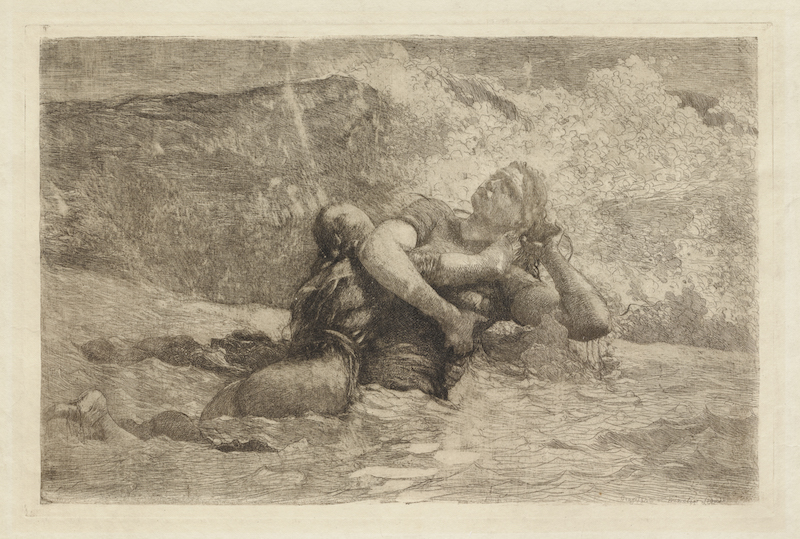
Winslow Homer (United States, 1836–1910), Study for “Undertow”, circa 1886, etching, open-bite, stopping out and scraping on cream simili-Japanese Vellum, plate: 6 5/8 x 10 1/16 inches, sheet: 9 3/4 x 13 inches. Clark Art Institute, Acquired by the Clark, 1968, 1968.20
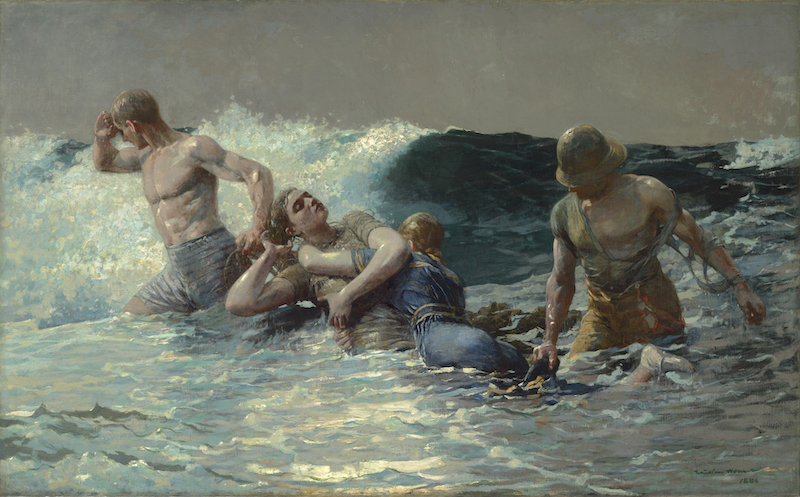
Winslow Homer (United States, 1836–1910), Undertow, 1886, oil on canvas, 29 13/16 x 47 5/8 inches. Clark Art Institute, Acquired by Sterling and Francine Clark before 1955, 1955.4
Iconic works like The Life Line, Eight Bells, and Perils of the Sea appear in both painted and etched form throughout the show, revealing how Homer moved fluidly between brush and needle.
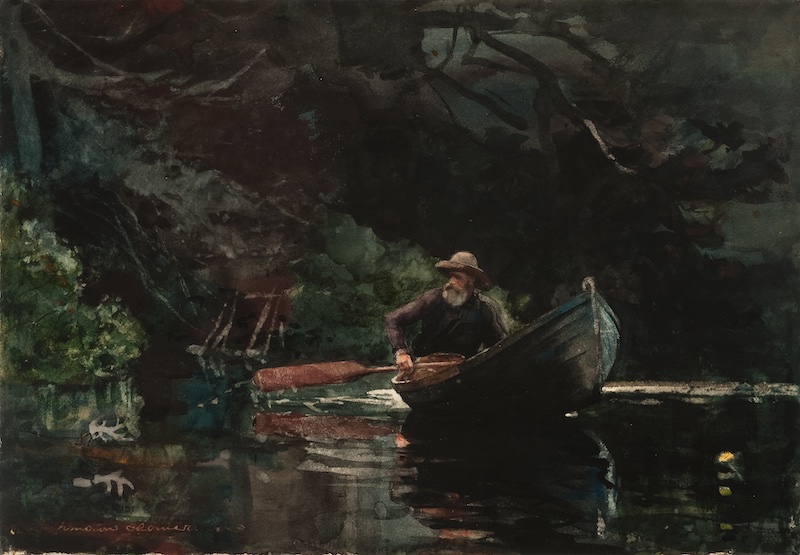
Winslow Homer (United States, 1836–1910), The Guide, 1889, watercolor on ivory wove paper, 13 3/4 x 19 1/2 inches. Portland Museum of Art, Maine. Bequest of Charles Shipman Payson, 1988.55.8. Image courtesy Meyersphoto.com
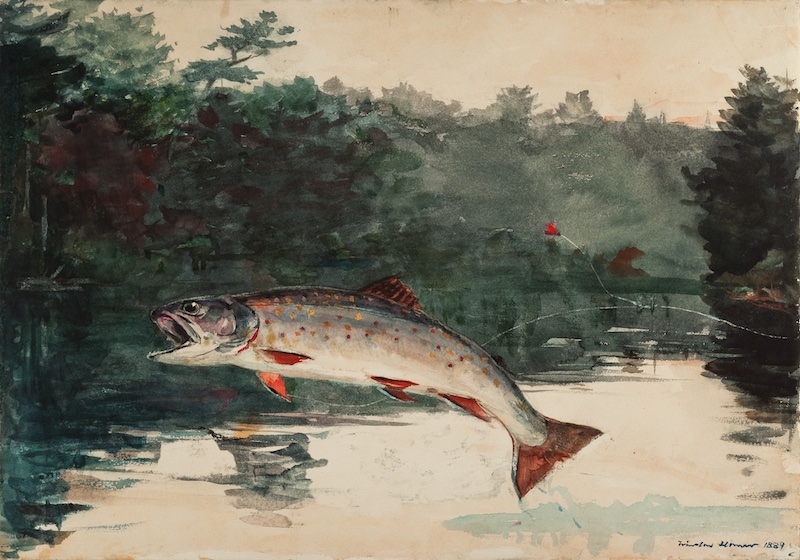
Winslow Homer (United States, 1836–1910), Leaping Trout, 1889, watercolor on paper, 14 1/16 x 20 1/16 inches. Portland Museum of Art, Maine. Bequest of Charles Shipman Payson, 1988.55.7. Image courtesy Meyersphoto.com
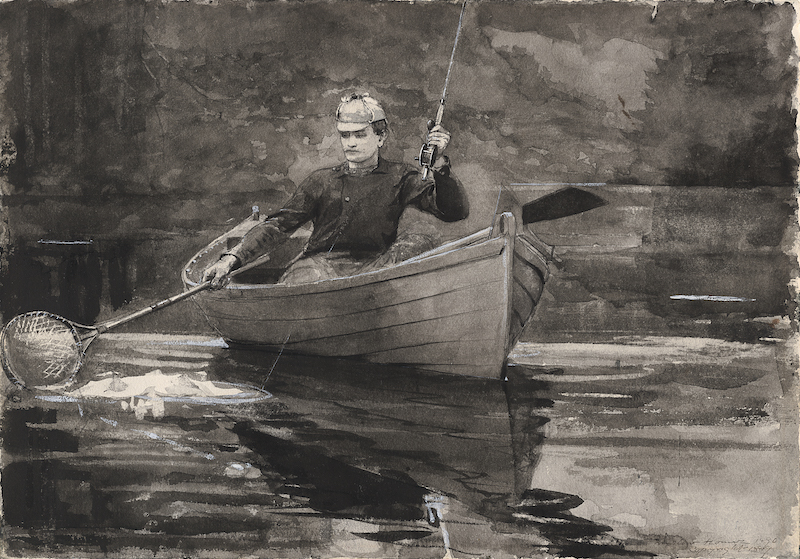
Netting the Fish, 1889. Transparent watercolor, heightened with opaque white watercolor, with rewetting, blotting, and scraping, over graphite, on moderately thick, slightly textured, cream wove paper. 35.3 × 50.8 cm (13 15/16 × 20 in.). Olivia Shaler Swan Memorial Collection. 1933.526.
Five years in the making, Winslow Homer: Painter, Etcher reunites prints scattered across American collections with the Maine coastline that shaped them, on view at the Portland Museum of Art through October 18, 2026.
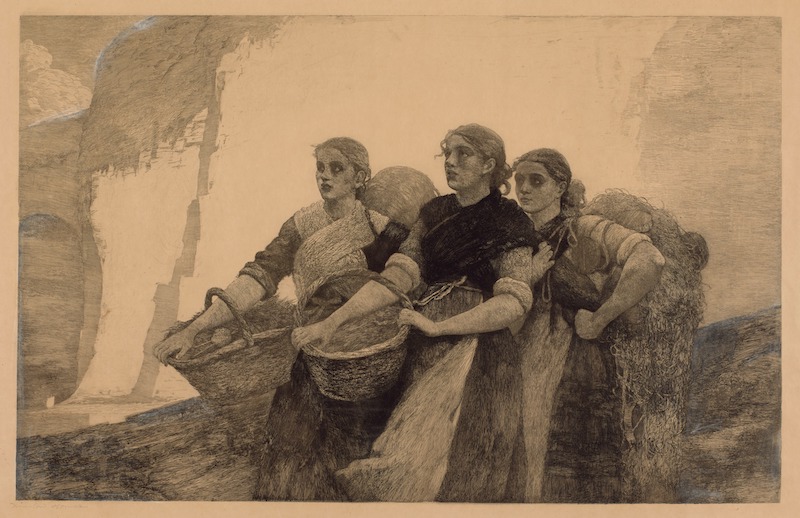
Winslow Homer (United States, 1836–1910), A Voice from the Cliffs, 1888, etching and aquatint heightened with white on paper, 19 1/8 x 30 inches. Bowdoin College Museum of Art, Brunswick, Maine. Gift of Susan L. and Donald M. Zuckert, Class of 1956, in honor of A. LeRoy Greason and Polly Greason as tribute to their 38 years of service to Bowdoin College, 1990.69
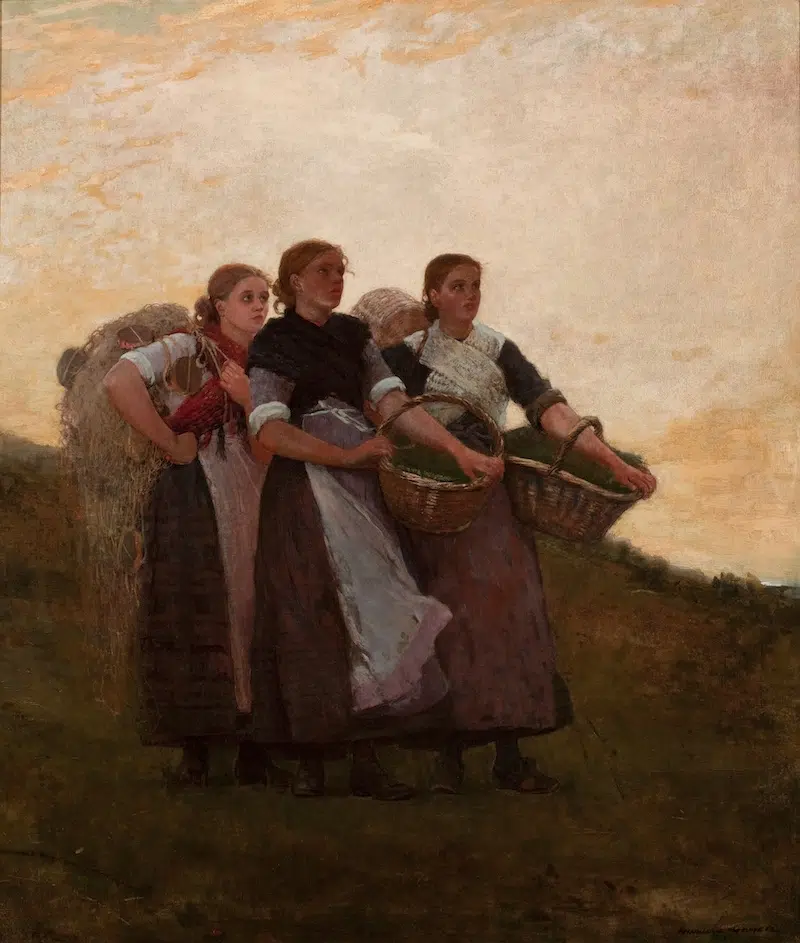
Winslow Homer (United States, 1836–1910), Hark! The Lark, 1882, oil on canvas, 36 3/8 x 31 3/8 inches. Milwaukee Art Museum. Layton Art Collection, Inc., Gift of Frederick Layton L99. Image courtesy John R. Glembin
![Winslow Homer (United States, 1836–1910), The Life Line [copyright proof], 1884|1887, etching, sulfur tint, and drypoint with scraping, burnishing, and selective wiping in black ink on cream, very thick, moderately textured machine-made wove paper; plate paper, image: 12 5/16 x 17 5/16 inches, sheet: 16 1/4 x 21 1/8 inches Portland Museum of Art, Maine. Museum purchase with support from Elizabeth and Robert Nanovic, 2021.1. Image courtesy The Old Print Shop](https://mymodernmet.com/wp/wp-content/uploads/2026/07/winslow-homer-portland-museum-art-10.jpg)
Winslow Homer (United States, 1836–1910), The Life Line [copyright proof], 1884|1887, etching, sulfur tint, and drypoint with scraping, burnishing, and selective wiping in black ink on cream, very thick, moderately textured machine-made wove paper; plate paper, image: 12 5/16 x 17 5/16 inches, sheet: 16 1/4 x 21 1/8 inches Portland Museum of Art, Maine. Museum purchase with support from Elizabeth and Robert Nanovic, 2021.1. Image courtesy The Old Print Shop
Exhibition Information:
Winslow Homer
Winslow Homer: Painter, Etcher
July 3–October 18, 2026
Portland Museum of Art
7 Congress Sq, Portland, ME 04101
Portland Museum of Art: Website | Instagram
My Modern Met granted permission to feature photos by the Portland Museum of Art.
Related Articles:
Bird Art Exhibition Explores the Enduring Symbolism of Our Feathered Friends
New Exhibition Explores Immersive Art Created by Women Artists in the 1960s and 1970s