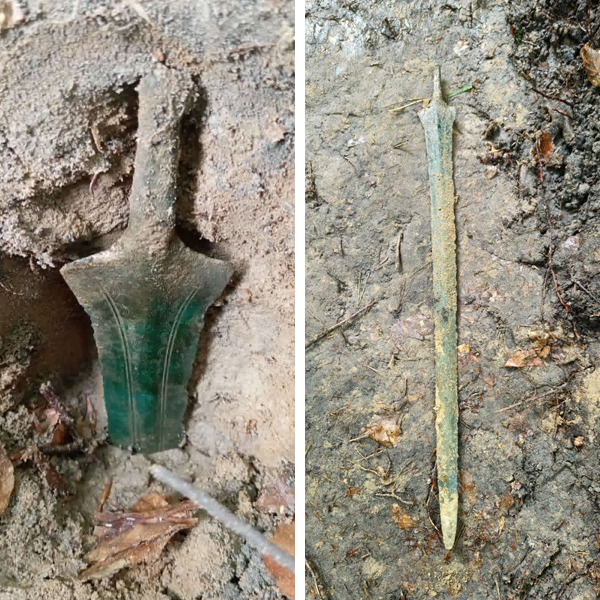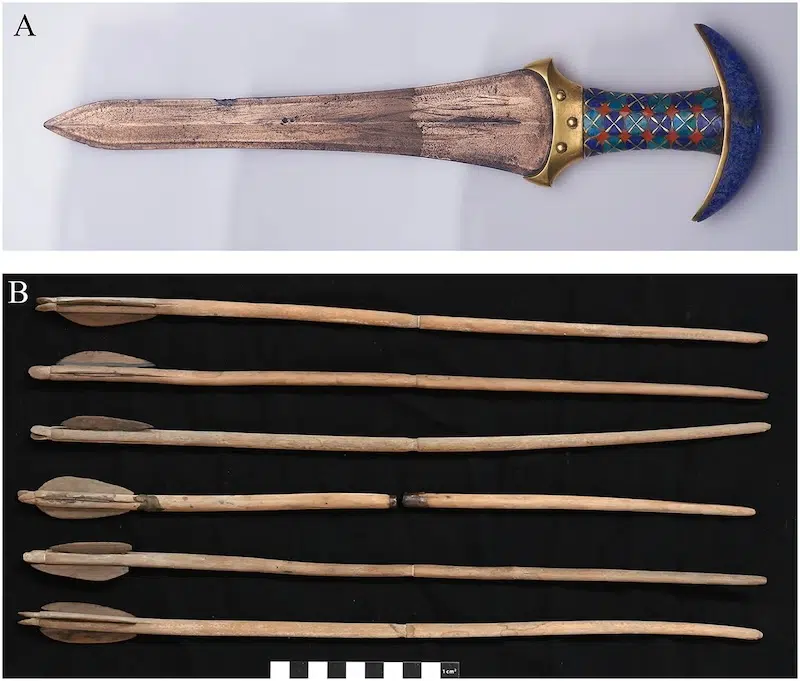
(A) Dagger of Princess Ita, courtesy of the Egyptian Museum; (B) Arrows of Princess Noub Hotep, courtesy of Eman Shawky.
For more than a century, the skeletal remains of Ancient Egyptian King Hor and five royal women sat untouched in a museum basement. The group, which lived during the Late Middle Kingdom (1850–1700 BCE), was originally excavated from their royal tombs in Dahshur, Egypt, in the late 1800s CE by a French archaeologist for study. While archaeologists had long examined the tombs and their ceremonial objects, the skeletons themselves had never been thoroughly researched. A new study published in Frontiers in Environmental Archaeology revisits these ancient remains with modern technology to see what the bones can reveal about the lives of Egypt’s royal family.
Using bioarchaeology, the scientific study of human remains, researchers can piece together facts left out from objects or written records. By examining body parts such as bones and teeth, scientists can estimate things like age, sex, and health at the time of death. These methods provide a more complete picture of how these royal individuals lived, were buried, and what kinds of physical stresses their bodies experienced over time.
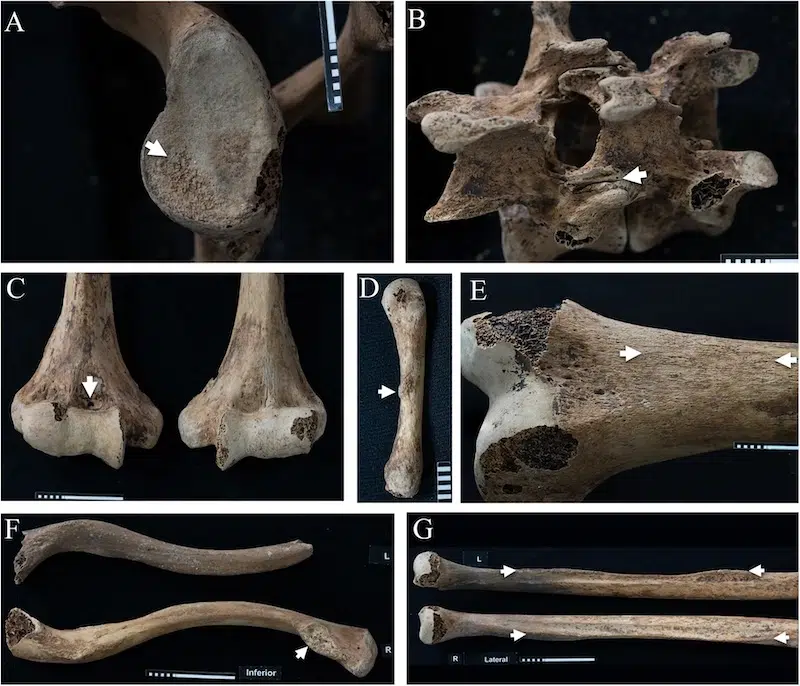
Four of the five royal women were daughters of the pharaoh Amenemhat II. Princess Ita, Princess Khenmet, and Princess Itaweret were buried next to each other, and an anonymous woman believed to be Princess Sathathormeryt. They were buried with weapons such as bows, daggers, and axes, which originally were only thought to be symbolic of status or ceremonial. However, the researchers found evidence in their skeletons that suggests the women were trained as warriors and used those weapons. Things like changes at muscle attachment sites, signs of arthritis in specific joints, and evidence of healed injuries point to intense upper-body exercise. While not definitive proof, the findings are consistent with the repetitive movements associated with activities such as drawing a bow or other intensive upper-body exercise.
But Dr. Zeinab Hashesh, lead author of the article in Frontiers in Environmental Archaeology, believes the evidence strongly supports the princesses “were active participants in skilled, physically demanding activities such as archery and hunting.” The bioarchaeology tells us that “Princess Ita was a young woman aged between 28 and 34 with strong upper-body muscle attachments, suggesting she habitually used weapons like maces or daggers, Princess Khenmet was a woman in her late 30s or 40s who showed signs of thinning bones, but had very robust ligament attachments. Princess Itaweret was a young woman aged between 20 and 34 who survived broken ribs and foot fractures; her skeleton shows she was a skilled archer.”
King Hor’s remains also offer insights into Egyptian royal life during the Middle Kingdom. His skeleton showed signs of arthritis and other natural age-related effects that help us see how his overall health was before death. Historical records of King Hor are limited, so bioarchaeology becomes even more important to fill in the historical gaps.
By combining evidence from artifacts and bioarchaeology, we have much more tangible, concrete evidence of how people lived thousands of years ago. Artifacts such as weapons, jewelry, pottery, and inscriptions reveal what people owned, believed, and how they wished to present themselves in death. Bioarchaeology complements this by examining the physical evidence preserved in bones and teeth, which can reveal age, health, diet, disease, injuries, and patterns of repetitive activity.
Rather than relying solely on historical interpretation, scientists can reconstruct past lives using physical evidence left behind in the human body itself, bringing us closer than ever to understanding the daily experiences of people who lived millennia ago.
The 4,000-year-old remains of five Egyptian princesses were analyzed using modern bioarchaeology, AKA the study of human remains. The results showed the princesses had intense physical training, suggesting they were skilled with the weapons they were buried with.
Sources: Ancient Egyptian princesses born 4,000 years ago were skilled archers, new study shows, Pharaoh’s Daughters Were Skilled at Archery 4,000 Years ago, Reveals New Research
Related Articles:
Archaeologists Discover 43,000 Ancient Egyptian “To-Do” Lists Offering a Rare Glimpse of Daily Life
Honey Found in 3,000-Year-Old Ancient Egyptian Tombs Is Still Safe To Eat
2,000-Year-Old Graffiti Tags From an Ancient Traveler Discovered in Five Egyptian Tombs
1,800-Year-Old Egyptian Kohl Bottle Discovered in England Sheds New Light on Roman-Era Travel