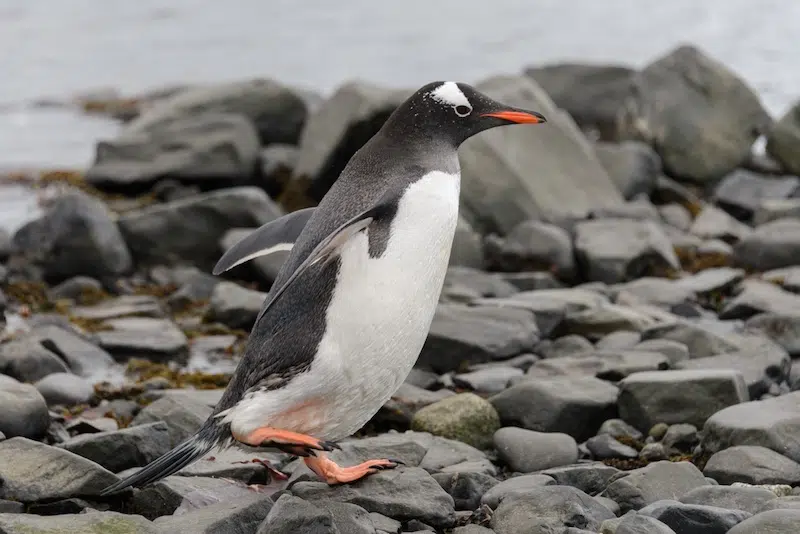
When it comes to discovering new species, 2026 has been a good year. Earlier this month, we reported on the first new cat species discovered in Bolivia, and during the summer, we learned about a new monkey species with striking orange lips living in the Congo Basin. Now, a new species of penguin has been confirmed for the first time in 100 years. It’s named Pygoscelis kerguelensis, or the southeastern gentoo penguin, and it lives on the remote Kerguelen Islands in the Indian Ocean, around 1,200 miles north of Antarctica.
Until recently, the gentoo penguin (aka Pygoscelis papua) was thought to be a single species spread across several areas. However a team of penguin experts led by scientists from University of California, UC Berkeley, and several institutions from Chile recently studied their genes and confirmed the gentoo is actually four separate species.
Gentoos tend to stick close to their breeding colonies, returning to the same nesting sites year after year. Over time, this meant different populations became isolated and adapted to their local environments, eventually evolving into separate species. The Eastern gentoo (Pygoscelis taeniata) lives on the Crozet, Marion, and Macquarie Islands, while the Northern gentoo (Pygoscelis papua) is found around the Falkland and Martillo Islands. The Southern gentoo (Pygoscelis ellsworthi) has the largest population and inhabits the Antarctic Peninsula, coastal Antarctica, and South Georgia.
The fourth and newly recognized, southeastern gentoo (Pygoscelis kerguelensis) lives on the remote Kerguelen Islands in the southern Indian Ocean, around 450 kilometers (279 miles) from the nearest land. It looks similar to other gentoo penguins but is genetically distinct enough to be recognized as a separate species. Its distinct size and vocalizations are further clues that set it apart.
The researchers studied 64 individual penguins from 10 breeding colonies living across the four regions. “There’s probably no species of penguin more debated than the gentoo penguin,” says Rauri Bowie, professor at UC Berkeley. “For over 100 years, it’s been controversial as to how many species or how many subspecies there are.”
The researchers believe the new-discovered species evolved over the past 300,000 to 500,000 years. One reason gentoos have been so successful may be their flexible diet. Unlike penguins such as emperors and Adélies, which rely on more specialized food sources, gentoos will eat almost anything they can catch in the water. This may have helped them survive when food was scarce or conditions changed.
“Birds exhibit a faster rate of adaptation compared to other vertebrates, enabling them to occupy a broad range of environments,” explain the researchers. “This accelerated adaptation frequently occurs when populations diverge and follow independent evolutionary trajectories in isolation, often facilitated by standing genetic variation, thereby enabling rapid adaptive divergence and ecological specialization.”
Despite the gentoo’s ability to adapt, however, three out of the four species in the Antarctic and sub-Antarctic regions are under threat due to global warming. The southern gentoo, the only one out of the four to live in Antarctica, is predicted to be less affected. Juliana Vianna, one of the paper’s authors and a professor at Andres Bello National University in Santiago, Chile says, “It’s very important that conservation institutions in all the different countries involved recognize and take appropriate action to save these three gentoo penguin species.”
Read the researchers’ full report on Communications Biology.
Researchers have confirmed that gentoo penguins are actually made up of four distinct species, including a previously unknown species, Pygoscelis kerguelensis, or the southeastern gentoo.
Sources: Integrative evidence reveals adaptive divergence and speciation in gentoo penguins;
Amazing new penguin discovered for first time in over 100 years
Related Articles:
Exceptionally Rare All-Black Penguin Caught on Camera by Wildlife Photographer
Underwater Robot Discovers More Than 100 New Species in Chile
Scientists Discover New Monkey Species With Striking Orange Lips in the Congo Basin
First New Cat Species in Over a Hundred Years Discovered in Bolivia