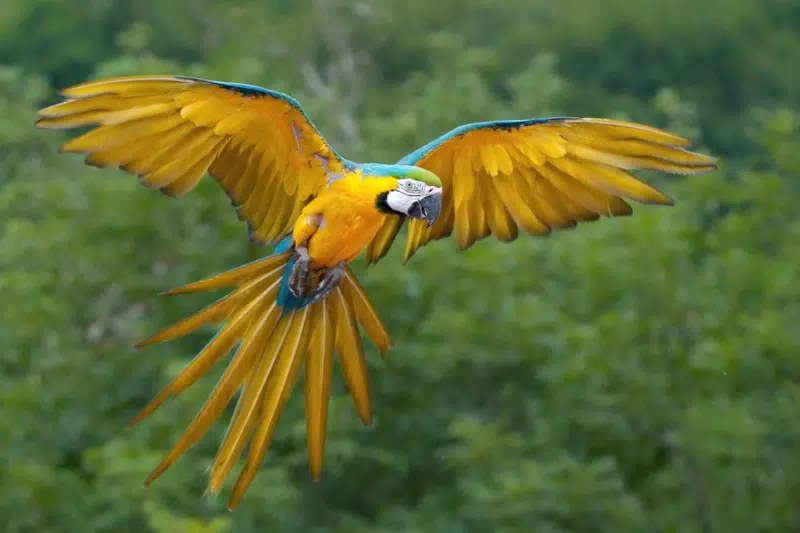
The blue-and-yellow macaw may not be Brazil’s national bird, but it’s nothing short of a national symbol to the South American nation. Its colors even evoke a sense of the Brazilian flag, and the birds are seen in everything, from t-shirts to murals. But for 200 years, they were gone from Rio de Janeiro, Brazil’s cultural capital and top tourist destination. Now, a “refaunation” effort has finally brought them back.
The recent arrival of the birds is due to the work of Refauna, a conservation project devoted to restoring ecosystems by reintroducing native animal species gone from Rio’s expansive Tijuca National Park but still found around the country. So far, only four blue-yellow macaws, three females and one male, have been brought into the park. But the plan is to reintroduce 50 birds by 2030.
The last recorded sight of the blue-and-yellow macaws, known in Brazil as arara-canindé, around Rio and Tijuca National Park dates back to 1818, when they were spotted by naturalist Johann Natterer. “They probably went extinct [in Rio] due to the wildlife trade and deforestation during the European colonization here,” Marcelo Rheingantz, executive director of Refauna, told The Guardian.
The four birds were not brought from other wild habitats. Instead, they were confiscated from people who possessed them illegally. That’s why part of their retraining includes rebuilding their muscles after being in cages for years, recognizing native fruits to ensure they can eat on their own, and avoiding bonding with humans. In turn, visitors to Tijuca National Park are instructed to not get close to them or feed them. All of the birds wear a collar, a leg band, and a microchip for monitoring, meaning they can be recaptured if needed.
The birds are named Fernanda, Selton, Fatima, and Sueli. The first two honor the leading actors of the Oscar-winning movie I’m Still Here, starring Fernanda Torres and Selton Mello, while the latter are named after the main characters of show Tapas & Beijos, which Torres also starred in.
“Reintroducing species is not simply about returning animals to the forest. It is about rebuilding ecological relationships and ensuring that these species can once again perform their ecological roles,” says Vanessa Kanaan, director of Instituto Fauna Brasil. The hope is for birds to be able to break into the tough macaw nuts to eat them and help spread their seeds through their droppings.
The reintroduction of the macaws is only the latest step in Refauna’s ongoing efforts to return long-lost species to Tijuca National Park. In 2010, they reintroduced the red-rumped agouti, a large rodent. In the following years, they also brought back the brown howler monkey and the yellow-footed tortoise.
“The project symbolizes the return of macaws to the skies of Rio, a city recognized by UNESCO as a world cultural heritage site nestled between the sea and the mountains,” Viviane Lasmar, director of Tijuca National Park, told O Globo. “Having this initiative within the park demonstrates that, even under intense urban pressure, the forest remains intact and capable of providing food, shelter, water, and conditions for these birds to attempt to establish a viable population.”
Sources: ‘A dream come true’: Brazil’s blue-and-yellow macaws return to Rio after 200 years; Após 200 anos, reintrodução das araras-canindés no Rio avança para novo estágio
Related Articles:
Top 10 Favorite Bird Videos From the Latest Audubon Photography Awards
New Studies Suggest That Birdwatching Will Help Boost Your Brain Health
Stunning Photo Captures Vibrant Plumage of Bird Mid-Flight Over the Himalayas