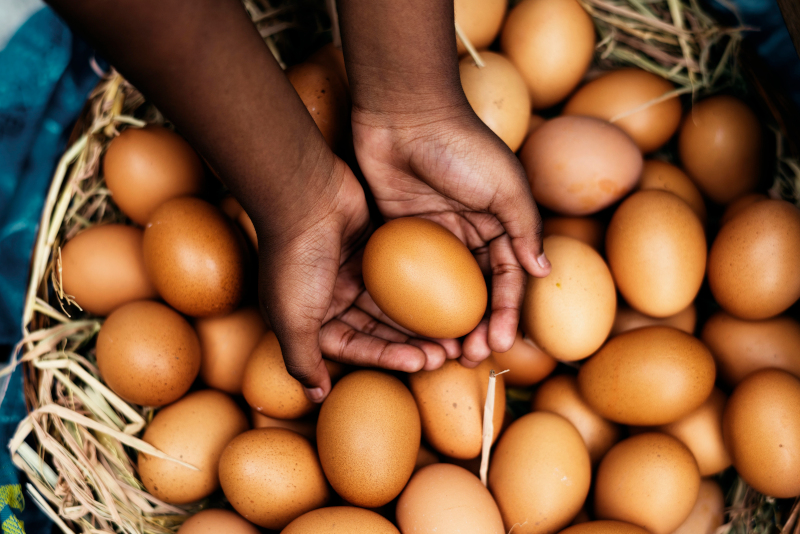
The phrase, “Give a man a fish, and you feed him for a day; teach a man to fish and you feed him for a lifetime,” could very well describe a successful social program in Ngororero, Rwanda. But rather than fish, the protagonists of this story are other animals. As part of the Second Sustainable Agricultural Intensification and Food Security Project (SAIP II), vulnerable families with small children received four chickens. The initiative has now provided them with eggs to eat and sell, improving both their health and their economy.
Among those benefited by this program is Anne Marie Mushimiyimana, a mother of three in a dire situation. “One of my children was suffering from malnutrition,” she told Top African News. “The child was often very thin and had little weight, but after we started having access to animal products, especially eggs, the child began gaining weight about one kilogram in a week.” According to the local government, stunting among children in Ngororero declined from 50.5% in 2020 to 35.8% in 2026.
Since Mushimiyimana received her original four chickens, the flock has grown to seven. Meanwhile, the eggs have gone from a pricey source of nutrition to something readily available at home. “Before, the money my husband earned would often be spent on buying food, especially animal products,” she said. “Now, because we can produce some of these foods ourselves, we are able to save that money.”
The surplus eggs are then sold, allowing her to use the money on different household needs, such as community-based health insurance. However, when a community kitchen is organized, she provides the needed eggs to cook healthy meals for children in the area. “Through the training we received from the facilitators, we learned how to keep chickens, and the eggs are now available in greater quantities,” Mushimiyimana added.
As part of the program, families also receive education on maintaining a balanced diet and growing vegetables, and they receive amaranth, spinach, and carrot seeds. In total, 2,700 families received chickens and chicken coops, while another 2,500 households received mushroom-growing tubes. Additionally, 600 families received planting materials for biofortified orange-fleshed sweet potatoes, adding Vitamin A to their diets.
“The goal is not simply to give a family chickens or vegetable seeds; we want to build a household nutrition system in which families can produce vegetables, eggs, mushrooms and nutrient-rich sweet potatoes, while learning how to combine those foods into a balanced diet,” shared Evode Imanimurinde, Nutrition Specialist at SAIP II.
Sources: Ngororero: Families Celebrate SAIP II Gains in Nutrition, Food Security and Improved Livelihoods
Related Articles:
Survivors and Perpetrators of Rwandan Genocide Pose Together in Powerful Portraits [Interview]
Artist Transforms Her Hair Into Incredible Sculptures Inspired by African Culture
Stylish Chicken Coop Cleverly Designed To Be Hidden Within a Hill at a Park
Kind Strangers Send 64 Pairs of Tiny Shoes to Chicken With Missing Toes So He Can Walk Around Easier