View this post on Instagram
For more than a century, one part of Barcelona’s iconic Casa Batlló remained hidden from public view. While millions of visitors explored Antoni Gaudí’s flowing interiors and sculptural rooftop, the building’s famed Third Floor continued serving its original purpose: a private home. Now, after a three-year restoration costing more than €4 million ($4.5 million), Casa Batlló has opened the residence for the first time, revealing the building’s last original living space exactly where generations of the Batlló family left it.
When textile industrialist Josep Batlló commissioned Gaudí to transform the building in 1904, the architect completely reimagined the structure. He redesigned the façade, added two new floors and the now-famous rooftop, and reshaped the interiors with the organic forms that define Casa Batlló today. The UNESCO World Heritage Site now welcomes millions of visitors each year along Barcelona’s Passeig de Gràcia.
Even as the rest of the house gradually became part of the museum, the Third Floor remained a private residence. Direct descendants of the Batlló family lived there until 2019, when its final resident, Mercedes Arbiol Muntané, passed away. Because the apartment never became an exhibition space, it preserved something exceptionally rare: an authentic domestic interior that had evolved through everyday life rather than museum interpretation.
Restoration architect Xavier Villanueva led the three-year conservation project with an emphasis on uncovering, rather than recreating, Gaudí’s original work. As conservators removed later additions, they revealed remarkably intact decorative details hidden beneath decades of renovations.
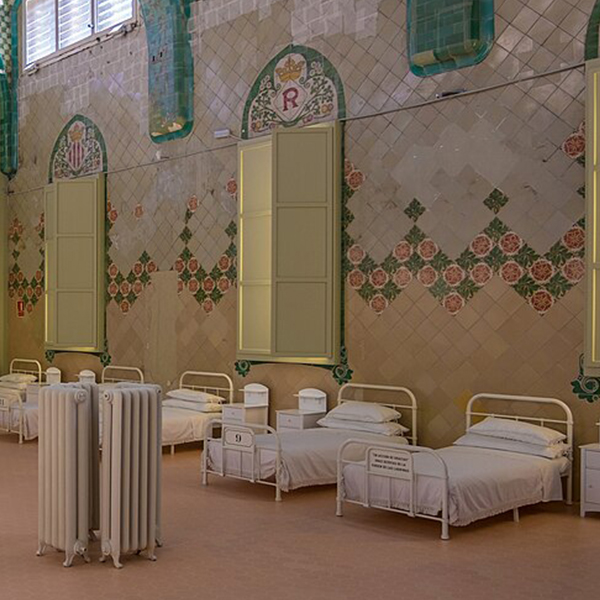
The restoration uncovered floral stuccoes, original undulating ceilings, and doors that Gaudí had repurposed from elsewhere in the house. Researchers also identified a previously undocumented door handle designed specifically for Casa Batlló. Whenever possible, craftspeople conserved the original woodwork, floors, and plaster. When repairs proved necessary, they recreated missing elements using traditional artisanal techniques.
Instead of furnishing the apartment as a period museum, Casa Batlló invited Italian designer Paola Navone and OTTO Studio to create interiors that feel contemporary while respecting Gaudí’s architecture. Custom lighting, hand-knotted rugs, sculptural furniture, and handcrafted objects add warmth throughout the residence. The new furnishings complement the building’s flowing forms instead of competing with them, allowing the apartment to feel like a home once again.
Spanning roughly 440 square meters (4,700 square feet), the residence unfolds through a series of distinct rooms. The Sala Gaudí welcomes visitors with rich red seating beneath restored ceilings decorated with olive branch motifs. Original picture hooks still line the upper walls, preserving traces of the family’s daily life. Elsewhere, a games room features a whimsical chandelier inspired by coral and mermaids, while a serene blue kitchen and adjoining gastrobar echo the marine palette that runs throughout Casa Batlló. Natural light and cross ventilation flow through every room, reflecting Gaudí’s thoughtful approach to residential design.
Rather than adding the apartment to the museum route, Casa Batlló now offers the restored residence as a collection of exclusive private rooms and experiences. The spaces host meetings, celebrations, presentations, and intimate dining events, allowing visitors to experience Gaudí’s architecture as it was originally intended: as a place to gather and live.
The newly opened Third Floor offers a rare glimpse into the everyday side of one of Gaudí’s most celebrated masterpieces. More than a restored interior, it preserves the atmosphere of a home that remained in the same family for generations, bringing visitors closer to the architect’s vision of domestic life than ever before.
Casa Batlló has opened its long-private Third Floor residence for the first time, revealing the last original living quarters inside Gaudí’s architectural masterpiece after more than a century.
View this post on Instagram
A meticulous three-year restoration uncovered original stucco work, undulating ceilings, and custom hardware, while Paola Navone’s contemporary interiors give the apartment new life as a private experience that honors Gaudí’s original vision for residential design.
View this post on Instagram
Casa Batlló: Website | Instagram
Sources: A 1906 Antoni Gaudí–Designed Residence Comes Back to Life in Barcelona; Casa Batlló restores Gaudí’s last original residence and opens it for the first time as an exclusive private rooms and experiences venue; Antoni Gaudí’s Last Original Residence at Casa Batlló Opens Following Three-Year Restoration
Related Articles:
Cotton House Hotel, Autograph Collection: Sleep in History While Experiencing the Heart of Barcelona
First House Ever Designed by Gaudí to Open as a Museum in Barcelona
Centennial of Gaudí’s Death Honored With Stunning Projection Mapping on Casa Batlló
Kengo Kuma Designs Dramatic Staircase With Metal Chain Curtains in Gaudí’s Casa Batlló