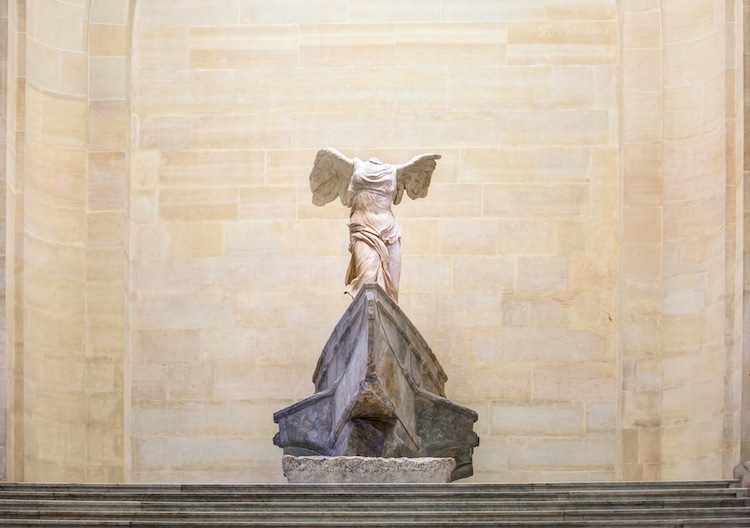
The Winged Victory of Samothrace (Photo: muratart via Shutterstock)
It’s no secret that the Louvre museum has one of the world’s most stunning collections of art. In addition to the Mona Lisa and an entire Michelangelo Gallery, the major museum also excels in antiquities, with gems that include the Great Sphinx, the Venus de Milo, and the Winged Victory of Samothrace, also known as Nike of Samothrace.
Though this Parian marble masterpiece remains one of history’s most famous sculptures, many people may not be aware of its history, including its ancient roots, 19th-century discovery, and soaring influence on modern and contemporary art.
The exact origins of the Winged Victory of Samothrace are not known. However, archaeologists and art historians have extensively studied the sculpture in order to estimate its age, intention, and subject matter.
According to the Louvre, the piece was likely crafted by the people of Rhodes, a Greek island, in the early 2nd century BC. This places its creation at the heart of the Hellenistic period (323 BCE-31 CE). This ancient art movement is particularly renowned for its expressive sculptures of mythological subjects in motion—an approach embodied by the Winged Victory.
The 18-foot sculpture depicts Nike, the ancient Greek goddess of victory. As wet and wind-blown drapery clings to her body, the winged figure triumphantly steps with her left leg toward the prow of a ship, leading historians to conclude that it was created as a naval monument to commemorate a successful sea battle.
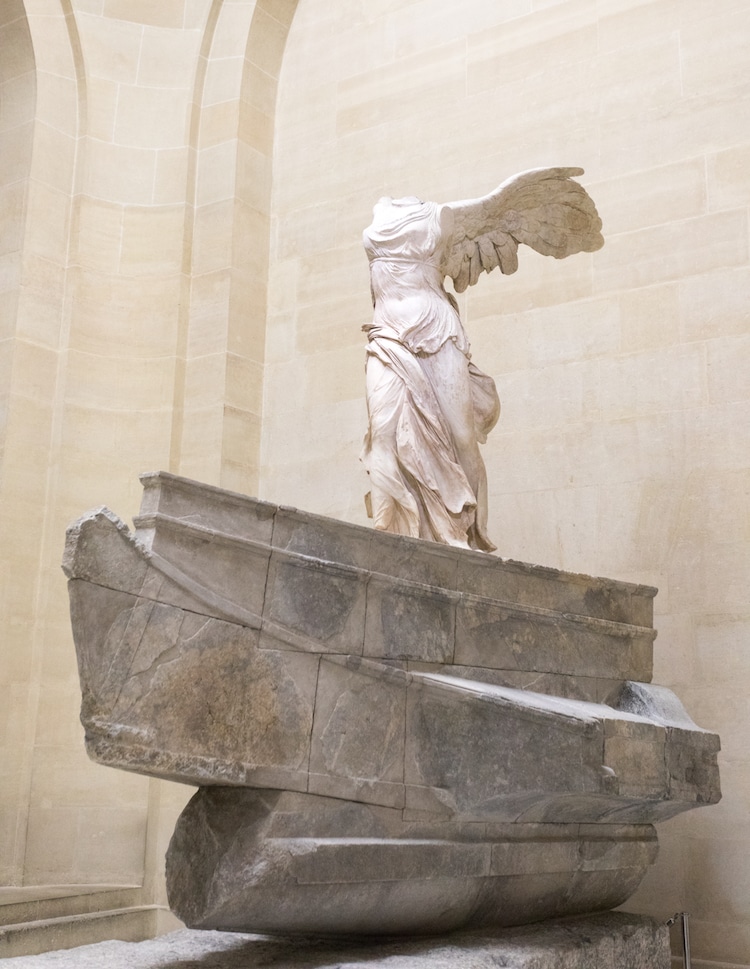
The Winged Victory of Samothrace (Photo: muratart via Shutterstock
The statue was one of many marble pieces that adorned the Sanctuary of the Great Gods, an ancient temple complex on the island of Samothrace. This seaside shrine was dedicated to the Mystery religion, or secret cult, of the Great Mother.
The historical context of the Winged Victory is from the Hellenistic era, when the Greeks honored the Gods with monuments.
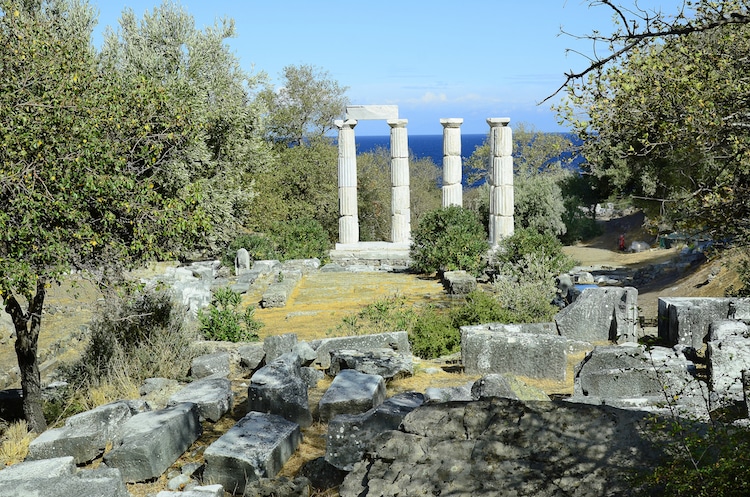
(Photo: fritz16 via Shutterstock)
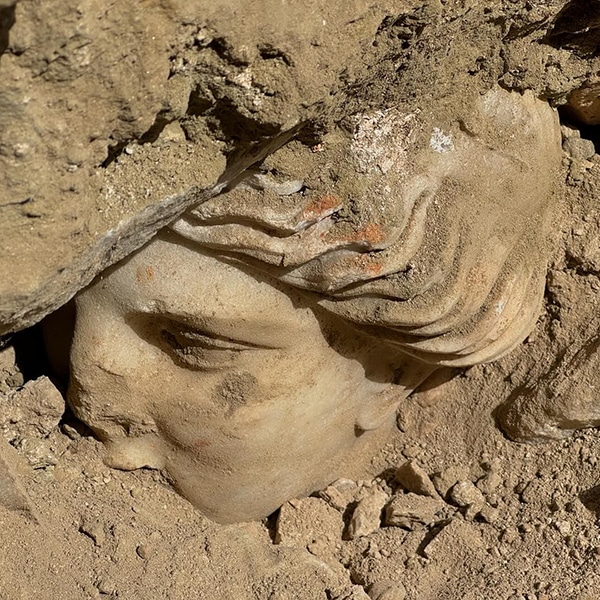
French diplomat and amateur archaeologist Charles Champoiseau unearthed the Winged Victory during excavations on the Greek island of Samothrace in April of 1863. While he reassembled 23 blocks that compose the ship, he sent the figure back to Paris just as he found it: in three pieces.
The base, torso, legs, and left wing eventually reached the Louvre, where they were reassembled in the Caryatid Room of classical antiquities. The museum also added a plaster right wing to the sculpture—an addition that remains today—but did not opt to recreate the head or arms, which have never been recovered and remain a mystery.
Decades of recovery and restoration gave new life to the Winged Victory after its fractured discovery.
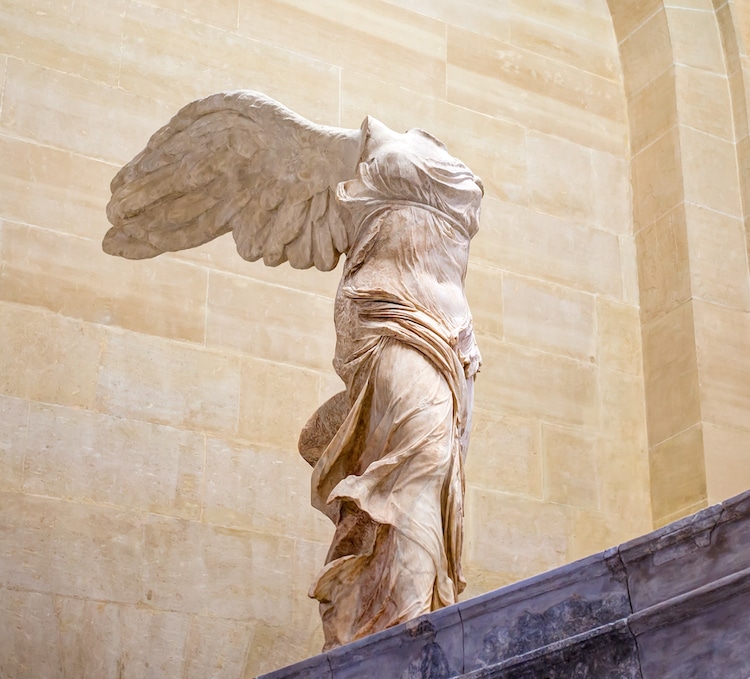
The Winged Victory of Samothrace (Photo: muratart via Shutterstock)
However, nearly 90 years after Champoiseau’s discovery, archaeologists from Austria uncovered missing fragments, including Nike's right hand. Unfortunately, the hand had no way of being reattached to the sculpture, as the figure remained armless. Still, its unearthing was extremely important, as the unclasped hand disproved an early theory that the figure had originally been grasping an object.
“It has been suggested that the Victory held a trumpet, a wreath, or a fillet in her right hand,” The Louvre scholars explain. “However, the hand found in Samothrace in 1950 had an open palm and two outstretched fingers, suggesting that she was not holding anything and was simply holding her hand up in a gesture of greeting.”
Today, the fragmented hand can be viewed at the top of the Louvre’s Daru Staircase, where the Winged Victory has been on display since 1883.
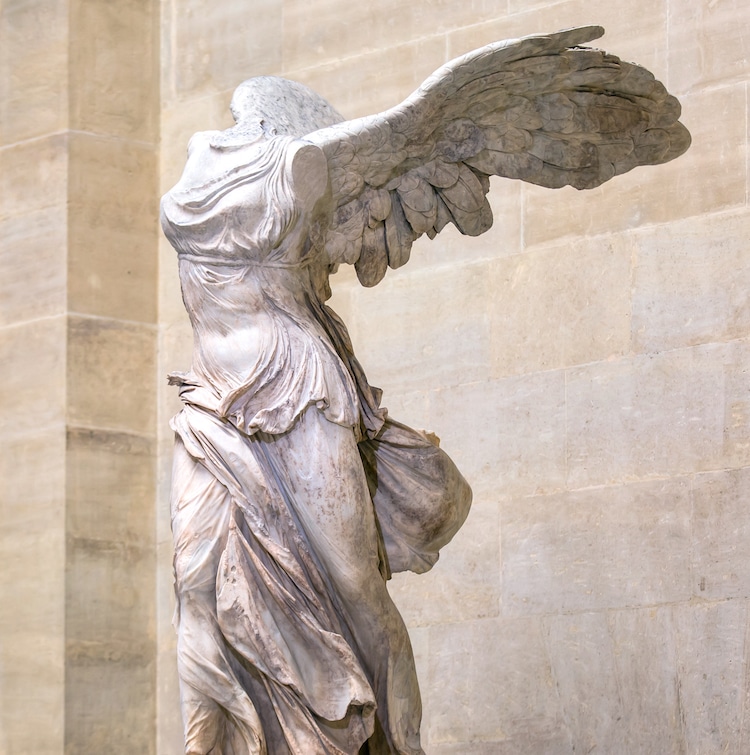
The Winged Victory of Samothrace (Photo: muratart via Shutterstock)
Like other Hellenistic sculptures, the Winged Victory is admired for its naturalistic anatomy and, consequently, its realistic depiction of movement.
To suggest a body in motion, the artist positioned Nike in an asymmetrical stance. Known as contrapposto (“counterpose”), this pose implies movement through the use of realistic weight distribution and an S-shaped composition. Other famous sculptures that demonstrate this classical approach to conveying the human body are The Walking Man by Rodin and Michelangelo’s David.
The “wet drapery” technique, along with the contrapposto, gives Nike the illusion of movement
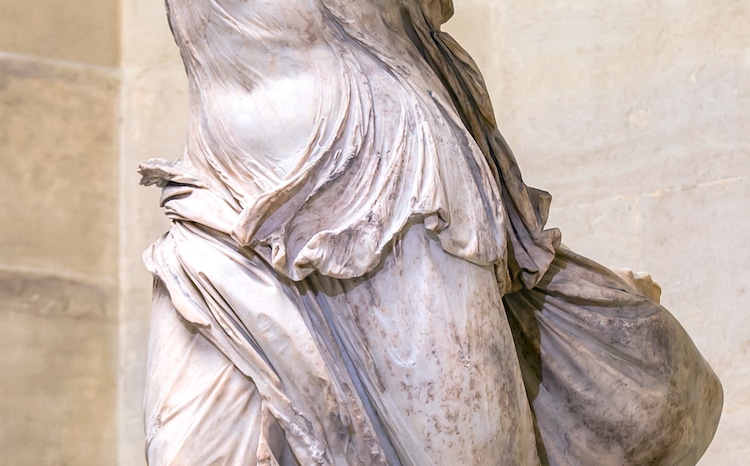
The Winged Victory of Samothrace (Photo: muratart via Shutterstock)
Another element that helps suggest movement is the billowing fabric draped across Nike’s body. Although carved from solid marble, the sculptor Pythokritos was able to create the illusion that the cloth is lightweight, fluid, and transparent in a sculpting technique called “wet drapery.” As Nike dramatically steps forward, the garments cling to all parts of her waist, stomach, and bust. Her himation (cloak) is windswept in the back, and her fine chiton (long dress) sticks to her thighs and abdomen, anchored by a sash wrapped below her breasts.
Today, the Winged Victory of Samothrace remains one of the most celebrated sculptures on earth. Since making its debut at the Louvre in the 19th century, it has had significant impact on countless artists. Surrealist Salvador Dalí directly appropriated this sculpture for his Double Nike de Samothrace (1973), and Futurist Umberto Boccioni employed the figure’s iconic stance for his Unique Forms of Continuity in Space (1913).
While these modern interpretations undoubtedly capture the spirit of the piece, no other Winged Victory can captivate audiences as triumphantly as the original treasure.
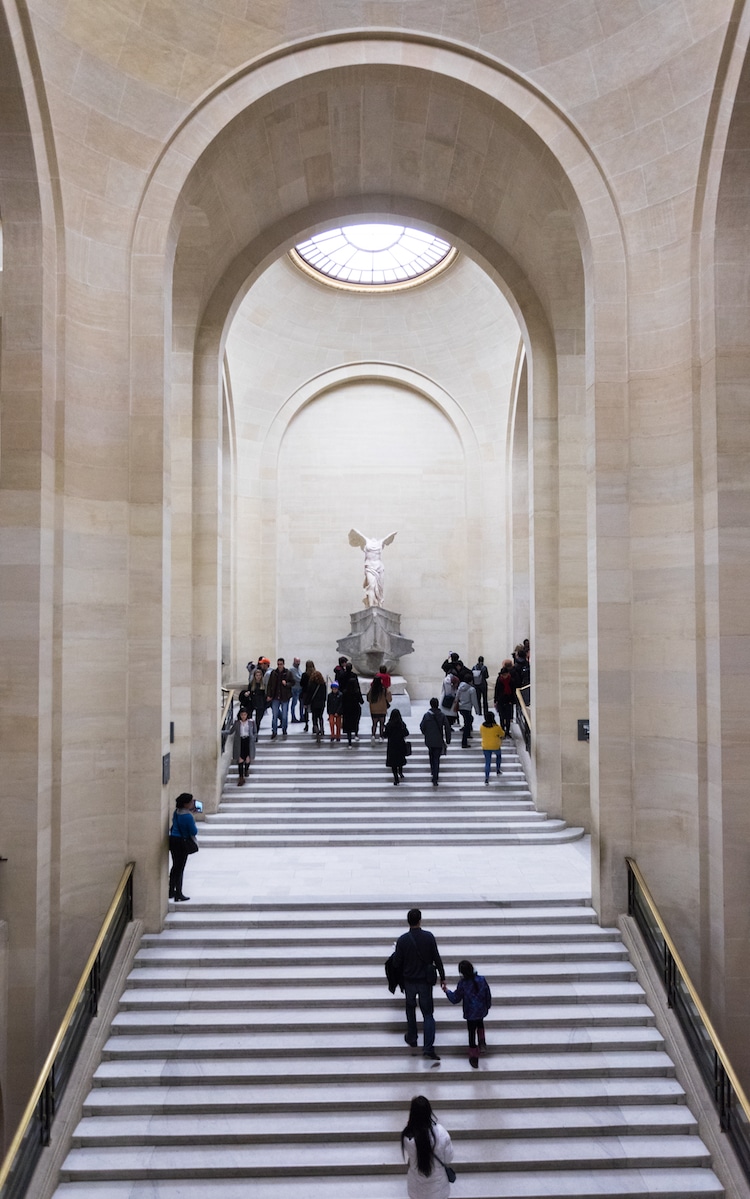
Daru Staircase (Photo: jackbolla via Shutterstock)
This article has been edited and updated.
Related Articles:
16 Great Sculptors Who Changed the History of Art