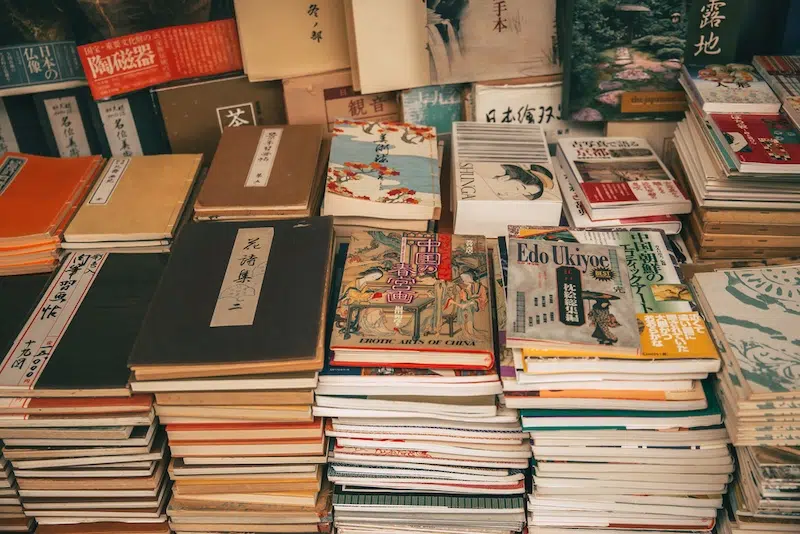
Secondhand book stores are some of the best places to find old stories and records of the past, but the independent businesses often struggle to make ends meet when competing with bookstore chains and online shops. Owners of most used bookstores don’t expect to receive large volumes of orders, but in Japan, many small stores have recently found themselves responding to an unusual amount of interest in their non-fiction collections.
This sudden uptake in orders might seem like a good thing at first, but there’s something about it that’s raising some eyebrows. One bookstore in Tokyo sold more than 1,000 books to a single shipping address, but the owner became suspicious after noticing that the orders were placed at remarkably quick intervals. Elsewhere in western Japan, a bookseller reported receiving an order for tens of thousands of books from an overseas company. In almost every case, the books being ordered are non-fiction titles, covering topics like history, medicine, and philosophy.
Many of the orders are being sent to a logistics facility in Okayama Prefecture, but the company declined to reveal the identity or location of the buyer when contacted by the media. Reports also reveal that a major Japanese book distributor sold more than 50 ton of books to the U.S. over the past year, although it also declined to provide details.
Earlier this year, AI firm Anthropic was found to have been purchasing millions of books in bulk from the U.S., UK, and Europe through a secret initiative called Project Panama to train its Claude AI models. And in most cases, the books are destroyed during the scanning process. It’s likely that the books in Japan are facing the same concerning fate.
Many people online are understandably worried about what this means for copyright issues and how information is recorded and accessed in the near future. One person wrote, “The books are cut, scanned, and tossed. And how faithful is this digital reincarnation? If the AI just devours it, then we risk losing our own history.” Another person commented, “We’re getting to a point where if data centers go down, our whole culture goes with it.”
Others believe allowing AI to learn from historical books will help make its tools more accurate and useful. One person said, “In a lot of ways, used bookstores are like graveyards for books that no one buys, so export them and put them to good use.” Another wrote, “At least they’re paying money for it, rather than stealing it from the Internet.”
Regardless of where you stand on the issue, there’s no denying that books should never be needlessly destroyed, and clearer legislation is needed to ensure AI can be trained in a fair and sustainable way.
Source: Tons of used books in Japan being bought up by someone or something
Related Articles:
Browse Over 1,100 Art Books at MoMA’s First-Ever Bookshop in Seoul
Dua Lipa Opens a Library Filled With 100 Banned Books in Porto, Portugal
18th-Century Portuguese Library Has Bats That Protect the Priceless Books Housed Inside
Why Swedish Schools Are Cutting Back on Digital Learning and Bringing Back Textbooks