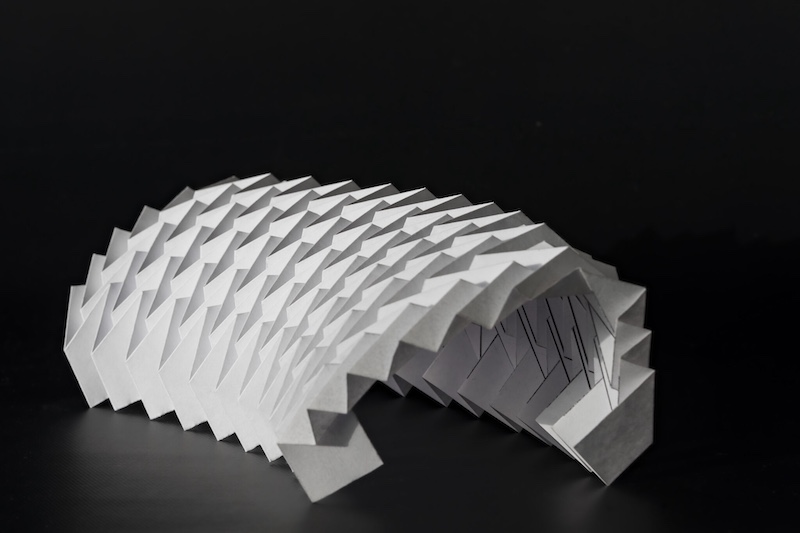
Curved surface structure using a semi-periodic Miura-ori tessellation. (Photo: Origamicke via Wikimedia Commons, CC BY-SA 4.0)
Origami is usually associated with folding paper into intricate shapes, but researchers are now using the same basic idea to create structures big enough to walk beneath. A team led by MIT researchers has developed a new construction method inspired by origami that produces lightweight, rigid structures from flat sheets.
The technique builds on the work of artist and scientist Ron Resch, who began experimenting with repeating folded patterns, known as tessellations, in the 1960s. His designs showed how carefully placed folds could transform a flat sheet into complex three-dimensional surfaces.
“We are demonstrating structural origami on building scales,” says lead author Alfonso Parra Rubio, a graduate student at MIT’s Center for Bits and Atoms.
Instead of folding one enormous sheet, the researchers broke the idea into smaller pieces. Each triangular unit is folded individually, then connected to others to create a larger network of interwoven beams. Once assembled, the pieces lock together to form a strong structure without needing interior support columns.
This modular approach also makes the structures easier to build. The pieces can be cut from flat sheets of material, such as aluminum, then folded and connected with simple hand tools. Researchers also developed a computer-based system that calculates the shape each piece needs to take to create the final form.
Despite using relatively little material, the resulting structures can be surprisingly strong. In simulations reported in the research paper, the team’s woven design was up to 3.5 times stiffer than another configuration made from the same amount of material.
To show that the idea could work at a much larger scale, the team created Lexicon, a 23-foot-wide sculpture made from folded aluminum. A group with no professional construction experience assembled the structure in a matter of days before suspending it inside the Boston Public Library.
The same approach could eventually have uses far beyond sculpture. Because the components can be transported flat and assembled relatively quickly, researchers imagine using the system for emergency shelters, architectural facades, lightweight aerospace components, and other structures where strength and low weight matter.
For now, Lexicon offers a striking example of how an idea that began with folded paper can be translated into architecture. By combining Resch’s geometric experiments with digital design and modern fabrication, the researchers are exploring origami's full potential.
A team of MIT researchers has found that origami could be an incredible inspiration for creating easily buildable structures.
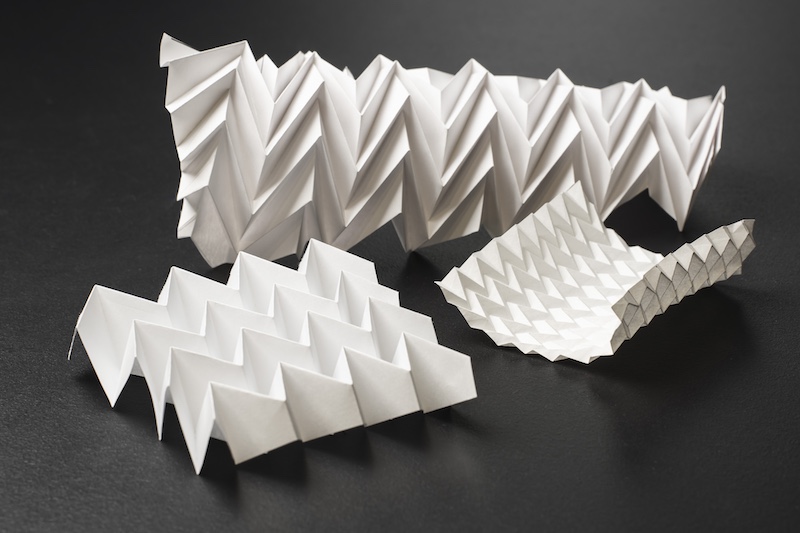
Miura-ori tessellations with different surface forms. (Photo: Origamicke via Wikimedia Commons, CC BY-SA 4.0)
The technique uses the work of artist and scientist Ron Resch, who began experimenting with repeating folded patterns, known as tessellations, in the 1960s.
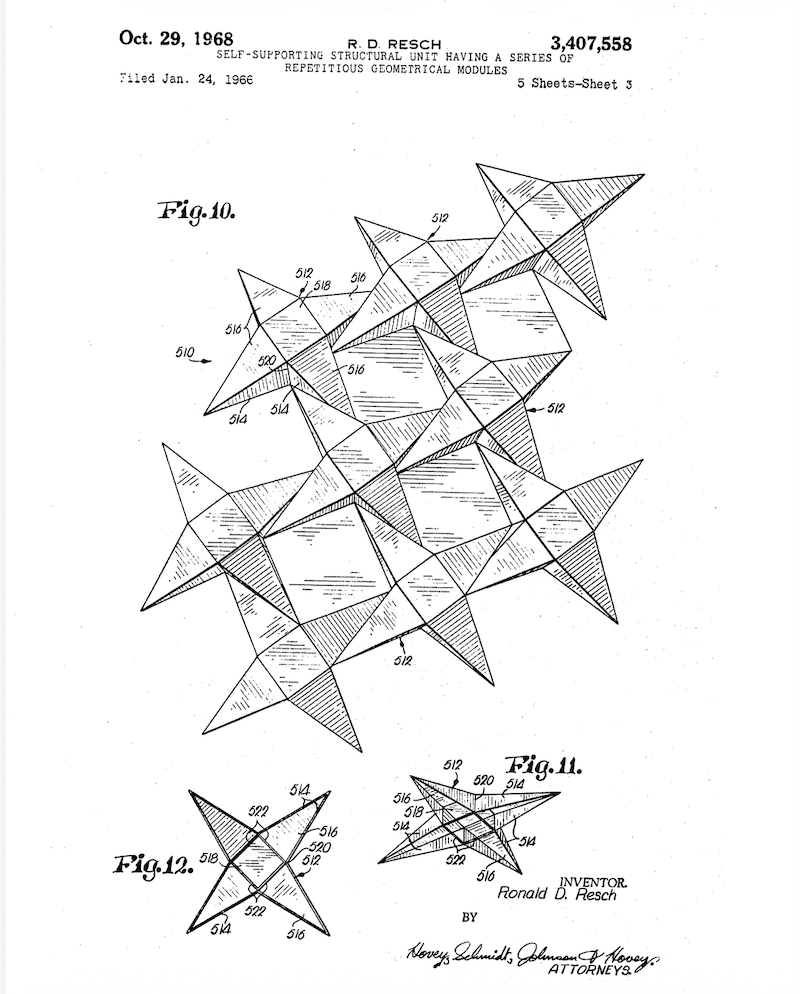
A drawing from Ron Resch’s 1968 patent shows how repeating geometric modules can form a three-dimensional structural system. (Image: Ronald D. Resch via Google Patents)
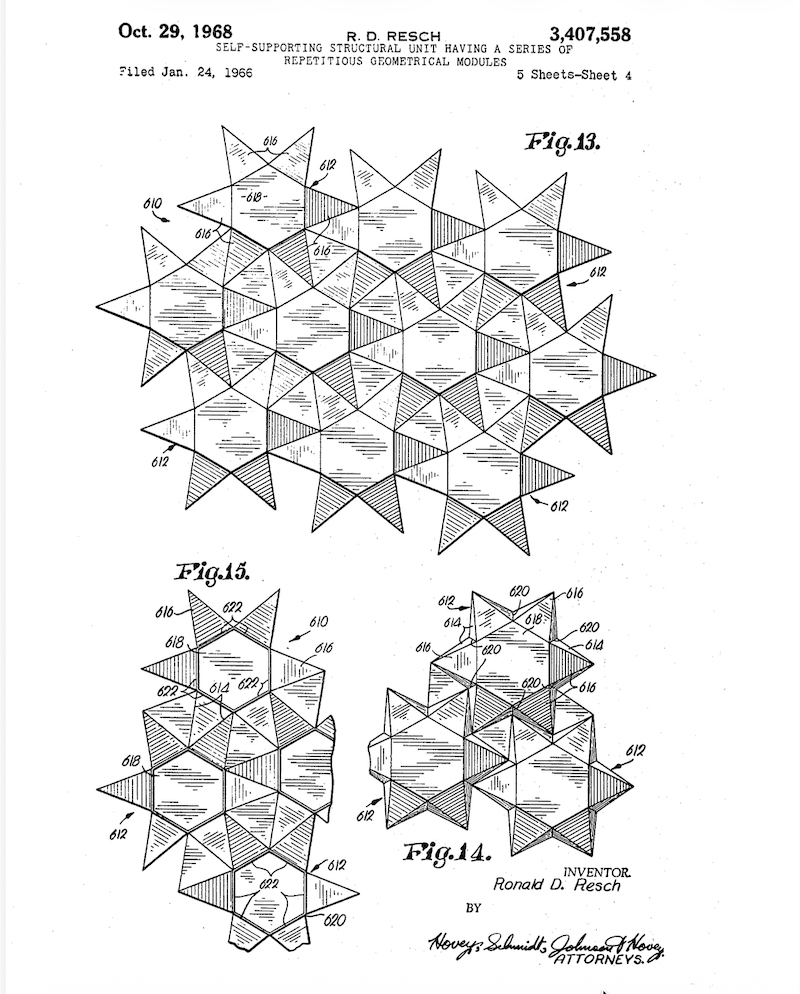
A drawing from Ron Resch’s 1968 patent shows how repeating geometric modules can form a three-dimensional structural system. (Image: Ronald D. Resch via Google Patents)
MIT researchers created a project called Lexicon, a 23-foot-wide sculpture demonstrating this technique, which has been suspended inside the Boston Public Library.
View this post on Instagram
Source: Origami-Based Construction Method Yields Lightweight, Load-Bearing Structures on Architectural Scales; Resch Tessellations as Stiff, Folded Modular Shells
Related Articles:
Origami Artist Creates a Dragon Hunter Sculpture From a Single Piece of Paper
Cyanotypes of Folded Paper Tessellations Unveil Crystal Patterns With Sunlight
Museum of Paper Cleverly Designed With a Roof That Looks Like a Sheet of Folded Paper