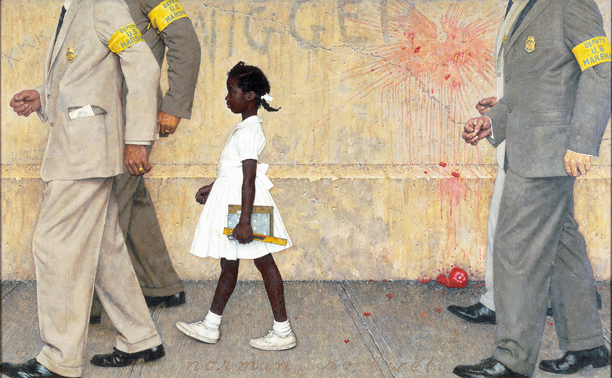
Norman Rockwell, “The Problem We All Live With,” 1963
In the middle of the 20th century, the Civil Rights Movement brought much-needed change to the United States of America. On the heels of the Harlem Renaissance, this movement emerged in order to end the discrimination against African Americans that had plagued the country since the end of the Civil War.
Several now-famous figures spearheaded this cause, with Martin Luther King, Jr. and Rosa Parks among the most well-known. In addition to these key players, however, the Civil Rights Movement had the support of one unlikely advocate: Norman Rockwell, a white artist known for his nostalgic views of “average America” (Thomas Buechner, Norman Rockwell: Artist and Illustrator).
Prior to the 1960s, Rockwell made a name for himself as the cover artist for The Saturday Evening Post. During the Civil Rights Movement, however, Rockwell experienced an unprecedented shift in focus, foregoing his charming illustrations of everyday life for poignant paintings rooted in social justice—with The Problem We All Live With leading the way.
Who was Norman Rockwell?
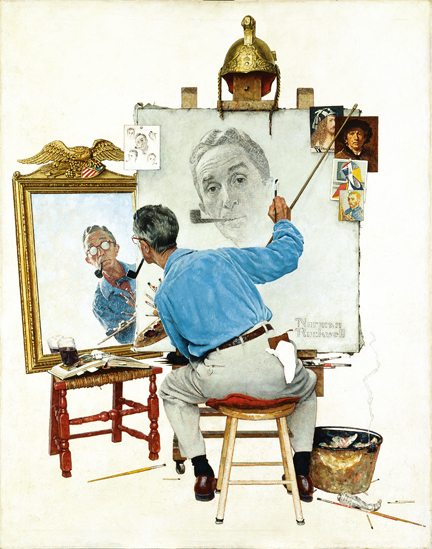
Norman Rockwell, “Triple Self-Portrait,” 1959
Norman Rockwell was born in New York City at the turn of the 20th century. As a child, he excelled as a painter, culminating in a job as a cover artist for Boys’ Life Magazine when he was just 18 years old.
Four years later, Rockwell would land a life-changing position at The Saturday Evening Post, a popular bi-monthly magazine. Over the span of 47 years, Rockwell completed 322 covers for the magazine, with most exploring quaint themes like childhood, coupledom, and the American workforce.
By the 1960s, Rockwell's work remained popular with the public. In 1963, however, he left his job at The Saturday Evening Post and accepted a role at Look Magazine. It is during his time with Look that Rockwell's interest in social justice emerged—and his old approach to art dissipated. “For 47 years, I portrayed the best of all possible worlds— grandfathers, puppy dogs—things like that,” Rockwell said in an interview at the age of 75. “That kind of stuff is dead now, and I think it’s about time.”
The year after he was hired by Look, Rockwell produced his most celebrated Civil Rights painting: The Problem We All Live With.
The Problem We All Live With
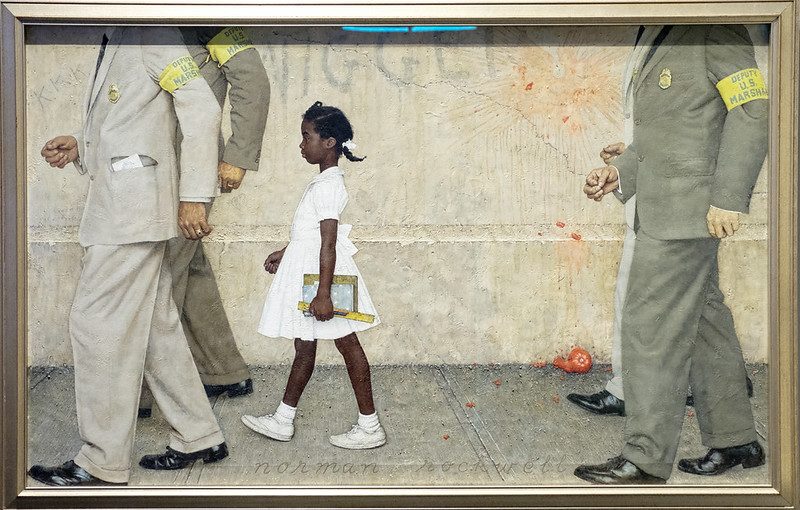
The Problem We All Live With stars Ruby Bridges, a 6-year-old African American girl, on her first day of class. Clutching school supplies and clad in a clean white dress, Bridges looks like any other student starting the first grade. What surrounds the young girl, however, is not typical. Flanked by U.S. Federal Marshals and strolling before a wall covered in racist graffiti and a recently thrown tomato, it is clear that Bridges' experience is exceptional—and prompted by politics.
Historical Context
The landmark 1954 Brown v. Board of Education Supreme Court decision ruled that state-sponsored segregation in public schools was unconstitutional. Although the ruling had been passed down six years prior, schools in the area had failed to comply. Bridges' parents responded to a call from the NAACP leaders to start the school desegregation process in New Orleans.
Bridges was the only one of these children sent to William Frantz Elementary School, and her first day of school started on November 14, 1960. While her walk to the institution's front doors was marred by a violent mob, Bridges did not buckle under pressure. In fact, “she showed a lot of courage,” Charles Burks, one of her Federal Marshal escorts, said. “She never cried. She didn't whimper. She just marched along like a little soldier, and we're all very very proud of her.”
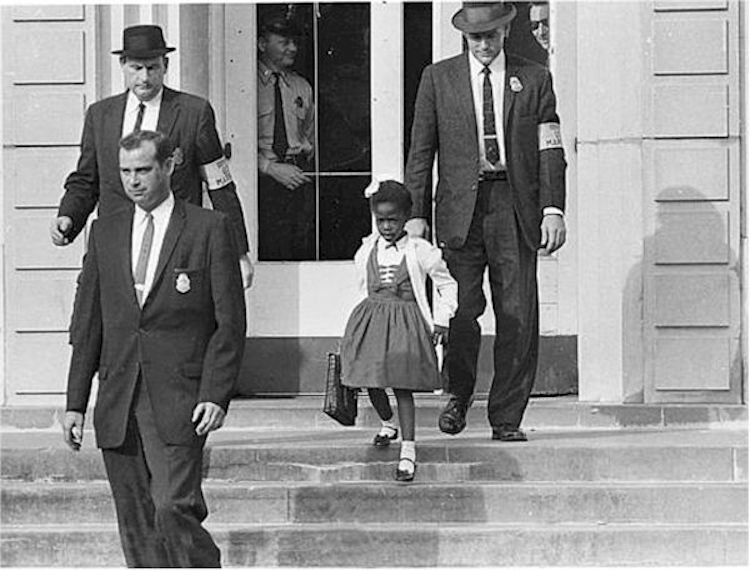
Bridges, however, attributes her mature handling of the situation not to bravery, but to childhood innocence. In 2011, she explained: “The girl in that painting at 6 years old knew absolutely nothing about racism—I was going to school that day. So every time I see that, I think about the fact that I was an innocent child that knew absolutely nothing about what was happening that day.”
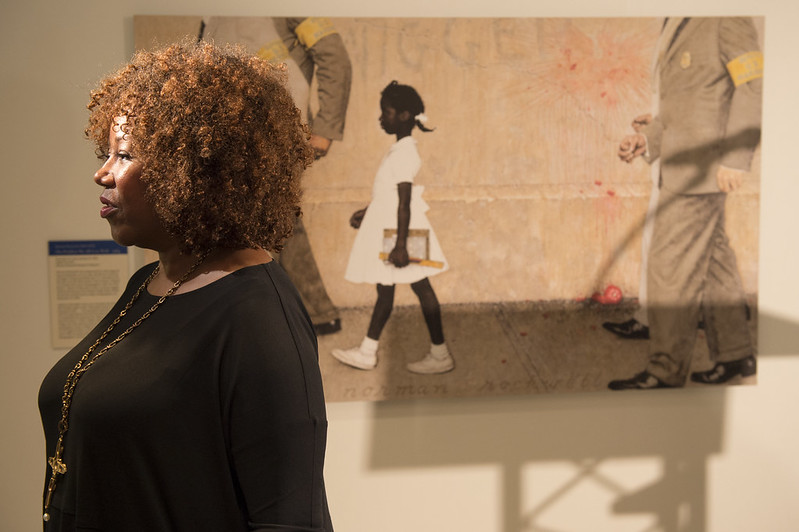
Ruby Bridges with her portrait
Exploring the Painting
Rockwell made numerous artistic choices in The Problem We All Live With to emphasize the seriousness of the occasion. For instance, Ruby Bridges is wearing a bright white frock and sneakers, perhaps emphasizing her innocence in the face of adversity. This is highlighted by the offensive graffiti and thrown tomato surrounding her path to school.
Additionally, Rockwell made the choice of only showing Bridges' face, while the depictions of the large, adult Marshals are cut off at the head. This is intended to underscore Bridges' perspective of the situation and stress her small size and young age. Rockwell's painting puts the viewer in the midst of the racist, angry mob; the tomato appears in front of the viewer as if they were standing next to the person who threw it.
Other Norman Rockwell Paintings With Similar Themes
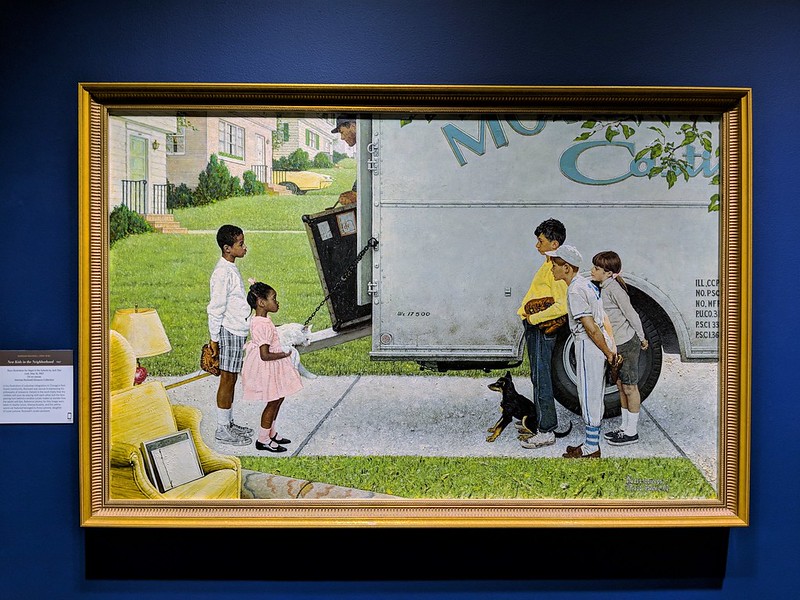
Norman Rockwell, “New Kids in the Neighborhood,” 1967
Three years after the publication of The Problem We All Live With, Rockwell revisited this theme. New Kids in the Neighborhood, another illustration for Look Magazine, features two groups of children: one Black and one white. Set in what appears to be a suburban neighborhood, the scene prominently features a moving truck. As the black children are positioned near the truck's cargo, it can be inferred that they are the New Kids in the Neighborhood—and, judging by their curious expressions, the white children aren't sure what to think.
Similar to the The Problem We All Live With—and in contrast to his past portrayals of kids—New Kids in the Neighborhood illustrates Rockwell's interest in exploring the effects of racism on children.
The Legacy of The Problem We All Live With
Today, Norman Rockwell remains primarily known for his charming Post covers. However, his Civil Rights-era paintings—especially The Problem We All Live With—are among his most powerful works of art.
As a testament to its significance, President Barack Obama had The Problem We All Live With temporarily installed in the White House in 2011. As he and Ruby Bridges gazed at the artwork, the pair couldn't help but marvel at the situation. “I think it's fair to say that if it hadn't been for you guys, I might not be here and we wouldn't be looking at this together,” Obama, the country's first African American president, remarked.
Later, Bridges reflected on his comment. “Just having him say that meant a lot to me and it always has. But to be standing shoulder to shoulder with history and viewing history—it's just once in a lifetime.”
Frequently Asked Questions
What does The Problem We All Live With represent?
This painting is a form of visual commentary on racism and segregation in 1960s America. Rockwell depicted an actual event, taking artistic liberties to document the historic event in which segregation was abolished and Black children were being integrated in schools with white children.
Who is the girl in The Problem We All Live With?
The girl in the painting is Ruby Bridges. She was among the first African American students to be integrated in school when she was 6 years old.
What does the white dress symbolize in The Problem We All Live With?
There is a sense of innocence with the white dress that Ruby wears. Visually, the white dress is also a stark contrast to the young girl's dark skin. This high contrast draws the viewer's eye to her.
This article has been edited and updated.
Related Articles:
Meet the Artists Painting the Obamas’ Post-Presidential Portraits
Striking B&W Photos Capture the Black Experience in 1940s South Side Chicago
Augusta Savage: How a Black Art Teacher and Sculptor Helped Shape the Harlem Renaissance
Illustrator Uses Art to Give a Voice to the Black Lives Matter Movement [Interview]
8 Artworks of the Civil Rights Movement That Exemplify the Struggle for Equal Rights