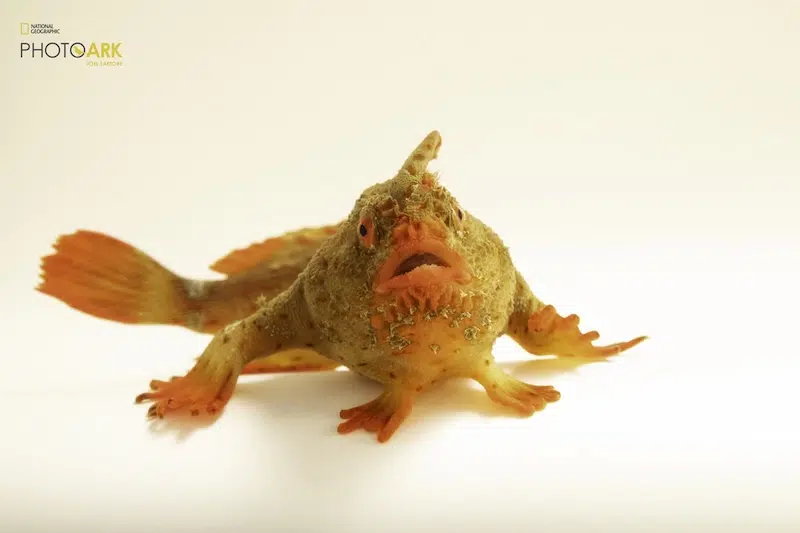
A critically endangered female red handfish (Thymichthys politus) at the Institute for Marine and Antarctic Studies in Hobart, Tasmania. (Photo: Joel Sartore/ National Geographic Photo Ark)
For its 18,000th animal and 20th anniversary milestones, National Geographic’s Photo Ark has chosen to feature a fascinating fish with an equally interesting name. The red handfish is not named for being the size of a human palm; it’s actually no bigger than a thumb. The creature gets its name from its unique form of locomotion: it uses its hand-like fins to walk along the seafloor.
Fewer than 250 of the red handfish remain in the wild, making it one of the rarest fish on Earth. It’s found only in small areas off the coast of Tasmania. The creatures travel about the length of a basketball court over their entire lifetime, making them particularly vulnerable to habitat loss, pollution, climate change, and human disturbance.
The National Geographic Photo Ark is now a 20-year effort to record every animal species it can. Photographers use studio-style lighting with a non-distracting background and feature animals already in human care. The intent is to capture images that force the viewer to look the creature in the eyes and form a connection.
“I started the Photo Ark in 2006 with the idea that if we can illuminate species of all sizes,” explains founder Joel Sartore, “especially the little ones that don’t get a lot of love—then we might be able to ignite connection and compassion for all of the living things we share this planet with.” He started the initiative in his hometown of Lincoln, Nebraska, with a picture of a naked mole rat and has since become a world-renowned photographer.
Sartore photographed the endangered red handfish at the Institute for Marine and Antarctic Studies at the University of Tasmania’s facility. He says the red handfish perfectly represents the mission of the Photo Ark, “There’s no better example of what the Photo Ark is all about than our 18,000th milestone species. The rare and remarkable red handfish is brilliantly unique and critically important to marine biodiversity. We should care about their future as much as we care about our own.”
Ian Miller, chief science and innovation officer at the National Geographic Society, concurs. “The Photo Ark does so much more than raise awareness. It spurs real, on-the-ground conservation. Joel’s portraits drive a shift in attitudes, proving that when people truly connect with the beauty of these animals, they’re moved to protect them.”
The Photo Ark is a teaching tool for students, an image source for Nat Geo media, and an awareness raiser for the public. It also helps fund conservation projects directly through grants, changing the fates of at-risk species. “The legacy of the Photo Ark isn’t just what Joel’s accomplished over these past two decades,” Miller shares, “but the tremendous possibilities for saving species as we look ahead to the next 20 years.”
Photo Ark founder Joel Sartore chose the rare and vulnerable red handfish for the double milestone: the Photo Ark’s 20th anniversary and its 18,000th animal photographed.
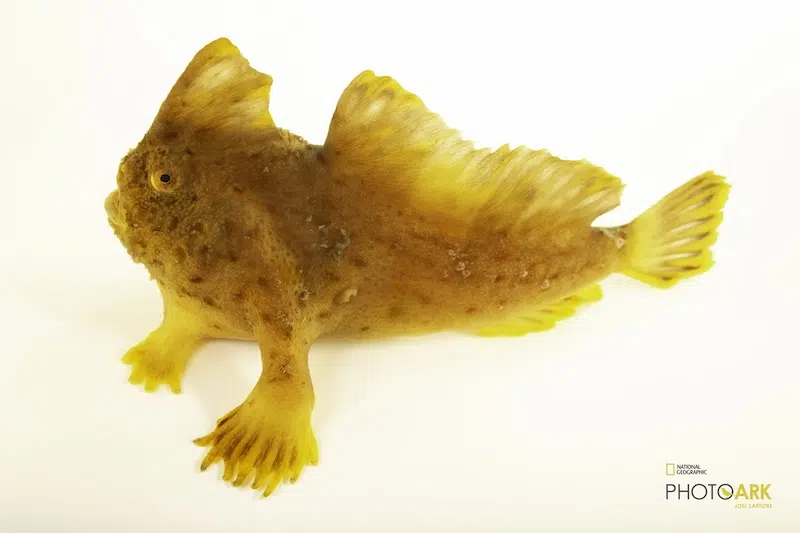
A critically endangered female red handfish (Thymichthys politus) at the Institute for Marine and Antarctic Studies in Hobart, Tasmania. (Photo: Joel Sartore/ National Geographic Photo Ark)
The Photo Ark is an initiative that aims to photograph every species it can in a studio-style setting, with no distractions, so the viewer can look the animal in the eye and make a connection.
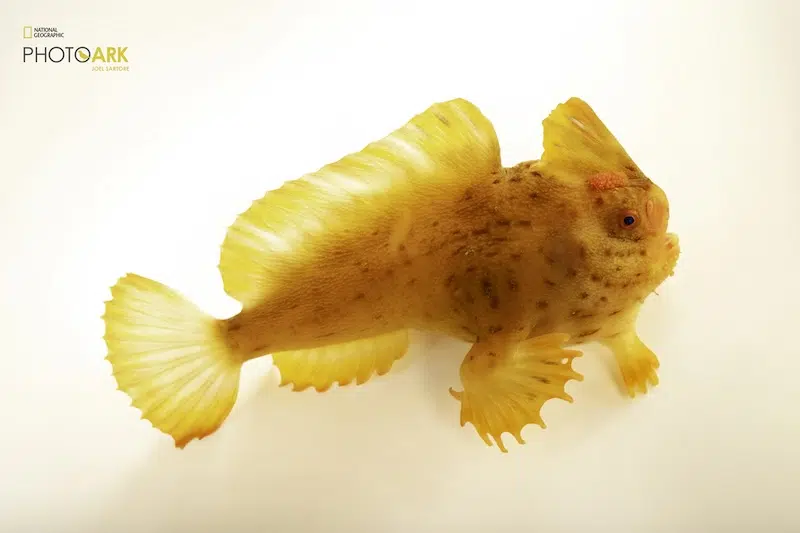
A critically endangered male red handfish (Thymichthys politus) at the Institute for Marine and Antarctic Studies in Hobart, Tasmania. (Photo: Joel Sartore/ National Geographic Photo Ark)
The red handfish is critically endangered, with fewer than 250 remaining in the wild. Its way of life makes it vulnerable as it uses its fin-like hands to walk along the seafloor, traveling the length of a basketball court over its lifetime.
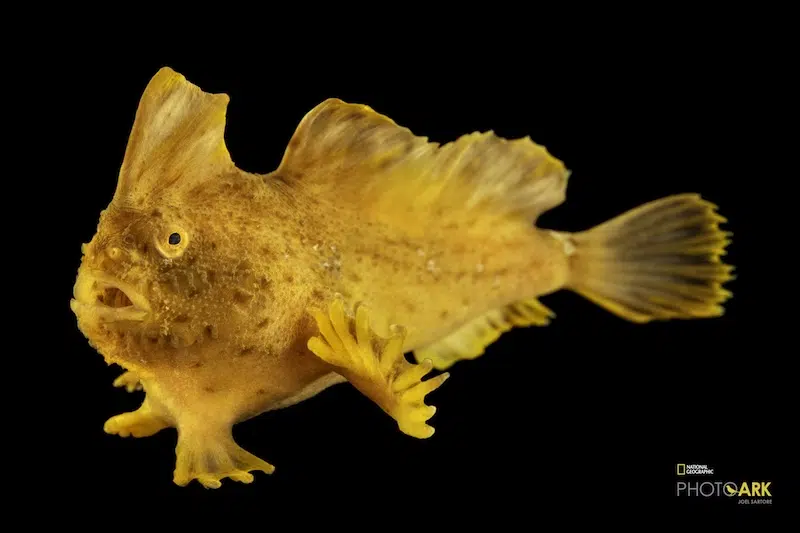
A critically endangered female red handfish (Thymichthys politus) at the Institute for Marine and Antarctic Studies in Hobart, Tasmania. (Photo: Joel Sartore/ National Geographic Photo Ark)
Sartore believes this fish is the perfect animal for Photo Ark’s milestones; his mission 20 years ago was to “illuminate species of all sizes — especially the little ones that don’t get a lot of love.”
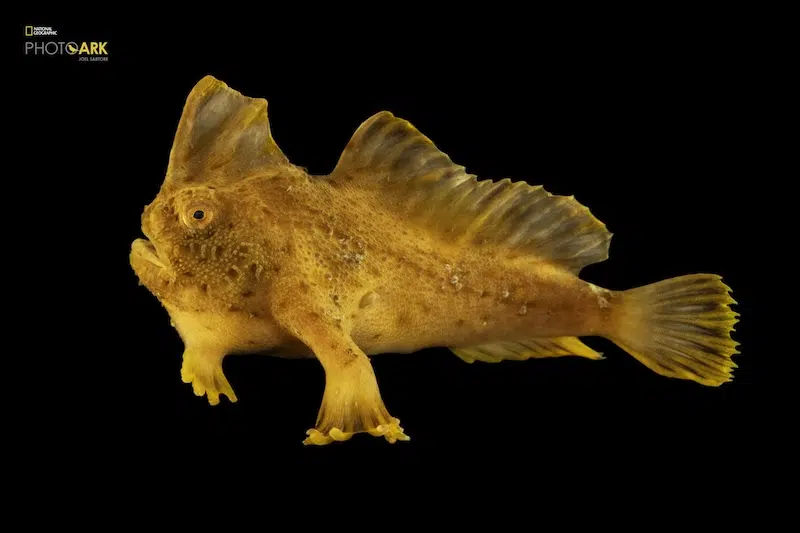
A critically endangered female red handfish (Thymichthys politus) at the Institute for Marine and Antarctic Studies in Hobart, Tasmania. (Photo: Joel Sartore/ National Geographic Photo Ark)
Over the last two decades, the Photo Ark has reached school kids and National Geographic media and helped earn grants that have funded important conservation efforts.
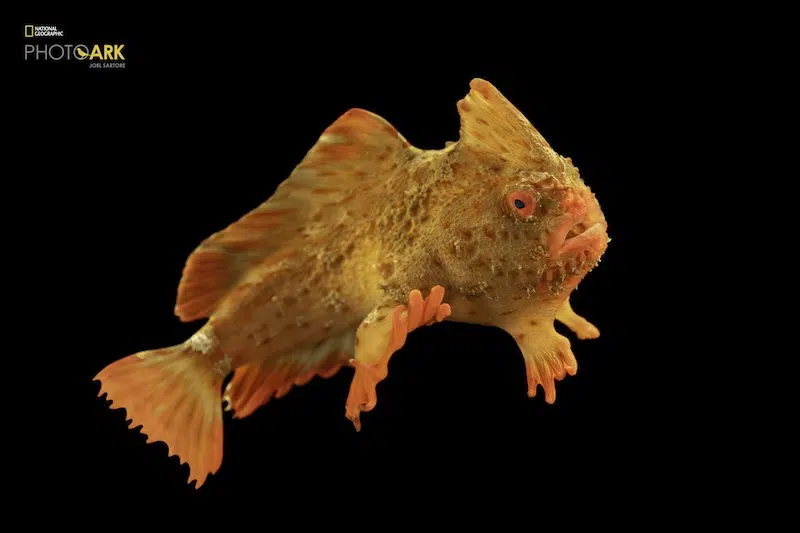
A critically endangered female red handfish (Thymichthys politus) at the Institute for Marine and Antarctic Studies in Hobart, Tasmania. (Photo: Joel Sartore/ National Geographic Photo Ark)
The Photo Ark’s legacy and impact will help many more precious critical species like the red handfish for many more years to come.
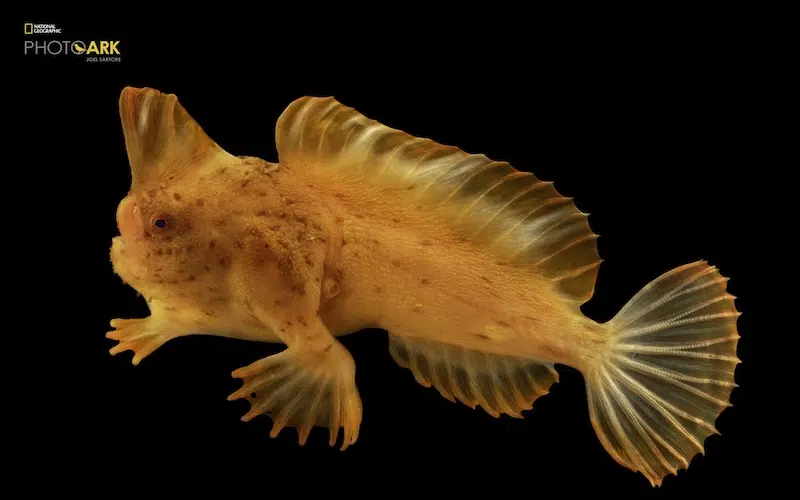
A critically endangered male red handfish (Thymichthys politus) at the Institute for Marine and Antarctic Studies in Hobart, Tasmania. (Photo: Joel Sartore/ National Geographic Photo Ark)
National Geographic Photo Ark: Website
Source: 20 Years, 18,000 Species: The National Geographic Photo Ark Selects Rare Red Handfish to Mark the Double Milestone
Related Articles:
National Geographic Promotes New ‘Secret of Bees’ Show With Billboards Doubling as Bee Hotels
Photographer Shares Why His Animal Portraits Are Shot From Bottom Up [Interview]