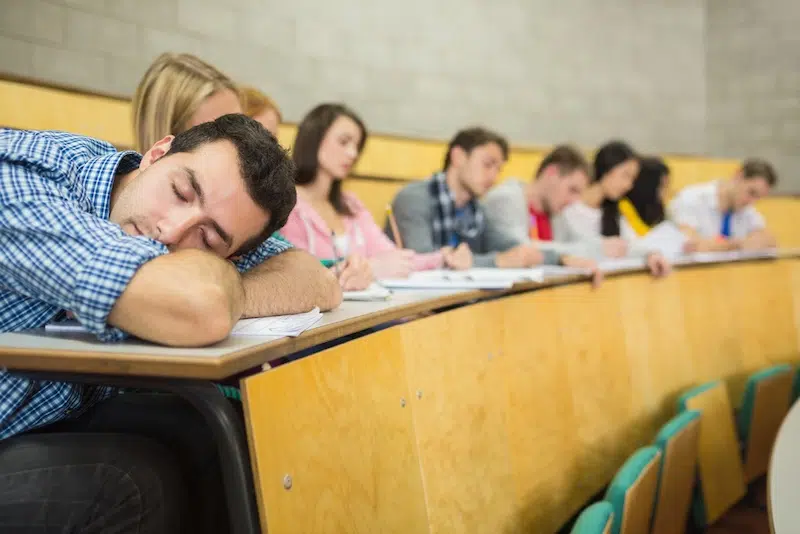
How much sleep do you get each night? According to the National Center for Health Statistics, one-third of American adults sleep less than seven hours a night—the amount of shuteye recommended by health authorities. Recognizing that many people, particularly students, struggle to get the rest they need, researchers recently explored whether offering small, financial rewards could encourage students to improve their sleeping habits.
The study, published in July 2026, was conducted by Osea Giuntella, associate professor of economics at the University of Pittsburgh; Sally Sadoff, professor of economics and strategy at the University of California, San Diego; and Silvia Saccardo, professor of social and decision sciences at Carnegie Mellon University.
The researchers gave more than 1,100 undergraduates at University of Pittsburgh a Fitbit, a wearable activity tracker that recorded how much they slept, and an app that sent bedtime reminders and morning feedback. They randomly chose 468 freshman students and paid them around $5 for every night they slept at least seven hours over the course of four weeks.
Before the study, students at the University of Pittsburgh were getting an average of just 6.6 hours of sleep a night. “Half were going to bed after 1 a.m. on average—a quarter after 2 a.m,” reveal the researchers. “They also did not know how much sleep they were getting. Two-thirds told us they usually slept seven hours—the trackers showed only about one-third of students slept that much on even three nights out of five.”
Students offered money for getting enough sleep reached the seven hour target on 26% more nights than those who weren’t paid. They also got an extra 19 minutes of sleep each school night—about the difference between closing your laptop at 11:40 p.m. instead of midnight. Getting more sleep seemed to pay off in the classroom, too. Students who received the incentives saw their GPA rise by around 0.08 points that semester. The boost to grades didn’t last forever though, and lowered after two semesters.
The researchers also learned that students who were paid nightly slept more than those who received a lump sum at the end of the semester. Interestingly, bedtime reminders alone made little difference. Students already wanted more sleep—they just needed a little extra incentive to make it happen.
“Very few universities or students treat sleep as part of an investment in education, or ask whether the schedules and incentives schools create make adequate sleep harder,” say the researchers. “Our results suggest they should.”
Source: We paid college students about $5 a night to sleep at least 7 hours – and their grades quickly improved
Related Articles:
Scientists Say 30 Minutes of This Type of Exercise Is the Best Way To Improve Sleep
Discover the Two-Shift Sleep Cycle of the Middle Ages That Might Actually Be Healthier for Us
Doctor Reveals the “Worst Sleeping Position” for a Peaceful Slumber
Sleep Study Shows Two Nights of Bad Sleep Ages You Four Years