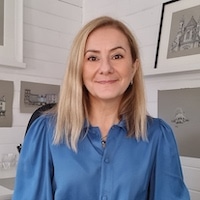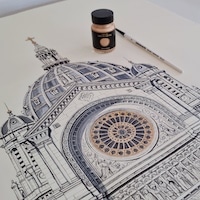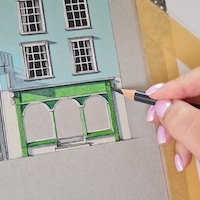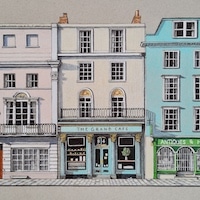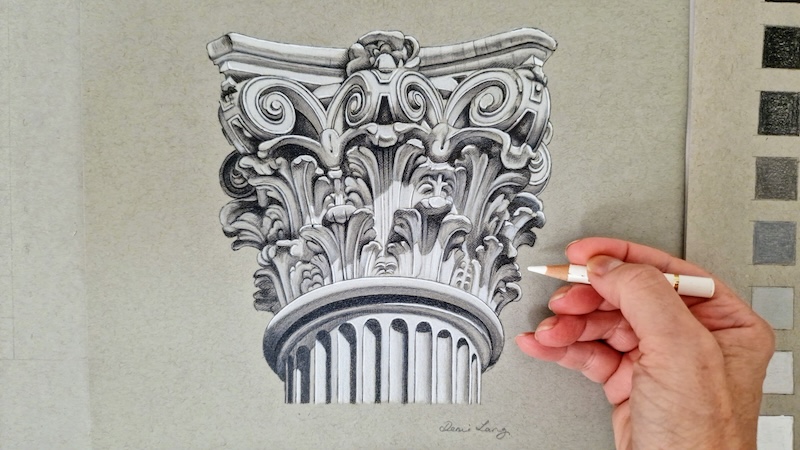
Demi Lang is a British artist who specializes in creating realistic and detailed architectural illustrations that seem to come off the page. Working primarily within pencils and ink, Lang is known for her charming drawings of famous and local buildings, whether it be the Notre Dame in Paris or a little bakery just around the corner. Her care for architecture and love of art both manifest themselves in the excellent quality of her work.
As luck would have it, Lang is also enthusiastic about teaching, which she fulfills as a published author and as a My Modern Met Academy instructor. Her first course with My Modern Met Academy, Architectural Illustration for Everyone, has remained a top favorite from our students ever since it launched a few years ago. Now she’s back to teach another illustration course launching today: Advanced Architectural Illustration: Monochrome Details.
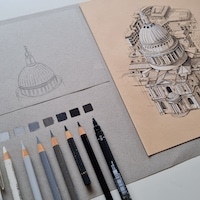
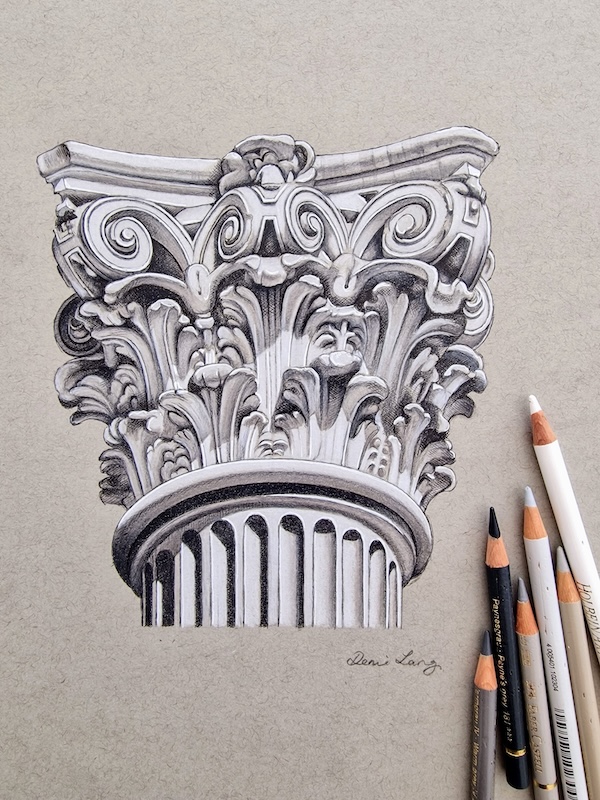
In Advanced Architectural Illustration, Lang challenges students’ skills in realistic drawing by limiting them to a monochromatic pencil palette. Students will work on techniques such as crosshatching, instead of relying on color to convey depth and realism. Lang also provides tips and tricks for selecting and processing images of architectural details to yield maximum impact. The result? A final project of a Corinthian column that is so detailed and realistic, it looks like it’s popping right off the page.
Advanced Architectural Illustration: Monochrome Details is now available for immediate purchase at the My Modern Met Academy website. With nearly two hours of lessons and resources, this course is a steal for its price of $34.95. Whether you’re a seasoned pro or a graduate of Lang’s first Academy course, this class is a great way to keep sharpening your architectural illustration skills in an attainable, fun way.
To celebrate the launch of our newest course, we had the pleasure of speaking with Lang and learning more about her journey. Read on for our exclusive interview, and get inspired by her practice.

How did you get your start with art?
I’ve always been creative! Looking back, my junior school was a creative hub where all creative activities were encouraged. I learned different methods of printing using linocuts and string, and we had to write up our finished English work using an italic fountain pen with an illuminated capital letter. This was all before the age of 11, so for someone like me, it was the perfect environment to sow the seeds for an artistic life.

What attracted you to illustration, especially in relation to architecture and its details?
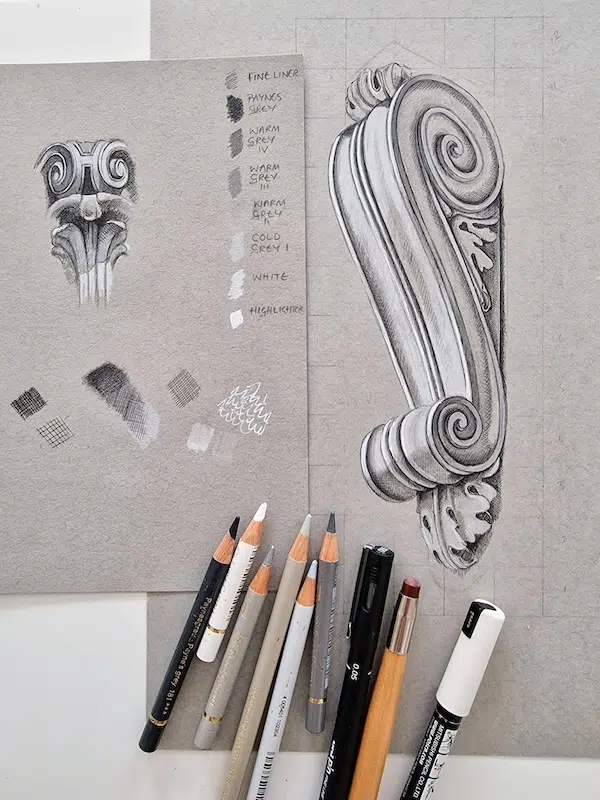
Illustrating with a pen enables you to capture every little detail of complex, ornate architecture, so it was a natural step for me. Also, discovering Strathmore toned gray paper was a revelation! The fact that it’s possible to bring architecture to life on the page and make it look 3D was very exciting and visually appealing to me. I was instantly inspired.
Do you have any artists specifically who have inspired you?
Yes! Many artists have inspired me along the way, including the Pre-Raphaelites, Edward Hopper, and David Hockney. In recent times, I have fallen in love with the work of the English artist, writer, and teacher John Ruskin. He has been a big influence. He spent a lot of time in two of my favorite places, Venice and Verona, studying and sketching the architecture, and capturing the architectural details in the most beautiful way. Now, I am exploring the work of M.C. Escher and the Amalfi coast in Italy; it will be interesting to see where that takes me.

What was the most challenging part of architectural illustration for you when you started, and what challenges you now?
The initial pencil drawing was (and still is) the biggest challenge of any work. My subject matter is usually very complex, and if you get the pencil drawing wrong, you run into problems later. I always take my time to ensure the drawing is good before I move to the next stage. My biggest challenge now is working on a large scale. For instance, a complex drawing a meter wide can take weeks to draw out in pencil to get the scale and precision just right. I often use the grid method, described in my new course to make the process easier. After the initial challenges, it’s exciting when it all starts to come together.

What is your favorite part of your artistic process? What are your favorite buildings to illustrate, and mediums to work in?
My favorite part is drawing in ink and creating depth with shading. I also really enjoy creating high contrasts in tonal values to emphasize light. I love old buildings with a lot of character, like Blenheim Palace and St. Paul’s Cathedral. They lend themselves well to this style of illustration. My favorite mediums are ink pen, pencil, and gold leaf. After much experimentation over the years, I’ve found a combination that works well for me.

What prompted you to begin teaching your art to others, and what is your favorite part about teaching?
I didn’t think I would ever have the confidence to teach until I made my first class with My Modern Met Academy. My first experience made me realize it was possible! My favorite part is seeing my students’ work and seeing their happiness and accomplishment at what they have achieved. It opens the door to an art journey for them and an enriched life of creativity. It’s very fulfilling to see this happen and it’s incredible that there are so many creative people out there eager to learn new skills.

Do you have any advice for people who are starting out with architectural illustration?
My advice would be to accept right at the beginning that this kind of art takes time. Work in stages and sections, so as it doesn’t feel too much and become overwhelming. A lot of people give up at this point. Please don’t! Think of completing each stage of a drawing as a mini artwork. You might have to complete 10 mini ones to complete a whole picture.
It also helps to start with something small so that you can see what is possible and get some satisfaction from your efforts. Then, you can move onto bigger subjects as your confidence grows. Patience and practice are key!
What do you hope that people take away from your new class with My Modern Met Academy?
I hope that people gain an understanding of creating stunning 3D images on a flat page, using the methods taught in the class. I also want them to learn about the benefits of using toned paper and tonal values to support this process.
I really hope the course sparks their inspiration and creativity, and the belief that anything is possible with patience and practice!

Is there anything else you’d like to share?
Looking back over the years, I can now easily recognize how my art has evolved and grown into the style I practice today. Art is an amazing journey of personal growth, marked by evolution, exploration, and sometimes uncertainty. By consistently practicing, I have developed my skills and ideas over a long period of time. I think it’s important to enjoy the journey, not just the destination. Advanced Architectural Illustration is broken down into manageable sections to allow students to navigate each stage and technique in their own time and to enjoy the process.
Watch a sneak peek for Demi’s new class, and enroll today.
Demi Lang: Website | Instagram | Facebook
My Modern Met Academy: Website | Facebook | Instagram | Pinterest | TikTok
My Modern Met granted permission to feature photos by Demi Lang.
Related Articles:
Level Up Your Architectural Illustration Skills With This New Online Art Class
Stunning Ink and Colored Pencil Architecture Drawings Inspired by Old-World Europe
This Book Is a Step-By-Step Guide To Creating Stunning Architectural Illustrations Like a Pro