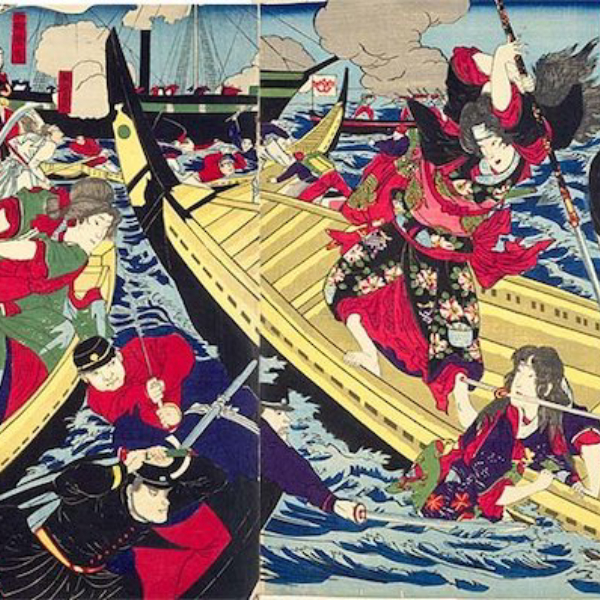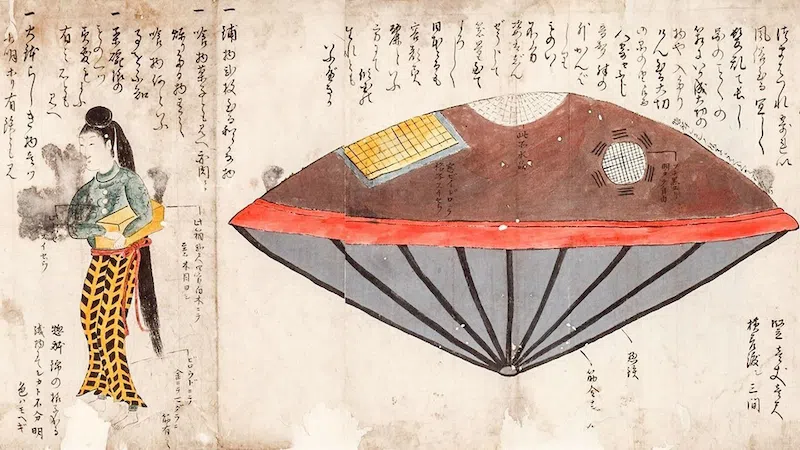
In 1803, something strange washed ashore on the coast of Hitachi Province, in what is now Ibaraki Prefecture, Japan. Local fishermen found a round, hollow vessel bobbing in the shallows. Inside sat a young woman in unfamiliar clothing. She clutched a small box and refused to let it go. She spoke a language no one recognized, and strange writing covered the vessel. Then, according to the old records, she vanished from history.
The story is known as utsuro-bune, meaning “hollow ship.” It appears in several manuscripts from Japan’s Edo period, which lasted from 1603 to 1868. Centuries later, the legend still puzzles researchers. The vessel’s unusual shape and the woman’s mysterious appearance have earned the tale a nickname: Japan’s flying saucer legend. It predates the 1947 sighting that helped spark America’s modern UFO craze by more than a century.
Tanaka Kazuo, a professor emeritus at Gifu University, spent decades investigating the legend. His interest in utsuro-bune began after the 1995 sarin gas attacks carried out by the Aum Shinrikyo cult. While researching pseudoscience and paranormal claims for a lecture series, he encountered the story and became fascinated by its unusual paper trail.
Tanaka tracked down 11 separate documents describing the Hitachi incident. The accounts disagree about the exact dates and locations. Several, however, offer detailed descriptions of the vessel. The most cited include Toen Shosetsu, a collection edited by novelist Kyokutei Bakin in 1825, and Ume no Chiri, an 1844 text by Nagahashi Matajiro. Other sources, including Records of Castaways, describe a vessel roughly 3.3 meters tall and 5.4 meters wide. According to these accounts, it featured rosewood, iron, glass, and crystal.
The folklorist Yanagita Kunio once dismissed utsuro-bune tales as pure invention. Tanaka disagrees, at least when it comes to the 1803 Hitachi case. He points to the story’s specific year and its consistent illustrations of a saucer-like craft. Those details, he argues, set it apart from vaguer regional versions of the legend.
The historical context also adds another layer to the mystery. During the Edo period, Japan enforced strict policies that limited contact with foreign countries. A confirmed foreign shipwreck or visitor could have triggered an official government investigation and left a formal paper trail. When British sailors landed at Otsuhama in 1824, the incident helped push Japan toward an edict ordering foreign ships to be repelled. Tanaka suspects that something similar, but smaller and quieter, may have occurred at Kashimanada Beach. A brief, real encounter could have later fused with older Japanese folk traditions about mysterious hollow ships.
The strange script inside the vessel remains unsolved. One theory suggests that it echoes the faux-Roman lettering sometimes used as a decorative border in ukiyo-e, a style of Japanese woodblock printing. If so, the writing may never have meant anything at all. Tanaka has not ruled out stranger explanations, either, and has even raised the possibility of alien writing, though he does so with a laugh rather than as a serious claim.
That mix of the plausible and the unexplainable is what keeps Tanaka going. New documents could still surface, and each one could reopen the case. A mysterious woman washing ashore in 1803 inside a disc-shaped vessel covered in unreadable script is not a story anyone can fully close the book on, and that may be exactly why it has outlasted two centuries of skeptics.
In 1803, a mysterious woman reportedly washed ashore in Japan inside a strange, disc-shaped vessel known as the utsuro-bune.
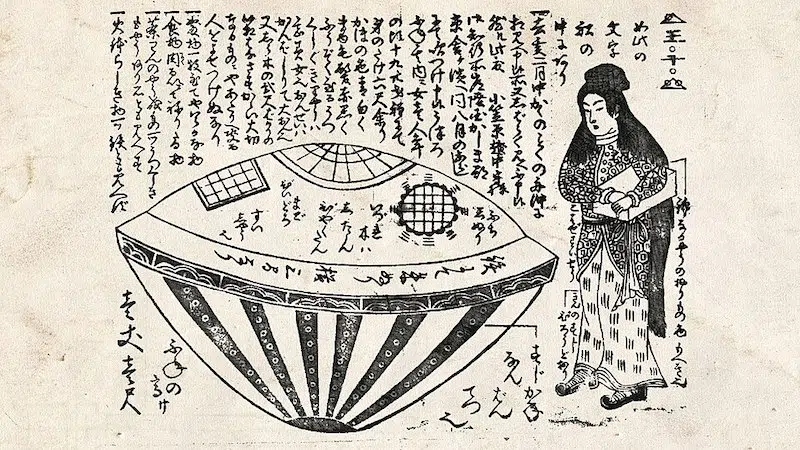
Source: “Utsurobune”: A UFO Legend from Nineteenth-Century Japan
Related Articles:
Vintage Japanese Matchbox Labels Masterfully Blend Cultural Identity With Commerce
Discover the Japanese Philosophy of “Ichi-Go Ichi-E” Helps Us Live in the Present
Mythical Animals Made of Straw Take Over Field in Japan for 2025 Wara Art Festival