Photo: José Pando Lucas
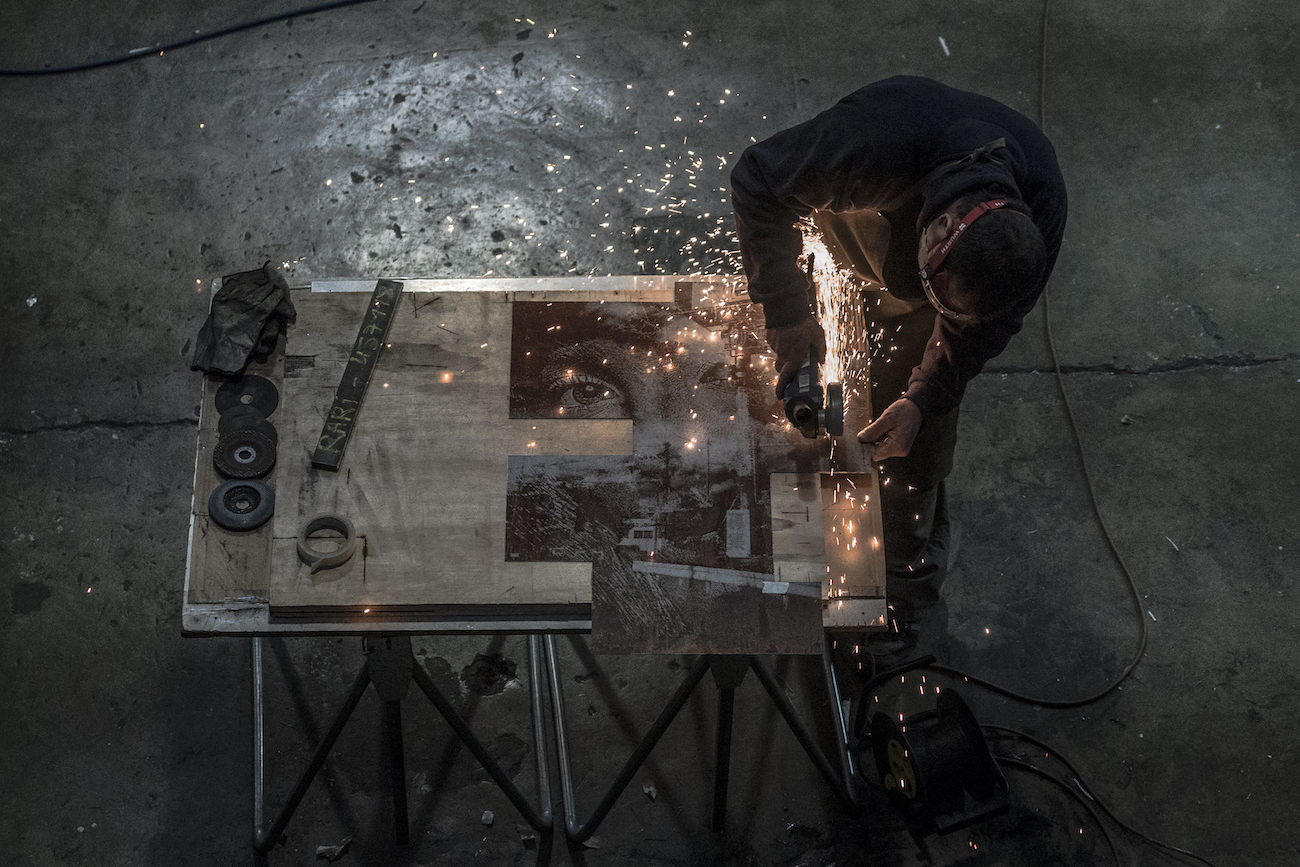
Portuguese artist Alexandre Farto, better known as VHILS, explores the relationship between people and their surroundings in Atrito: Arqueologia do Presente. The exhibition marks his first solo show at Galleria Continua São Paulo. It features 14 metal structures bearing portraits, street signs, and advertising fragments from cities around the world.
Curated by Ana Carolina Ralston, the exhibition examines how urban development reshapes collective memory and individual identity. VHILS uses acid, oxidation, and subtraction to transform corroded metal into layered compositions. The works bring together visual traces of Lisbon, São Paulo, and Shanghai. A large-scale intervention on the gallery’s glass facade also extends the exhibition into the surrounding city.
Since beginning his career in graffiti in the early 2000s, VHILS has expanded his practice to include bas-relief carving, metal etching, wood carving, sculpture, and site-specific installations. His work considers what is lost as cities change, particularly as globalization and development threaten established communities. After more than a decade of working with Brazilian communities, he returns to São Paulo with these questions at the center of his latest exhibition.
Atrito: Arqueologia do Presente opens on November 14 and runs through February 20, 2027 at Galleria Continua São Paulo.
My Modern Met had the opportunity to speak with VHILS before the opening of his exhibition. Scroll down to read our exclusive interview where he discusses the connections between cities, material and memory, and what urban environments reveal about contemporary society.
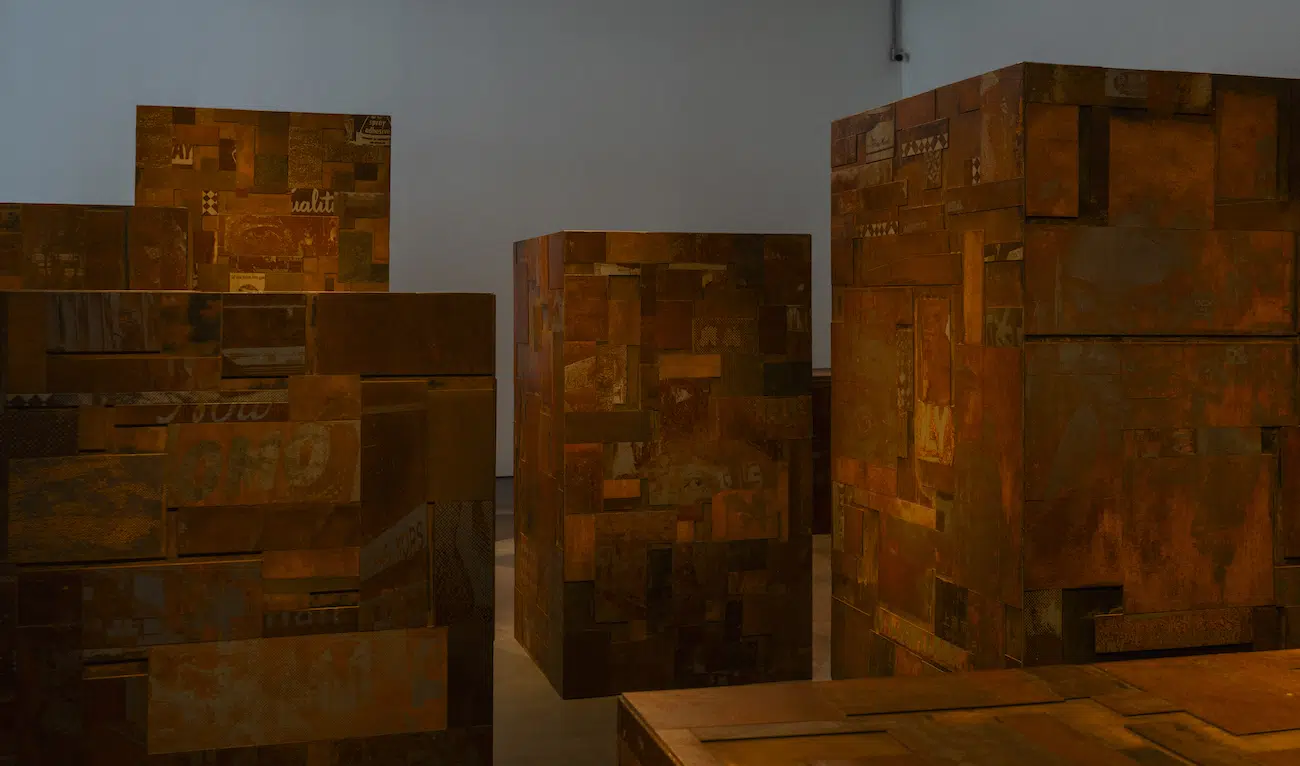
Photo: José Pando Lucas
Your practice involves removing layers to reveal what lies beneath. How has this process shaped the way you think about portraiture, memory, and identity?
I started to understand the city through its surfaces. Growing up on the south bank of the Tagus, I saw political murals being covered by advertising, and later by graffiti, while the industrial landscape around me was changing. These different moments accumulated on top of one another. I became curious about what remained underneath, and about how those changes were shaping us.
Subtraction grew out of that curiosity. A wall already contains a history before I touch it: layers of paint, repairs, wear, traces of different uses. When I carve a face into it, those things become part of the portrait. The same face would become a different work on a different wall.
That relationship is central to how I think about identity. We are shaped by our surroundings, by other people, and by histories we haven’t necessarily chosen. There isn’t a pure self underneath all of that, waiting to be uncovered. Those layers are part of who we are. In the portrait, I try to bring the person and the material into the same image, so that the two become inseparable.
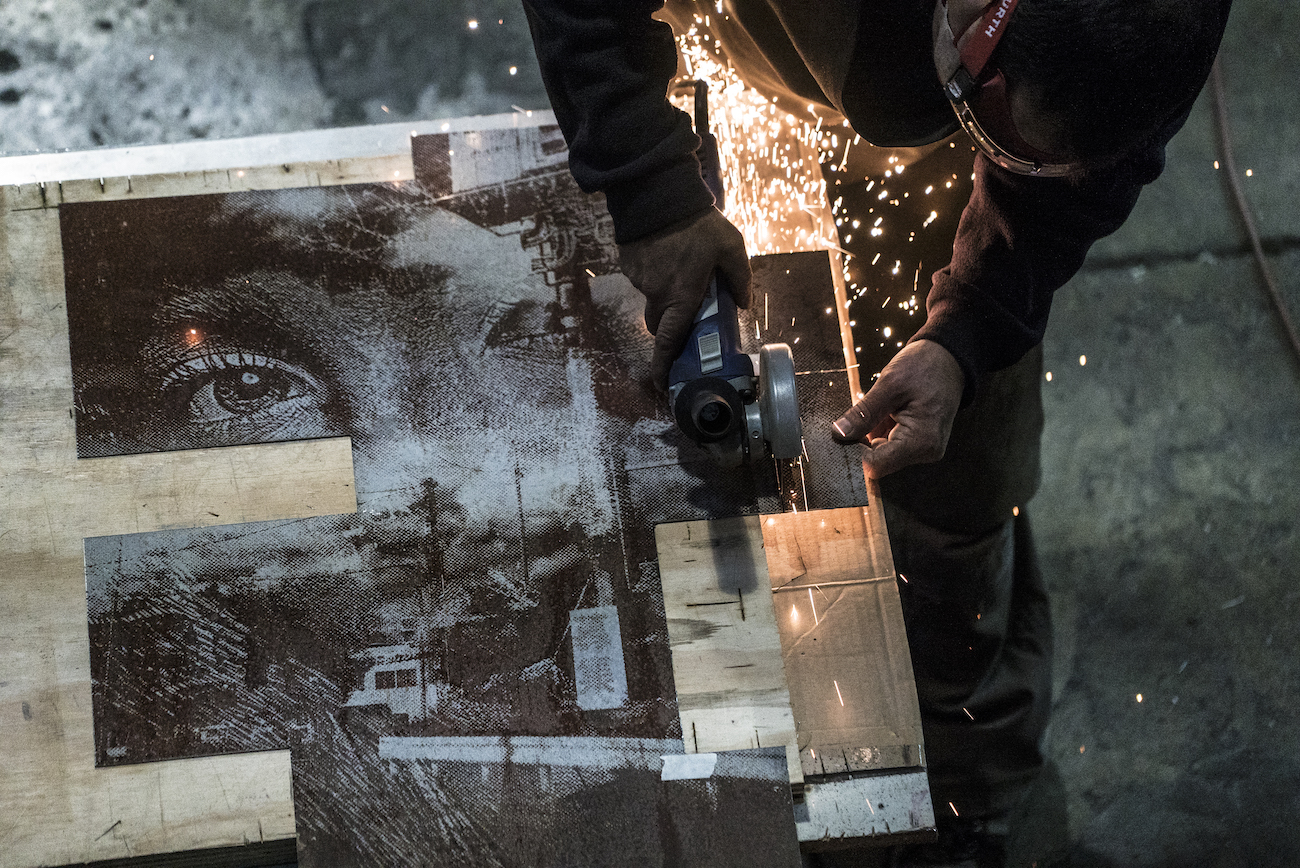
Photo: José Pando Lucas
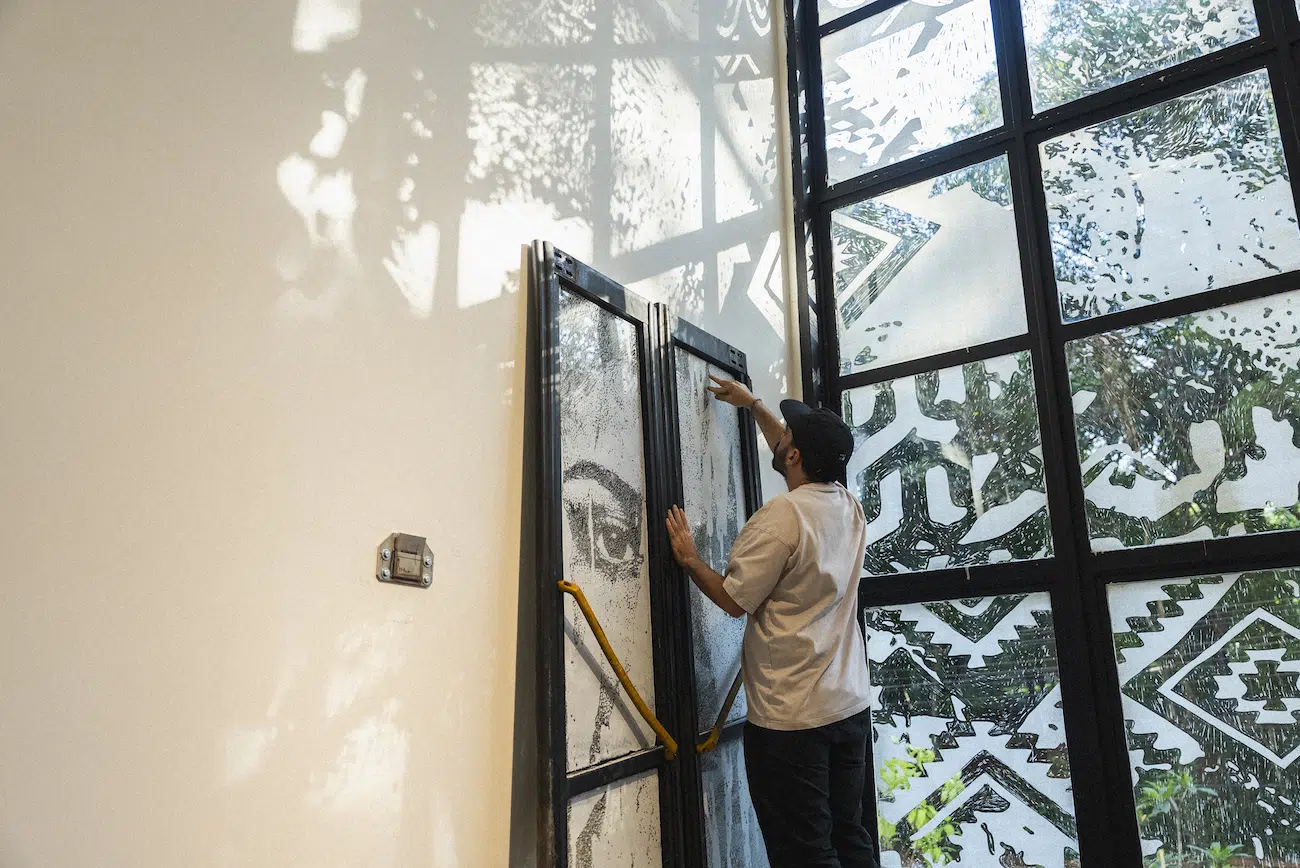
Photo: José Pando Lucas
In Atrito, you bring together fragments of Lisbon, São Paulo, and Shanghai. What interested you in placing these different urban environments alongside one another?
Traveling between cities, I’ve often recognized a process before recognizing the place. A neighborhood is being redeveloped, advertising promises a better life, and the people already living there are under pressure to move. The histories and circumstances are different, but the language used to justify these changes can be surprisingly familiar.
Lisbon, São Paulo, and Shanghai have allowed me to think about those connections from very different positions. In Atrito, fragments of signs, advertising, and portraits come together across the metal structures. I wanted the installation to bring the scale of these global processes into contact with the scale of an individual life. Rather than looking at a single image from the outside, you move among the structures and become part of the installation.
The friction lies between the promise of connection and the loss of particular ways of living. Cities exchange ideas and cultures, which is something I value deeply. At the same time, development can limit the possibilities of what a neighborhood might become. Bringing these places together allows me to question that process without reducing it to the story of a single city.
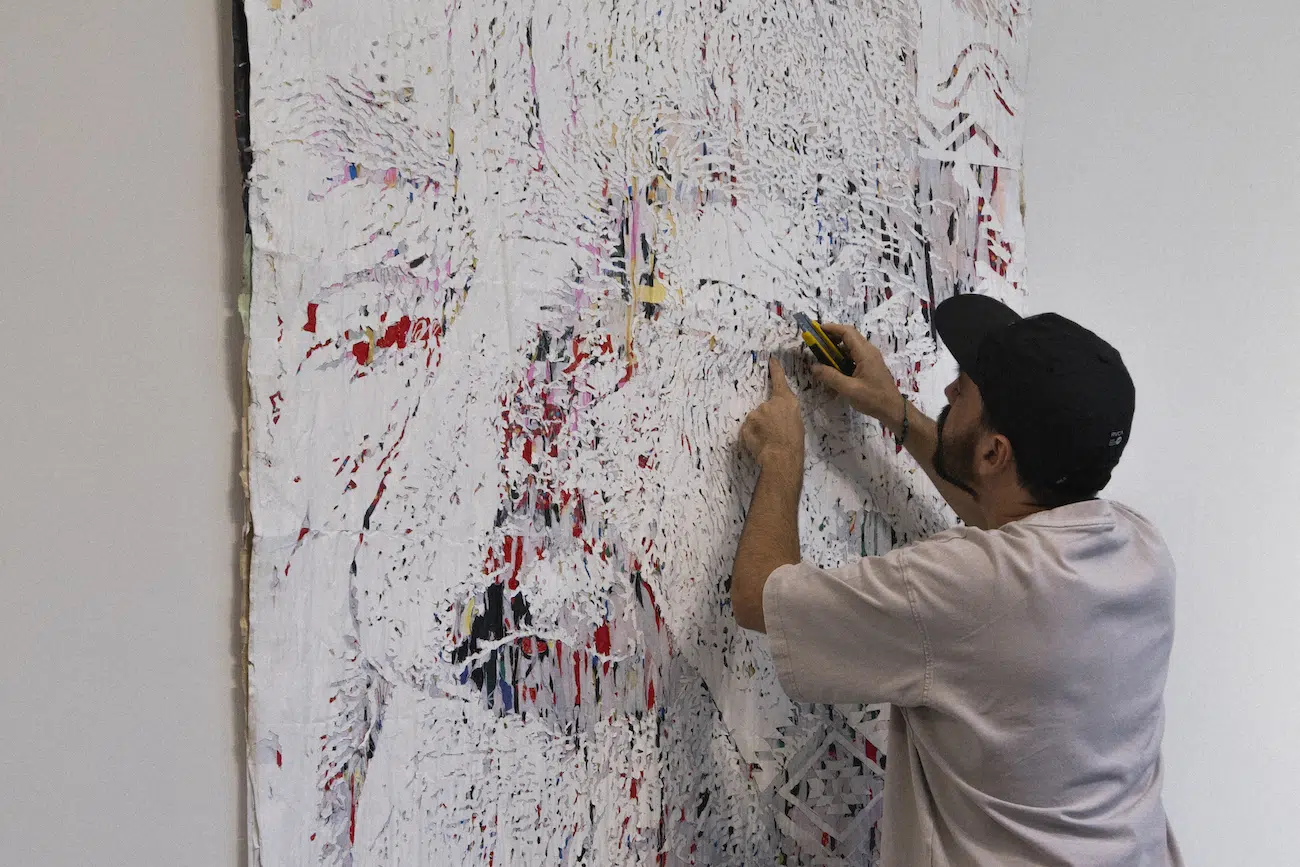
Photo: José Pando Lucas
How does working with metal, particularly its capacity to corrode and change over time, influence the meaning of your work?
Metal has a physical weight and an association with strength that I find useful. We use it to build structures that are meant to last. Yet its surface can also reveal how vulnerable it is to its environment.
In my work with metal, acid and oxidation are part of the image-making process. I can prepare the surface and establish certain conditions, but I also have to respond to how the material reacts. As the work develops, some marks deepen while others become less distinct. That gives the image a degree of uncertainty that is important to me. The face is formed through the transformation of the material itself, rather than simply being placed on top of it.
Corrosion also changes how we perceive time. Something associated with progress and durability carries evidence of its own deterioration. That contradiction becomes particularly apparent when fragments of advertising appear on the same surface. The promise in the image and the condition of the material no longer quite agree. Both remain visible at once.
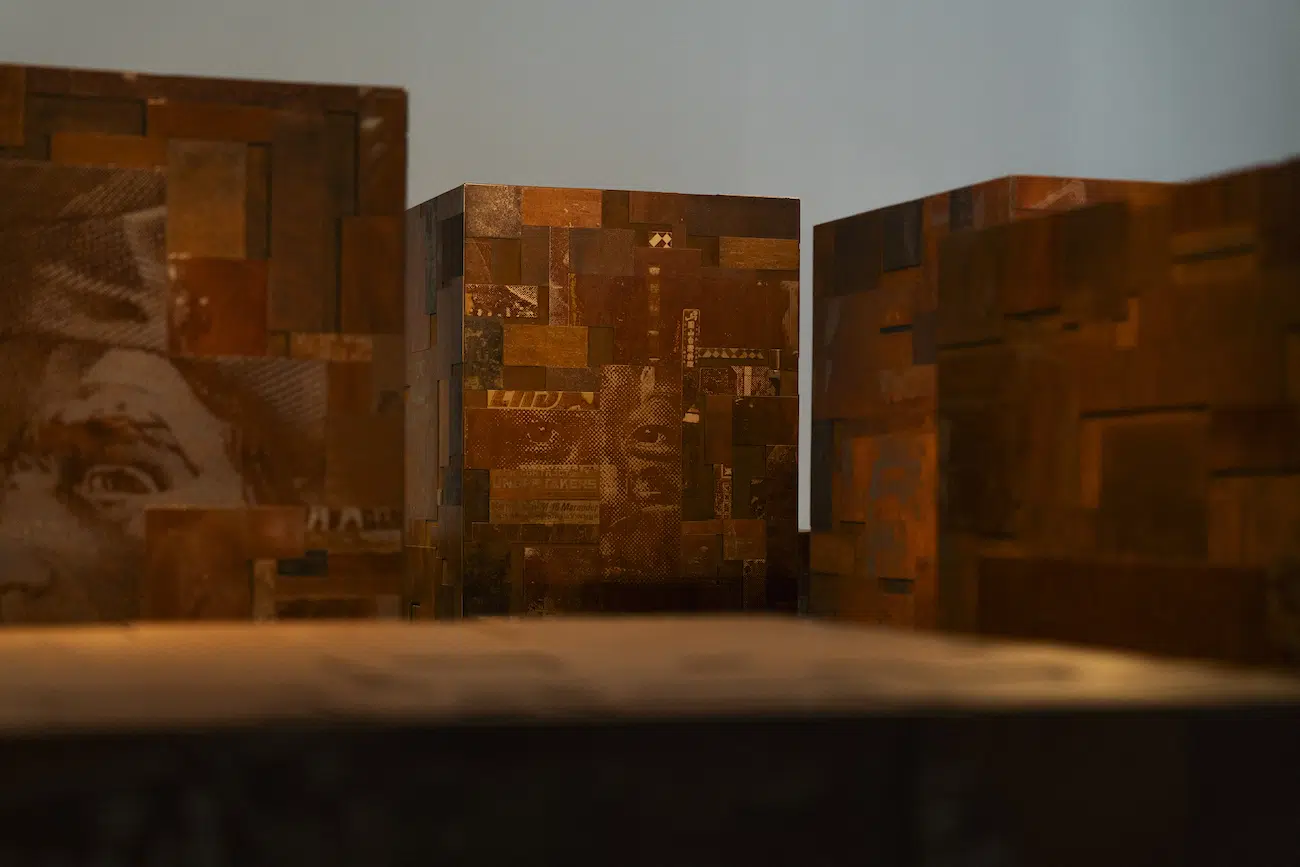
Photo: José Pando Lucas
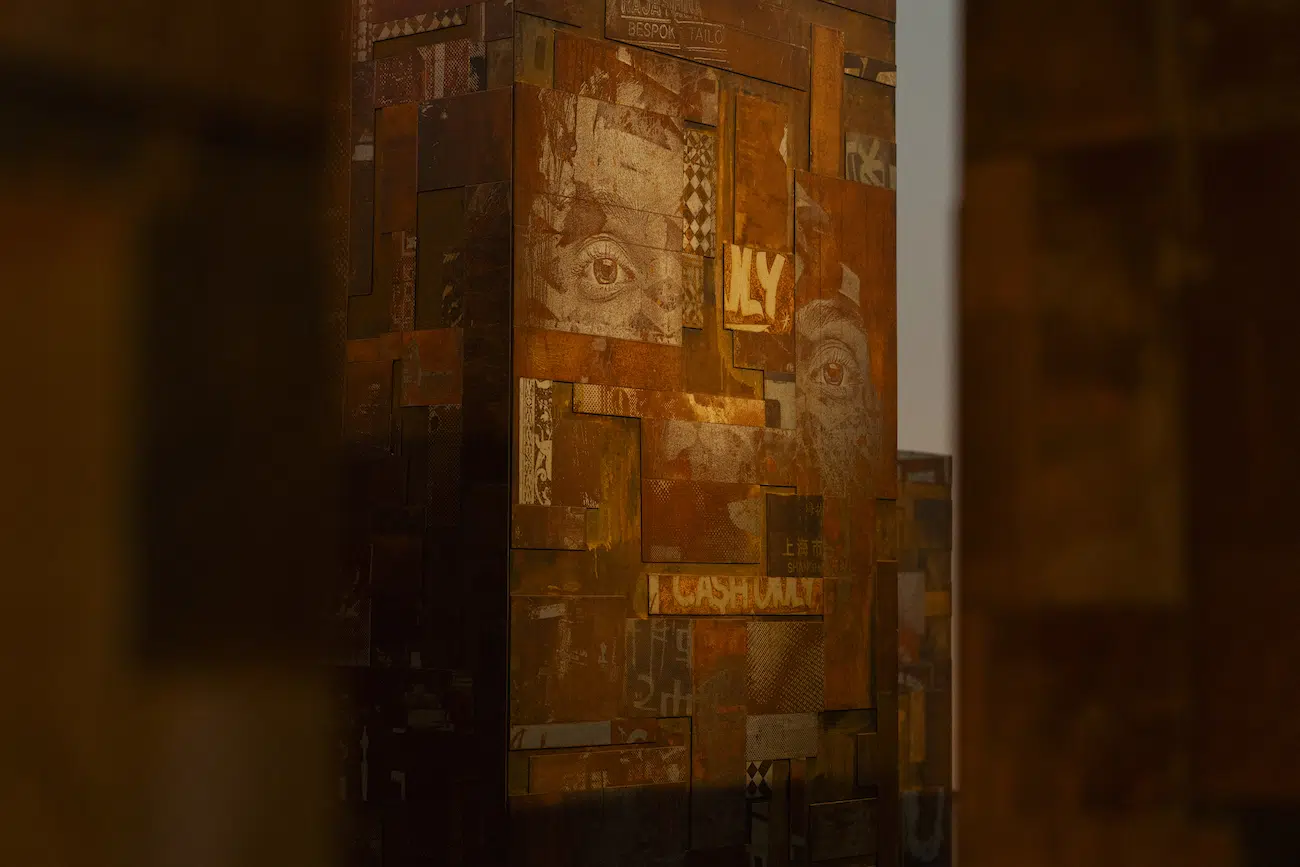
Photo: José Pando Lucas
The exhibition has been described as a contemporary Tower of Babel. Do you see visual art as a universal language, and how do you balance shared human experiences with cultural differences?
An image can begin a conversation between people who don’t speak the same language. I’ve experienced that through working in public spaces. But a shared encounter doesn’t necessarily lead to the same interpretation.
Someone might recognize a face before noticing the fragments around it. Someone else might understand a sign that I can’t read. Their interpretations will be different, and that difference is valuable.
I don’t want to erase those differences in order to make the image easier to understand.
The Tower of Babel represents something that remains unresolved, which suits this installation. Different languages and references occupy the same space without forming a single, completely readable message. The viewer has to move among them and piece things together. There is room for recognition, but also for uncertainty.
To me, art can create a meeting point while allowing those differences to remain. It doesn’t need to translate everything.
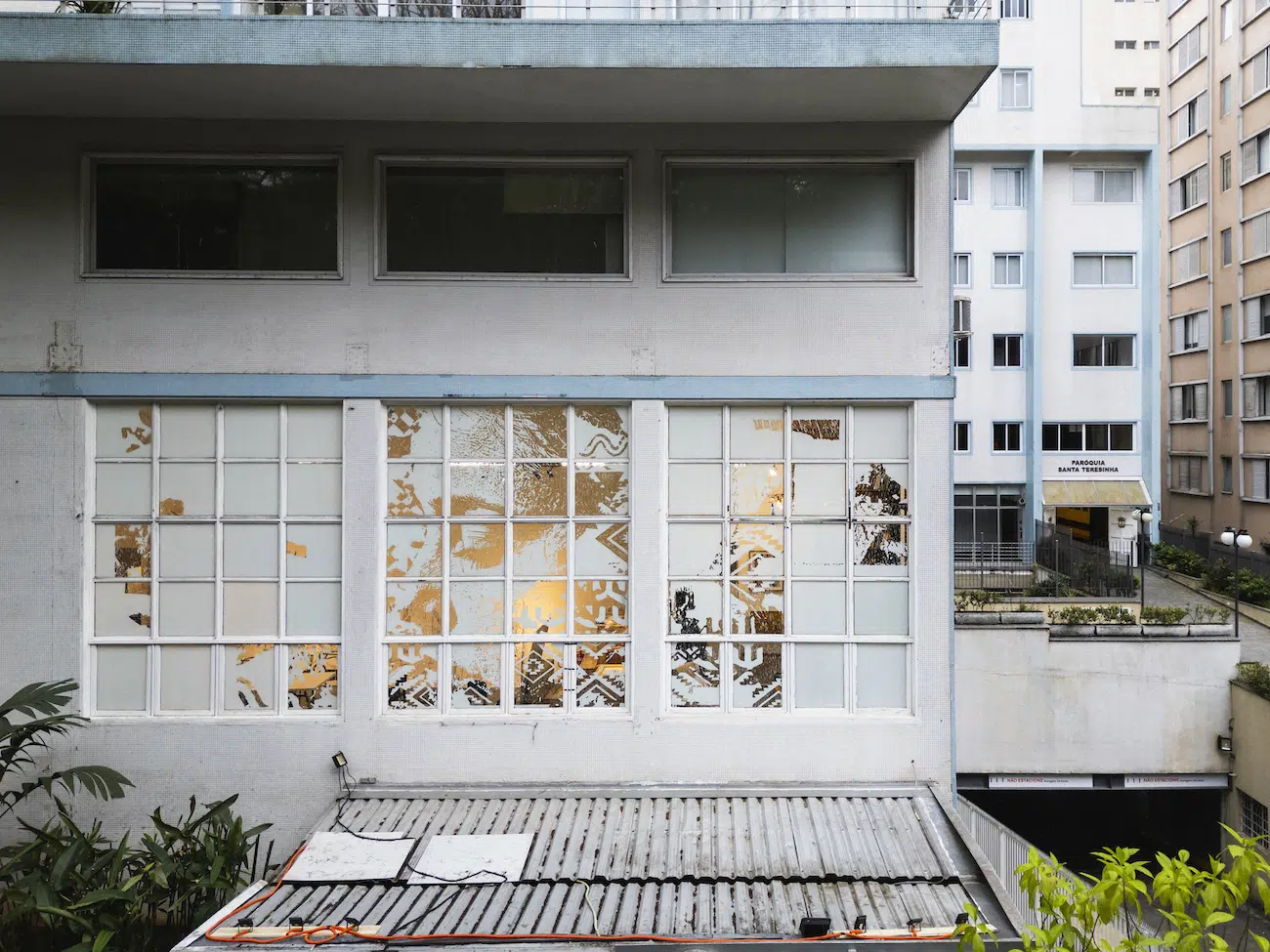
Photo: José Pando Lucas
Having worked with Brazilian communities for more than a decade, how have these experiences shaped your relationship with the country and influenced your return to São Paulo?
My first project in Brazil was in São Paulo in 2011, on the facade of Galeria Vermelho. Since then, my connection to the country has developed through projects in different places and the relationships I’ve built over the years.
My experience in Morro da Providência, where I worked with Maurício Hora, was particularly important. The relationship between a portrait, a wall, and a person’s life was very direct. Residents were facing profound changes in their neighborhood. Working in that context gave a very real dimension to the questions I had been exploring about urban transformation. These were issues directly affecting people’s lives, rather than abstract ideas.
A portrait cannot resolve displacement or the inequalities behind it. But it can give visibility to individuals in situations where decisions about the city often reduce them to numbers. Maurício’s relationship with the community was essential to the project, reinforcing the importance of local knowledge and existing relationships in this kind of intervention.
Later projects, including Incisão and Alquimia, allowed me to explore other aspects of my practice in Brazil. Returning with Atrito brings those experiences together with questions I’ve continued to explore elsewhere. In São Paulo, the density of images, construction, and human activity makes these questions particularly relevant. I want the exhibition, including the facade, to engage directly with that reality.
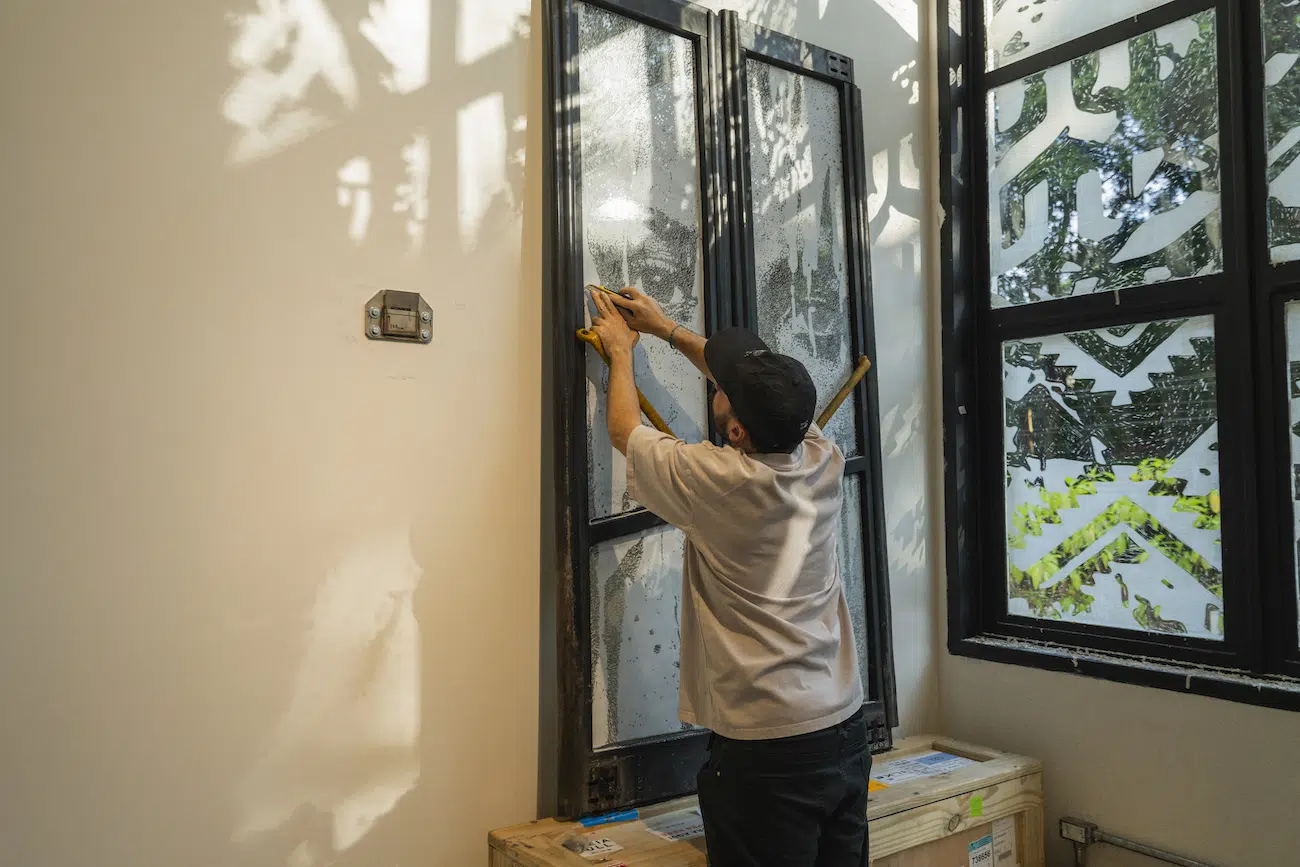
Photo: José Pando Lucas
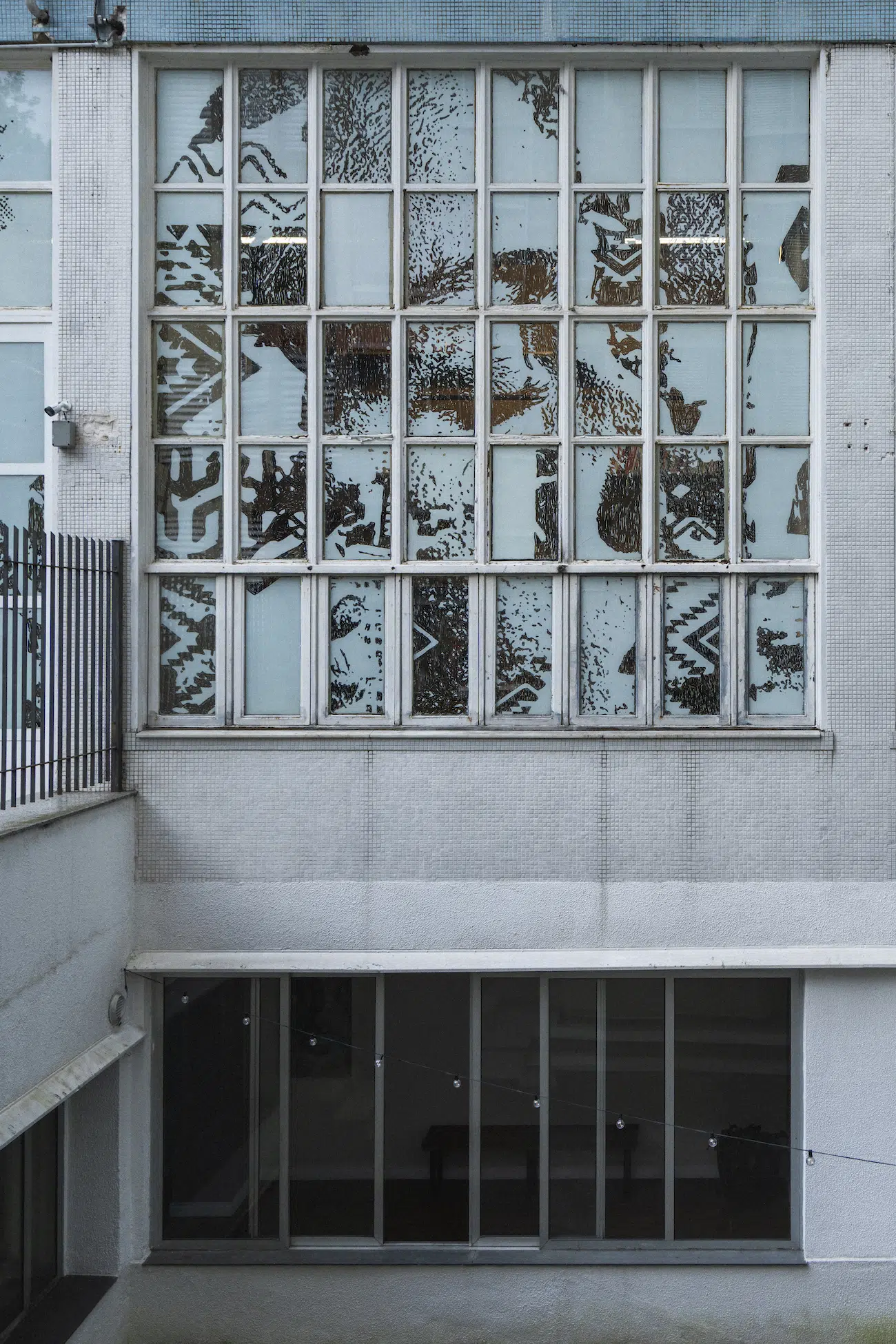
Photo: José Pando Lucas
Your installation transforms Galleria Continua’s glass facade into an artwork that engages with the surrounding city. How does creating work for a specific location change your approach?
I begin with the place: the architecture, the scale of the street, and the way people move through it. All these elements influence the work. A facade is seen from a distance, often by people passing through who may never enter the building.
At Galleria Continua, the glass facade forms a boundary between the gallery and the city. Working on this surface allows the artwork to reach people who might not otherwise visit the exhibition. That is important to me because it maintains a connection to the accessibility of public space. A passerby can stop, ignore it, or return to it another day.
I wanted the facade to be an integral part of the exhibition, rather than simply an indication of what is inside. It brings the work into the everyday life of the street, where its meaning is less controlled.
The title Atrito: Arqueologia do Presente suggests that the present can be understood through the traces we leave behind. What do you think our cities reveal about contemporary society, and what risks being lost or forgotten?
Cities reveal our priorities very clearly. You can see where money is being invested, which images occupy public space, and who can still afford to live in a neighborhood. You can also see what is allowed to deteriorate. These choices shape people’s lives, even when they are presented as purely technical or economic decisions.
What concerns me is the speed at which traces of other ways of living can disappear. A workshop closes or a building is demolished, and a network of relationships may go with it. Photographing the facade doesn’t preserve the conditions that allowed that community to exist. Sometimes we become interested in a place’s identity only after the people who sustained it can no longer remain there.
Change is part of a city’s life. The question is how people can participate in it, rather than simply be subjected to it. That is where the idea of an archaeology of the present comes in: paying attention to these processes as they unfold, instead of waiting until they have become part of history.
Through my work, I try to slow that encounter down. A damaged surface or a fragment that would otherwise be discarded can hold someone’s attention long enough for questions to emerge. What happened here? Who was here? What are we accepting as the necessary cost of moving forward?
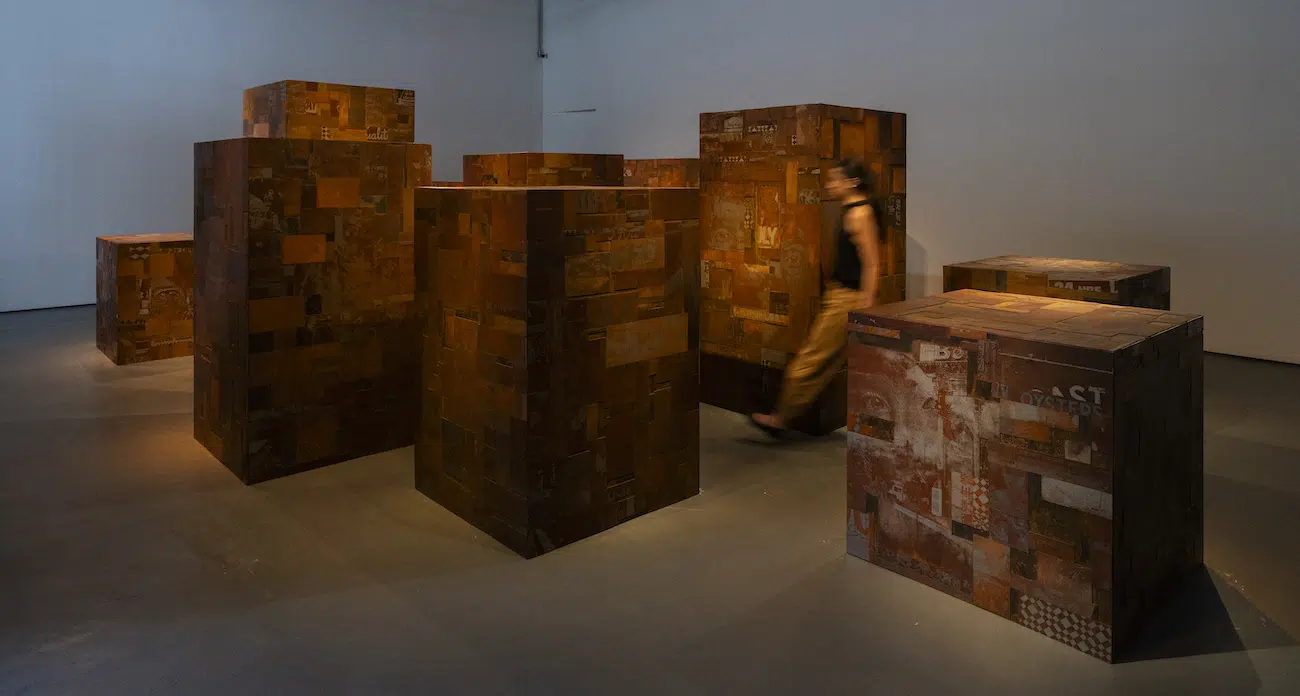
Photo: José Pando Lucas
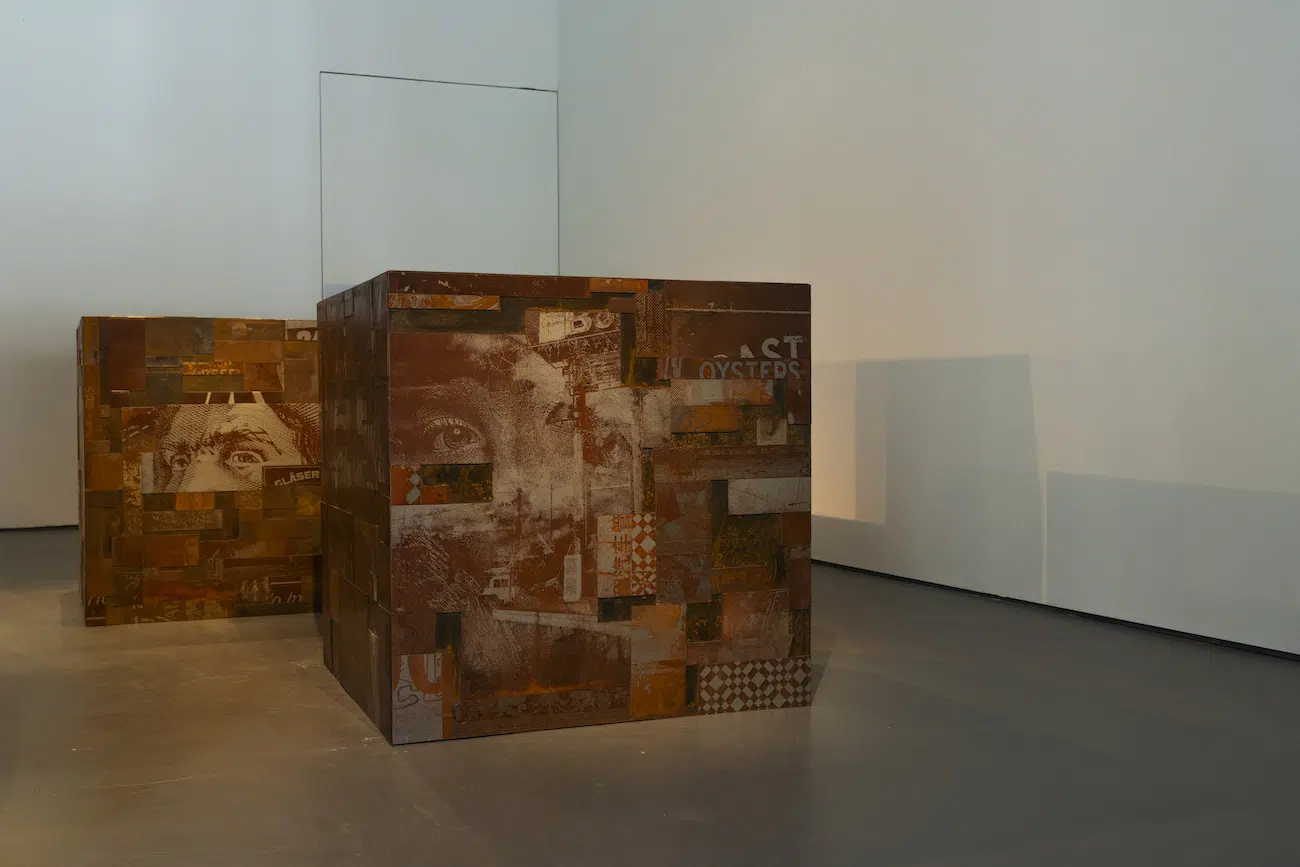
Photo: José Pando Lucas
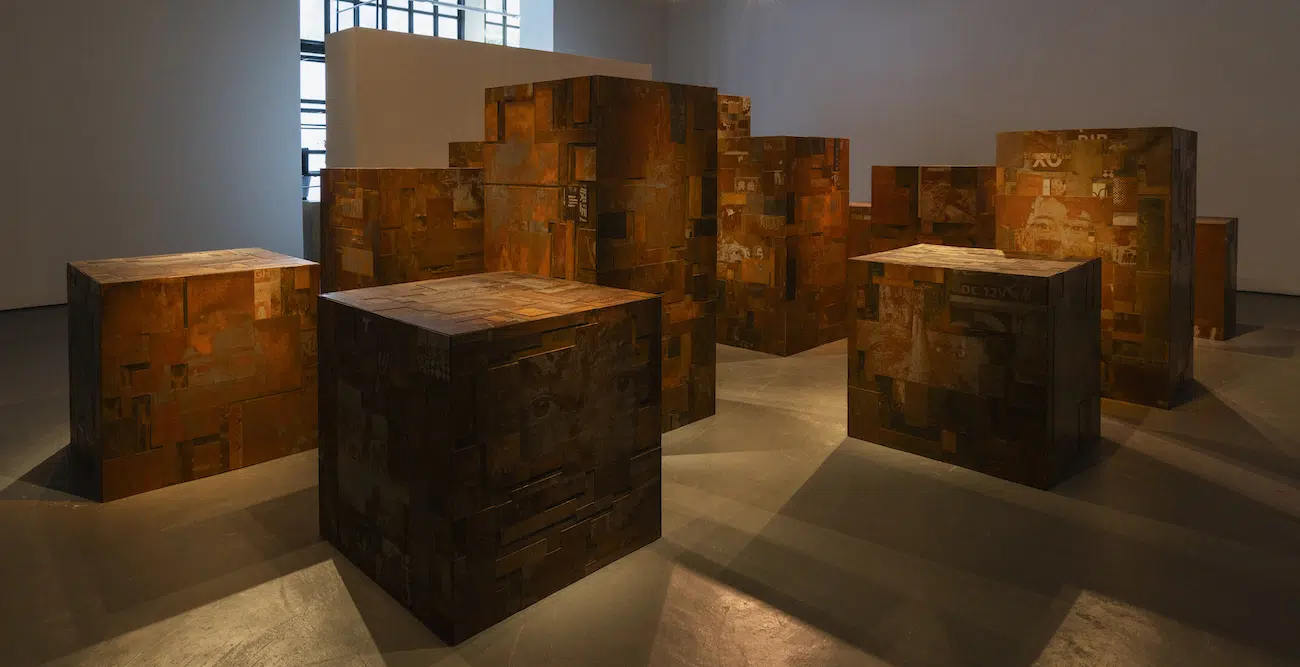
Photo: José Pando Lucas